Mexico Macro Daily(Beta Mode)
Mexican Confidence Weakens Amid Equity Selloff
Market Snapshot
| Asset | Level | Change |
|---|---|---|
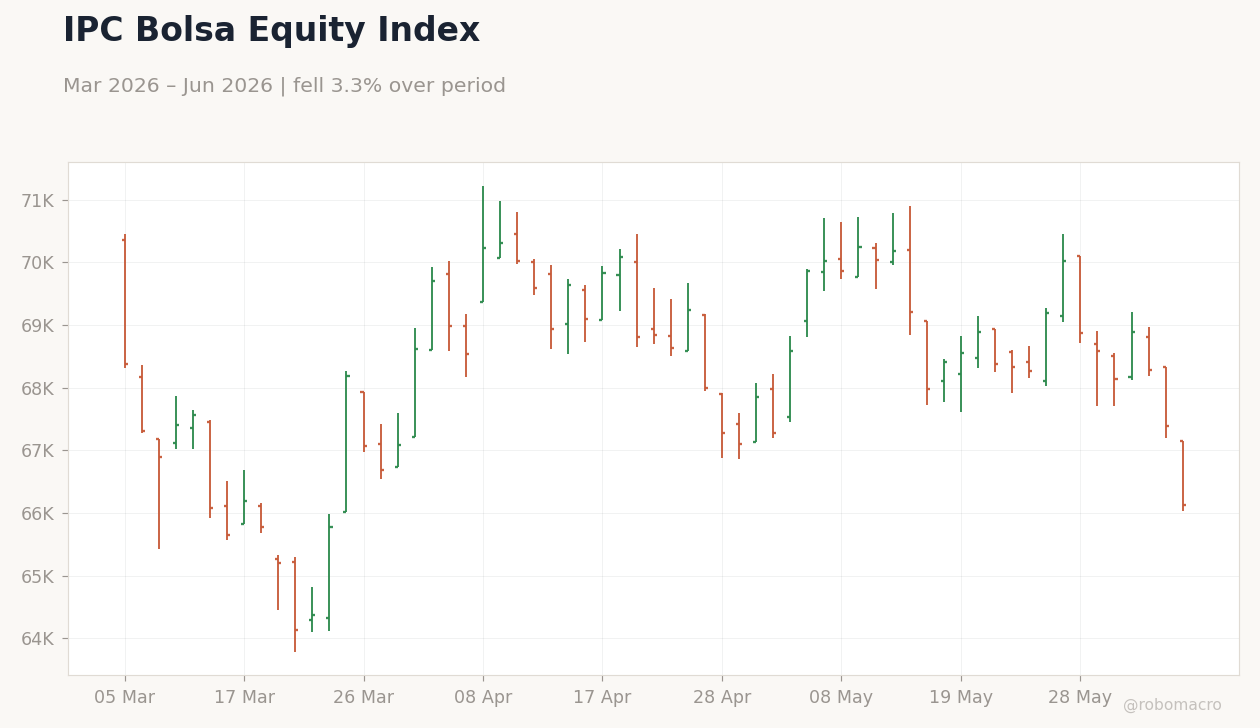
| IPC Bolsa | 66,108.30 | -1.91% |
| USD/MXN | 17.33 | +0.16% |
| EUR/MXN | 20.11 | +0.02% |
| WTI Crude | 91.27 | -1.90% |
| Silver | 69.14 | -6.29% |
| Gold | 4,375.80 | -2.23% |
| Brent Crude | 93.84 | -1.25% |
| Bitcoin | 60,593.98 | -5.03% |
| Mexico Short-term Rate | 5.43% | -1.63% |
| Mexico Long-term Rate | 8.88% | +1.60% |
Prior Economic Events
| Data | Prior | Cons | Actual |
|---|---|---|---|
| Business Confidence Index | 47.90 | - | 47.50 |
| Consumer Confidence Index | 44.40 | - | 43.50 |
 Mexico Short-term Policy Rate | Type: macro_line | Rate %: 5.43 (2026-04-01) | Range: 3.11–8.79 | Trend(6pt): 3.11,5.81,8.52,7.88,5.52,5.43
Today's Economic Events
| Data | Prior | Cons | Time |
|---|---|---|---|
| No events available | |||
- Business and consumer confidence indices fell in early June, signaling softening domestic demand.
- IPC Bolsa declined 1.91% to 66,108.30 while USD/MXN rose 0.16% to 17.33 amid commodity weakness.
- Banxico short-term rate held at 5.43% as long-term yields climbed 1.60% to 8.88%.
Yesterday's Recap
Mexico’s Business Confidence Index dropped to 47.5 from 47.9 while the Consumer Confidence Index fell to 43.5 from 44.4. The IPC Bolsa closed 1.91% lower at 66,108.30 as investors reduced exposure to equities. USD/MXN advanced 0.16% to 17.33 while EUR/MXN edged 0.02% higher to 20.11.
WTI Crude fell 1.90% to 91.27 and Brent declined 1.25% to 93.84, pressuring Mexico’s external accounts. Silver dropped 6.29% and gold fell 2.23%, reducing safe-haven demand for peso-linked assets. Mexico’s short-term rate eased 1.63% to 5.43% while the long-term rate rose 1.60% to 8.88%, steepening the curve.
The Day Ahead
No major data releases are scheduled for 5 or 6 June. Markets will monitor ongoing preparations for the 2026 World Cup amid concerns over infrastructure readiness during the rainy season. Spanish investment plans worth 100 billion euros through 2030 remain in focus as a potential offset to weak fixed investment.
LNG production start at Sempra’s new West Coast terminal could support export revenues. Traders will also track any updates on USMCA energy consultations and nearshoring project announcements.
Other Economic Notes
Gross fixed investment extended its multi-year slump in March, highlighting policy uncertainty and tariff risks. Spain’s commitment to double bilateral trade by 2030 offers a concrete channel for fresh capital inflows into manufacturing and energy. Nearshoring continues with new auto-parts facilities, yet labor disputes such as the Orla Mining blockade illustrate execution risks.
Remittance inflows remain supportive but have not offset the investment contraction.
Global Macro News
The Bank of Japan is expected to raise rates at its June meeting, tightening global financial conditions that could pressure emerging-market currencies including the peso. Federal Reserve officials signaled readiness to respond in either direction on rates, with some advisers urging caution against further hikes. Middle East tensions and ETF outflows weighed on Bitcoin, which fell 5.03%, indirectly affecting risk sentiment toward Mexico.
<i>↓ p.2</i>