Nordics Macro Daily(Beta Mode)

March 20, 2026 robomacro.com

Riksbank Holds Amid Iran War Risks

Market Snapshot

AssetLevelChange
OMX Stockholm 302,864.69-1.52%
Oslo Bors1,966.50-1.60%
OMX Copenhagen 251,623.82-1.08%
OMX Helsinki 255,837.41-1.42%
USD/SEK9.33+0.48%
USD/NOK9.56+0.70%
EUR/SEK10.81+0.53%
EUR/NOK11.07+0.81%
Brent Crude106.77-1.73%
Gold4,492.00-2.36%
Bitcoin70,689.60+1.11%
Sweden 10Y Govt Yield2.64%-5.73%
Norway 10Y Govt Yield4.16%+0.98%

Prior Economic Events

Data Prior Cons Actual
Riksbank Rate Decision1.751.751.75
Riksbank Press Conference---
Sweden 10Y Yield TrendSweden 10Y Yield Trend | Type: macro_line | Sweden 10Y Yield %: 2.64 (2026-02-01) | Range: 0.1101–3.024 | Trend(6pt): 0.3702,1.863,2.752,2.043,2.822,2.64

Today's Economic Events

Data Prior Cons Time
No events available
  • Sweden's Riksbank kept rates at 1.75% as energy shocks and geopolitical risks weigh on inflation outlook.
  • Nordic equities fell 1-1.6%, with Norwegian krone strengthening year-to-date vs Swedish krona on oil dynamics.
  • Norway eyes inflation pressures, potentially delaying rate cuts into 2026.

Yesterday's Recap

Sweden's Riksbank held its key interest rate steady at 1.75% on March 19, matching consensus expectations and signaling caution amid energy price volatility and the ongoing Iran war's impact on inflation. The subsequent press conference emphasized strategic patience, with officials noting uncertainties from global energy shocks without committing to near-term changes. Nordic equity markets broadly declined, with Sweden's OMX Stockholm 30 dropping 1.52% to 2,864.69, Norway's Oslo Bors falling 1.60% to 1,966.50, Denmark's OMX Copenhagen 25 slipping 1.08% to 1,623.82, and Finland's OMX Helsinki 25 decreasing 1.42% to 5,837.41, reflecting risk-off sentiment tied to falling Brent crude prices.

Currency movements showed divergence: USD/SEK rose 0.48% to 9.33 and EUR/SEK increased 0.53% to 10.81, indicating krona weakness, while USD/NOK climbed 0.70% to 9.56 and EUR/NOK advanced 0.81% to 11.07, though the Norwegian krone has strengthened 7% year-to-date against the Swedish krona on oil and gas gains. Bond yields mixed, with Sweden's 10-year government yield dropping 5.73% to 2.64% amid safe-haven flows, contrasting Norway's 10-year yield rising 0.98% to 4.16% on inflation bets. Brent crude fell 1.73% to 106.77, pressuring Norway's export outlook, while gold declined 2.36% to 4,492.00, underscoring broader commodity volatility.

Bitcoin rose 1.11% to 70,689.60.

The Day Ahead

The Nordic calendar remains light on March 20 with no major data releases or events scheduled across Sweden, Norway, Denmark, or Finland, allowing markets to digest yesterday's Riksbank hold and global developments. Investors will monitor any spillover from international markets, particularly oil price fluctuations amid the Iran conflict, which could influence Norway's krone and fiscal projections. Attention may shift to broader eurozone indicators, given Denmark's peg to the euro and Finland's ECB alignment, though no specific Nordic triggers are imminent.

Looking slightly further, potential wage data or inflation previews in the coming weeks could set the tone for Norges Bank's next moves. Overall, expect subdued trading unless external shocks from energy or geopolitics intervene.

Page 1

Nordics Macro Daily(Beta Mode)

March 20, 2026 robomacro.com
Norway 10Y Yield Trend Norway 10Y Yield Trend | Type: macro_line | Norway 10Y Yield %: 4.162 (2026-02-01) | Range: 1.23–4.162 | Trend(6pt): 1.42,3.126,3.767,3.541,4.092,4.162
Brent Crude Oil Price Brent Crude Oil Price | Type: market_hloc | Brent Crude: 106.8 (2026-03-20) | Range: 59.96–108.7 | Trend(5pt): 62.07,66.52,67.55,72.48,106.8
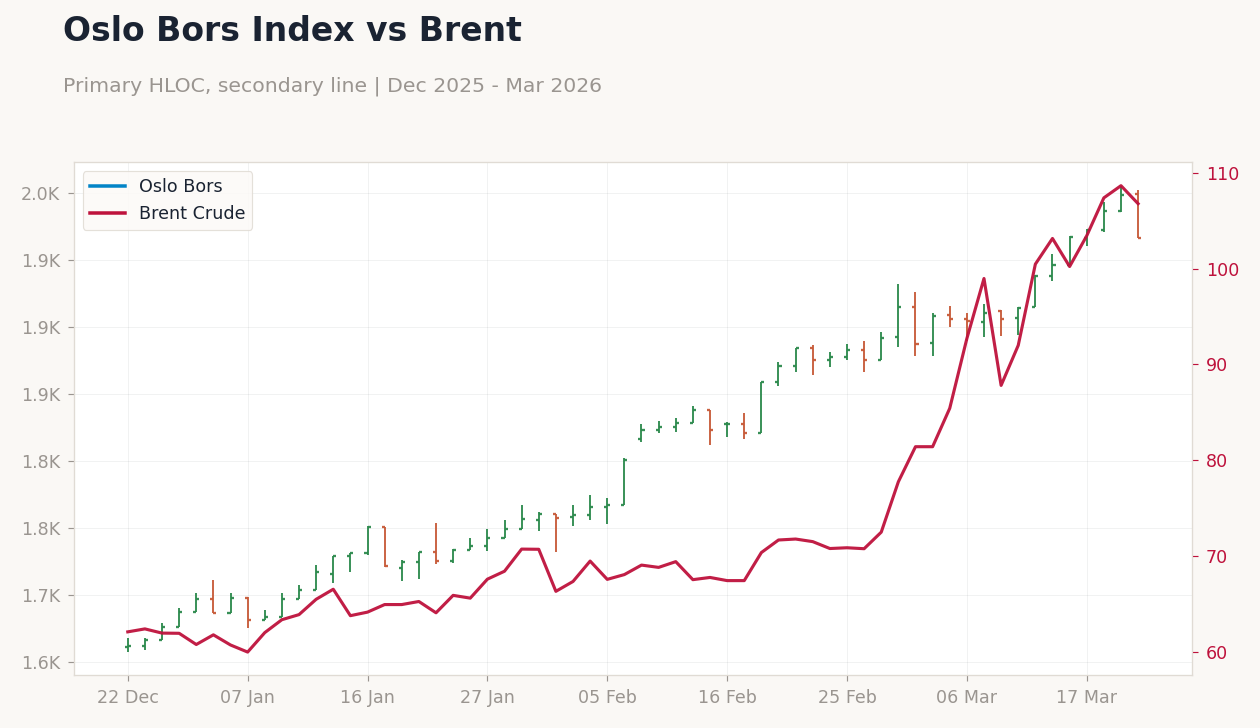
Oslo Bors Index vs Brent Oslo Bors Index vs Brent | Type: market_hloc | Oslo Bors: 1966 (2026-03-20) | Range: 1662–1998 | Trend(5pt): 1662,1722,1823,1915,1966 | Brent Crude: 106.8 (2026-03-20) | Range: 59.96–108.7 | Trend(5pt): 62.07,66.52,67.55,72.48,106.8
OMX Stockholm 30 Index OMX Stockholm 30 Index | Type: market_hloc | OMX Stockholm: 2865 (2026-03-20) | Range: 2845–3223 | Trend(6pt): 2845,2985,3120,3205,3015,2865

Other Economic Notes

Sweden faces domestic headwinds with IKEA announcing 625 job cuts amid cost pressures, exacerbating labor market uncertainties in a manufacturing-heavy economy already grappling with energy shocks. Norway benefits from elevated oil and gas prices boosting its krone, but persistent inflation surprises could strain wage negotiations and fiscal planning. Broader Nordic themes include export vulnerabilities, with Denmark and Finland exposed to eurozone slowdowns via trade links, while regional housing markets—particularly in Sweden—remain sensitive to rate paths amid high household debt.

Global Macro News

The escalating war with Iran continues to reshape global energy markets, pushing Brent crude above $100 but with yesterday's 1.73% dip highlighting supply volatility that directly bolsters Norway's oil-dependent revenues while pressuring import-reliant Sweden and Denmark. U.S. economic resilience amid high oil prices insulates broader growth but burdens households, potentially dampening Nordic export demand to North America.

Central banks worldwide, including the Bank of Canada, are grappling with oil-driven inflation, mirroring Norges Bank's concerns over wage pressures and rate cut risks into 2026. In emerging markets, Nigeria's balance of payments fell 38.1% in 2025 due to commodity disruptions, underscoring global trade fragilities that could hit Finland's eurozone-tied economy. Overall, these dynamics foster a risk-averse environment, with Nordic assets sensitive to any escalation in geopolitical tensions or oil supply disruptions.

Nordic Central Banks Watch

Sweden's Riksbank maintained its key rate at 1.75% yesterday, with the committee voting to hold steady for the fourth straight meeting, citing energy shocks and Iran war uncertainties that cloud the inflation path without altering its no-change outlook for the year. Norway's Norges Bank, facing surprise inflation and wage pressures, may adopt a more hawkish stance, with recent announcements signaling risks to betting on 2026 rate reductions and plans to release detailed interest rate discussion summaries from next week's meeting to provide more policy nuance. Denmark's Nationalbank, pegged to the euro via ERM II, shadows the ECB's deposit rate at 2.00%, implying no independent moves but potential FX interventions if EUR/DKK stability is threatened by global volatility.

Finland, under direct ECB jurisdiction, adheres to the same 2.00% rate, with eurozone unemployment at 6.70% highlighting labor market slack that could temper inflationary pressures in the bloc. Policy divergences persist: Riksbank and Norges Bank pursue independent tightening biases amid domestic inflation fights, while Denmark and Finland's ECB alignment offers less flexibility, potentially widening yield spreads like Sweden's 2.64% versus eurozone benchmarks. Oil revenue dynamics continue to support Norges Bank's fiscal buffer, contrasting Sweden's manufacturing vulnerabilities.

Investors watch for any Norges Bank signals on krone strength, which has gained against the krona on war-fueled energy jumps.

Sponsored by Arbitrage Search
Page 2