| Asset | Level | Change |
|---|---|---|
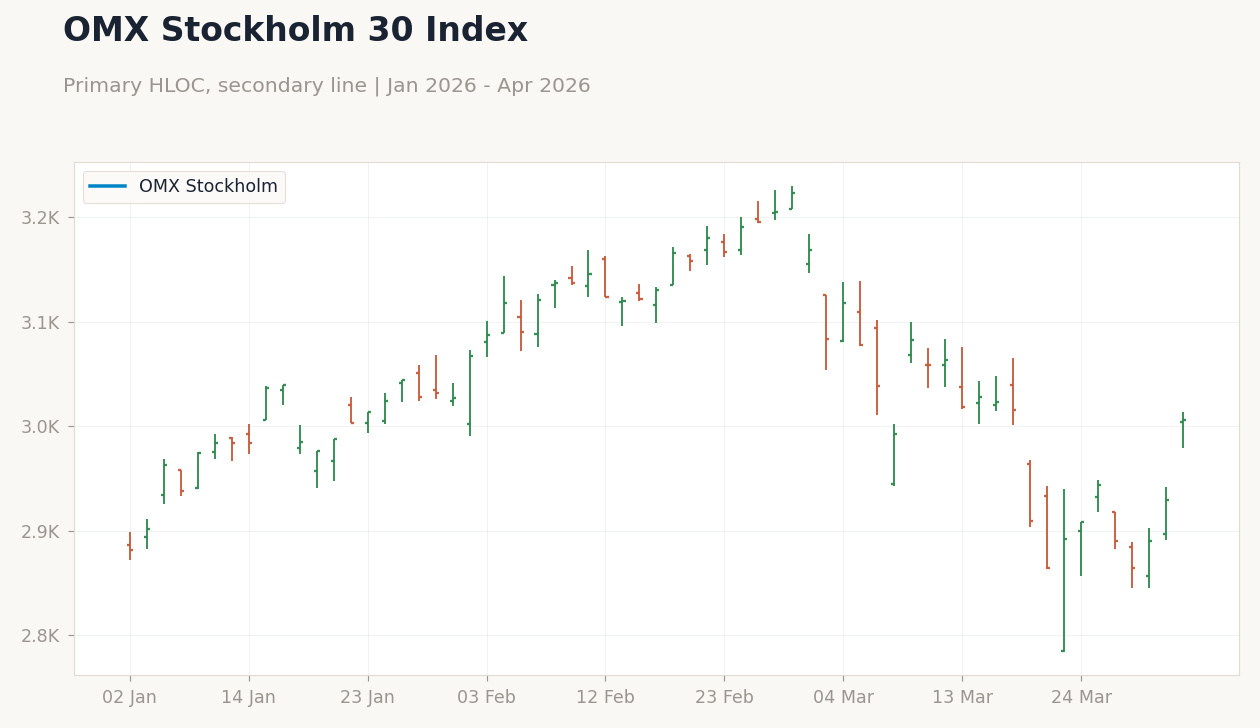
| OMX Stockholm 30 | 3,006.37 | +2.63% |
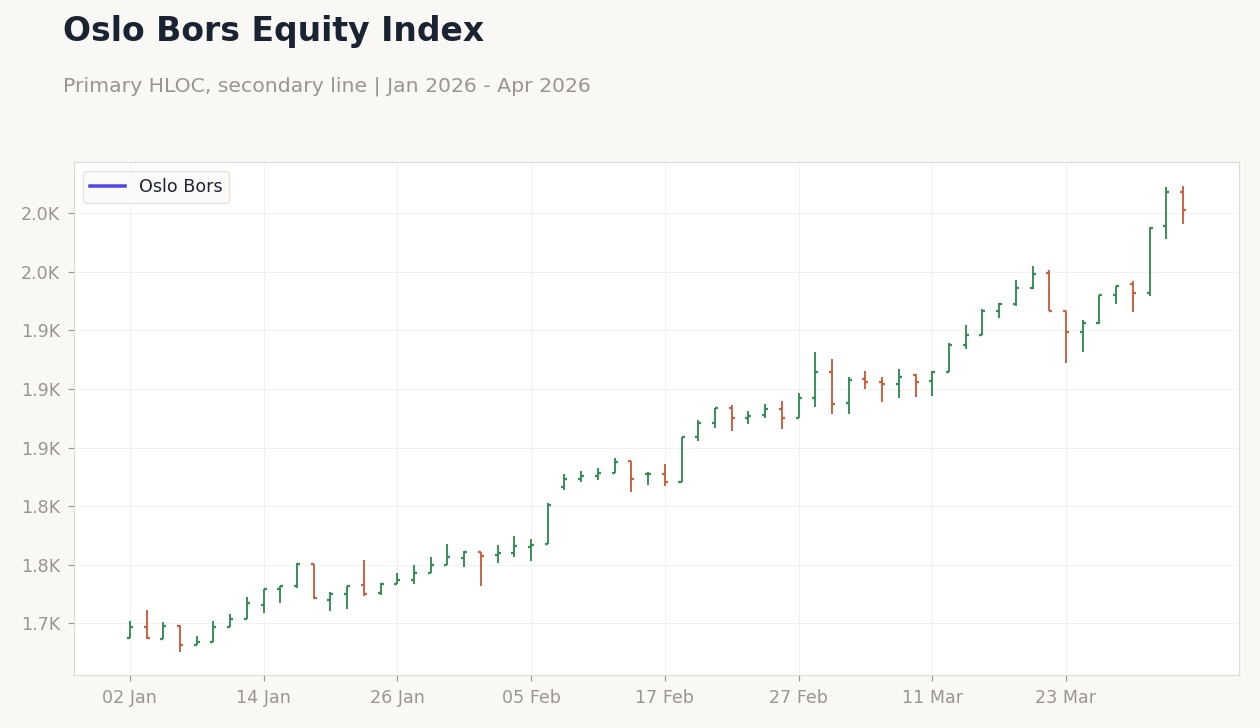
| Oslo Bors | 2,053.05 | -0.72% |
| OMX Copenhagen 25 | 1,709.95 | +1.72% |
| OMX Helsinki 25 | 5,953.41 | +1.87% |
| USD/SEK | 9.49 | +0.50% |
| USD/NOK | 9.78 | +1.02% |
| EUR/SEK | 10.95 | +0.15% |
| EUR/NOK | 11.28 | +0.68% |
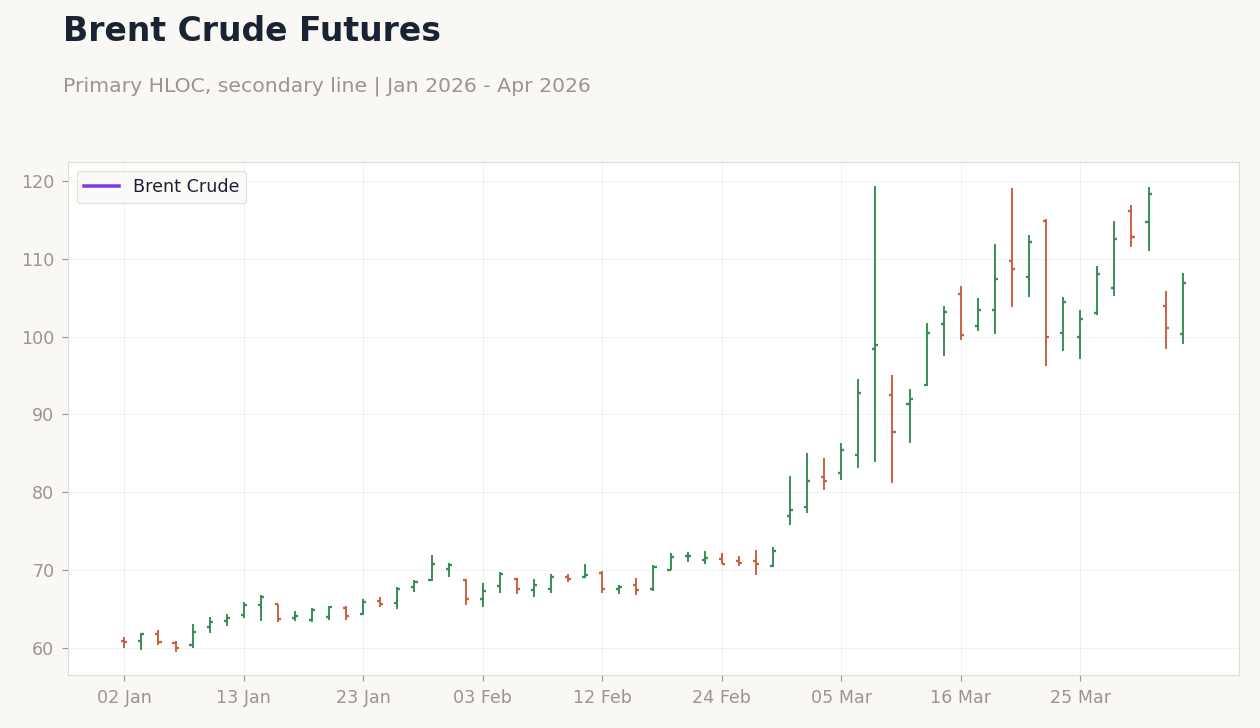
| Brent Crude | 107.14 | +5.91% |
| Gold | 4,696.80 | -1.81% |
| Bitcoin | 66,434.91 | -2.64% |
| Sweden 10Y Govt Yield | 2.64% | -5.73% |
| Norway 10Y Govt Yield | 4.16% | +0.98% |
| Data | Prior | Cons | Actual |
|---|---|---|---|
| No events available | |||
Sweden 10Y Bond Yield | Type: macro_line | Sweden 10Y Yield (%): 2.64 (2026-02-01) | Range: 0.1101–3.024 | Trend(6pt): 0.4212,1.533,2.888,2.067,2.8,2.64
| Data | Prior | Cons | Time |
|---|---|---|---|
| No events available | |||
Nordic markets showed divergence on April 1, with Sweden's OMX Stockholm 30 surging 2.63% to 3,006.37, driven by tech and export sectors amid positive sentiment on Riksbank policy stability. Norway's Oslo Bors fell 0.72% to 2,053.05, weighed down by energy volatility despite Brent crude jumping 5.91% to $107.14, highlighting fiscal sensitivities for the oil exporter. Denmark's OMX Copenhagen 25 climbed 1.72% to 1,709.95, supported by shipping and manufacturing resilience, while Finland's OMX Helsinki 25 rose 1.87% to 5,953.41 on eurozone stability cues.
Currencies depreciated against the dollar, with USD/SEK up 0.50% to 9.49 and USD/NOK rising 1.02% to 9.78, reflecting broader risk aversion; EUR/SEK edged 0.15% higher to 10.95, while EUR/NOK increased 0.68% to 11.28. Bond yields varied, with Sweden's 10Y government yield dropping 5.73% to 2.64% on safe-haven flows, contrasting Norway's 10Y yield up 0.98% to 4.16% amid oil-driven inflation bets. No major data releases occurred across the Nordics, but Swedish political news dominated, with Moderates signaling potential Sweden Democrats inclusion in government, potentially impacting fiscal policy ahead of 2026 elections.
Finland and Denmark remained quiet, though eurozone ties kept Finnish markets attuned to ECB signals.
The Nordic calendar remains light on April 2, with no scheduled data releases or events across Sweden, Norway, Denmark, or Finland, allowing markets to digest recent oil price surges and global inflation cues. Traders will monitor Riksbank commentary for hints on the upcoming rate decision, as Danske Bank predicts a hold amid persistent inflation pressures. Norway's focus shifts to oil market developments, with SEB forecasting an average Brent price of $100 per barrel for the rest of 2026, potentially bolstering fiscal inflows but pressuring the krone.
Denmark's Nationalbank is expected to maintain its EUR/DKK peg without intervention, tracking ECB moves. Finland, under ECB jurisdiction, may see indirect impacts from eurozone data, though no immediate releases are due. Overall, attention turns to global drivers like U.S.
economic strength and geopolitical tensions influencing Nordic trade.
Subscribe to Nordics Macro Daily and get each new issue delivered to your inbox.
Already a member? Visit robomacro.com to log in and manage subscriptions, or use Forgot Password to set a password.
Norway 10Y Bond Yield | Type: macro_line | Norway 10Y Yield (%): 4.162 (2026-02-01) | Range: 1.23–4.162 | Trend(6pt): 1.47,2.909,3.887,3.669,4.122,4.162
Brent Crude Futures | Type: market_hloc | Brent Crude: 106.9 (2026-04-02) | Range: 59.96–118.3 | Trend(6pt): 60.75,65.59,67.42,87.8,118.3,106.9
OMX Stockholm 30 Index | Type: market_hloc | OMX Stockholm: 3006 (2026-04-01) | Range: 2864–3223 | Trend(6pt): 2881,3024,3122,2993,2890,3006
Oslo Bors Equity Index | Type: market_hloc | Oslo Bors: 2053 (2026-04-01) | Range: 1681–2068 | Trend(5pt): 1697,1737,1821,1914,2053
Broader Nordic themes highlight political shifts in Sweden potentially easing immigration policies and boosting labor supply for export industries. Norway's oil-dependent economy benefits from elevated Brent prices, supporting petroleum fund growth but raising inflation risks amid manufacturing slowdowns. Denmark and Finland face eurozone headwinds, including overlapping global shocks like oil disruptions, which could strain trade balances in these manufacturing hubs.
Global macro developments are increasingly affecting the Nordics, with U.S. economic strength evident in new data, potentially supporting demand for Swedish and Danish exports but heightening Fed policy divergence risks. UK warnings from the Bank of England about 'large and overlapping' shocks, including potential recession from Iran war tensions, could spill over to Nordic trade partners via energy prices and supply chains.
Fed economists' concerns over an 'inflationary surge' from AI hype add to global overheating fears, pressuring Riksbank and Norges Bank to maintain vigilance on imported inflation. Oil shocks are a key worry, with Canadian deliberations noting impacts on inflation and Bank of Canada rate holds amid economic weakness, mirroring Norway's vulnerabilities as an exporter. Eurozone faces ECB adverse scenarios with inflation risks, directly impacting Finland and indirectly Denmark via its peg, while broader tensions like those in India from oil and rupee pressures underscore commodity-driven stresses.
Bangladesh's record remittances provide a counterpoint to emerging market resilience, but AI's debated role in solving inflation, as per Deutsche Bank queries, suggests tech-driven productivity may not offset Nordic energy cost pressures. Overall, these factors amplify risks for open Nordic economies, with Brent's rally offering mixed blessings for Norway amid global uncertainty.
The Riksbank faces a crucial hold decision, with Danske Bank predicting policy stability amid sticky inflation, potentially diverging from ECB easing as Sweden's independent stance prioritizes krona support. Norges Bank remains focused on oil revenue dynamics, with elevated Brent prices bolstering fiscal buffers but complicating inflation targeting; the bank may hold rates to counter krone weakness, differing from peers. Danmarks Nationalbank continues to shadow the ECB to uphold the EUR/DKK peg, with no recent FX interventions noted, aligning closely with eurozone policy at the current ECB deposit rate of 2.00%.
Finland, governed directly by the ECB, benefits from eurozone unemployment at 6.70% but faces shared inflation risks, highlighting policy convergence with Denmark versus the independence of Sweden and Norway. Divergences persist, as Riksbank and Norges Bank navigate domestic pressures like services inflation and oil fund inflows, while Denmark and Finland adhere to ECB guidance amid global shocks. (cont...)
Recent news underscores Riksbank's hold likelihood, reducing odds for near-term cuts, while Norges Bank's outlook ties to SEB's $100 Brent forecast for 2026.