| Asset | Level | Change |
|---|---|---|
| OMX Stockholm 30 | 3,040.54 | -0.51% |
| Oslo Bors | 1,997.11 | +0.19% |
| OMX Copenhagen 25 | 1,717.44 | -1.24% |
| OMX Helsinki 25 | 6,238.59 | +0.94% |
| USD/SEK | 9.33 | +0.75% |
| USD/NOK | 9.32 | +0.12% |
| EUR/SEK | 10.88 | +0.25% |
| EUR/NOK | 10.87 | -0.40% |
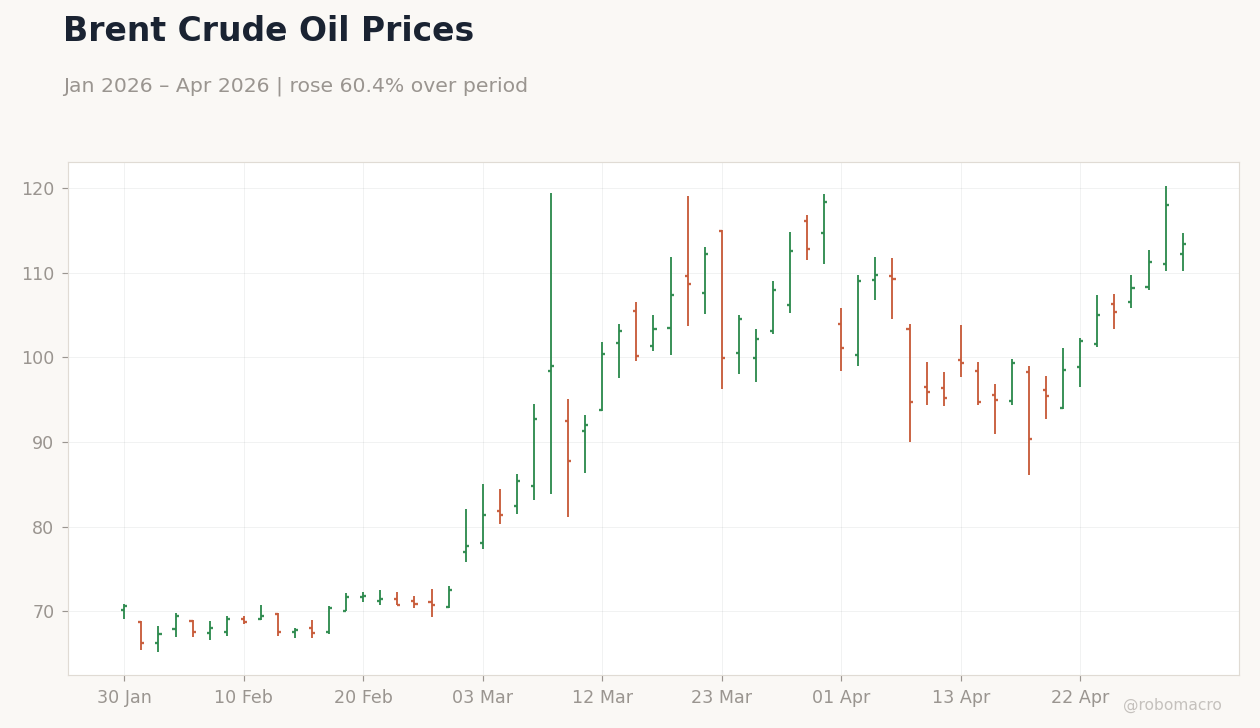
| Brent Crude | 113.61 | -3.74% |
| Gold | 4,556.90 | +0.26% |
| Bitcoin | 75,557.02 | -1.04% |
| Sweden 10Y Govt Yield | 2.76% | +4.55% |
| Norway 10Y Govt Yield | 4.25% | +1.99% |
| Data | Prior | Cons | Actual |
|---|---|---|---|
| No events available | |||
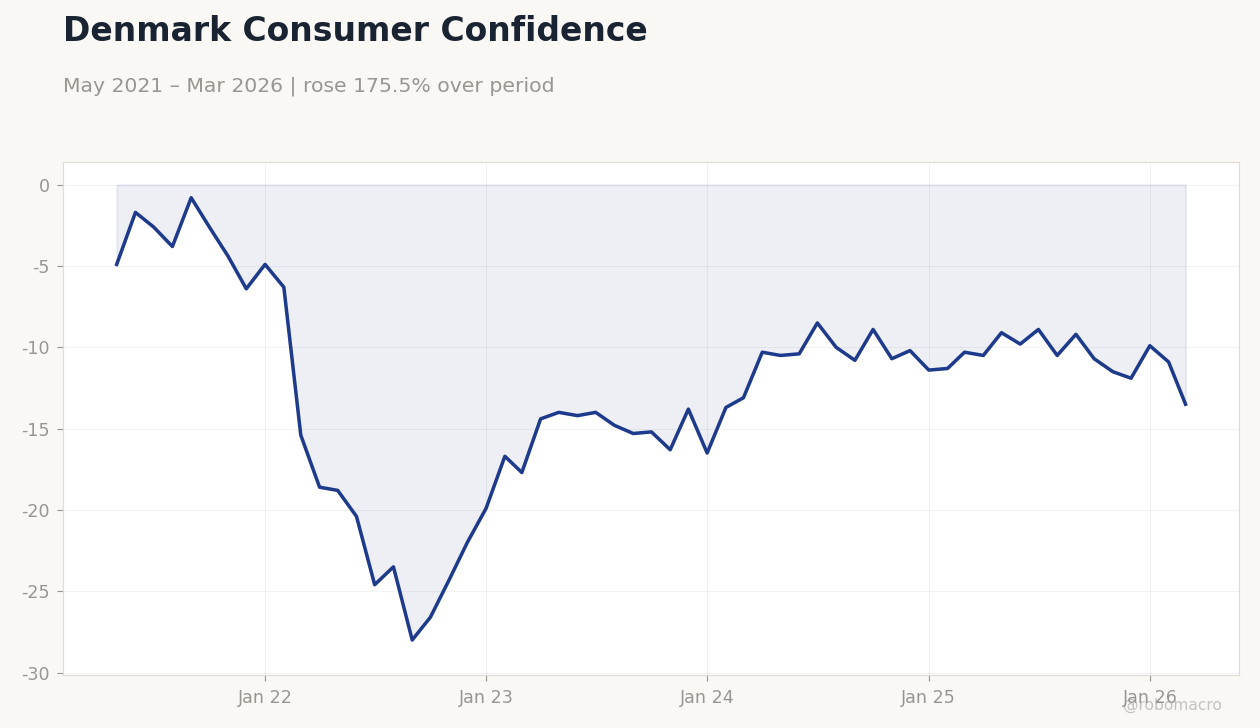
Denmark Consumer Confidence | Type: macro_line | Denmark Confidence Index: -13.5 (2026-03-01) | Range: -28–-0.8 | Trend(6pt): -4.9,-24.6,-15.3,-10.7,-9.9,-13.5
| Data | Prior | Cons | Time |
|---|---|---|---|
| No events available | |||
Nordic markets exhibited varied movements on April 29, with the OMX Stockholm 30 declining 0.51% to 3,040.54 amid broader risk aversion, while Oslo Bors rose 0.19% to 1,997.11 buoyed by energy sector resilience. OMX Copenhagen 25 fell 1.24% to 1,717.44, reflecting export-oriented pressures in Denmark, whereas OMX Helsinki 25 advanced 0.94% to 6,238.59 on positive sentiment in Finland's eurozone-linked economy. Currency dynamics highlighted SEK weakness, with USD/SEK up 0.75% to 9.33 and EUR/SEK rising 0.25% to 10.88, contrasting with NOK's relative stability as USD/NOK edged up 0.12% to 9.32 but EUR/NOK declined 0.40% to 10.87.
Brent crude dropped 3.74% to 113.61, pressuring Norway's oil-dependent revenues, though the krone gained strength per local reports. Sweden's parliament passed a sweeping citizenship reform bill on April 29, rejecting opposition calls for transitional rules, which tightens requirements and could affect long-term workforce integration in the export-heavy economy. Bond yields climbed, with Sweden's 10Y government yield up 4.55 basis points to 2.76% and Norway's rising 1.99 basis points to 4.25%, signaling hawkish policy expectations.
No major macro data releases occurred across the Nordics, keeping focus on these market shifts and policy news.
The Nordic calendar remains quiet on April 30 with no scheduled economic releases or events across Sweden, Norway, Denmark, or Finland, allowing markets to digest recent global developments. Investors will monitor any spillover from international news, such as Brazil's rate cut amid resilient growth, which could influence commodity prices affecting Norway's oil sector. Attention may turn to broader eurozone indicators given Finland's ECB ties and Denmark's peg, though no direct Nordic data is due.
Potential forest fire risks in Sweden around Valborg celebrations could indirectly impact local sentiment, but macro focus stays subdued. Markets anticipate continued volatility in FX pairs like EUR/SEK and EUR/NOK amid global rate divergence. Overall, a light day positions Nordic assets to track external cues like Brent movements and equity trends.
Subscribe to Nordics Macro Daily and get each new issue delivered to your inbox.
Already a member? Visit robomacro.com to log in and manage subscriptions, or use Forgot Password to set a password.
Brent Oil Price Dynamics | Type: macro_line | Brent Crude USD: 113.9 (2026-04-27) | Range: 59.93–138.2 | Trend(5pt): 68.91,111.5,90.73,78.01,113.9
Norway 10Y Yield Curve | Type: macro_line | Norway 10Y Yield %: 4.245 (2026-03-01) | Range: 1.23–4.245 | Trend(6pt): 1.47,2.909,3.887,3.669,4.122,4.245 | Brent Oil Price: 113.9 (2026-04-27) | Range: 59.93–138.2 | Trend(5pt): 68.91,111.5,90.73,78.01,113.9
Sweden 10Y Yield Curve | Type: macro_line | Sweden 10Y Yield %: 2.76 (2026-03-01) | Range: 0.1101–3.024 | Trend(6pt): 0.4212,1.533,2.888,2.067,2.8,2.76
Brent Crude Oil Prices | Type: market_hloc | Brent Crude: 113.4 (2026-04-30) | Range: 66.3–118.3 | Trend(6pt): 70.69,71.49,100.2,109.3,111.3,113.4
Sweden's new citizenship reforms, effective soon, may constrain labor supply in manufacturing and services, exacerbating wage pressures in an economy already facing sticky inflation. Norway benefits from krone appreciation, which aids import costs but challenges exporters, while oil production dynamics remain key to fiscal stability. Broader Nordic themes include integration challenges, as seen in Norway's review of immigrant language training to boost employment amid low unemployment rates.
Global markets provided a mixed backdrop for the Nordics, with Brazil's central bank cutting rates despite faster inflation and strong growth, which could stabilize commodity markets and indirectly benefit Norway's oil sector amid Brent's recent dip. India's bullish economic narrative contrasts with a struggling rupee, highlighting currency risks that echo Nordic FX volatility in SEK and NOK. The UK's GDP growth queries underscore sluggish European recovery, pressuring Finland's eurozone ties and Denmark's peg stability.
Greece's positive economic outlook from its central bank chief offers mild optimism for euro-area peripherals, relevant for Finland. Brazil and the ILO are boosting South-South cooperation on the care economy, potentially influencing global labor trends. Mercedes Benz plans to hire 600 contractors in Brazil as its economy recovers, signaling emerging market resilience.
Thailand held its key rate to support the economy amid oil shocks, mirroring Nordic central banks' balancing acts. Overall, these developments suggest cautious global growth, with emerging market rate moves potentially easing pressure on Nordic yields.
Riksbank maintains its independent policy stance with rates steady, monitoring SEK weakness and recent parliamentary reforms that could influence inflation via labor dynamics, while diverging from ECB easing signals. Norges Bank holds firm on rates, supported by krone strength and oil revenues, though Brent's decline introduces caution; the bank announced plans to limit new 1000-krone note orders, signaling currency management focus. Danmarks Nationalbank continues to shadow the ECB to uphold the EUR/DKK peg, with no interventions noted recently amid stable eurozone conditions.
Bank of Finland operates under the ECB framework, where the deposit rate stands at 2.00% as of April 29, 2026, reflecting a less aggressive easing path that contrasts with Riksbank's hawkishness. Policy divergences persist, with Norway's oil-driven resilience allowing tighter settings than Finland's eurozone alignment, while Sweden grapples with domestic inflation stickiness. Denmark's peg ensures minimal deviation from ECB moves, potentially amplifying any euro weakening against the SEK.
Investors watch for inflation reports, with Norges Bank's oil fund investments in global assets like Emcure Pharma underscoring diversified revenue strategies.