UK Macro Daily(Beta Mode)
BoE Warns on Supply Shock
Market Snapshot
| Asset | Level | Change |
|---|---|---|
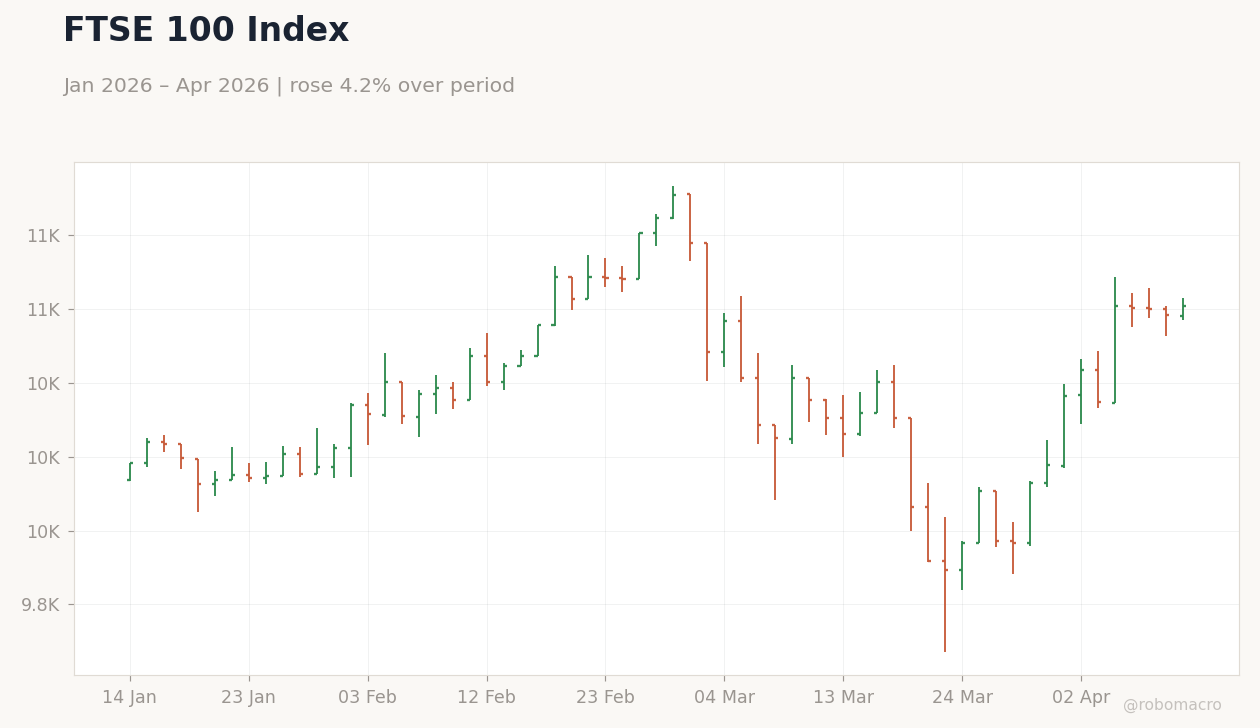
| FTSE 100 | 10,583.00 | -0.17% |
| FTSE 250 | 22,724.30 | +2.01% |
| GBP/USD | 1.36 | +0.39% |
| GBP/EUR | 1.15 | +0.16% |
| GBP/JPY | 215.66 | +0.22% |
| Brent Crude | 95.57 | +0.82% |
| Gold | 4,839.60 | +0.30% |
| UK Nat Gas | 2.60 | +0.04% |
| Bitcoin | 74,055.32 | -0.58% |
| UK 2Y Gilt | - | - |
| UK 10Y Gilt | 4.43% | -0.42% |
Prior Economic Events
| Data | Prior | Cons | Actual |
|---|---|---|---|
| BoE Gov Bailey Speech | - | - | - |
 UK 10Y Gilt Yield | Type: macro_line | 10Y Yield %: 4.432 (2026-02-01) | Range: 0.644–4.689 | Trend(6pt): 0.9058,2.145,4.42,4.416,4.451,4.432
Today's Economic Events
| Data | Prior | Cons | Time |
|---|---|---|---|
| BoE Gov Bailey Speech | - | - | 14:00 |
| Thursday (2026-04-16) | |||
| GDP Month-over-Month | 0 | 0.10 | 02:00 |
| GDP 3-Month Avg | 0.20 | 0.20 | 02:00 |
| Goods Trade Balance | -14,450m | -20,200m | 02:00 |
| Goods Trade Balance Non-EU | -3,460m | - | 02:00 |
| Industrial Production Month-over-Month | -0.10 | 0.30 | 02:00 |
| Manufacturing Production Month-over-Month | 0.10 | 0.20 | 02:00 |
| Tuesday (2026-04-21) | |||
| Headline Unemployment Rate | 5.20 | - | 02:00 |
- Bank of England highlights major supply shock from Middle East conflict, pressuring UK growth and inflation.
- IMF slashes UK forecasts hardest among G7 due to Iran war escalation and weak late-2025 performance.
- Markets mixed: FTSE 250 surges 2% amid risk appetite, while gilt yields dip on easing bets.
Yesterday's Recap
On April 14, Bank of England Governor Andrew Bailey delivered a high-impact speech, emphasizing the Middle East conflict's role in triggering a major supply shock to the UK economy, which weighed on sentiment. UK equities showed divergence, with the FTSE 100 closing at 10,583.00 after a 0.17% decline driven by energy sector weakness, while the FTSE 250 rallied 2.01% to 22,724.30 on midcap strength in industrials. Sterling strengthened modestly, with GBP/USD up 0.39% to 1.36, GBP/EUR gaining 0.16% to 1.15, and GBP/JPY rising 0.22% to 215.66, supported by relative yield appeal.
Brent crude advanced 0.82% to 95.57 amid geopolitical tensions, but UK natural gas edged up just 0.04% to 2.60 on stable supply outlooks. Gold climbed 0.30% to 4,839.60 as a safe-haven play, while Bitcoin dipped 0.58% to 74,055.32. The UK 10-year gilt yield fell 0.42% to 4.43%, reflecting bets on potential BoE easing amid growth risks.
No major data releases occurred, but Bailey's comments amplified concerns over persistent inflation pressures from external shocks.
The Day Ahead
Today, April 15, features another high-impact speech from BoE Governor Bailey at 14:00 ET, where markets will scrutinize guidance on inflation and supply disruptions. Looking to Thursday, April 16, key releases at 02:00 include GDP month-over-month (consensus 0.1%, previous 0%), alongside the 3-month average GDP (consensus 0.2%, previous 0.2%), goods trade balance (consensus -20.2 billion, previous -14.45 billion), and industrial production (consensus 0.3%, previous -0.1%). Manufacturing production is also due, with consensus at 0.2% month-over-month versus previous 0.1%.
Next week, Tuesday, April 21, brings headline unemployment rate (previous 5.2%), average earnings including bonus (previous 3.9%), and employment change (previous 84,000). Wednesday, April 22, features inflation rate year-over-year (previous 3%) and core inflation (previous 3.2%), which could influence BoE policy bets. These data points will be critical for assessing UK resilience amid global tensions.
Other Economic Notes
Broader UK themes center on stagflation risks, with flatlining growth and biting inflation exacerbated by the Iran war, as warned by analysts and the Independent. (cont...)