ANZ Macro Daily(Beta Mode)
RBA Hawkish, NZ CPI Eyed; AUD at One-Month High
Market Snapshot
| Asset | Level | Change |
|---|---|---|
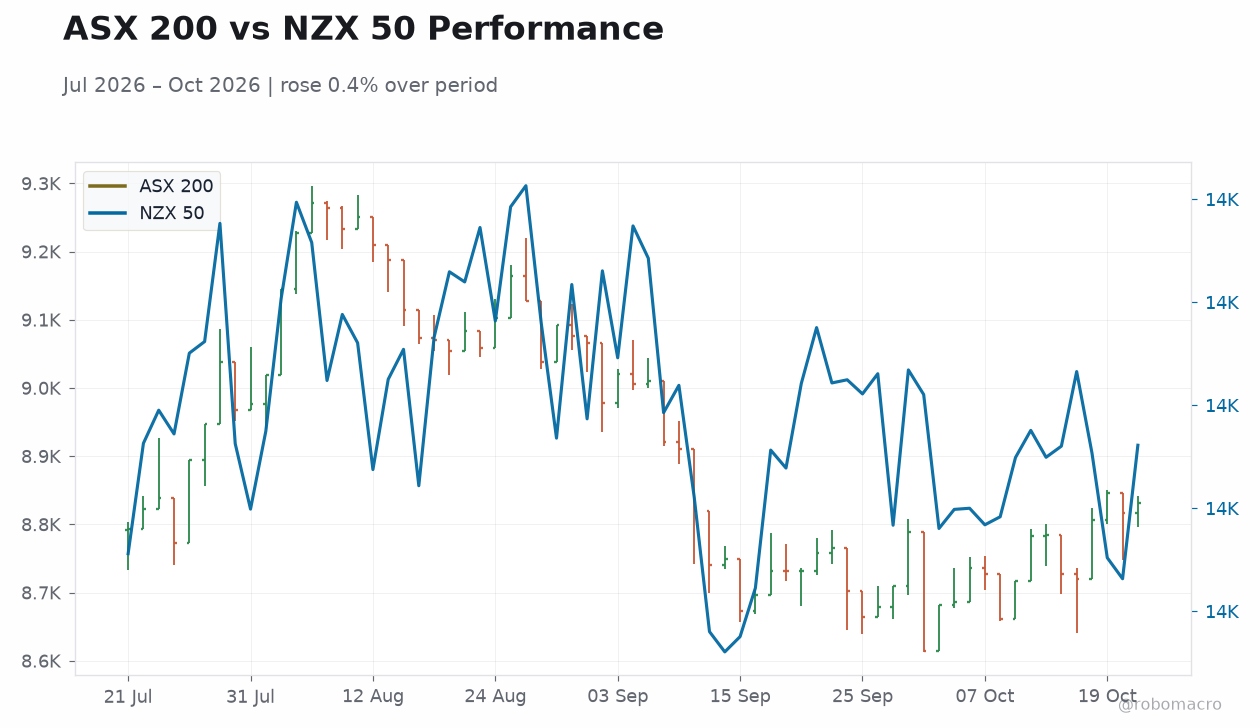
| ASX 200 | 8,831.30 | +0.16% |
| NZX 50 | 13,761.29 | +0.95% |
| AUD/USD | 0.70 | +0.74% |
| NZD/USD | 0.57 | +0.68% |
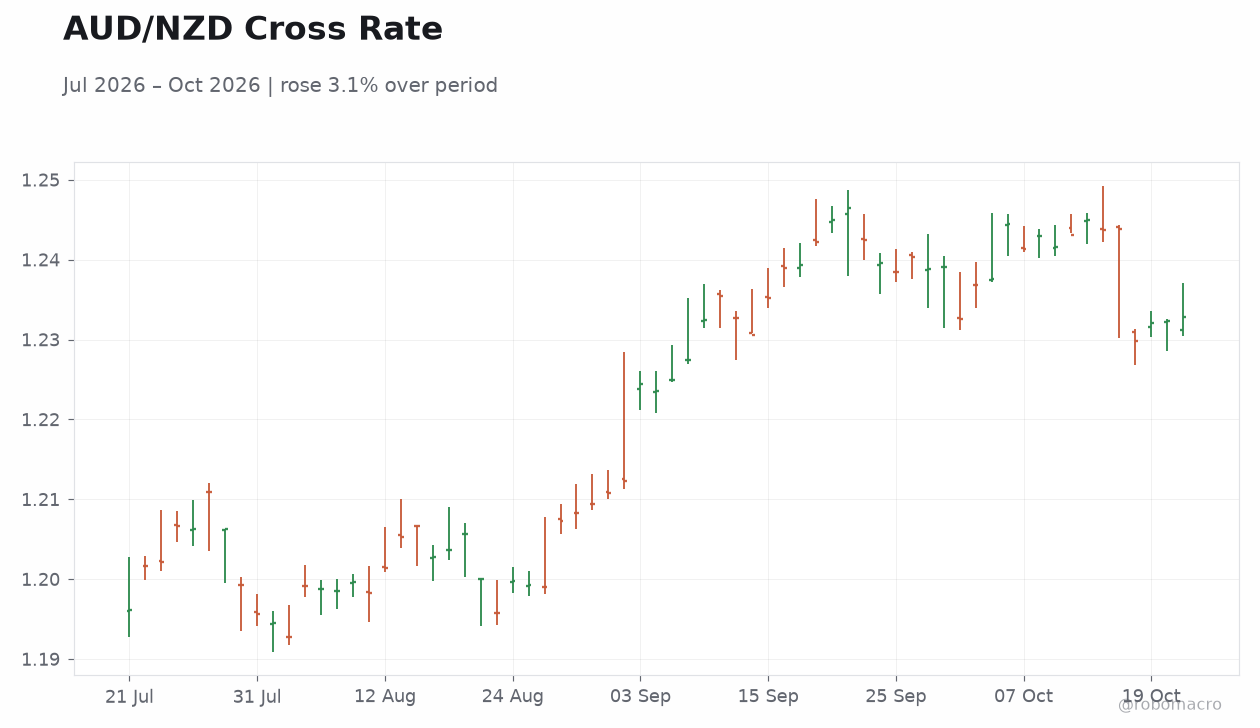
| AUD/NZD | 1.23 | +0.04% |
| BHP | 58.54 | -1.61% |
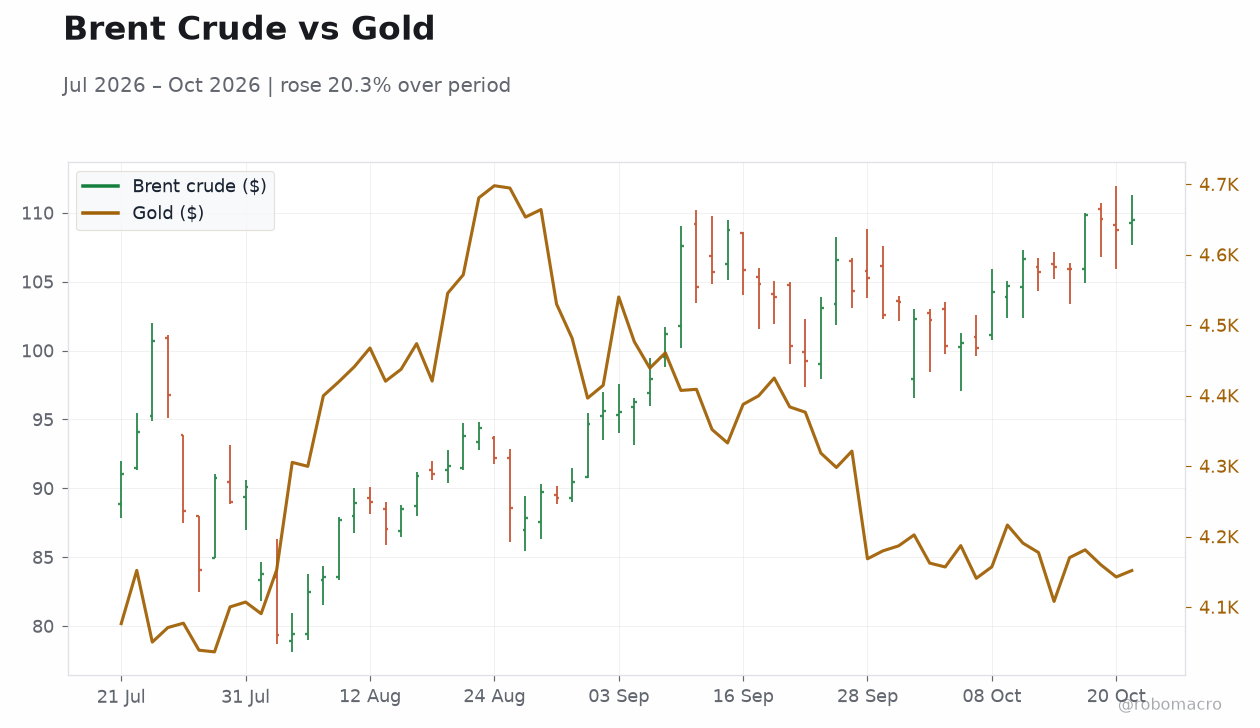
| Gold | 4,149.50 | +0.17% |
| Brent Crude | 109.56 | +0.71% |
| Bitcoin | 84,438.10 | +1.81% |
| Australia 2Y Govt Yield | 4.92% | +3 bp |
| Australia 10Y Govt Yield | 5.31% | +2 bp |
Prior Economic Events
| Data | Prior | Cons | Actual |
|---|---|---|---|
| No events available | |||
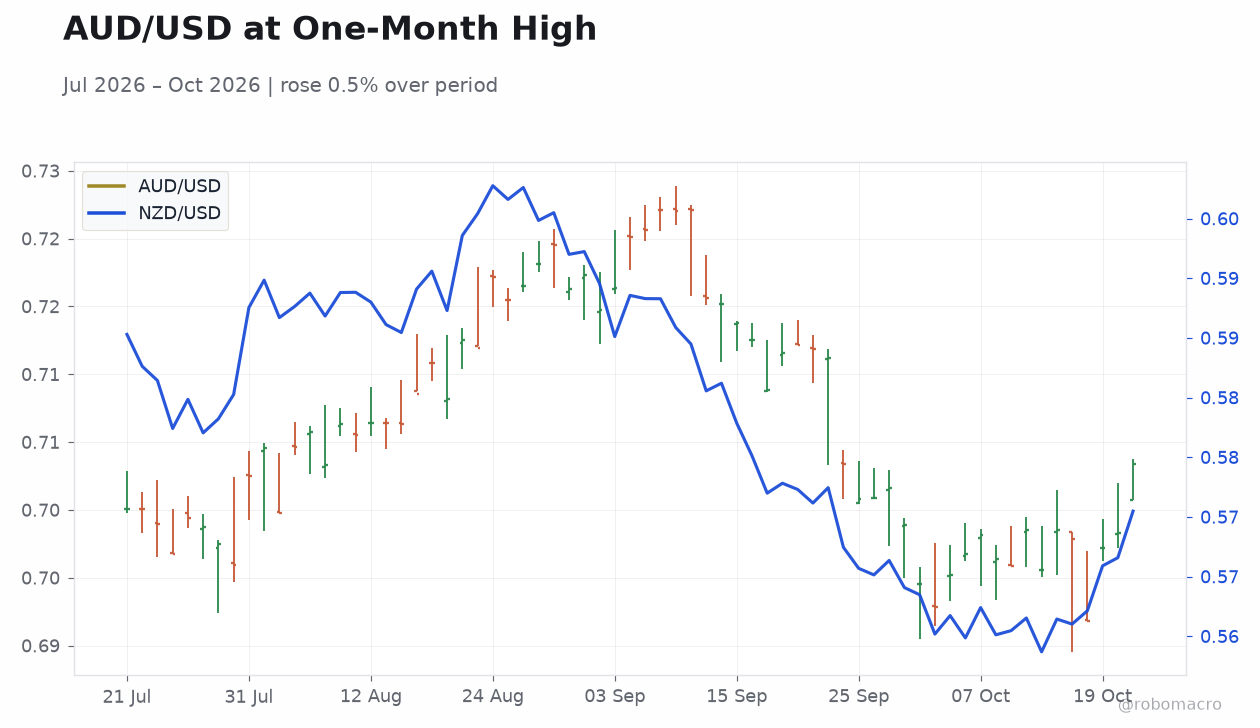 AUD/USD at One-Month High | Type: market_hloc | AUD/USD: 0.7034 (2026-10-21) | Range: 0.6919–0.7221 | Trend(6pt): 0.7001,0.7064,0.7164,0.7008,0.6972,0.7034 | NZD/USD: 0.5705 (2026-10-21) | Range: 0.5587–0.5978 | Trend(6pt): 0.5853,0.588,0.5851,0.5657,0.5659,0.5705
Today's Economic Events
| Data | Prior | Cons | Time |
|---|---|---|---|
| Inflation Rate Quarter-over-Quarter | 1.50 | 0.80 | 17:45 |
- RBA Deputy Governor Hauser says Australia's inflation outlook is "materially worse" than expected, keeping the RBA hawkish ahead of its policy meeting and lifting AUD/USD to a one-month high of 0.70.
- New Zealand Q3 CPI quarter-over-quarter is due today (consensus 0.8% vs prior 1.5%), the last major inflation print before the RBNZ decision; swaps markets price a steeper RBNZ path than the central bank itself.
- Australian 2Y and 10Y yields rose 3 bp and 2 bp to 4.92% and 5.31% respectively, while NZX 50 outperformed (+0.95%) and BHP lagged (-1.61%) despite firm Brent crude at $109.56.
Yesterday's Recap
Australian markets traded a hawkish RBA signal on Tuesday, with the ASX 200 edging up 0.16% to 8,831.30 even as RBA Deputy Governor Hauser warned that Australia's inflation outlook is "materially worse" than expected ahead of the policy meeting. The Australian curve bear-flattened modestly, with the 2-year yield up 3 bp to 4.92% and the 10-year up 2 bp to 5.31%, reflecting the market's read that the RBA is not yet ready to ease. AUD/USD extended its rally to a one-month high around 0.70, up 0.74% on the day, while AUD/NZD was essentially flat at 1.23 (+0.04%).
Across the Tasman, NZX 50 rose 0.95% to 13,761.29 and NZD/USD gained 0.68% to 0.57 as traders positioned for a steeper RBNZ hiking path than the central bank's own guidance. BHP fell 1.61% to A$58.54, underperforming the broader index despite Brent crude firming 0.71% to $109.56 and gold up 0.17% at $4,149.50. No scheduled Australian or New Zealand data releases printed yesterday, leaving the RBA commentary and RBNZ pricing as the dominant domestic drivers.
The Day Ahead
The focus today is New Zealand's Q3 inflation report at 17:45 ET, with quarter-over-quarter CPI consensus at 0.8% following the prior 1.5% print — the final major inflation data point before the RBNZ's upcoming decision. A print at or above consensus would reinforce market pricing for further RBNZ tightening and support NZD, while a soft outcome would revive the case for a hold and likely weigh on the kiwi, as ASB has flagged. No top-tier Australian data is scheduled, so AUD direction will be driven by offshore risk sentiment, commodity prices and positioning around the RBA's hawkish rhetoric.
Australian 2-year and 10-year yields at 4.92% and 5.31% remain the key domestic markers to watch for any further repricing of the RBA path. With Brent crude above $109, energy-driven inflation risk remains a live theme for both economies.
Other Economic Notes
Australia's inflation backdrop remains the central domestic vulnerability, with CPI running at 4.00% year-over-year as of August, well above target and consistent with the RBA's hawkish tone. ↓ p.2