| Asset | Level | Change |
|---|---|---|
| ASX 200 | 8,795.20 | +0.02% |
| NZX 50 | 13,733.93 | -0.09% |
| AUD/USD | 0.70 | +0.10% |
| NZD/USD | 0.57 | -0.09% |
| AUD/NZD | 1.23 | +0.18% |
| BHP | 55.05 | -3.64% |
| Gold | 4,013.40 | -1.16% |
| Brent Crude | 111.45 | -1.52% |
| Bitcoin | 81,529.55 | +0.27% |
| Australia 2Y Govt Yield | 4.92% | +6 bp |
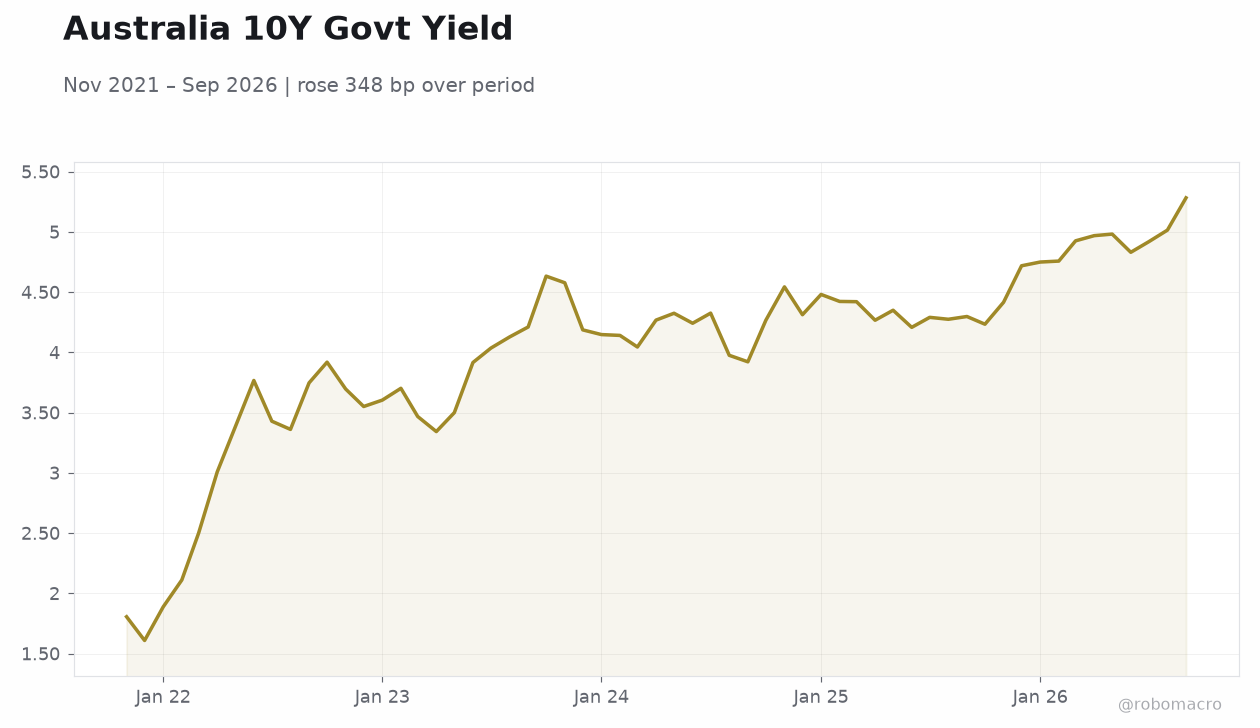
| Australia 10Y Govt Yield | 5.28% | -3 bp |
| Data | Prior | Cons | Actual |
|---|---|---|---|
| Inflation Rate Quarter-over-Quarter | 1.50 | 0.80 | 0.70 |
Australia 10Y Govt Yield | Type: macro_line | Yield %: 5.283 (2026-09-01) | Range: 1.609–5.283 | Trend(6pt): 1.806,3.604,4.045,4.35,4.919,5.283
| Data | Prior | Cons | Time |
|---|---|---|---|
| No events available | |||
New Zealand’s inflation rate quarter-over-quarter came in at 0.7% versus the 0.8% consensus, confirming a modest easing from the prior 1.5% print and leaving the annual rate at 3.70%. The softer outcome weighed on NZD/USD, which fell 0.09% to 0.57. In Australia, the ASX 200 finished virtually unchanged at 8,795.20 while BHP fell 3.64% to 55.05 amid a broader commodity sell-off that also pushed gold down 1.16%.
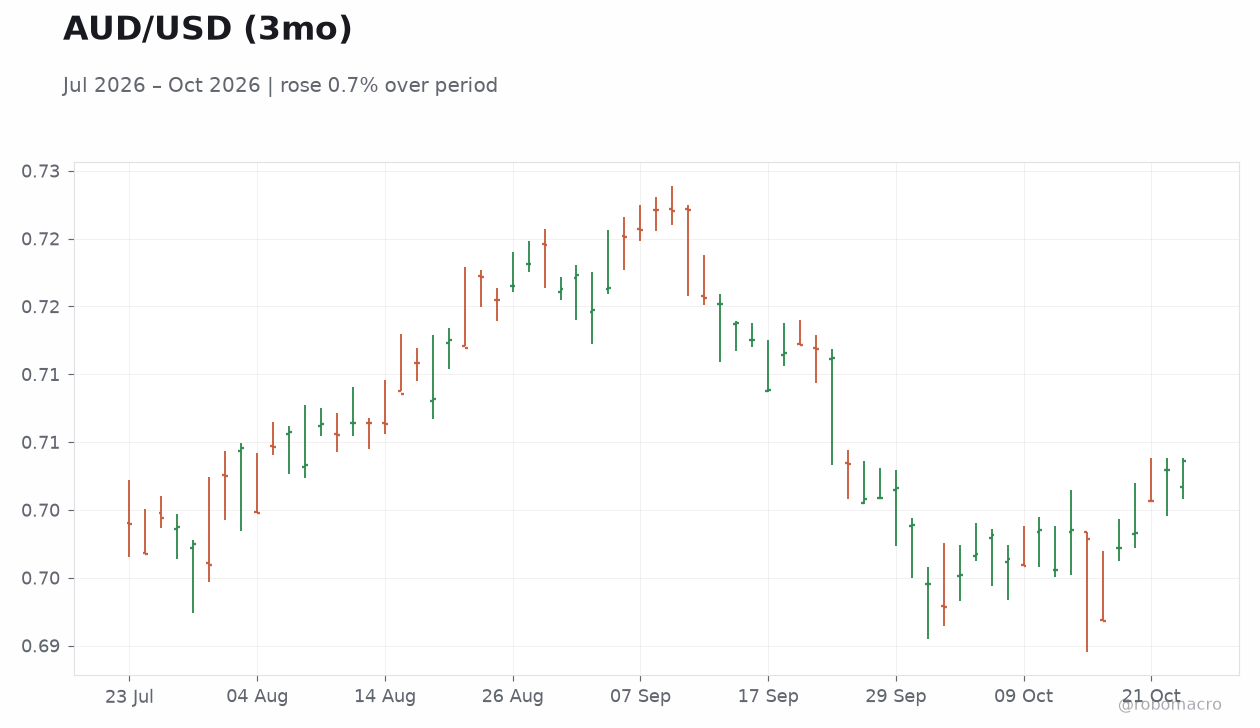
The Australia 2-year yield rose 6 bp to 4.92% and the 10-year yield eased 3 bp to 5.28%, reflecting mixed rate expectations. AUD/USD advanced 0.10% to 0.70, shrugging off external geopolitical concerns. NZX 50 declined 0.09% to 13,733.93 as investors digested the inflation data ahead of the RBNZ meeting.
Australia’s role as a major exporter of iron ore, coal and LNG leaves the economy highly sensitive to Chinese demand and global commodity cycles. Energy-price increases have reinforced upside risks to the inflation outlook and kept the RBA’s tightening door open. New Zealand’s dairy and tourism sectors continue to face softer domestic demand, yet the 3.70% annual inflation rate remains above the RBNZ’s target ceiling.
Both economies maintain tight linkages between housing markets and household spending, amplifying the transmission of any policy-rate changes. Divergent growth trajectories are widening the gap between Australian and New Zealand rate paths.
Attention now turns to the RBA’s November policy decision, with markets pricing a sharply higher probability of a hike following recent inflation signals and energy-price shocks. No major Australian or New Zealand data releases are scheduled for today or tomorrow, leaving focus on speeches from RBA and RBNZ officials. Treasury Secretary Chalmers is expected to comment further on growth forecasts that already flag slower momentum.
Housing-market indicators and retail-sales prints due next week will provide fresh readings on domestic demand. China’s latest trade and industrial-production figures will also be watched closely given their direct impact on Australian commodity exports. Geopolitical tensions surrounding Iran have so far left AUD resilient, with markets focusing instead on domestic inflation drivers.
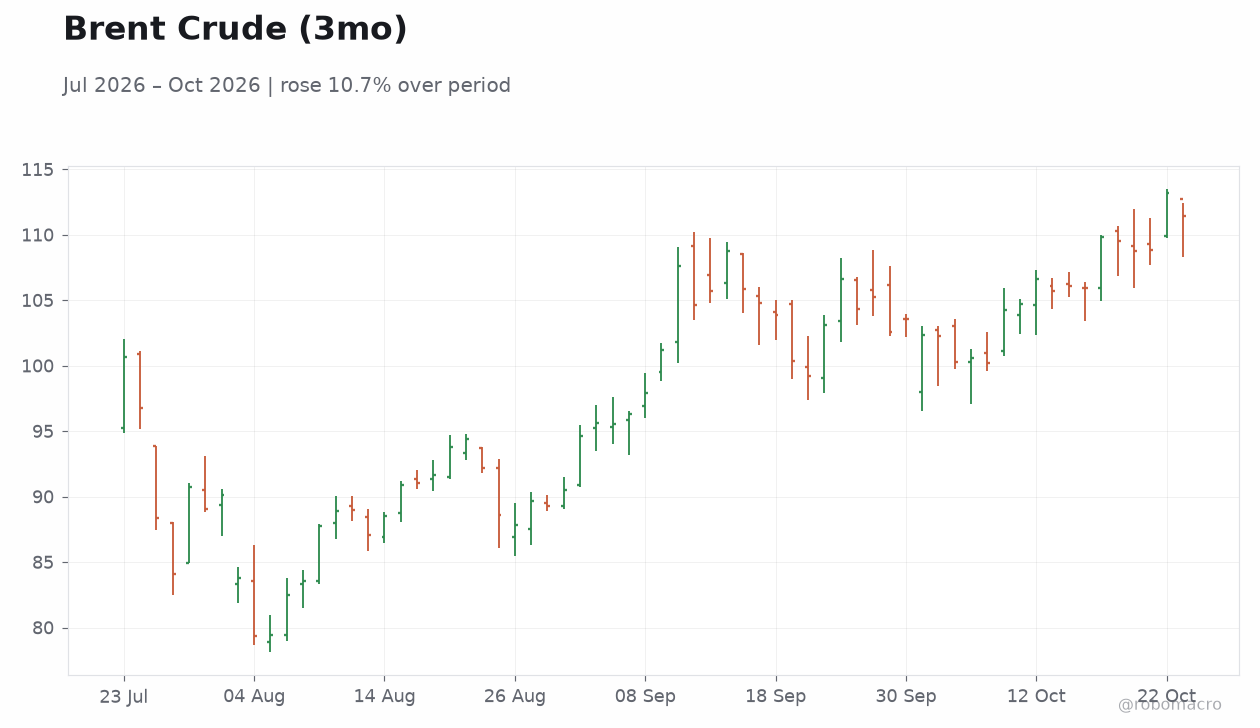
Brent crude fell 1.52% to 111.45, easing some external price pressure yet leaving Australian energy costs elevated. ↓ p.2
Subscribe to ANZ Macro Daily and get each new issue delivered to your inbox.
Already a member? Visit robomacro.com to log in and manage subscriptions, or use Forgot Password to set a password.
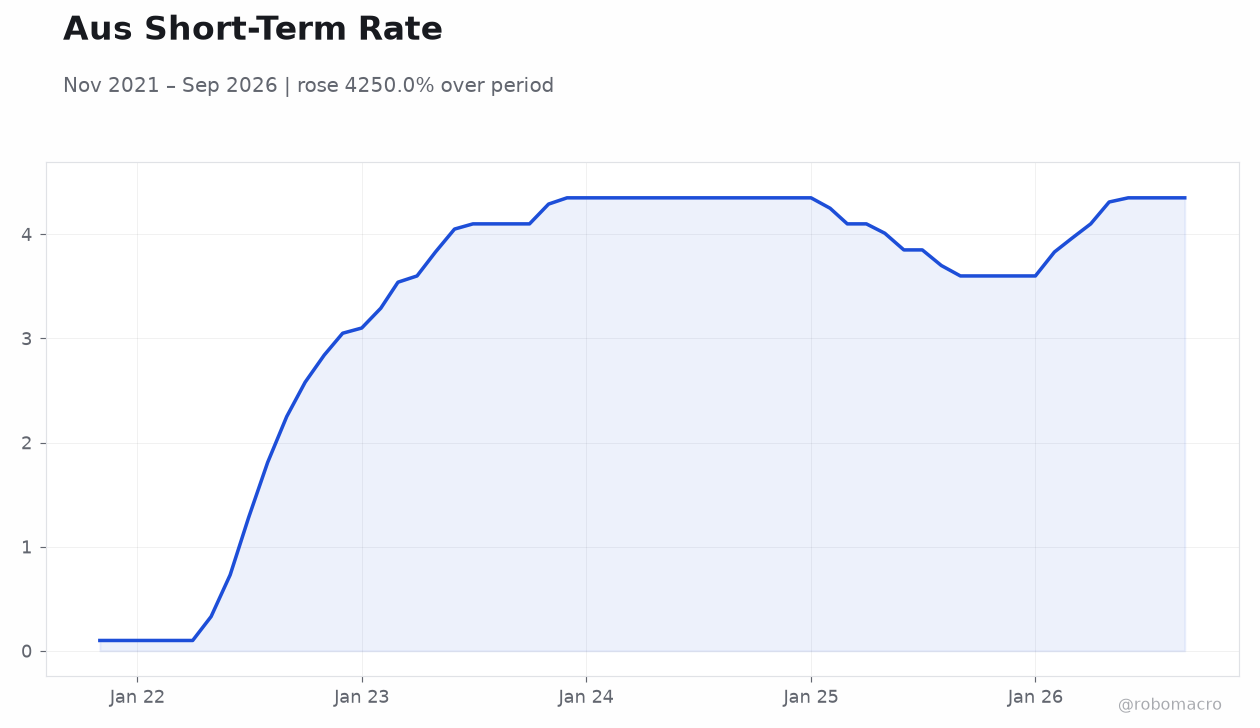
Aus Short-Term Rate | Type: macro_line | Rate %: 4.35 (2026-09-01) | Range: 0.1–4.35 | Trend(5pt): 0.1,3.1,4.35,4.01,4.35
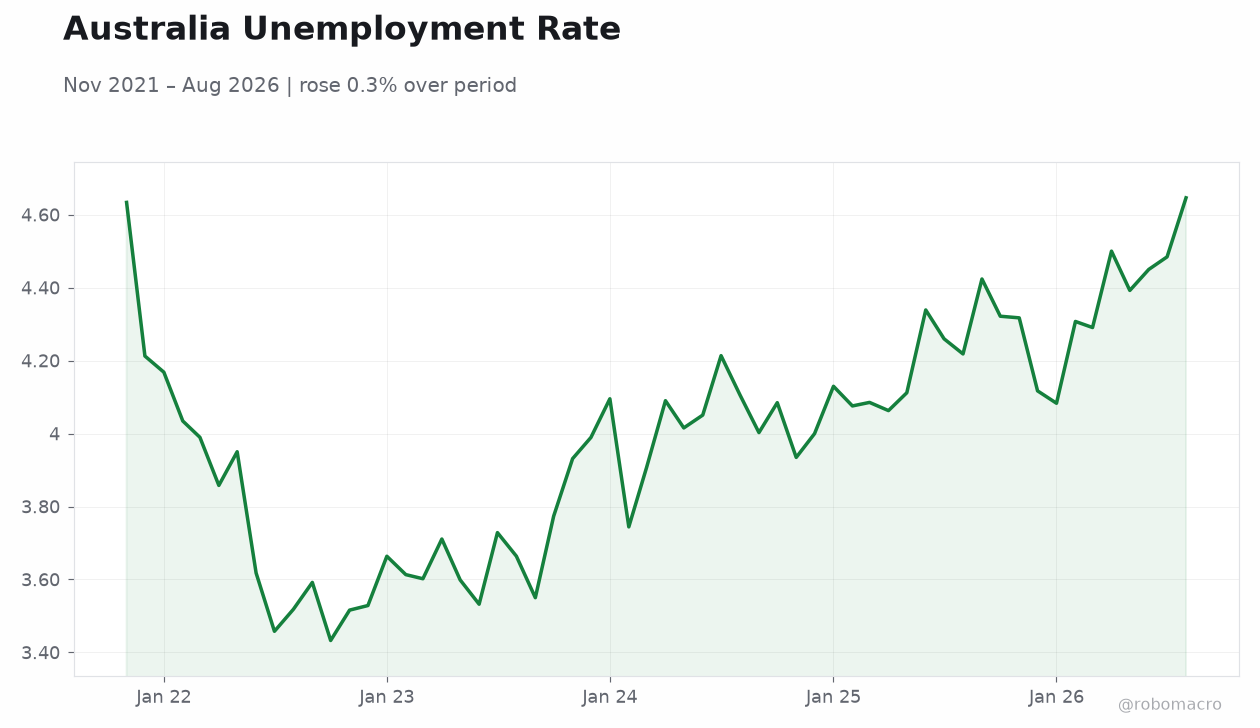
Australia Unemployment Rate | Type: macro_line | Unemployment %: 4.646 (2026-08-01) | Range: 3.433–4.646 | Trend(6pt): 4.634,3.664,3.907,4.112,4.484,4.646
Brent Crude (3mo) | Type: market_hloc | USD per Barrel: 111.5 (2026-10-23) | Range: 79.36–113.2 | Trend(6pt): 100.7,88.52,97.92,103.5,113.2,111.5
AUD/USD (3mo) | Type: market_hloc | Exchange Rate: 0.7036 (2026-10-23) | Range: 0.6919–0.7221 | Trend(6pt): 0.699,0.7064,0.7206,0.7016,0.7007,0.7036
Bitcoin rose 0.27% to 81,529.55, providing limited spillover to risk assets in the region. Global yield curves have steepened modestly, influencing Australian 2-year and 10-year spreads. China’s growth trajectory remains the dominant external variable for both ANZ economies, with any further slowdown likely to weigh on commodity revenues and AUD.
Equity markets outside the region showed mixed performance, underscoring selective risk appetite.
Australia’s role as a major exporter of iron ore, coal and LNG leaves the economy highly sensitive to Chinese demand and global commodity cycles. Energy-price increases have reinforced upside risks to the inflation outlook and kept the RBA’s tightening door open. New Zealand’s dairy and tourism sectors continue to face softer domestic demand, yet the 3.70% annual inflation rate remains above the RBNZ’s target ceiling.
Both economies maintain tight linkages between housing markets and household spending, amplifying the transmission of any policy-rate changes. Divergent growth trajectories are widening the gap between Australian and New Zealand rate paths. The RBA has signalled that November’s meeting could deliver a rate increase, with market-implied probabilities roughly doubling in recent sessions on the back of persistent inflation and energy shocks.
The cash rate currently stands at 4.60%. ↓ p.3
In New Zealand, softer quarterly inflation has not removed the prospect of an RBNZ hike, with the OCR at 2.75% and the committee still viewing upside risks as material ahead of the election. The RBNZ has historically moved more aggressively than the RBA in both tightening and easing cycles. Recent commentary suggests the two central banks are on divergent paths, with Australia leaning toward further restriction while New Zealand weighs pre-election timing.
Housing-market data will remain a key input for both boards given its weight in domestic inflation and financial-stability assessments.
Geopolitical tensions surrounding Iran have so far left AUD resilient, with markets focusing instead on domestic inflation drivers. Brent crude fell 1.52% to 111.45, easing some external price pressure yet leaving Australian energy costs elevated. Bitcoin rose 0.27% to 81,529.55, providing limited spillover to risk assets in the region.
Global yield curves have steepened modestly, influencing Australian 2-year and 10-year spreads. China’s growth trajectory remains the dominant external variable for both ANZ economies, with any further slowdown likely to weigh on commodity revenues and AUD. Equity markets outside the region showed mixed performance, underscoring selective risk appetite.
Attention now turns to the RBA’s November policy decision, with markets pricing a sharply higher probability of a hike following recent inflation signals and energy-price shocks. No major Australian or New Zealand data releases are scheduled for today or tomorrow, leaving focus on speeches from RBA and RBNZ officials. Treasury Secretary Chalmers is expected to comment further on growth forecasts that already flag slower momentum.
Housing-market indicators and retail-sales prints due next week will provide fresh readings on domestic demand. China’s latest trade and industrial-production figures will also be watched closely given their direct impact on Australian commodity exports.
The RBA has signalled that November’s meeting could deliver a rate increase, with market-implied probabilities roughly doubling in recent sessions on the back of persistent inflation and energy shocks. The cash rate currently stands at 4.60%. In New Zealand, softer quarterly inflation has not removed the prospect of an RBNZ hike, with the OCR at 2.75% and the committee still viewing upside risks as material ahead of the election.
The RBNZ has historically moved more aggressively than the RBA in both tightening and easing cycles. Recent commentary suggests the two central banks are on divergent paths, with Australia leaning toward further restriction while New Zealand weighs pre-election timing. Housing-market data will remain a key input for both boards given its weight in domestic inflation and financial-stability assessments.
↓ p.4
Australia’s role as a major exporter of iron ore, coal and LNG leaves the economy highly sensitive to Chinese demand and global commodity cycles. Energy-price increases have reinforced upside risks to the inflation outlook and kept the RBA’s tightening door open. New Zealand’s dairy and tourism sectors continue to face softer domestic demand, yet the 3.70% annual inflation rate remains above the RBNZ’s target ceiling.
Both economies maintain tight linkages between housing markets and household spending, amplifying the transmission of any policy-rate changes. Divergent growth trajectories are widening the gap between Australian and New Zealand rate paths.