Australia CPI Shock Lifts RBA Hike Risk
0.90 Construction Work Done0.50 Inflation Rate4.90 Inflation Rate0.50 RBA Trimmed Mean CPI3.80 RBA Trimmed Mean CPI
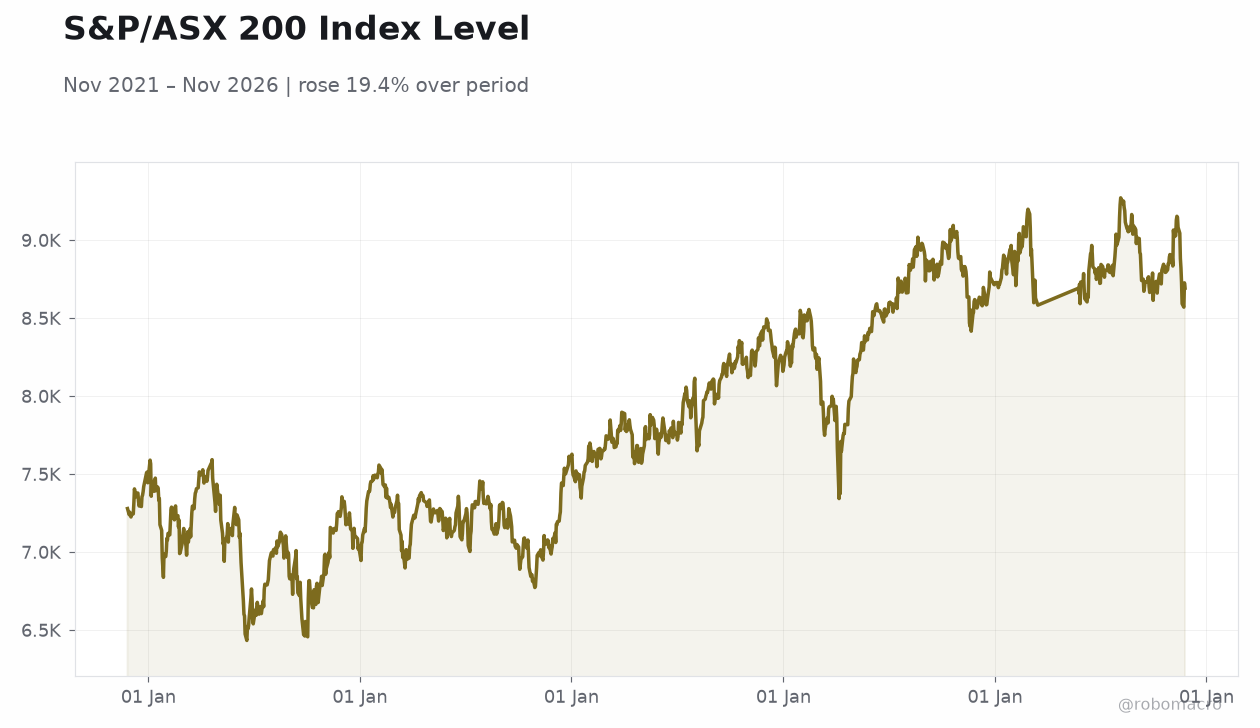
ASX 2008,692.40-0.39%
NZX 5014,047.93+0.36%
AUD/USD0.66+0.03%
NZD/USD0.55+0.78%
Market Snapshot
| Asset | Level | Change |
|---|
| ASX 200 | 8,692.40 | -0.39% |
| NZX 50 | 14,047.93 | +0.36% |
| AUD/USD | 0.66 | +0.03% |
| NZD/USD | 0.55 | +0.78% |
| AUD/NZD | 1.21 | -0.75% |
| BHP | 52.22 | -1.90% |
| Gold | 3,570.90 | +0.25% |
| Brent Crude | 90.39 | -1.11% |
| Bitcoin | 59,756.66 | +0.01% |
| Australia 2Y Govt Yield | 4.81% | -5 bp |
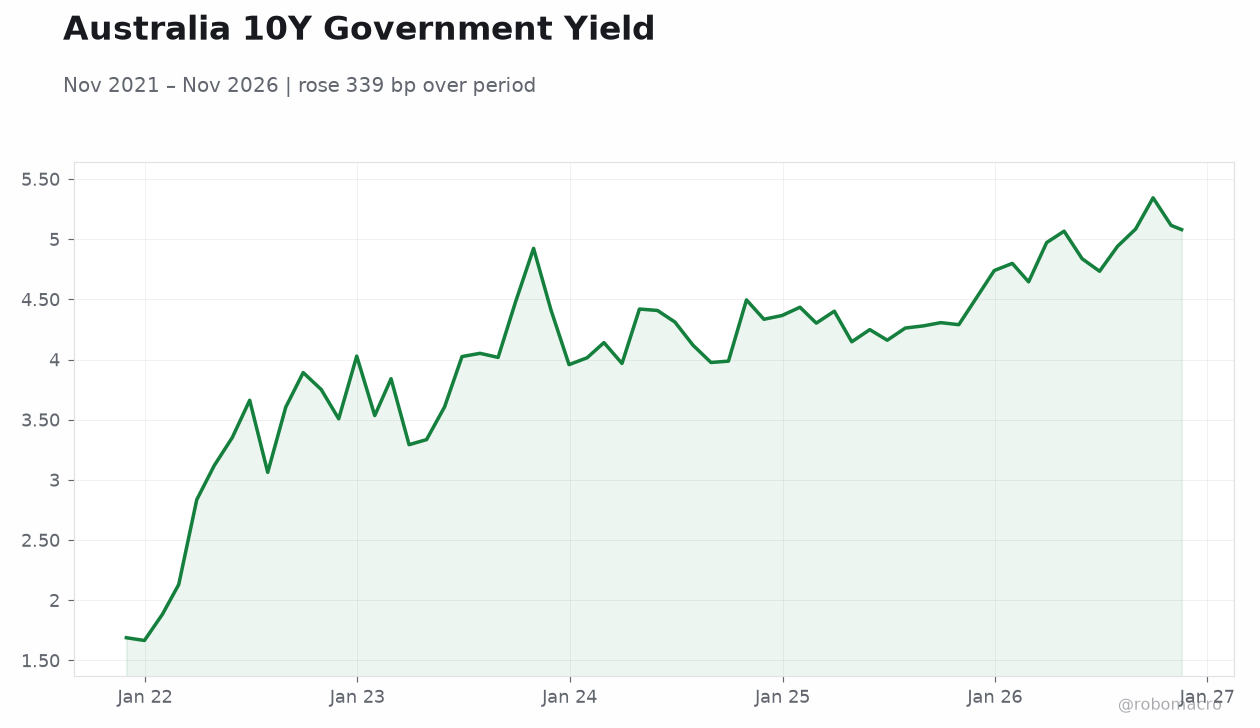
| Australia 10Y Govt Yield | 5.08% | -5 bp |
Prior Economic Events
| Data |
Prior |
Cons |
Actual |
| RBA Jacobs Speech | - | - | - |
| Construction Work Done Quarter-over-Quarter | -2.10 | 0.70 | 0.90 |
| Inflation Rate Month-over-Month | 0.80 | 0.40 | 0.50 |
| Inflation Rate Year-over-Year | 4.30 | 4.70 | 4.90 |
| RBA Trimmed Mean CPI Month-over-Month | 0.30 | 0.30 | 0.50 |
| RBA Trimmed Mean CPI Year-over-Year | 3.60 | 3.60 | 3.80 |
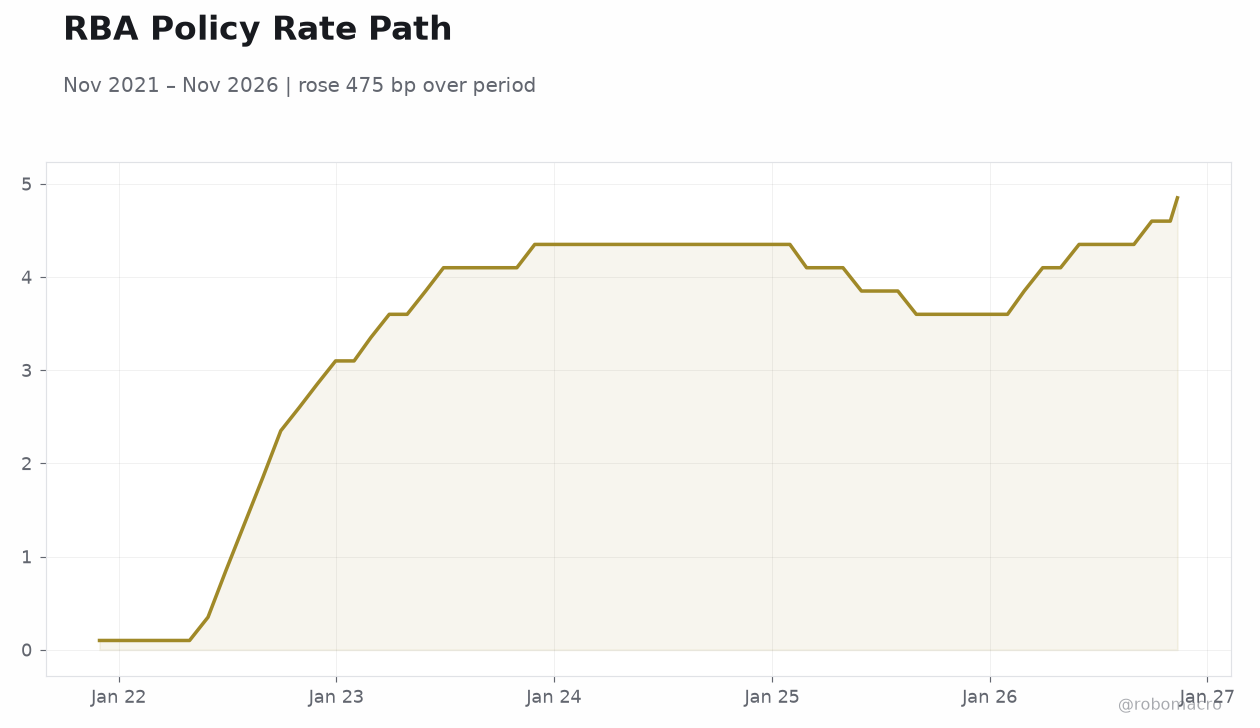 RBA Policy Rate Path | Type: macro_line | RBA policy rate (%): 4.85 (2026-11-12) | Range: 0.1–4.85 | Trend(5pt): 0.1,3.35,4.35,3.6,4.85
Today's Economic Events
| Data |
Prior |
Cons |
Time |
| RBA Bulletin | - | - | 19:30 |
- Australia's Q3 CPI surprised sharply to the upside, with headline inflation at 4.9% y/y and trimmed mean at 3.8% y/y, both above consensus
- RBA's Jacobs described financial conditions as "clearly restrictive," reinforcing the case for the November hike to 4.85% to remain in place
- AUD/USD reclaimed 0.6600 before fading, while NZD/USD outperformed and AUD/NZD fell 0.75% to 1.21
Yesterday's Recap
Australia's Q3 CPI printed materially above expectations, with headline inflation at 4.9% y/y versus consensus of 4.7% and the prior 4.3%, while the month-over-month figure came in at 0.5% against a 0.4% consensus. The RBA trimmed mean rose 0.5% m/m and 3.8% y/y, both above the 0.3% and 3.6% consensus respectively, confirming broad-based price pressure. Construction work done rebounded 0.9% q/q, beating the 0.7% consensus and reversing the prior -2.1% contraction.
RBA Deputy Governor Jacobs said in a speech that financial conditions are "clearly restrictive" and that higher rates are restricting the economy, a message that sits awkwardly alongside the hot inflation print. Markets reacted defensively: the ASX 200 fell 0.39% to 8,692.40, with BHP down 1.90% to 52.22 as inflation worries deepened. Australian 2-year and 10-year government yields each eased 5 bp to 4.81% and 5.08% respectively, a counterintuitive move that suggests the market is beginning to price a growth slowdown even as inflation runs hot.
AUD/USD reclaimed 0.6600 intraday but closed only 0.03% higher, reflecting the tension between hawkish inflation and deteriorating activity data.
The Day Ahead
The RBA Bulletin is the sole scheduled Australian release today, and it will be scrutinised for the Bank's internal assessment of inflation dynamics, the labour market, and the transmission of restrictive policy settings. With headline CPI at 4.9% y/y and the trimmed mean at 3.8% y/y, the Bulletin's commentary on services inflation and wage pressures will be key for calibrating expectations ahead of the 8 December RBA meeting. No New Zealand data is scheduled, leaving NZD direction to offshore drivers and the broader risk backdrop.
Australian bond markets will also watch whether the recent yield decline extends, given the tension between hot inflation and softening activity. Attention is already shifting toward the December RBA decision, where the November hike to 4.85% will be reassessed against this inflation evidence.
Page 1
Never miss an issue
Subscribe to ANZ Macro Daily and get each new issue delivered to your inbox.
Already a member? Visit robomacro.com
to log in and manage subscriptions, or use Forgot Password to set a password.