ASEAN Macro Daily(Beta Mode)
PH Inflation Cools to 6.4%, ASEAN Equities Rise
Market Snapshot
| Asset | Level | Change |
|---|---|---|
| JCI | 5,916.07 | +0.69% |
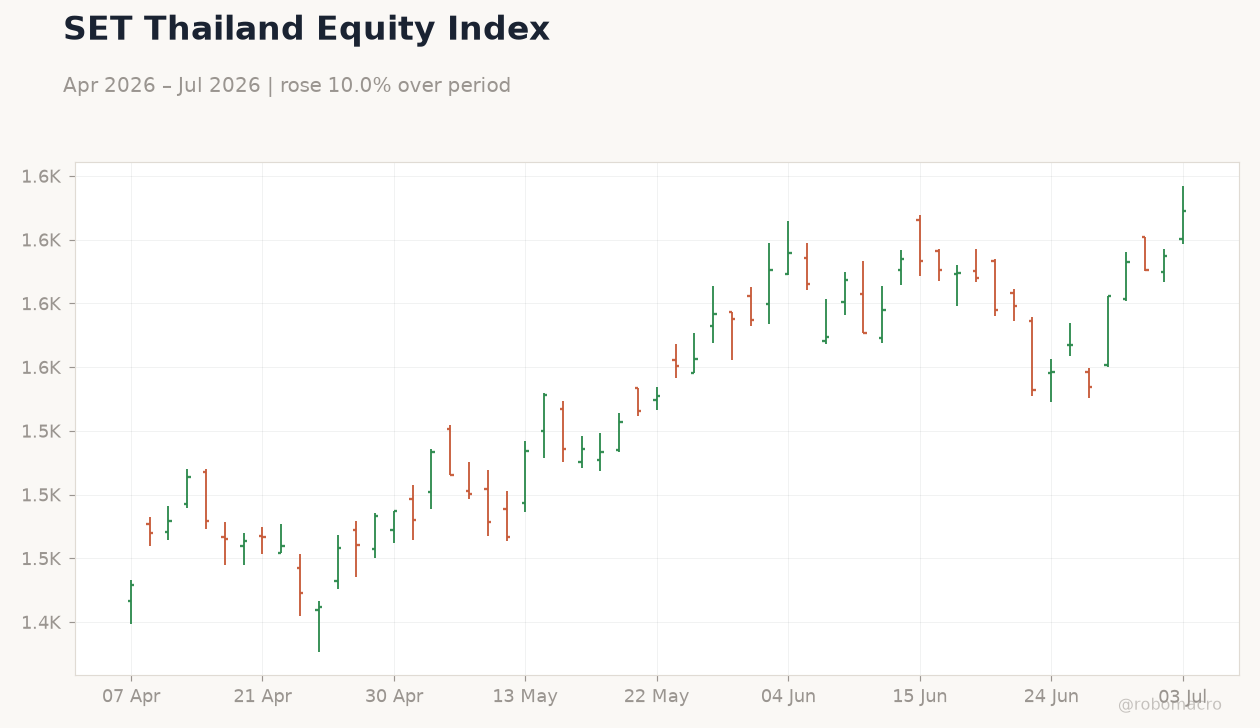
| SET | 1,611.28 | +1.11% |
| KLCI | 1,683.53 | +0.27% |
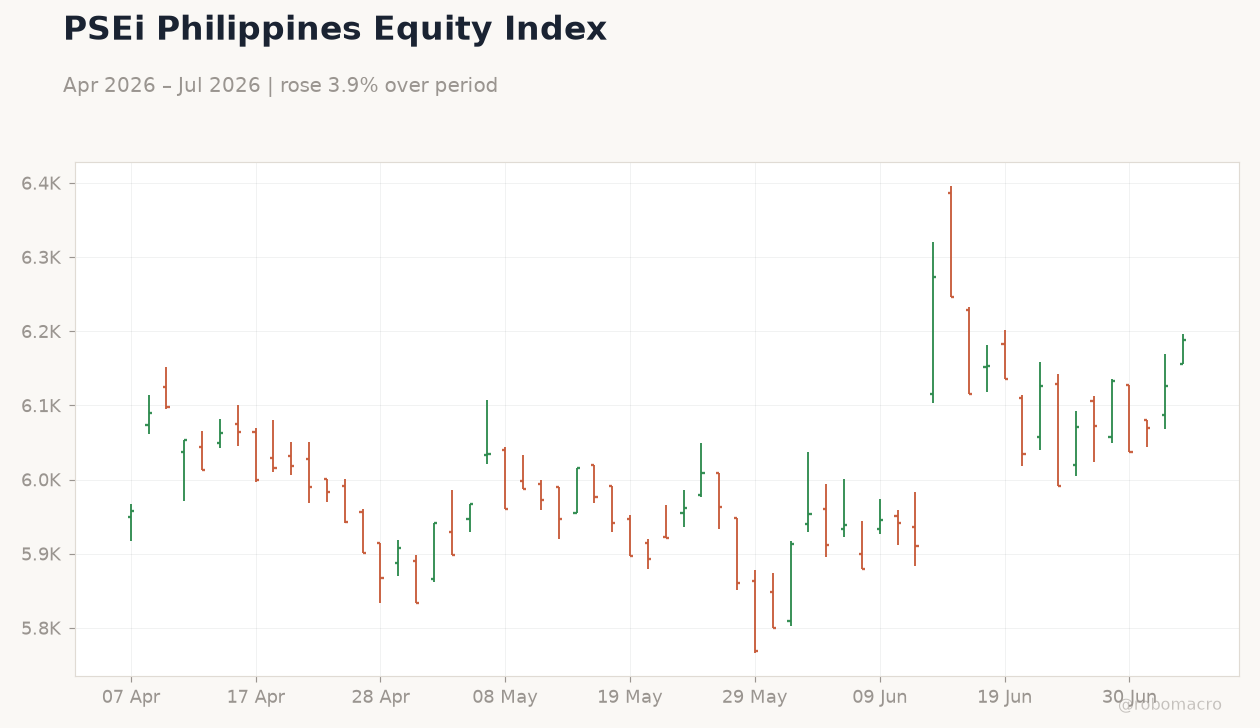
| PSEi | 6,188.03 | +1.02% |
| STI | 5,259.81 | +0.30% |
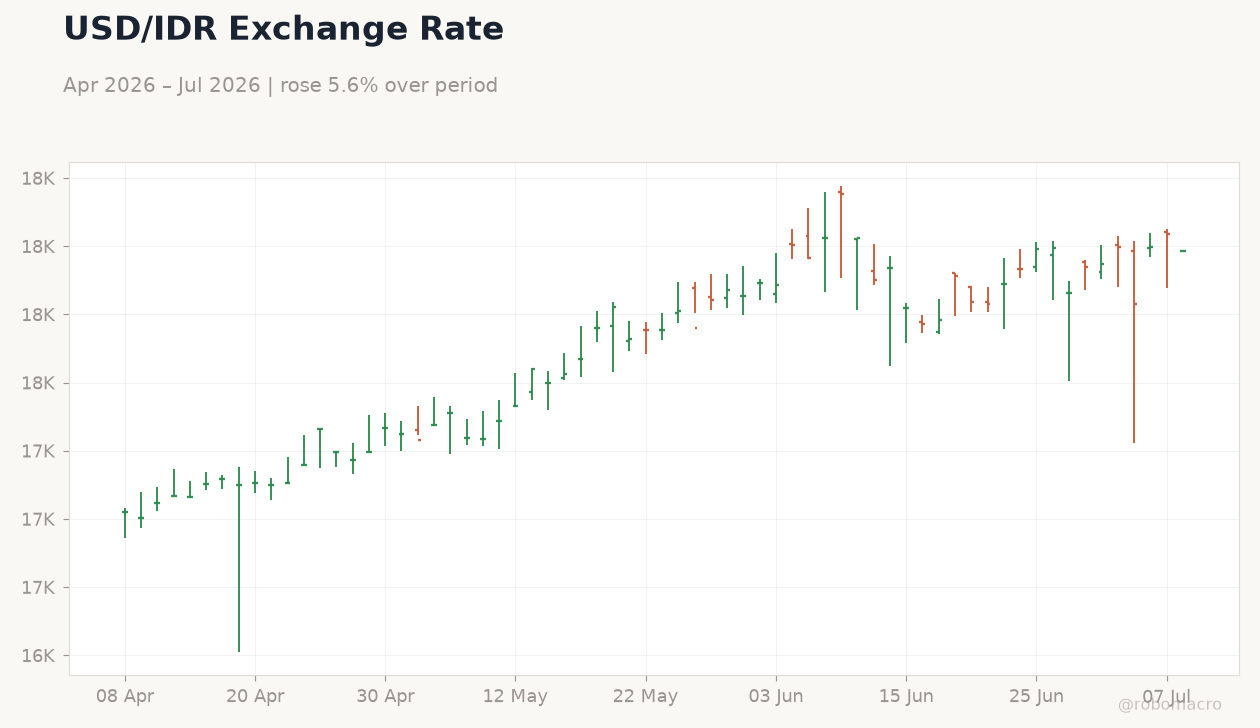
| USD/IDR | 17,983.00 | -0.35% |
| USD/THB | 33.35 | +0.25% |
| USD/MYR | 4.08 | -0.14% |
| USD/PHP | 61.42 | +0.16% |
| USD/SGD | 1.29 | +0.12% |
| Brent Crude | 76.40 | +6.13% |
| Gold | 4,110.90 | -1.06% |
| Bitcoin | 63,590.58 | -0.63% |
| Indonesia 10Y Govt Yield | - | - |
| Thailand 10Y Govt Yield | - | - |
Prior Economic Events
| Data | Prior | Cons | Actual |
|---|---|---|---|
| Inflation Rate Year-over-Year | 6.80 | 6.60 | 6.40 |
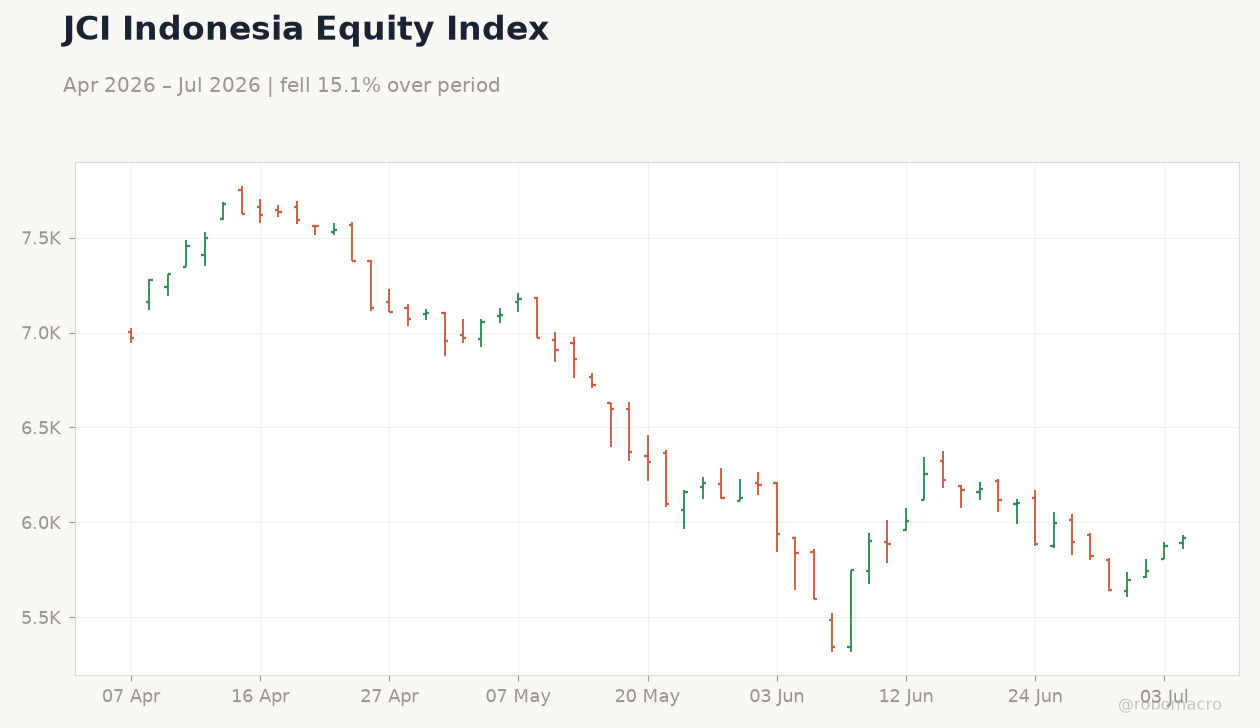 JCI Indonesia Equity Index | Type: market_hloc | Index Level: 5916 (2026-07-06) | Range: 5342–7676 | Trend(6pt): 6971,7107,6318,6008,5876,5916
Today's Economic Events
| Data | Prior | Cons | Time |
|---|---|---|---|
| Headline Unemployment Rate | 4.70 | - | 17:00 |
- Philippine inflation eased to 6.4% y/y in June, below consensus, while equities across ASEAN posted broad gains led by Thailand’s SET.
- Indonesia’s foreign reserves rose to $145.6 billion in June and the rupiah strengthened after Bank Indonesia’s surprise rate hike.
- Malaysia’s ringgit showed resilience amid capital-flow measures, with Brent crude surging 6.13% supporting commodity-linked currencies.
Yesterday's Recap
Philippine June inflation printed 6.4% y/y, softer than the 6.6% consensus and 6.8% prior reading. Regional equities closed higher, with Thailand’s SET rising 1.11% to 1,611.28, the Philippines’ PSEi gaining 1.02% to 6,188.03, and Indonesia’s JCI advancing 0.69% to 5,916.07. The Indonesian rupiah strengthened as USD/IDR fell 0.35% to 17,983 after Bank Indonesia delivered a surprise rate increase, while forex reserves reached $145.6 billion.
Malaysia’s KLCI edged up 0.27% to 1,683.53 and the ringgit firmed 0.14% versus the dollar amid ongoing capital-flow discussions. Singapore’s STI rose 0.30% to 5,259.81. Thailand’s June CPI rose 2.42% y/y, below forecasts.
Indonesia’s economic growth remains among the highest in the G20.
The Day Ahead
The Philippines releases its headline unemployment rate at 17:00 ET, with markets watching for any shift from the prior 4.7% reading that could influence BSP policy timing. No major data releases are scheduled for Indonesia, Thailand, Malaysia, Singapore or Vietnam. Traders will monitor USD/IDR and USD/PHP flows for follow-through from yesterday’s BI decision and Philippine inflation print.
Regional equity futures point to a cautious open ahead of any US data that could alter rate expectations.
Other Economic Notes
Indonesia’s record forex reserves underscore improved external buffers following the BI tightening move. Thailand’s softer CPI print reinforces the case for BoT patience on rates while the economy benefits from tourism recovery. Commodity strength, particularly Brent’s 6.13% jump, offers tailwinds for Indonesia and Malaysia’s export sectors.
Indonesia’s Islamic finance sector remains ripe for continued expansion.
Global Macro News
Hawkish Fed signals cited by Bank Indonesia contributed to selective pressure on ASEAN currencies despite yesterday’s equity gains. Stronger US data expectations have kept Treasury yields elevated, limiting the scope for broad EM rallies. Brent crude’s sharp advance reflects supply concerns that benefit Indonesia and Malaysia as net commodity exporters.
<i>↓ p.2</i>