ASEAN Macro Daily(Beta Mode)
BI Holds at 6% as Equities Advance
Market Snapshot
| Asset | Level | Change |
|---|---|---|
| JCI | 5,924.36 | +0.20% |
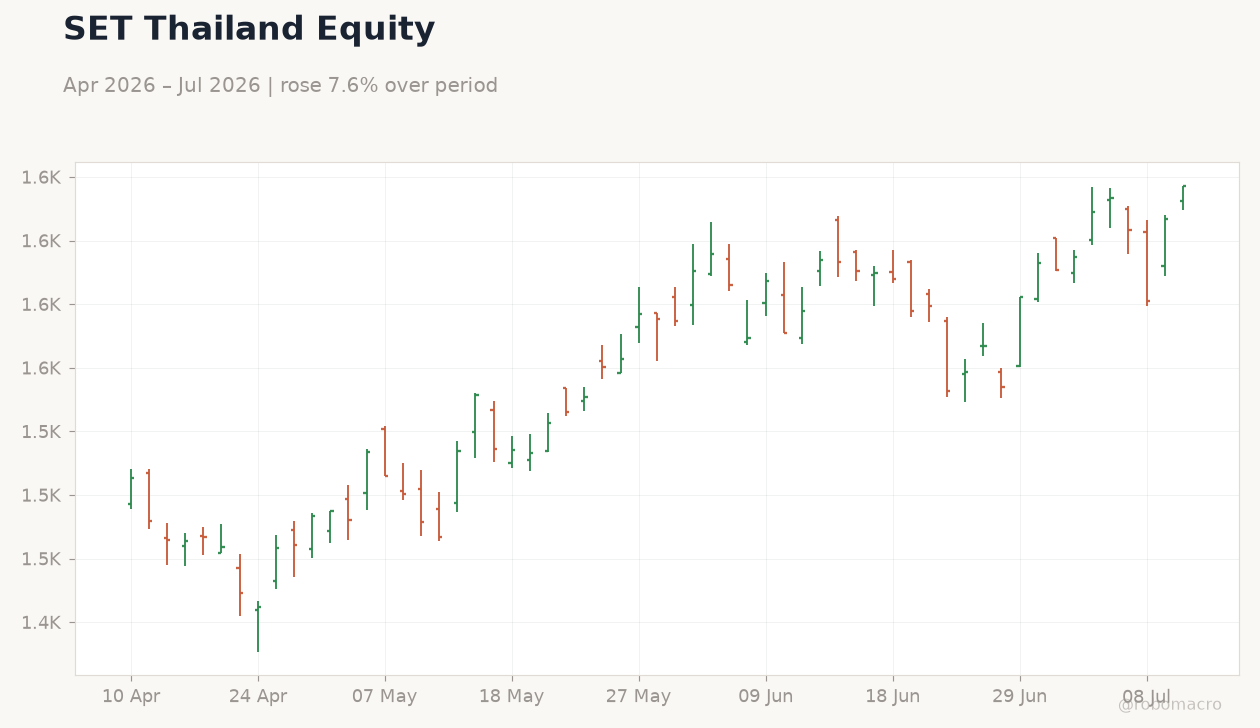
| SET | 1,621.55 | +0.82% |
| KLCI | 1,691.49 | +0.83% |
| PSEi | 6,286.70 | +1.01% |
| STI | 5,469.29 | +0.65% |
| USD/IDR | 18,064.00 | -0.34% |
| USD/THB | 33.24 | -0.36% |
| USD/MYR | 4.07 | -0.19% |
| USD/PHP | 61.50 | +0.30% |
| USD/SGD | 1.29 | +0.06% |
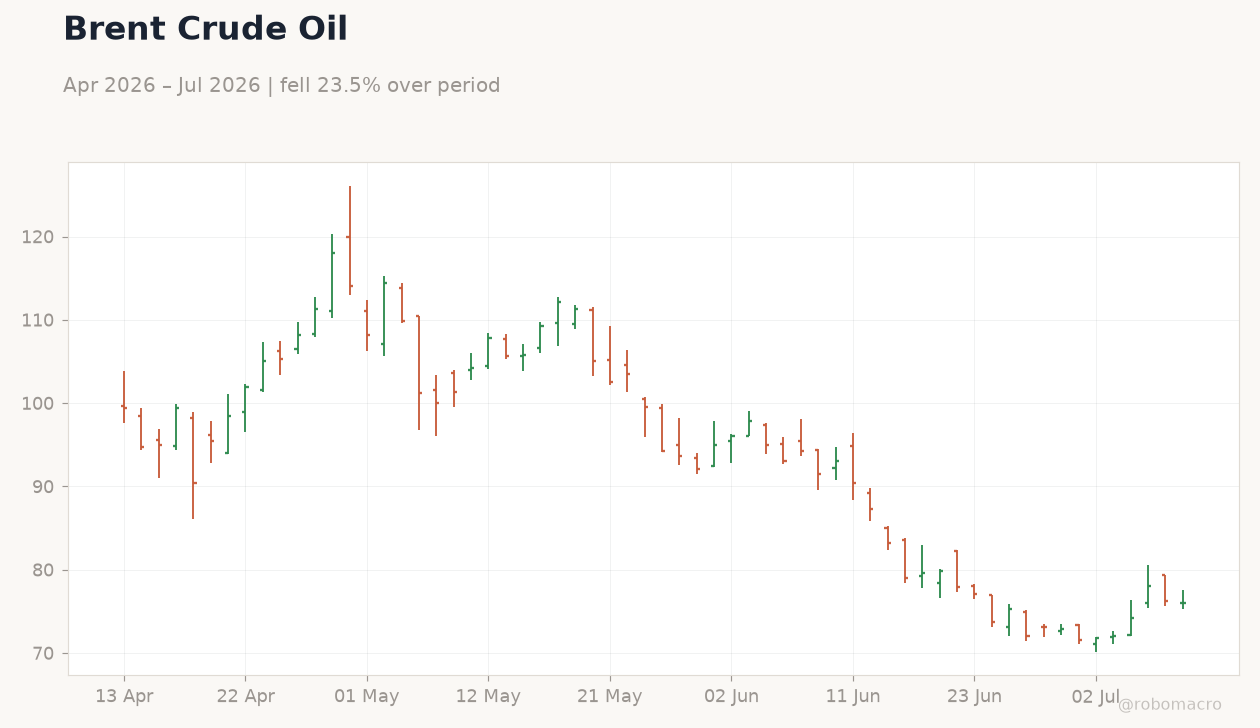
| Brent Crude | 76.01 | -0.38% |
| Gold | 4,113.70 | -0.41% |
| Bitcoin | 63,724.31 | -0.12% |
| Indonesia 10Y Govt Yield | - | - |
| Thailand 10Y Govt Yield | - | - |
Prior Economic Events
| Data | Prior | Cons | Actual |
|---|---|---|---|
| No events available | |||
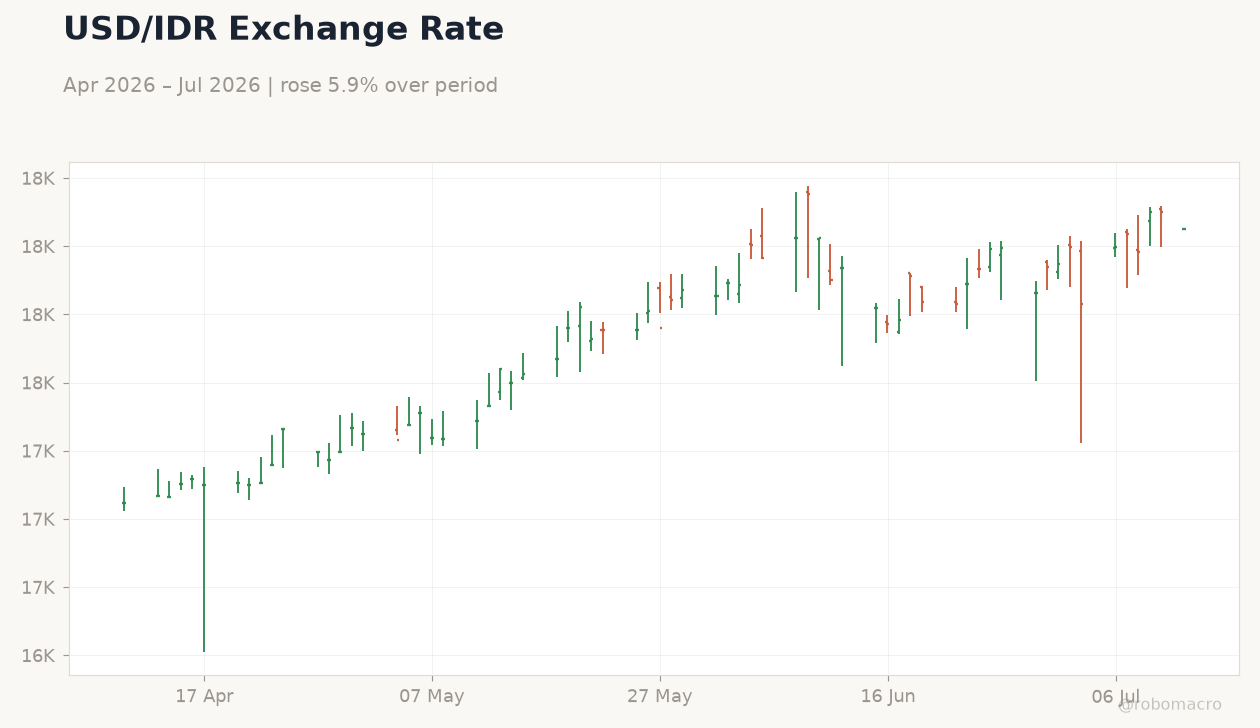 USD/IDR Exchange Rate | Type: market_hloc | Rate: 1.806e+04 (2026-07-12) | Range: 1.706e+04–1.819e+04 | Trend(6pt): 1.706e+04,1.729e+04,1.776e+04,1.773e+04,1.812e+04,1.806e+04
Today's Economic Events
| Data | Prior | Cons | Time |
|---|---|---|---|
| GDP Growth Quarter-over-Quarter Advance Estimate | 1 | - | 20:00 |
| Inflation Rate Month-over-Month | 0.10 | - | 00:00 |
| Inflation Rate Year-over-Year | 2 | - | 00:00 |
- BI holds policy rate at 6% to support rupiah amid persistent weakness risks
- Regional equities rise, led by SET (+0.82%) and KLCI (+0.83%)
- Thailand inflation outlook improves below BoT 2.8% forecast
Yesterday's Recap
ASEAN equity markets closed higher on 11 July, with Indonesia’s JCI rising 0.20% to 5,924.36, Thailand’s SET advancing 0.82% to 1,621.55, Malaysia’s KLCI gaining 0.83% to 1,691.49, the Philippines PSEi climbing 1.01% to 6,286.70, and Singapore’s STI up 0.65% to 5,469.29. Bank Indonesia held its benchmark rate at 6% in July to defend the rupiah, which strengthened 0.34% to 18,064 versus the USD. Thailand’s central bank signaled inflation will likely undershoot its 2.8% 2026 forecast while describing growth as “not good” yet resilient to external shocks.
Malaysia’s ringgit firmed 0.19% to 4.07 per USD as safe-haven demand for the greenback eased. Indonesia retail sentiment continued to weaken amid slower consumer spending and fiscal pressures from the free-meal program. No major data releases occurred across the six economies on 11 July.
The Day Ahead
Singapore will release its GDP growth quarter-over-quarter advance estimate on 13 July at 20:00 ET. Malaysia is scheduled to publish both month-over-month and year-over-year inflation figures on 17 July. Market participants will monitor any follow-through comments from Bank Indonesia on rupiah stabilization measures.
Thailand’s ongoing scrutiny of large USDT transactions and proof-of-funds rules for cash deposits may generate further regulatory headlines. No other high-impact releases are flagged for the Philippines or Vietnam this week.
Other Economic Notes
Indonesia faces Q1 2026 headwinds from fuel-price increases and cooling retail demand, with recovery now eyed for Q3. Thailand’s central bank is tightening oversight of unregulated buy-now-pay-later lending and shadow-economy flows through stablecoins. Malaysia’s BNM remains more optimistic than the finance ministry on 2026 GDP, placing growth in the upper half of the 4-5% range.
Regional FDI and electronics supply-chain shifts continue to favor Vietnam, while Singapore’s NODX electronics data point to uneven recovery. Commodity prices, with Brent at 76.01, provide modest support to Indonesia’s terms of trade.
Global Macro News
Global risk appetite shifted toward emerging markets, lifting several ASEAN currencies against the USD. The Indonesian rupiah benefited most, while the Philippine peso edged 0.30% weaker to 61.50. <i>↓ p.2</i>