ASEAN Macro Daily(Beta Mode)
BI Holds, Rupiah Weakens on Risk Aversion
Market Snapshot
| Asset | Level | Change |
|---|---|---|
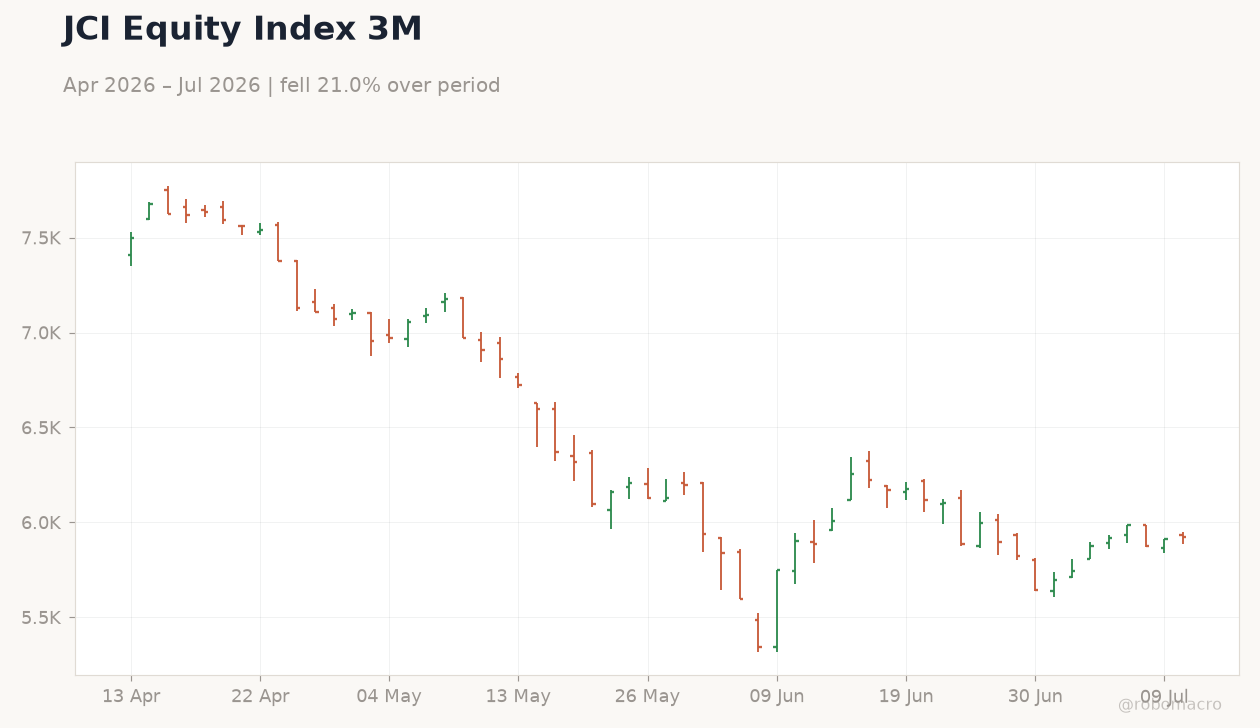
| JCI | 5,924.36 | +0.20% |
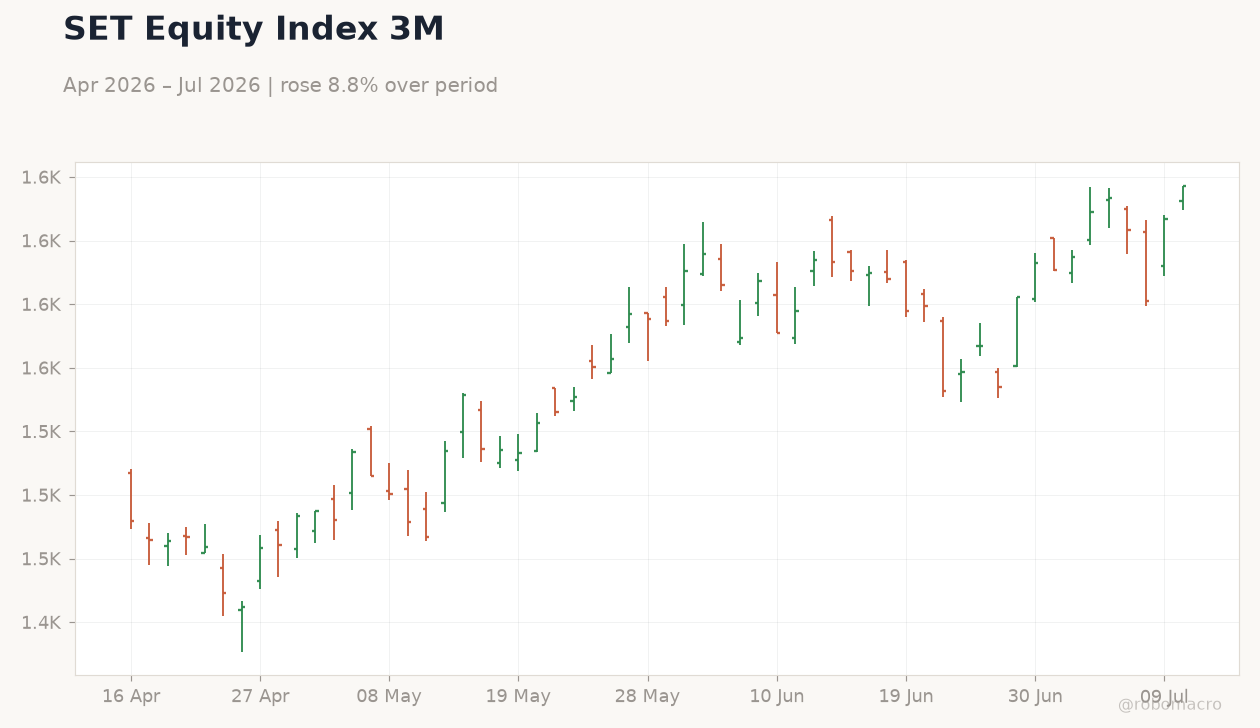
| SET | 1,621.55 | +0.82% |
| KLCI | 1,691.49 | +0.83% |
| PSEi | 6,286.70 | +1.01% |
| STI | 5,469.29 | +0.65% |
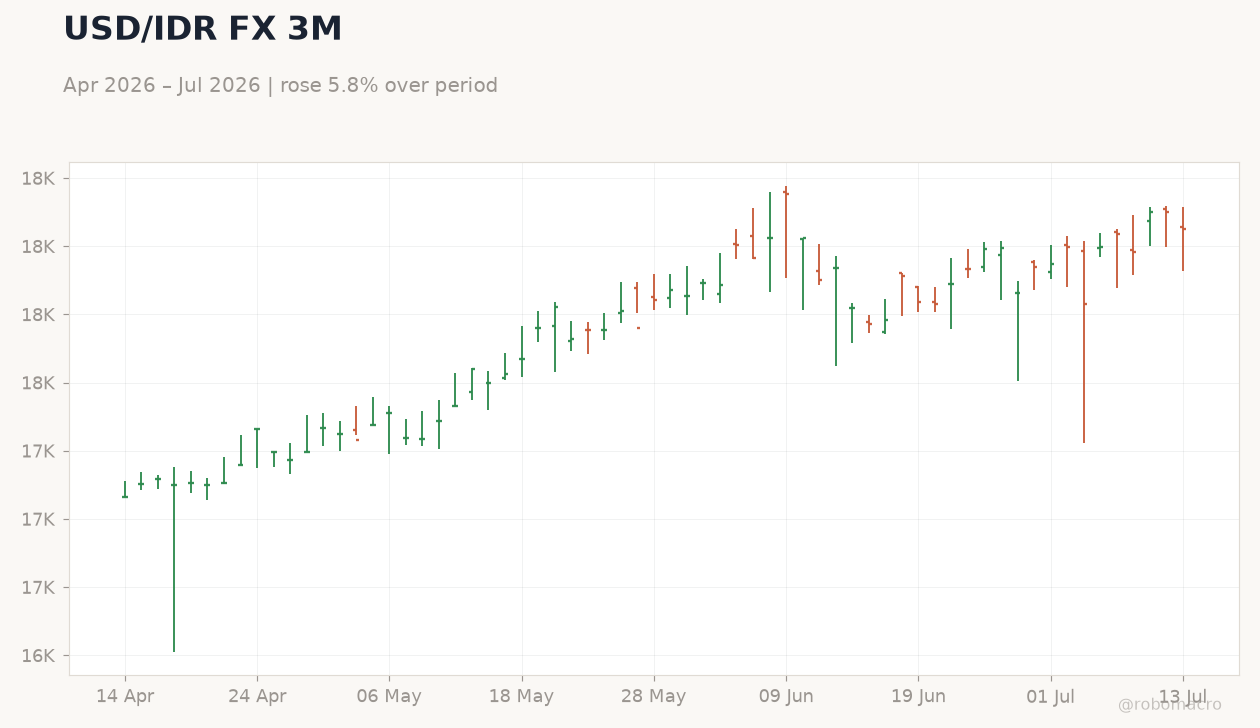
| USD/IDR | 18,065.00 | -0.33% |
| USD/THB | 33.47 | +0.42% |
| USD/MYR | 4.07 | -0.10% |
| USD/PHP | 61.55 | +0.07% |
| USD/SGD | 1.29 | +0.15% |
| Brent Crude | 83.67 | +10.08% |
| Gold | 4,010.40 | -2.28% |
| Bitcoin | 61,840.72 | -3.01% |
| Indonesia 10Y Govt Yield | - | - |
| Thailand 10Y Govt Yield | - | - |
Prior Economic Events
| Data | Prior | Cons | Actual |
|---|---|---|---|
| No events available | |||
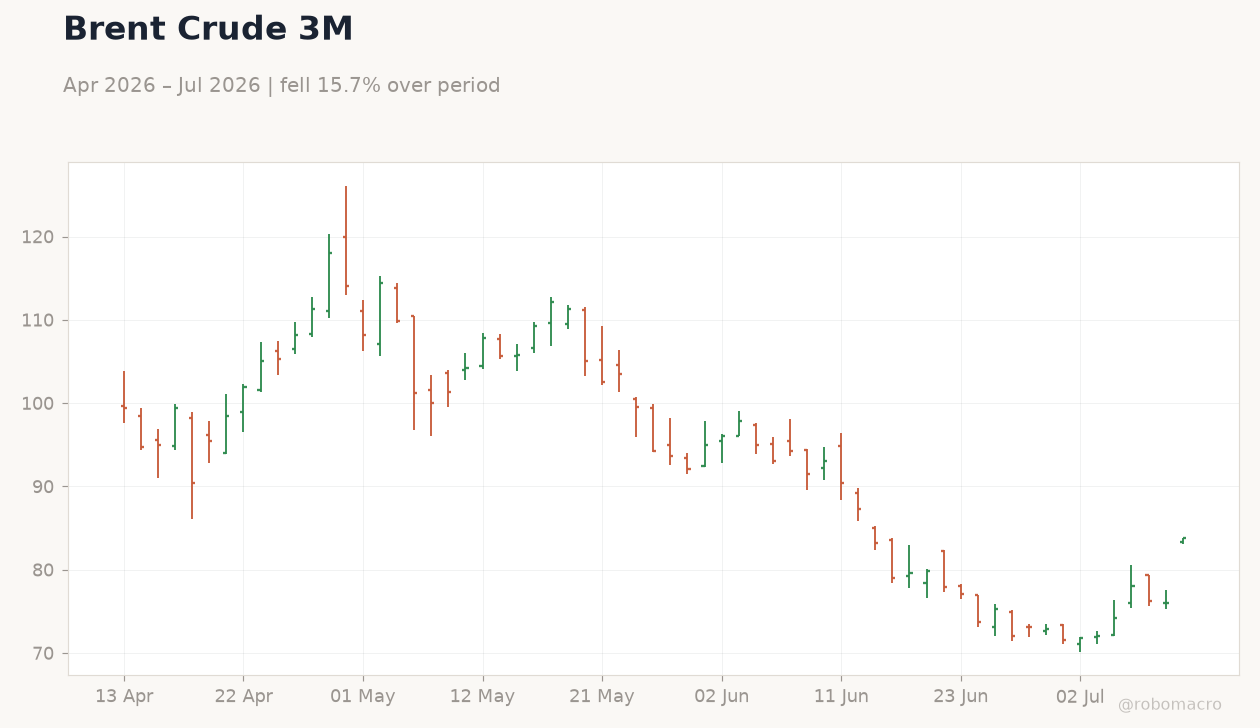 Brent Crude 3M | Type: market_hloc | Brent $/bbl: 83.78 (2026-07-13) | Range: 71.57–118 | Trend(6pt): 99.36,114.4,99.58,78.96,76.3,83.78
Today's Economic Events
| Data | Prior | Cons | Time |
|---|---|---|---|
| GDP Growth Quarter-over-Quarter Advance Estimate | 1 | 1.10 | 16:00 |
| Inflation Rate Month-over-Month | 0.10 | - | 20:00 |
| Inflation Rate Year-over-Year | 2 | 2 | 20:00 |
- Bank Indonesia held its policy rate at 6% to defend the rupiah amid global risk aversion.
- Regional equities rose across ASEAN with PSEi leading gains of 1.01% on remittance strength.
- Singapore GDP advance estimate due today while Malaysia inflation data follows on July 16.
Yesterday's Recap
ASEAN equity markets posted broad gains on July 12 despite thin economic data releases. Indonesia’s JCI advanced 0.20% to 5,924.36 while the rupiah strengthened 0.33% to 18,065 per dollar after Bank Indonesia reiterated its “all-out” commitment to rupiah stability. Thailand’s SET climbed 0.82% to 1,621.55 and the baht weakened 0.42% to 33.47 as the Bank of Thailand flagged abnormal stablecoin flows and prepared proof-of-funds rules for large cash deposits.
Malaysia’s KLCI rose 0.83% to 1,691.49 with the ringgit edging 0.10% stronger to 4.07. The Philippines’ PSEi gained 1.01% to 6,286.70 while Singapore’s STI added 0.65% to 5,469.29. Brent crude surged 10.08% to 83.67 on supply concerns, lifting commodity-linked currencies and equities across the region.
Indonesia’s 10-year benchmark yield was unchanged amid the volatility.
The Day Ahead
Singapore will release its Q2 GDP advance estimate at 16:00 ET today with consensus pointing to a 1.1% quarter-on-quarter expansion. Malaysia is scheduled to publish June inflation figures on July 16 evening, with year-over-year consensus at 2.0% and month-over-month data expected to remain subdued. No major releases are listed for Indonesia, Thailand, the Philippines or Vietnam over the next 24 hours.
Traders will monitor Bank Indonesia’s ongoing rupiah interventions and any signals from the Bank of Thailand on stablecoin oversight. Regional FX desks remain focused on USD strength and potential spillovers from global risk sentiment into ASEAN capital flows.
Other Economic Notes
Indonesia’s economy faces near-term headwinds from fiscal pressures and fuel-price adjustments that are cooling retail demand, though officials project a recovery in the third quarter. Malaysia’s central bank remains more upbeat than the finance ministry on 2026 growth prospects, citing potential outcomes in the upper half of the 4-5% range. Thailand continues to target shadow-economy activity through tighter oversight of large USDT transfers and unregulated buy-now-pay-later lending.
Supply-chain shifts continue to favor Vietnam’s electronics exports while Malaysia’s semiconductor shipments also expanded year-over-year. Commodity price volatility, especially the sharp move in Brent, is transmitting directly into inflation and trade balances across the commodity exporters.