ASEAN Macro Daily(Beta Mode)
BI Holds at 5.75%, Defying Hike Bets
Market Snapshot
| Asset | Level | Change |
|---|---|---|
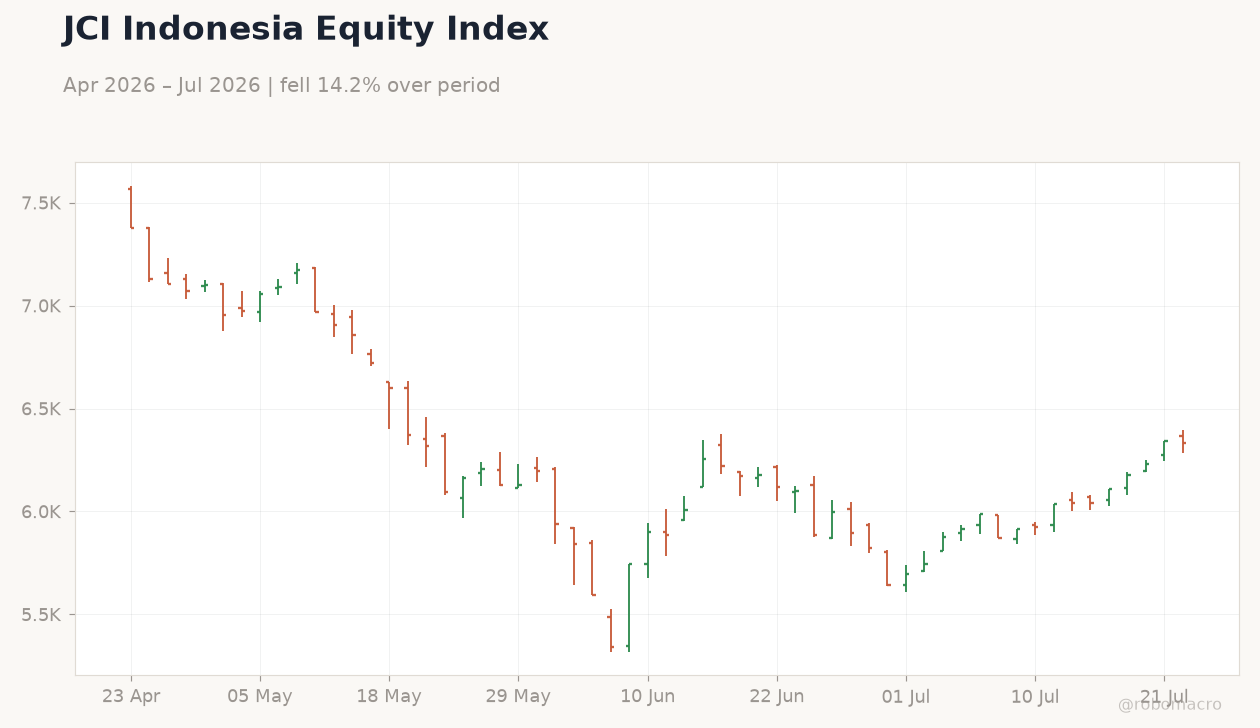
| JCI | 6,334.48 | -0.09% |
| SET | 1,639.04 | +0.23% |
| KLCI | 1,711.37 | -0.52% |
| PSEi | 6,404.11 | +1.25% |
| STI | 5,595.42 | +1.24% |
| USD/IDR | 17,910.00 | -0.01% |
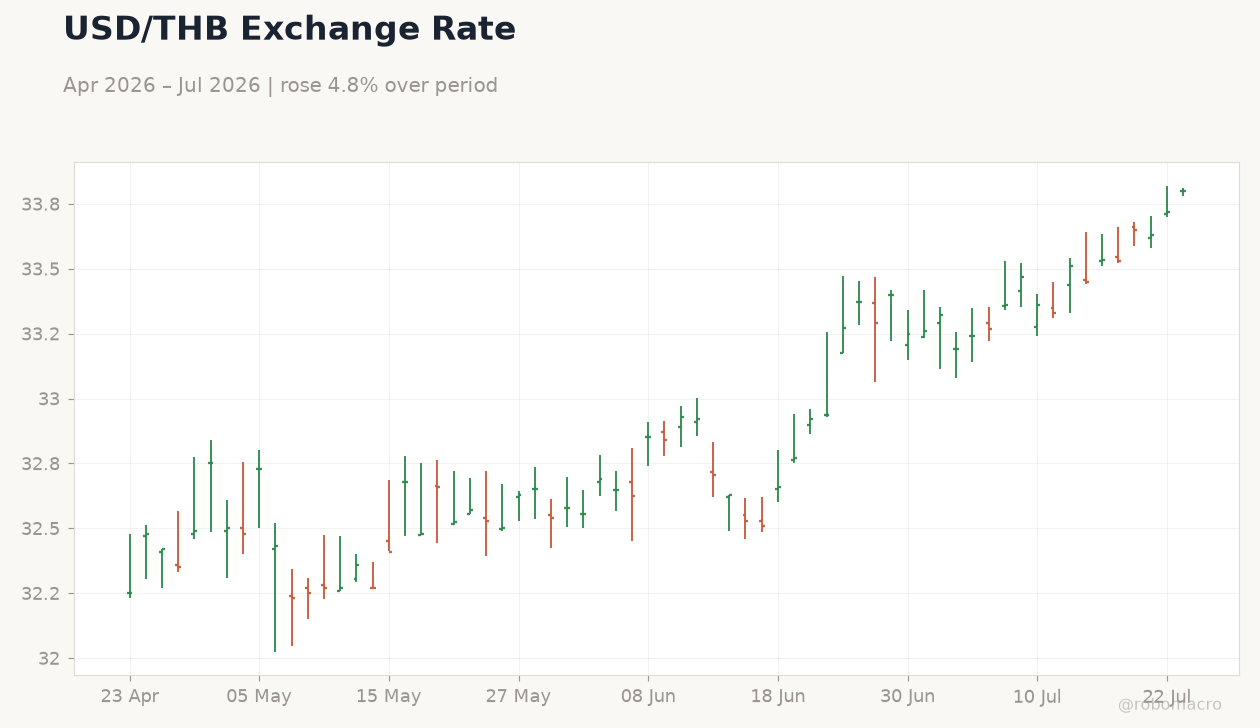
| USD/THB | 33.80 | +0.24% |
| USD/MYR | 4.09 | +0.01% |
| USD/PHP | 61.70 | +0.02% |
| USD/SGD | 1.29 | +0.06% |
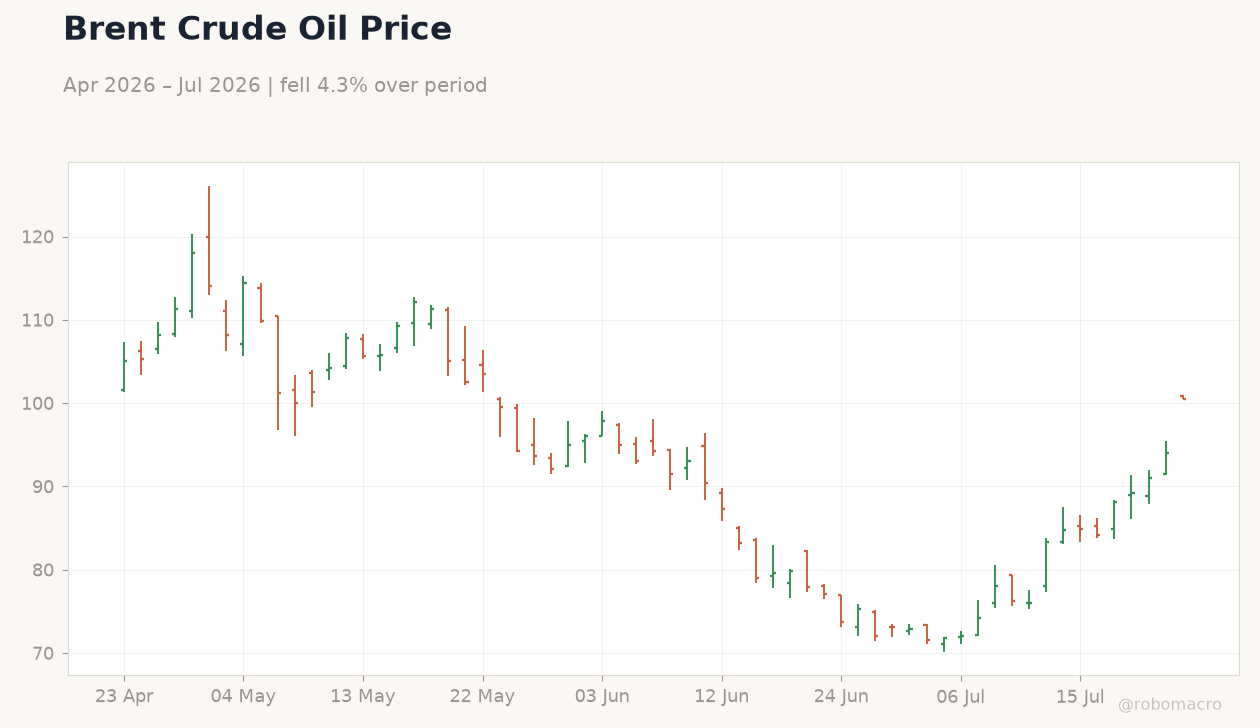
| Brent Crude | 100.54 | +6.88% |
| Gold | 4,052.50 | -2.28% |
| Bitcoin | 65,123.78 | -1.48% |
| Indonesia 10Y Govt Yield | - | - |
| Thailand 10Y Govt Yield | - | - |
Prior Economic Events
| Data | Prior | Cons | Actual |
|---|---|---|---|
| Central Bank Interest Rate Decision | 5.75 | 6 | 5.75 |
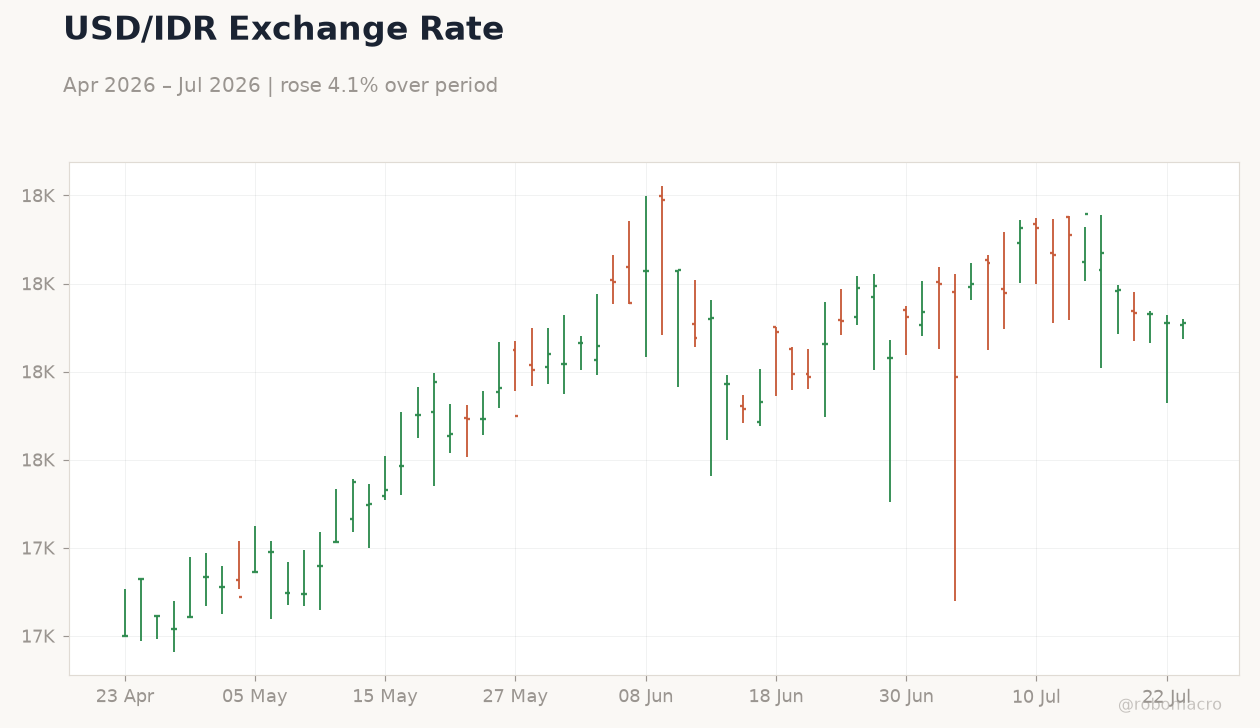 USD/IDR Exchange Rate | Type: market_hloc | USD/IDR: 1.791e+04 (2026-07-23) | Range: 1.72e+04–1.819e+04 | Trend(6pt): 1.72e+04,1.753e+04,1.803e+04,1.792e+04,1.791e+04,1.791e+04
Today's Economic Events
| Data | Prior | Cons | Time |
|---|---|---|---|
| No events available | |||
- Bank Indonesia holds policy rate at 5.75% despite market expectations for a hike to support the rupiah.
- Regional equities mixed as STI and PSEi rise over 1% while KLCI declines 0.52%.
- Brent crude jumps 6.88% to $100.54, adding pressure on ASEAN import-dependent economies.
Yesterday's Recap
Bank Indonesia kept its benchmark rate unchanged at 5.75%, defying consensus forecasts for a 25bp hike. The decision triggered immediate rupiah weakness, with USD/IDR ending at 17,910.00. Coordinated FX interventions and liquidity measures helped stabilize the currency later in the session.
Thailand’s baht weakened to a 15-month low amid rising oil prices and portfolio outflows. Malaysia’s foreign reserves slipped to $131.8 billion as of mid-July. The Philippines’ PSEi gained 1.25% on positive sentiment, while Singapore’s STI rose 1.24%.
Indonesia’s JCI closed marginally lower at 6,334.48. Thailand’s SET edged up 0.23% to 1,639.04, while Malaysia’s KLCI fell 0.52% to 1,711.37. USD/THB rose 0.24% to 33.80 and USD/MYR ticked up 0.01% to 4.09.
USD/PHP gained 0.02% to 61.70 and USD/SGD advanced 0.06% to 1.29. Gold fell 2.28% to 4,052.50 and Bitcoin declined 1.48% to 65,123.78.
The Day Ahead
No high-impact data releases are scheduled across the six ASEAN economies today. Markets will monitor follow-through flows after Bank Indonesia’s surprise hold and any further FX intervention signals. Thailand’s ongoing discussions on cash limits for gold trading may influence baht volatility.
Investors will also track regional responses to the sharp rise in Brent crude, which could widen current-account pressures in Indonesia, Thailand and the Philippines. MAS is expected to maintain its current SGD NEER policy band absent major external shocks. Thailand’s FDI applications surged 80% to $40.6 billion in the first half, led by AI-related semiconductor projects, while Malaysia’s semiconductor exports grew 12% year-on-year.
The Philippines approved MariBank’s upgrade to a full digital banking license.
Other Economic Notes
Thailand recorded an 80% surge in FDI applications to $40.6 billion in the first half, driven by AI-related semiconductor projects. Malaysia’s manufacturing sector showed resilience with semiconductor exports rising 12% year-on-year. The Philippines approved MariBank’s upgrade to a full digital banking license, supporting financial inclusion.
<i>↓ p.2</i>