ASEAN Macro Daily(Beta Mode)
BI Holds Rate, Singapore MPS in Focus
Market Snapshot
| Asset | Level | Change |
|---|---|---|
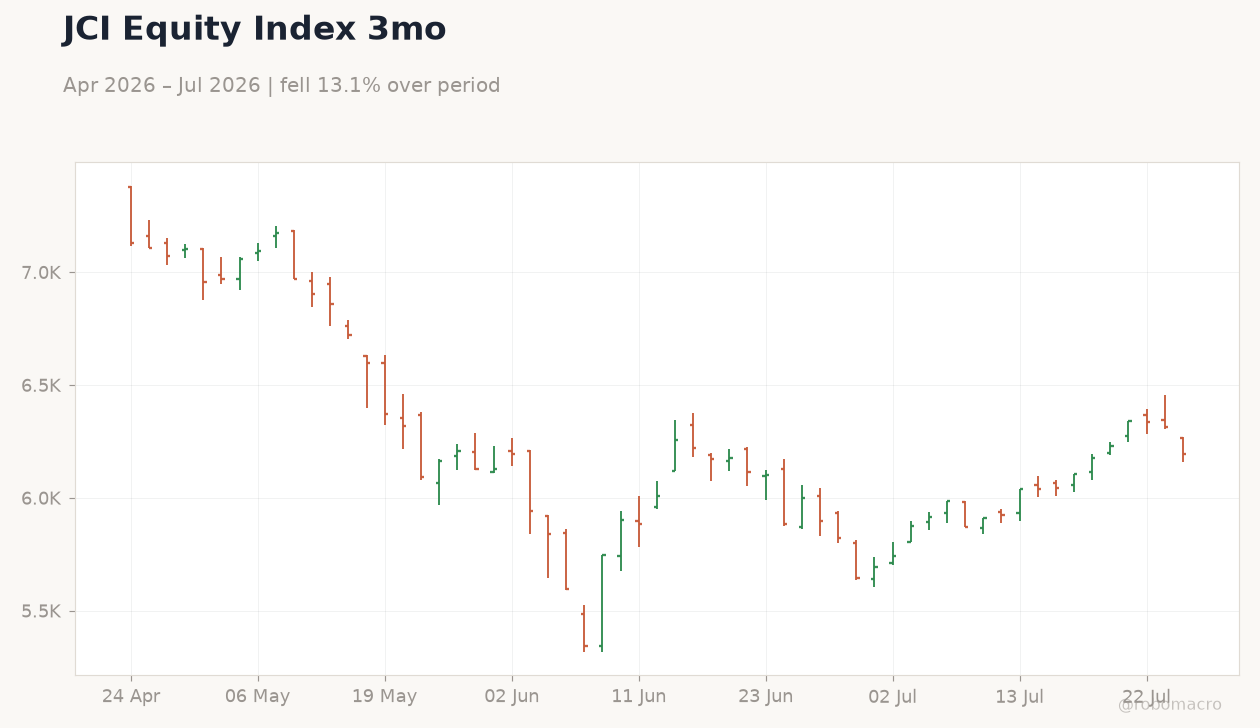
| JCI | 6,196.43 | -1.88% |
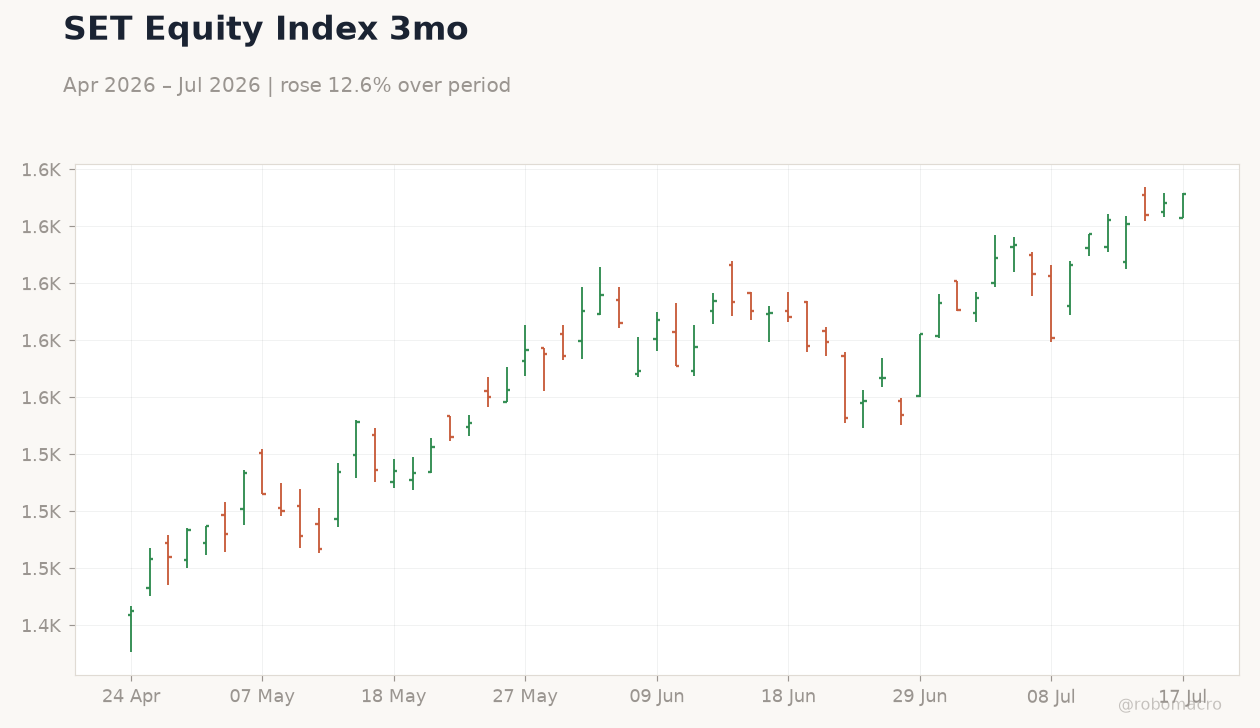
| SET | 1,639.04 | +0.23% |
| KLCI | 1,701.02 | -0.79% |
| PSEi | 6,404.11 | +1.25% |
| STI | 5,588.34 | +0.12% |
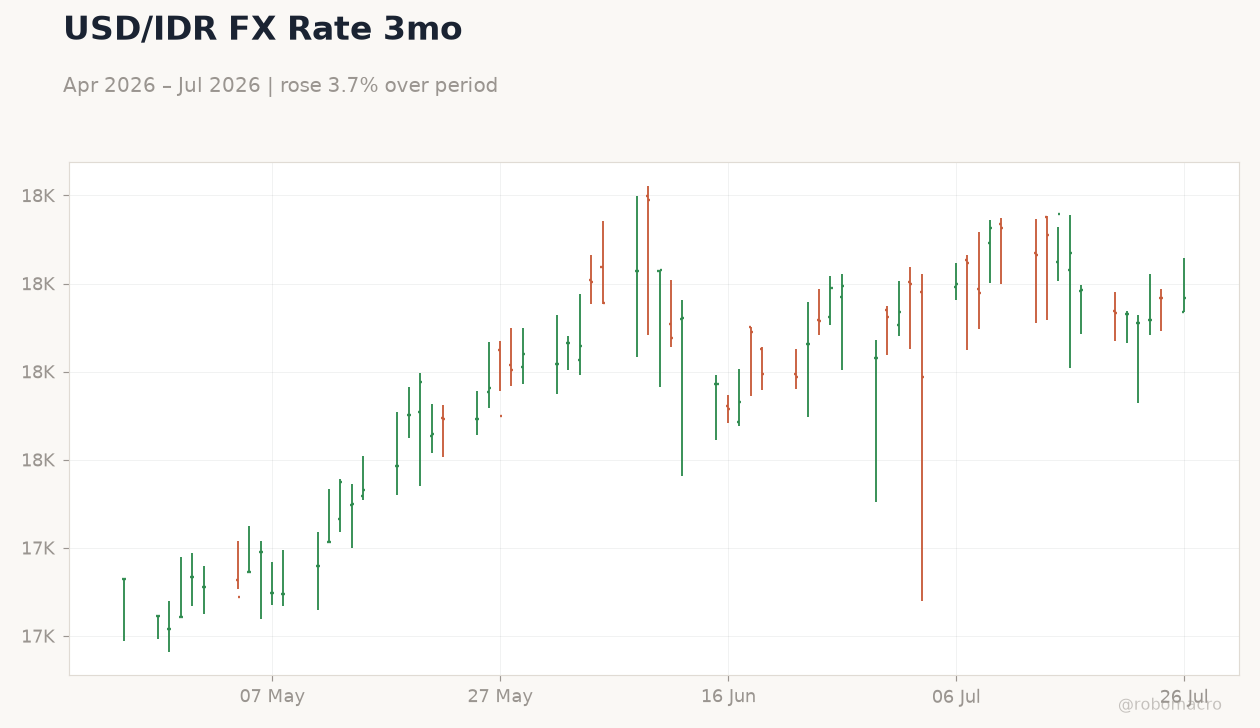
| USD/IDR | 17,968.00 | +0.01% |
| USD/THB | 33.66 | -0.50% |
| USD/MYR | 4.09 | +0.06% |
| USD/PHP | 61.71 | +0.16% |
| USD/SGD | 1.29 | -0.27% |
| Brent Crude | 96.78 | -3.88% |
| Gold | 4,070.80 | +0.60% |
| Bitcoin | 65,133.94 | +1.28% |
| Indonesia 10Y Govt Yield | - | - |
| Thailand 10Y Govt Yield | - | - |
Prior Economic Events
| Data | Prior | Cons | Actual |
|---|---|---|---|
| No events available | |||
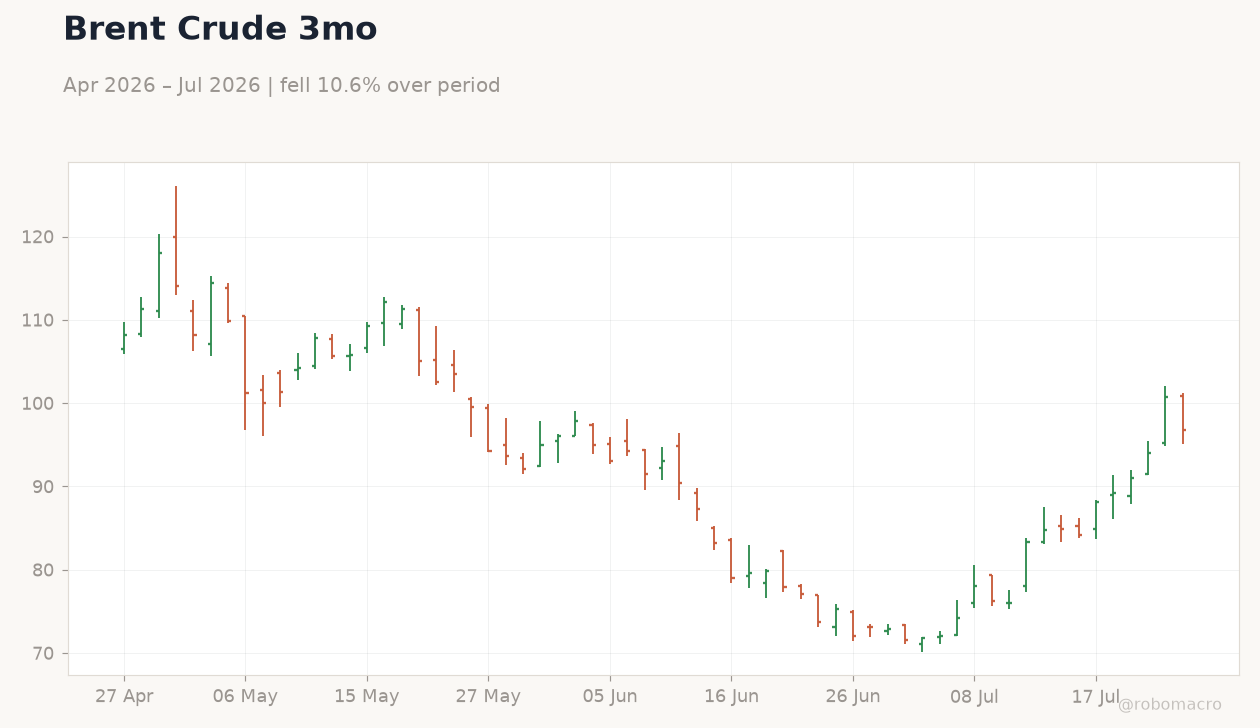 Brent Crude 3mo | Type: market_hloc | USD per Barrel: 96.78 (2026-07-24) | Range: 71.57–118 | Trend(6pt): 108.2,112.1,91.45,71.57,100.7,96.78
Today's Economic Events
| Data | Prior | Cons | Time |
|---|---|---|---|
| Monetary Policy Statement | - | - | 20:00 |
| Monday (2026-07-27) | |||
| Monetary Policy Statement | - | - | 20:00 |
- Bank Indonesia holds BI rate at 5.75% in hawkish pause to support rupiah.
- Singapore central bank set to issue monetary policy statement on mild inflation.
- Thailand raises 2026 growth forecast to 2.5% after June exports beat estimates.
Yesterday's Recap
Bank Indonesia kept its policy rate unchanged at 5.75%, a decision markets interpreted as hawkish given persistent rupiah weakness and external risks, with UOB analysts flagging potential for further tightening if capital outflows intensify. The rupiah advanced modestly against a softer US dollar despite rising risk aversion, closing near 17,968 per USD while USD/THB eased 0.50% to 33.66. Equity markets diverged across the region, with Indonesia’s JCI dropping 1.88% to 6,196.43 on profit-taking after recent commodity gains, while the Philippines’ PSEi climbed 1.25% to 6,404.11 and Thailand’s SET rose 0.23%.
Thailand’s finance ministry upgraded its 2026 GDP forecast to 2.5% from 1.6%, citing stronger foreign demand and export momentum. Brent crude fell 3.88% to 96.78, providing relief to import-dependent ASEAN economies. Singapore’s STI posted a modest 0.12% gain to 5,588.34 as investors positioned ahead of the MAS statement.
Malaysia’s KLCI slipped 0.79% amid thin regional flows. Indonesia’s palm-oil and nickel exports supported commodity sentiment even as JCI saw profit-taking, while Malaysia’s semiconductor exports rose 11% y/y in June.
The Day Ahead
Singapore’s Monetary Authority will release its monetary policy statement this evening, with expectations centered on a hold in the S$NEER band amid contained inflation and steady growth. Market participants will watch for any signals on future tightening if imported cost pressures from oil re-emerge. Thailand’s latest trade and tourism data releases could reinforce the upgraded growth outlook.
No major releases are scheduled for Indonesia, Malaysia or the Philippines, leaving focus on external drivers such as US tariff announcements. Regional FX desks will monitor USD/IDR and USD/SGD moves for signs of intervention by BI or MAS. Investors also await any updates on Vietnam’s FDI inflows and manufacturing PMI trends.
Thailand’s tourism receipts in the first 20 days of July ran 18% above the same period in 2025, supporting the BoT’s growth forecast, while Malaysia’s data-centre build-out faces resource constraints.
Other Economic Notes
ASEAN economies face divergent external pressures, with Indonesia’s commodity exporters benefiting from firm palm-oil and nickel demand while Thailand and Malaysia absorb higher energy costs. <i>↓ p.2</i>