| Asset | Level | Change |
|---|---|---|
| JCI | 6,196.43 | -1.88% |
| SET | 1,639.04 | +0.23% |
| KLCI | 1,701.02 | -0.79% |
| PSEi | 6,404.11 | +1.25% |
| STI | 5,588.34 | +0.12% |
| USD/IDR | 17,958.00 | -0.05% |
| USD/THB | 33.61 | +0.00% |
| USD/MYR | 4.09 | +0.08% |
| USD/PHP | 61.70 | +0.14% |
| USD/SGD | 1.29 | +0.16% |
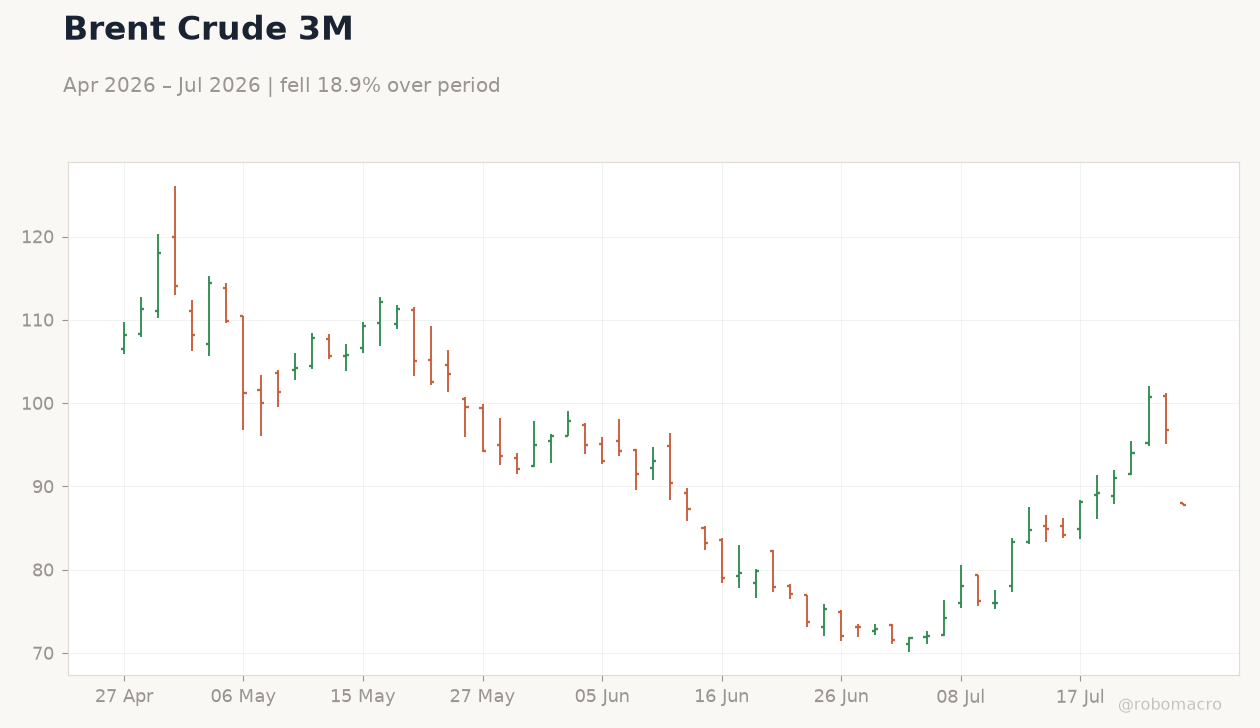
| Brent Crude | 87.76 | -9.32% |
| Gold | 4,075.20 | +0.19% |
| Bitcoin | 63,644.07 | -2.60% |
| Indonesia 10Y Govt Yield | - | - |
| Thailand 10Y Govt Yield | - | - |
| Data | Prior | Cons | Actual |
|---|---|---|---|
| No events available | |||
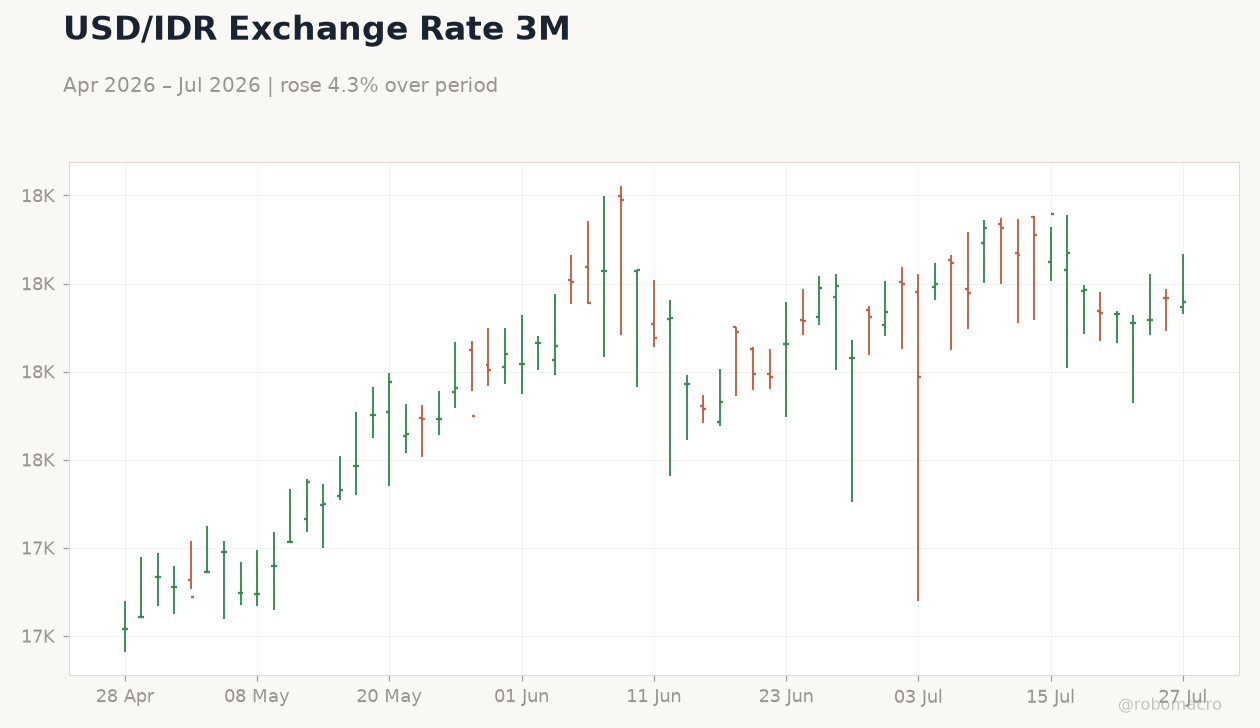
USD/IDR Exchange Rate 3M | Type: market_hloc | Rate: 1.796e+04 (2026-07-27) | Range: 1.722e+04–1.819e+04 | Trend(5pt): 1.722e+04,1.778e+04,1.788e+04,1.779e+04,1.796e+04
| Data | Prior | Cons | Time |
|---|---|---|---|
| Trade Balance | -1,610m | - | 00:00 |
| Inflation Rate Year-over-Year | 3.34 | - | 00:00 |
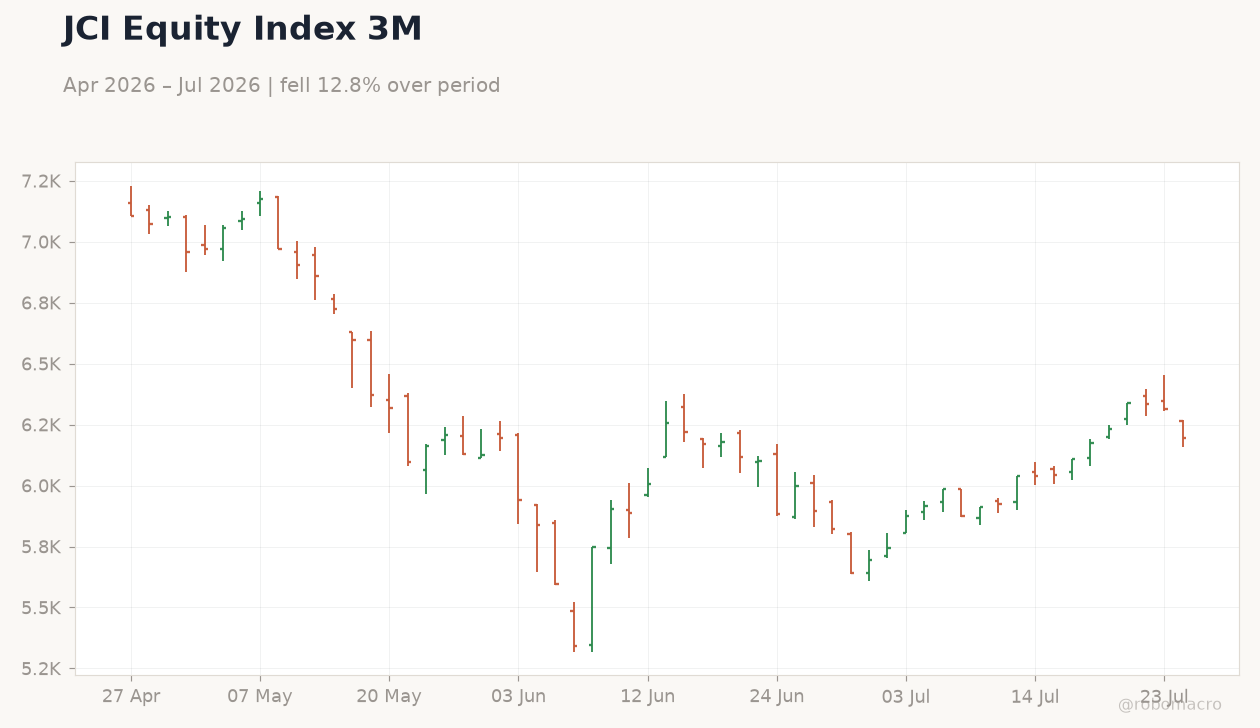
Indonesia dominated ASEAN news flow as Bank Indonesia governor Perry Warjiyo stepped down suddenly, triggering immediate questions over central bank independence and rupiah stability. The central bank held its policy rate at 5.75%, a decision markets interpreted as hawkish given persistent currency weakness at USD/IDR 17,958. Equity markets reflected the uncertainty, with the JCI falling 1.88% to 6,196.43 while the rupiah posted a modest 0.05% gain against the dollar.
Thailand saw the SET index edge 0.23% higher to 1,639.04 amid reports that the government may scrap its $30 billion land bridge project over economic viability concerns. Malaysia’s KLCI declined 0.79% to 1,701.02 as resource constraints weighed on data-centre expansion plans. The Philippines PSEi outperformed with a 1.25% gain to 6,404.11, supported by resilient remittances.
Singapore’s STI advanced 0.12% to 5,588.34 as MAS unexpectedly tightened its exchange-rate policy band to combat inflation. Brent crude’s 9.32% drop to 87.76 added downside pressure across commodity-linked ASEAN currencies. Thailand raised its 2026 growth forecast to 2.5% after June exports beat expectations, while remaining on the US Treasury currency monitoring list.
US tariffs of up to 12.5% on top trading partners including Thailand and Malaysia add external headwinds.
Indonesia’s August 3 trade balance and July inflation prints will provide the next key data points for assessing external balances and price pressures. Markets will watch whether the inflation reading stays near the prior 3.34% year-over-year pace or accelerates further. No major releases are scheduled for Thailand, Malaysia, the Philippines, Singapore or Vietnam on the immediate horizon.
Regional investors will also monitor any official statements clarifying the succession process at Bank Indonesia. Capital-flow data and reserve adequacy metrics are likely to receive heightened scrutiny following the governor’s departure. Thailand’s potential abandonment of the land-bridge megaproject removes a fiscal drag but highlights execution risks for large infrastructure plans.
Commodity price volatility, illustrated by Brent’s sharp decline, poses asymmetric risks for Indonesia’s export revenues and Malaysia’s energy sector.
Subscribe to ASEAN Macro Daily and get each new issue delivered to your inbox.
Already a member? Visit robomacro.com to log in and manage subscriptions, or use Forgot Password to set a password.
Brent Crude 3M | Type: market_hloc | USD/bbl: 87.76 (2026-07-27) | Range: 71.57–118 | Trend(6pt): 108.2,112.1,91.45,71.57,100.7,87.76
JCI Equity Index 3M | Type: market_hloc | Index: 6196 (2026-07-24) | Range: 5342–7174 | Trend(6pt): 7107,6318,6008,5876,6315,6196
Supply-chain diversification away from China continues to benefit Vietnam and Malaysia, with electronics and semiconductor shipments showing sustained momentum. Thailand’s decision to abandon the land-bridge megaproject removes a potential fiscal drag but highlights execution risks for large infrastructure plans. Commodity price volatility, illustrated by Brent’s sharp decline, poses asymmetric risks for Indonesia’s export revenues and Malaysia’s energy sector.
Regional growth forecasts remain sensitive to US tariff actions scheduled to affect multiple ASEAN trading partners. Capital-flow management tools are likely to stay in focus as central banks navigate divergent domestic and external pressures. Malaysia faces intensifying scrutiny over resource constraints despite leading the region in data-centre build-out.
The Philippines economy faced headwinds in the first half, marked by slower growth and higher inflation amid domestic and external challenges.
US plans to impose new tariffs of up to 12.5% on top trading partners including Thailand and Malaysia add external headwinds to export-oriented ASEAN economies. Middle East geopolitical tensions continue to influence global oil prices, with Brent’s steep drop easing some import-cost pressures for Thailand and the Philippines. Stronger US dollar dynamics have kept regional currencies under watch, particularly the rupiah and Thai baht.
Global risk aversion has supported safe-haven flows into gold, which rose 0.19%, while Bitcoin’s 2.60% decline signals reduced risk appetite. US Treasury monitoring of currency practices keeps Thailand on the watch list, limiting policy space for baht management. Supply-chain rerouting toward ASEAN remains intact despite tariff risks, supporting FDI inflows into Vietnam and Malaysia.
Bank Indonesia’s surprise leadership change occurs against a backdrop of a hawkish hold at 5.75%, with the committee prioritising rupiah defence over growth support. The Bank of Thailand maintains a dovish bias amid oil-price volatility and export weakness, keeping the baht under pressure. Bank Negara Malaysia continues to balance data-centre-driven capital inflows with resource constraints, holding rates steady while monitoring reserve adequacy.
Bangko Sentral ng Pilipinas is expected to remain on hold after softer Q2 growth, focusing on remittance-supported consumption. The Monetary Authority of Singapore tightened its NEER band unexpectedly to address inflation concerns, diverging from interest-rate focused peers. The State Bank of Vietnam has kept policy accommodative to sustain manufacturing FDI momentum, with limited FX intervention reported.
Policy divergence across the six central banks remains pronounced, with BI and MAS adopting more defensive stances while BoT and SBV favour growth accommodation.