| Asset | Level | Change |
|---|---|---|
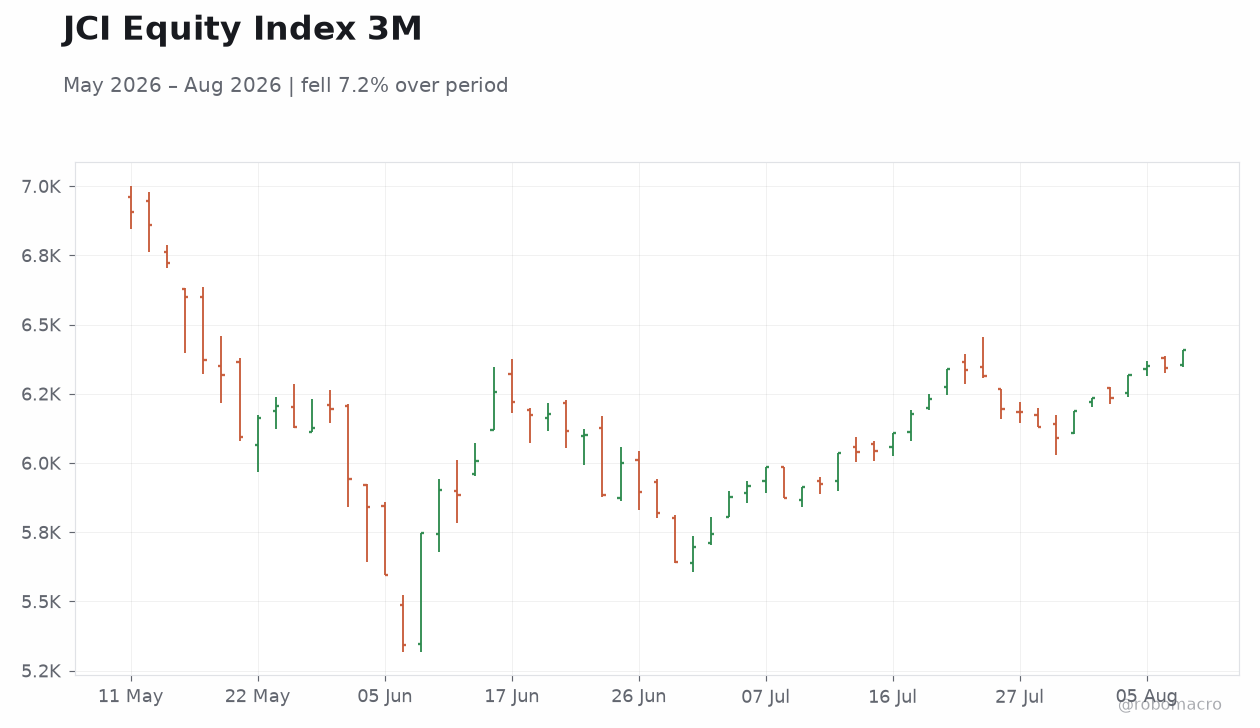
| JCI | 6,409.65 | +1.04% |
| KLCI | 1,735.75 | -0.08% |
| STI | 5,698.43 | +1.05% |
| USD/IDR | 17,790.00 | -0.68% |
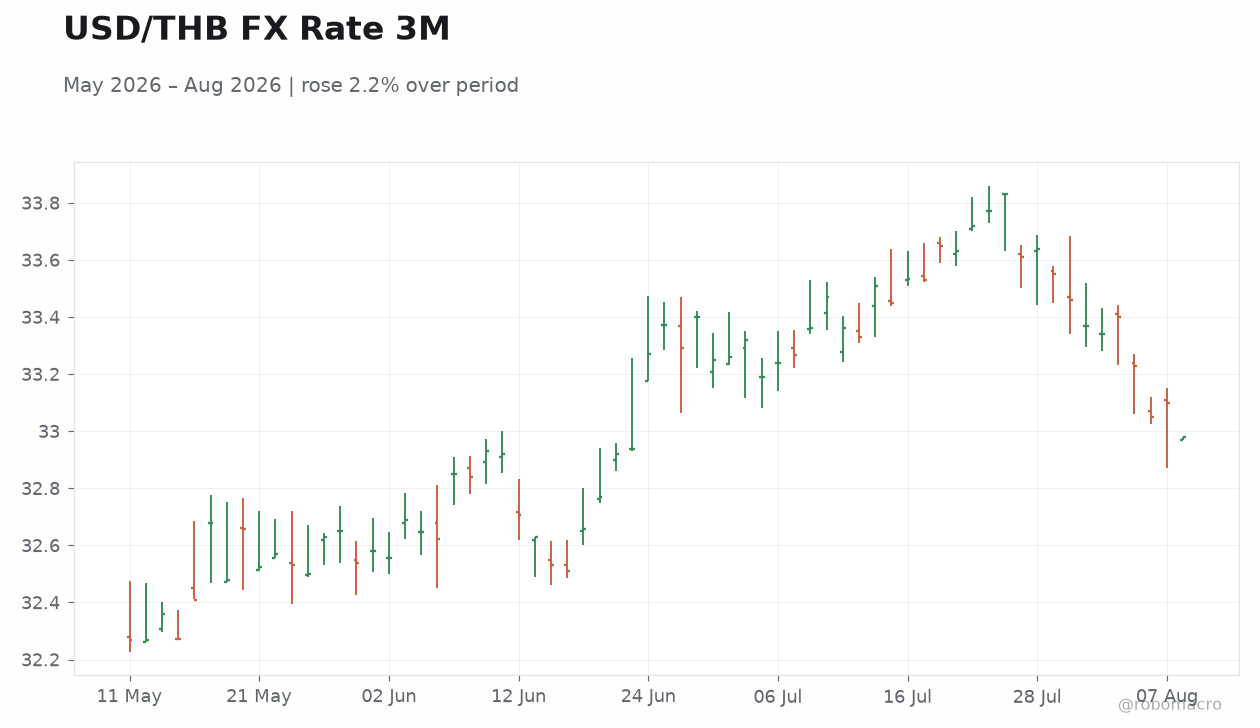
| USD/THB | 32.98 | -0.36% |
| USD/MYR | 4.09 | -0.02% |
| USD/PHP | 60.72 | -0.10% |
| USD/SGD | 1.28 | -0.26% |
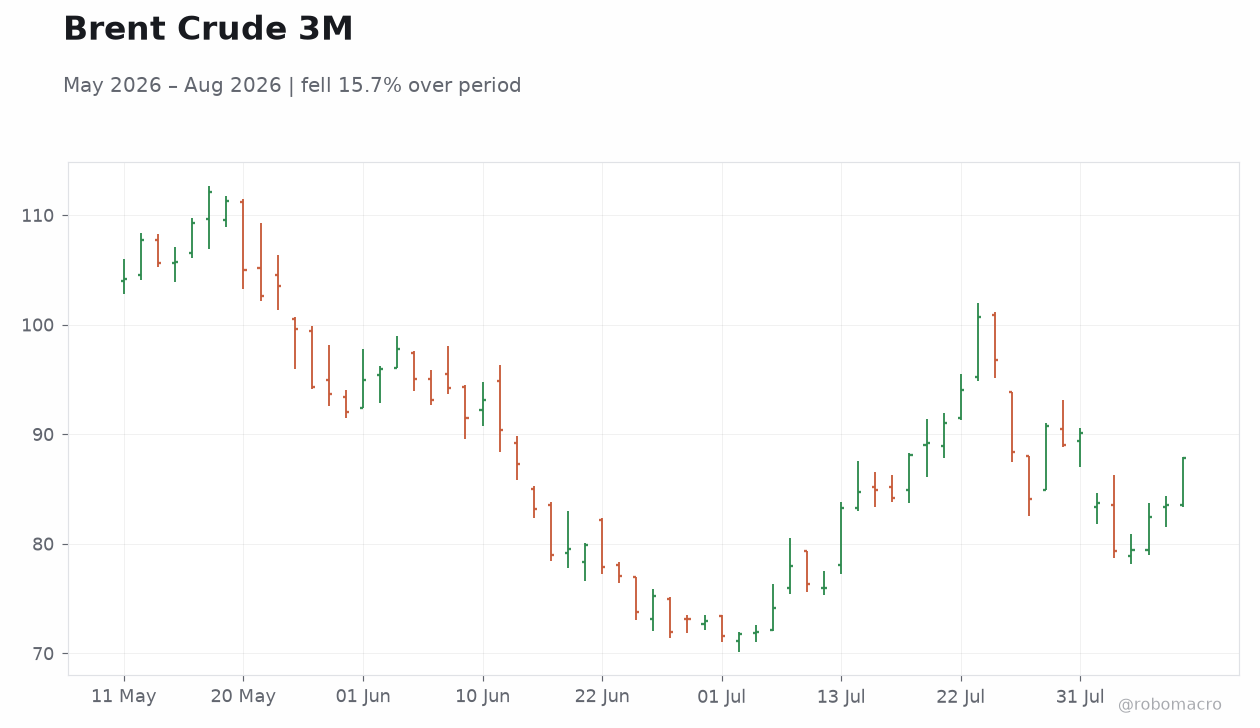
| Brent Crude | 87.85 | +5.15% |
| Gold | 4,448.60 | +2.49% |
| Bitcoin | 63,922.13 | -1.42% |
| Indonesia 10Y Govt Yield | - | - |
| Thailand 10Y Govt Yield | - | - |
| Data | Prior | Cons | Actual |
|---|---|---|---|
| No events available | |||
Brent Crude 3M | Type: market_hloc | Brent $/bbl: 87.85 (2026-08-10) | Range: 71.57–112.1 | Trend(6pt): 104.2,96,73.74,84.23,82.49,87.85
| Data | Prior | Cons | Time |
|---|---|---|---|
| GDP Growth Quarter-over-Quarter | 0.70 | - | 22:30 |
| GDP Growth Year-over-Year | 2.80 | - | 22:30 |
| Inflation Rate Month-over-Month | 0 | - | 00:00 |
| Inflation Rate Year-over-Year | 1.90 | - | 00:00 |
Indonesia’s economy grew 5.29% y/y in Q2, exceeding expectations as government spending rose 15.97% and household consumption provided support. The rupiah weakened to a record 17,790 against the USD, amplifying import costs and debt servicing pressures across the commodity-driven economy. JCI rose 1.04% to 6,409.65 on the growth beat, while foreign selling remained contained.
Thailand’s SET index was little changed amid ongoing probes into stablecoin flows by the Bank of Thailand. Malaysia’s KLCI slipped 0.08% to 1,735.75 despite the central bank’s 4-5% full-year growth outlook. Singapore’s STI advanced 1.05% to 5,698.43 as reserve managers delivered positive returns amid volatility.
Brent crude jumped 5.15% to 87.85, lifting regional energy exporters. Gold rose 2.49% to 4,448.60 while Bitcoin fell 1.42% to 63,922.13. USD/IDR eased 0.68% and USD/THB declined 0.36%.
Indonesia’s inaugural Panda Bond issuance marks a strategic diversification of sovereign funding away from traditional USD markets. Supply-chain shifts continue to favour Vietnam and Malaysia, where electronics exports grew strongly in recent months. Thailand’s tourism recovery has slowed, trimming second-quarter growth and prompting fiscal measures aimed at high-value visitors.
Thailand will release Q2 GDP growth figures on 16 August, with consensus expecting a modest sequential pickup from the prior 0.7% quarter-on-quarter print. Malaysia’s July inflation data due the following day will show whether the 1.9% y/y rate has stabilised after the recent energy shock. No major releases are scheduled for Indonesia, the Philippines or Singapore in the immediate session.
Markets will monitor BI’s response to the rupiah’s slide and any signals on reserve management. Vietnam trade data later in the week may highlight continued electronics export momentum. Regional bond markets stayed range-bound as investors awaited clearer signals from BI after the governor’s departure.
Commodity price strength, especially in Brent, offers a near-term buffer for Indonesia and Malaysia current accounts.
Subscribe to ASEAN Macro Daily and get each new issue delivered to your inbox.
Already a member? Visit robomacro.com to log in and manage subscriptions, or use Forgot Password to set a password.
USD/IDR FX Rate 3M | Type: market_hloc | USD/IDR: 1.779e+04 (2026-08-10) | Range: 1.736e+04–1.819e+04 | Trend(6pt): 1.736e+04,1.786e+04,1.792e+04,1.807e+04,1.791e+04,1.779e+04
USD/THB FX Rate 3M | Type: market_hloc | USD/THB: 32.98 (2026-08-10) | Range: 32.27–33.83 | Trend(6pt): 32.27,32.56,33.27,33.53,33.1,32.98
JCI Equity Index 3M | Type: market_hloc | JCI Index: 6410 (2026-08-07) | Range: 5342–6906 | Trend(6pt): 6906,5595,5896,6108,6351,6410
Indonesia’s inaugural Panda Bond issuance marks a strategic diversification of sovereign funding away from traditional USD markets. Supply-chain shifts continue to favour Vietnam and Malaysia, where electronics exports grew strongly in recent months. Thailand’s tourism recovery has slowed, trimming second-quarter growth and prompting fiscal measures aimed at high-value visitors.
Regional bond markets stayed range-bound as investors awaited clearer signals from BI after the governor’s departure. Commodity price strength, especially in Brent, offers a near-term buffer for Indonesia and Malaysia current accounts. Wildfires across Indonesia linked to El Niño add downside risks to agricultural output and export earnings.
US plans to close five consulates, including one in Indonesia, raising concerns over reduced diplomatic presence amid China’s regional influence.
US plans to close five consulates, including one in Indonesia, raising concerns over reduced diplomatic presence amid China’s regional influence. Persistent global energy cost pressures have kept inflation risks elevated, influencing policy settings from RBI to MAS. India’s retail inflation at 4.38% and RBI repo rate at 5.25% underscore a cautious stance that echoes ASEAN central banks’ focus on price stability.
Strong investment returns at Singapore’s reserve managers highlight resilience in official portfolios despite volatility. Emerging-market stress, visible in the rupiah’s decline, reflects broader capital-flow sensitivity to US policy signals and dollar strength. Wildfires across Indonesia linked to El Niño add downside risks to agricultural output and export earnings.
Thailand’s crackdown on stablecoin trades may reshape its financial landscape, impacting liquidity and foreign participation in digital markets.
Bank Indonesia faces immediate credibility questions after Governor Perry Warjiyo’s resignation, with markets watching for any shift in rupiah defence tactics or reserve drawdowns. The committee is expected to maintain its current stance while monitoring capital outflows, though no vote split has been disclosed. Bank of Thailand continues tightening oversight of USDT flows and grey-economy transactions without altering its policy rate path.
BNM reiterated its 4-5% growth forecast and signalled readiness to hold rates steady given contained inflation. BSP is likely to stay on hold after July CPI came in below expectations, reducing near-term cut pressure. MAS tightened its exchange-rate band in response to imported inflation risks, marking a divergence from interest-rate focused peers.
<i>↓ p.2</i>
SBV has kept policy accommodative to support manufacturing FDI inflows while maintaining reserve adequacy.