ASEAN Macro Daily(Beta Mode)
Indonesia's GDP Beats but Rupiah Weakens
Market Snapshot
| Asset | Level | Change |
|---|---|---|
| JCI | 6,267.88 | -1.53% |
| KLCI | 1,731.46 | -0.23% |
| STI | 5,754.17 | +0.98% |
| USD/IDR | 17,871.00 | +0.45% |
| USD/THB | 33.09 | +0.33% |
| USD/MYR | 4.08 | -0.15% |
| USD/PHP | 61.17 | +0.61% |
| USD/SGD | 1.28 | -0.01% |
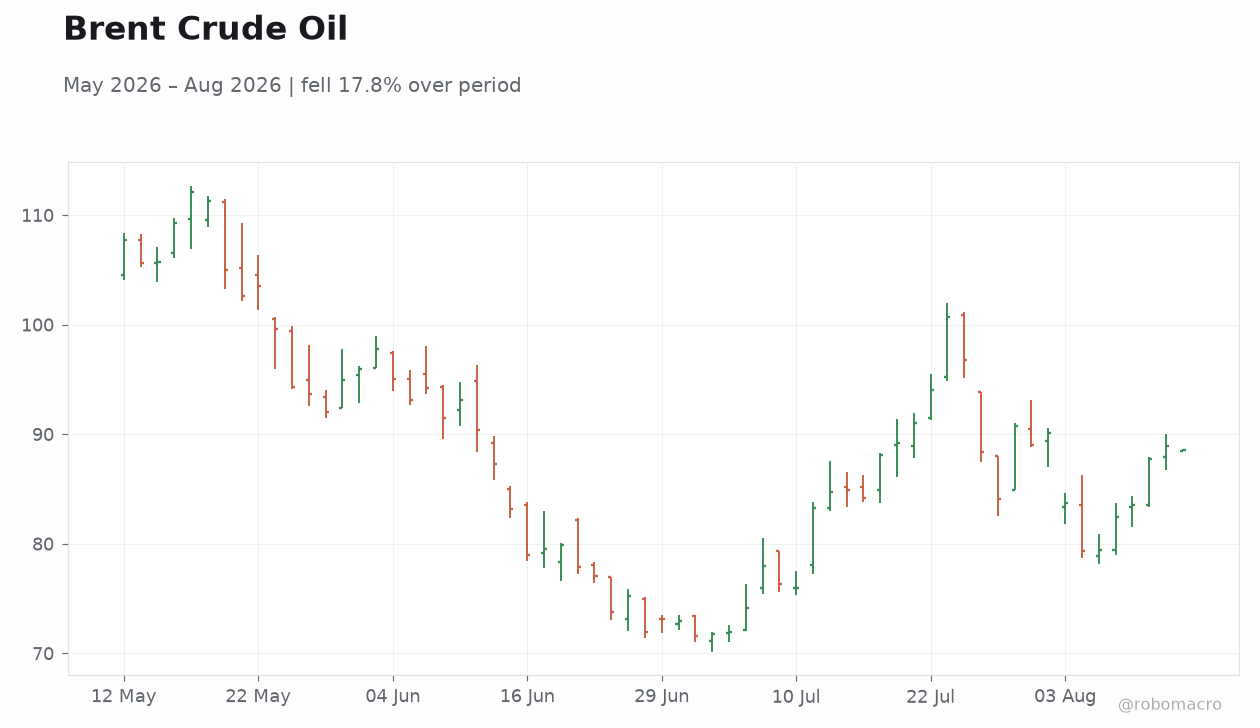
| Brent Crude | 88.52 | -0.44% |
| Gold | 4,463.50 | +1.84% |
| Bitcoin | 63,441.17 | -0.17% |
| Indonesia 10Y Govt Yield | - | - |
| Thailand 10Y Govt Yield | - | - |
Prior Economic Events
| Data | Prior | Cons | Actual |
|---|---|---|---|
| No events available | |||
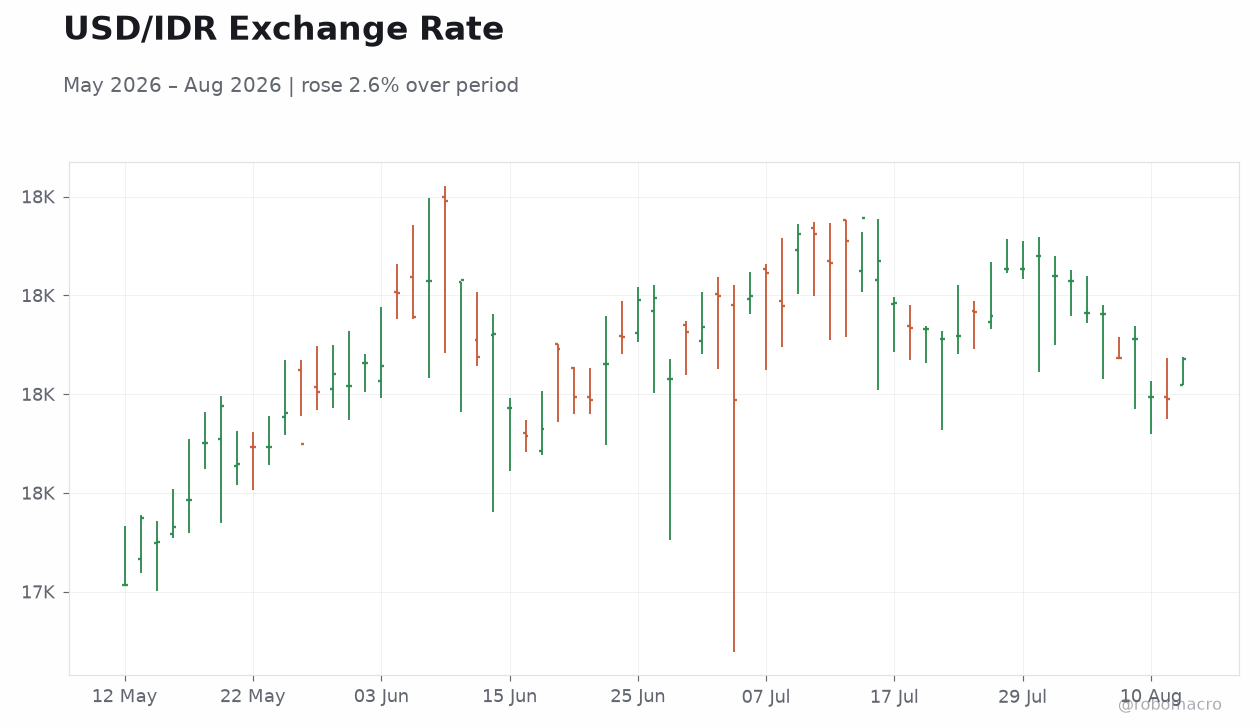 USD/IDR Exchange Rate | Type: market_hloc | IDR per USD: 1.787e+04 (2026-08-12) | Range: 1.741e+04–1.819e+04 | Trend(6pt): 1.741e+04,1.786e+04,1.799e+04,1.798e+04,1.779e+04,1.787e+04
Today's Economic Events
| Data | Prior | Cons | Time |
|---|---|---|---|
| GDP Growth Quarter-over-Quarter | 0.70 | - | 22:30 |
| GDP Growth Year-over-Year | 2.80 | - | 22:30 |
| Inflation Rate Month-over-Month | 0 | - | 00:00 |
| Inflation Rate Year-over-Year | 1.90 | - | 00:00 |
| Central Bank Interest Rate Decision | 5.75 | - | 03:30 |
- Indonesia Q2 GDP rose 5.29% y/y, beating forecasts on household spending and government outlays.
- Rupiah fell to record lows near 17,871 per USD amid central bank leadership uncertainty.
- Regional equities diverged: JCI dropped 1.53% while STI gained 0.98% on safe-haven flows.
Yesterday's Recap
Indonesia’s economy expanded 5.29% y/y in Q2, exceeding consensus thanks to 15.97% growth in government spending and resilient household consumption. The rupiah weakened 0.45% to 17,871 per USD, touching historic lows and raising import-cost concerns across the archipelago. JCI fell 1.53% to 6,267.88 as investors digested the governor transition, while KLCI slipped 0.23% to 1,731.46.
In contrast, STI rose 0.98% to 5,754.17 on foreign inflows into financials. USD/THB climbed 0.33% to 33.09 and USD/PHP added 0.61% to 61.17, reflecting broad EM pressure. USD/MYR eased 0.15% to 4.08.
Thailand and Malaysia saw limited moves, with no major data releases. Gold’s 1.84% gain to 4,463.50 underscored regional risk aversion while Brent crude fell 0.44% to 88.52.
The Day Ahead
Thailand will release Q2 GDP growth figures on 16 August, with markets watching for signs of tourism-driven recovery. Malaysia’s July inflation data due 17 August should confirm whether price pressures remain contained near 1.9% y/y. Indonesia’s BI policy decision on 19 August draws focus after the governor change, with the committee expected to hold the 5.75% rate.
No high-impact releases are scheduled for Singapore, Philippines or Vietnam in the immediate window. Traders will also monitor USD/IDR and regional bond yields for further EM stress signals.
Other Economic Notes
Indonesia’s inaugural Panda Bond issuance marks a strategic diversification of funding sources away from traditional USD markets. Persistent haze from Sumatran wildfires has begun disrupting cross-border air quality and tourism in Malaysia and Singapore. Malaysia’s central bank continues to project 4-5% full-year growth despite global energy volatility.
Supply-chain shifts from China remain supportive for Vietnam’s manufacturing FDI pipeline. Regional equity and FX volatility is likely to stay elevated until BI leadership clarity emerges.
Global Macro News
India’s RBI held its repo rate at 5.25% with CPI at 4.38% y/y, keeping external pressure on ASEAN currencies through carry-trade flows. Stronger US data and persistent oil prices near $88 have lifted the dollar and weighed on EM assets. <i>↓ p.2</i>