ASEAN Macro Daily(Beta Mode)
Indonesia GDP Beats as Rupiah Hits Record Low
Market Snapshot
| Asset | Level | Change |
|---|---|---|
| JCI | 6,373.85 | +1.69% |
| KLCI | 1,741.61 | +0.59% |
| STI | 5,720.75 | -0.58% |
| USD/IDR | 17,877.00 | +0.31% |
| USD/THB | 33.13 | +0.03% |
| USD/MYR | 4.09 | -0.12% |
| USD/PHP | 61.32 | +0.36% |
| USD/SGD | 1.28 | +0.03% |
| Brent Crude | 86.96 | -2.27% |
| Gold | 4,407.10 | -0.04% |
| Bitcoin | 63,465.07 | +0.10% |
| Indonesia 10Y Govt Yield | - | - |
| Thailand 10Y Govt Yield | - | - |
Prior Economic Events
| Data | Prior | Cons | Actual |
|---|---|---|---|
| No events available | |||
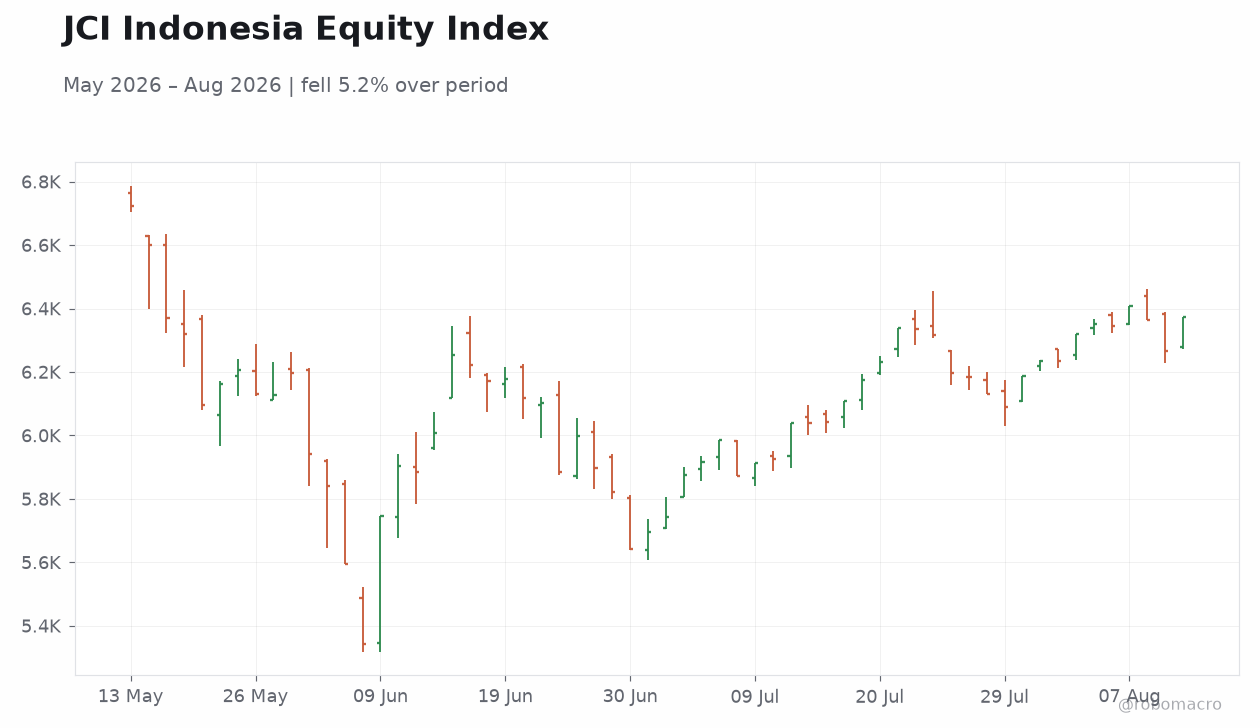 JCI Indonesia Equity Index | Type: market_hloc | JCI Index: 6374 (2026-08-12) | Range: 5342–6723 | Trend(5pt): 6723,5902,5745,6315,6374
Today's Economic Events
| Data | Prior | Cons | Time |
|---|---|---|---|
| No events available | |||
- Indonesia Q2 GDP expands 5.3% y/y, topping forecasts on household and government spending.
- MAS tightens S$NEER band as energy-driven inflation risks persist.
- Regional equities mixed; JCI gains 1.69% while STI slips 0.58%.
Yesterday's Recap
Indonesia reported Q2 GDP growth of 5.29%, exceeding expectations as household consumption and a 15.97% surge in government spending provided support. The rupiah reached fresh historic lows against the dollar at USD/IDR 17,877, amplifying import costs across the economy. Markets noted the nomination of Destry Damayanti as the incoming Bank Indonesia governor, with the rupiah edging higher on the announcement.
Singapore’s MAS posted a S$20 billion net profit from investment gains and unexpectedly tightened its exchange-rate policy band to counter persistent energy inflation. Thailand’s Bank of Thailand flagged abnormal USDT flows and stepped up audits of high-volume stablecoin trades to curb gray-economy activity. Malaysia’s central bank governor reaffirmed the 4-5% growth trajectory for 2026 despite external shocks.
Equity markets reflected the divergence, with Jakarta’s JCI rising 1.69% to 6,373.85 while Singapore’s STI fell 0.58% to 5,720.75. KLCI added 0.59% to 1,741.61 amid steady foreign inflows, while Brent crude dropped 2.27% to 86.96, easing some imported inflation pressures for the region.
The Day Ahead
Attention turns to ongoing monitoring of Indonesia’s trade balance and sovereign bond auctions amid the new Panda Bond issuance. Thailand continues its crackdown on stablecoin trades in the gray economy, with Bank of Thailand and SEC audits of high-volume USDT flows expected to shape liquidity conditions. The Philippines will track overseas remittances data supporting the peso, while Vietnam’s industrial production momentum from July remains in focus for export-oriented sectors.
Singapore’s MAS will continue monitoring S$NEER movements within the newly tightened band. No central-bank rate decisions are slated across the six ASEAN economies in the immediate session, leaving capital-flow management and currency defense as primary market drivers.
Other Economic Notes
Indonesia’s inaugural Panda Bond issuance marks a strategic diversification of sovereign funding away from traditional dollar markets, potentially reducing external vulnerabilities. Regional haze from Indonesian wildfires has prompted cloud-seeding operations and school closures in neighboring countries, adding near-term supply-chain friction for palm oil and commodities. China-Indonesia joint naval drills east of Taiwan underscore shifting geopolitical alignments that could influence FDI flows into ASEAN manufacturing hubs.
<i>↓ p.2</i>


