ASEAN Macro Daily(Beta Mode)
Thai GDP Misses, BI Rate Decision Looms
Market Snapshot
| Asset | Level | Change |
|---|---|---|
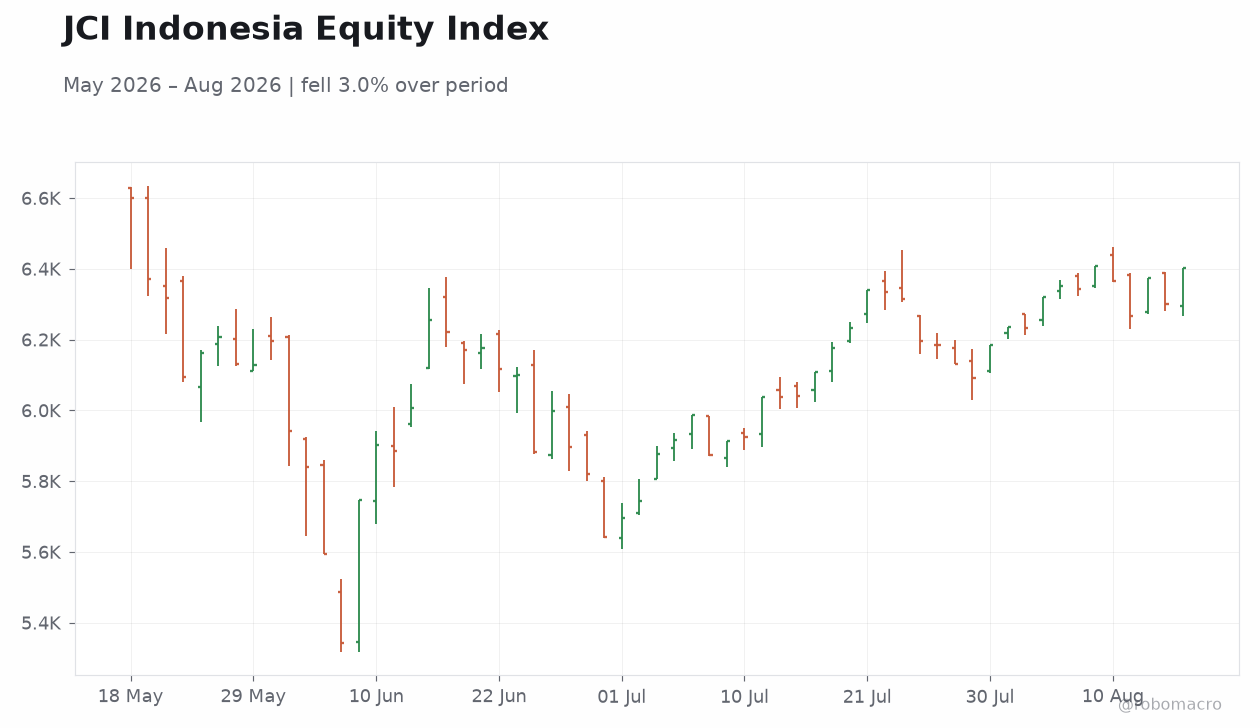
| JCI | 6,401.89 | +1.59% |
| KLCI | 1,727.39 | -0.42% |
| STI | 5,743.59 | +0.41% |
| USD/IDR | 17,830.00 | -0.18% |
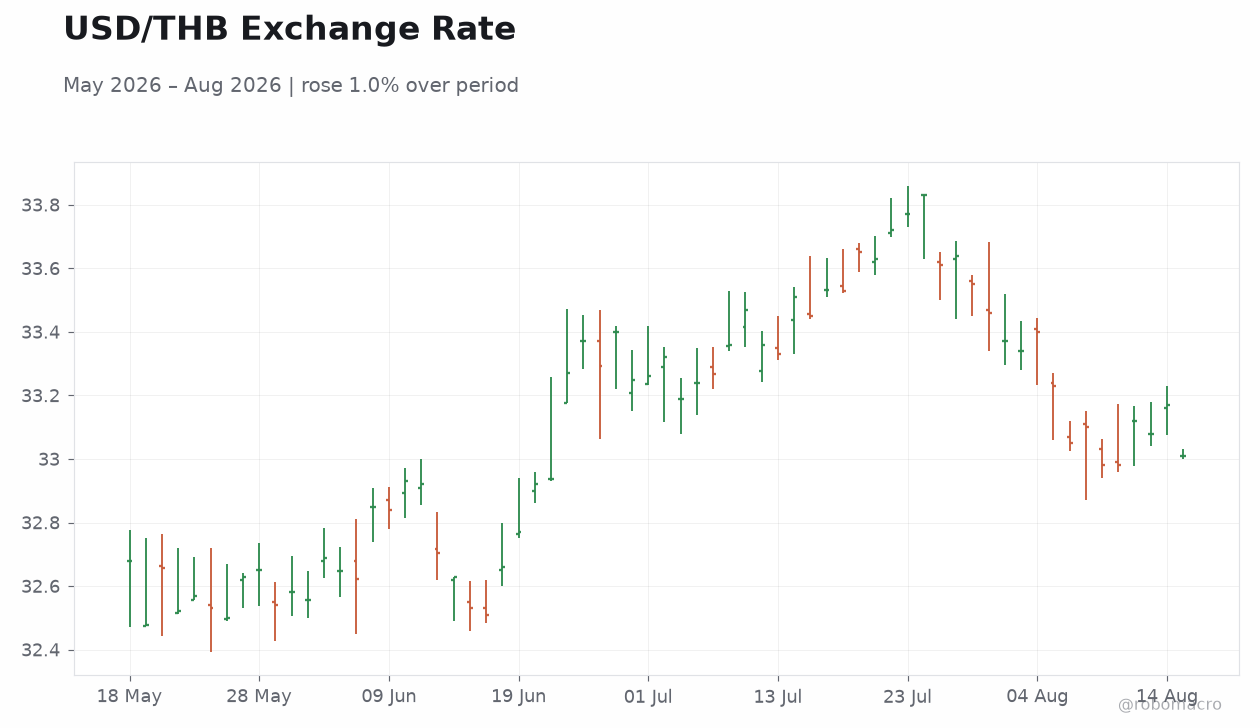
| USD/THB | 33.01 | -0.48% |
| USD/MYR | 4.06 | -0.59% |
| USD/PHP | 61.47 | +0.21% |
| USD/SGD | 1.28 | -0.22% |
| Brent Crude | 91.10 | +2.91% |
| Gold | 4,473.10 | +2.12% |
| Bitcoin | 64,293.91 | +2.35% |
| Indonesia 10Y Govt Yield | - | - |
| Thailand 10Y Govt Yield | - | - |
Prior Economic Events
| Data | Prior | Cons | Actual |
|---|---|---|---|
| GDP Growth Quarter-over-Quarter | 0.60 | -0.60 | -0.20 |
| GDP Growth Year-over-Year | 2.80 | 1.70 | 1.90 |
| Inflation Rate Month-over-Month | 0 | - | 0 |
| Inflation Rate Year-over-Year | 1.90 | - | 1.80 |
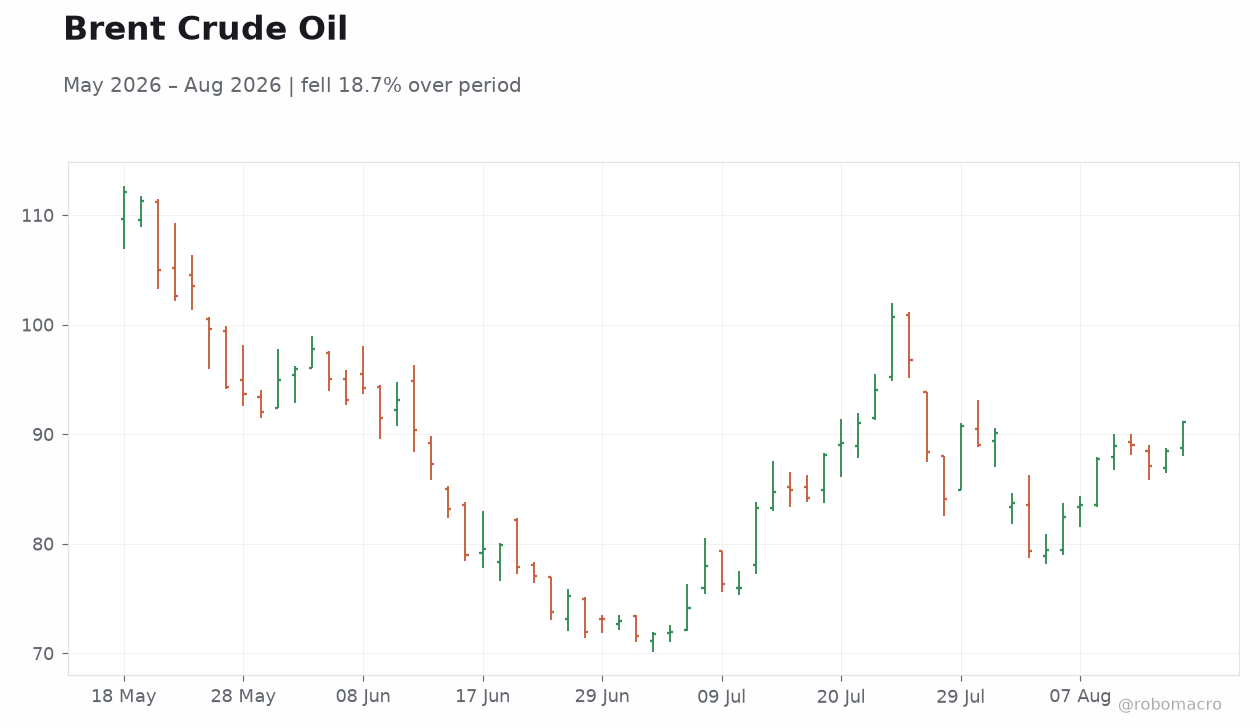 Brent Crude Oil | Type: market_hloc | USD per Barrel: 91.1 (2026-08-17) | Range: 71.57–112.1 | Trend(6pt): 112.1,91.45,71.57,100.7,87.07,91.1
Today's Economic Events
| Data | Prior | Cons | Time |
|---|---|---|---|
| Central Bank Interest Rate Decision | 5.75 | 5.75 | 03:30 |
- Thailand Q2 GDP grew 1.9% y/y, below 2.8% prior, while Malaysia inflation eased to 1.8% y/y.
- Regional equities mixed with JCI up 1.59% and KLCI down 0.42%; ASEAN currencies broadly firmer versus USD.
- Indonesia policy continuity and upcoming BI decision support rupiah amid stable 5.75% policy rate expectation.
Yesterday's Recap
Thailand reported Q2 GDP that missed the prior quarter’s pace, with quarter-over-quarter growth at -0.20% versus the -0.60% consensus and year-over-year expansion slowing to 1.9% from 2.8%. Malaysia’s inflation rate held flat month-over-month at 0% and eased to 1.8% year-over-year from 1.9%. Equity markets showed divergence as Indonesia’s JCI rose 1.59% to 6,401.89 while Malaysia’s KLCI fell 0.42% to 1,727.39 and Singapore’s STI gained 0.41% to 5,743.59.
ASEAN currencies strengthened modestly, with USD/THB declining 0.48% to 33.01, USD/MYR down 0.59% to 4.06, and USD/IDR easing 0.18% to 17,830. News flow highlighted Thailand’s real investment reaching 535 billion baht in the first half, driven by AI and clean energy, alongside ongoing focus on Indonesia’s 2027 budget targets and policy continuity supporting the rupiah. Thailand’s Q2 growth ranked lowest among major ASEAN peers as elevated energy prices weighed on momentum despite tourism gains.
The Day Ahead
Indonesia’s central bank is scheduled to announce its interest rate decision at 03:30 ET, with consensus pointing to a hold at 5.75%. Market participants will monitor any signals on rupiah defense and capital flow measures. Thailand’s baht rally may face scrutiny amid expectations of continued dovish BoT stance to support growth.
Broader regional attention turns to Malaysia’s trade balance and potential updates on ringgit fundamentals after stronger Q2 GDP. No major releases are slated for the Philippines, Singapore or Vietnam in the immediate session. Thailand’s real investment surge in AI and clean energy sectors offers a positive offset to soft growth readings, while Indonesia’s 2027 budget framework emphasizes steady inflation and deficit targets that reinforce policy predictability.
Other Economic Notes
Thailand’s Q2 growth ranked lowest among major ASEAN peers as elevated energy prices weighed on momentum despite tourism gains. Malaysia’s economy is projected to expand around 5% this year, underpinning ringgit resilience on improved fundamentals. Indonesia’s policy continuity under the incoming central bank leadership supports stable inflation and deficit targets in the 2027 budget framework.
Regional FDI flows remain supported by supply-chain shifts, with Thailand attracting investment in high-tech sectors. Malaysia’s strong fundamentals continue to uplift ringgit prospects, while Vietnam and Singapore benefit from electronics and non-oil export gains tied to ongoing supply-chain reconfiguration.