ASEAN Macro Daily(Beta Mode)
BI Poised to Hold Rates as Rupiah Stabilizes
Market Snapshot
| Asset | Level | Change |
|---|---|---|
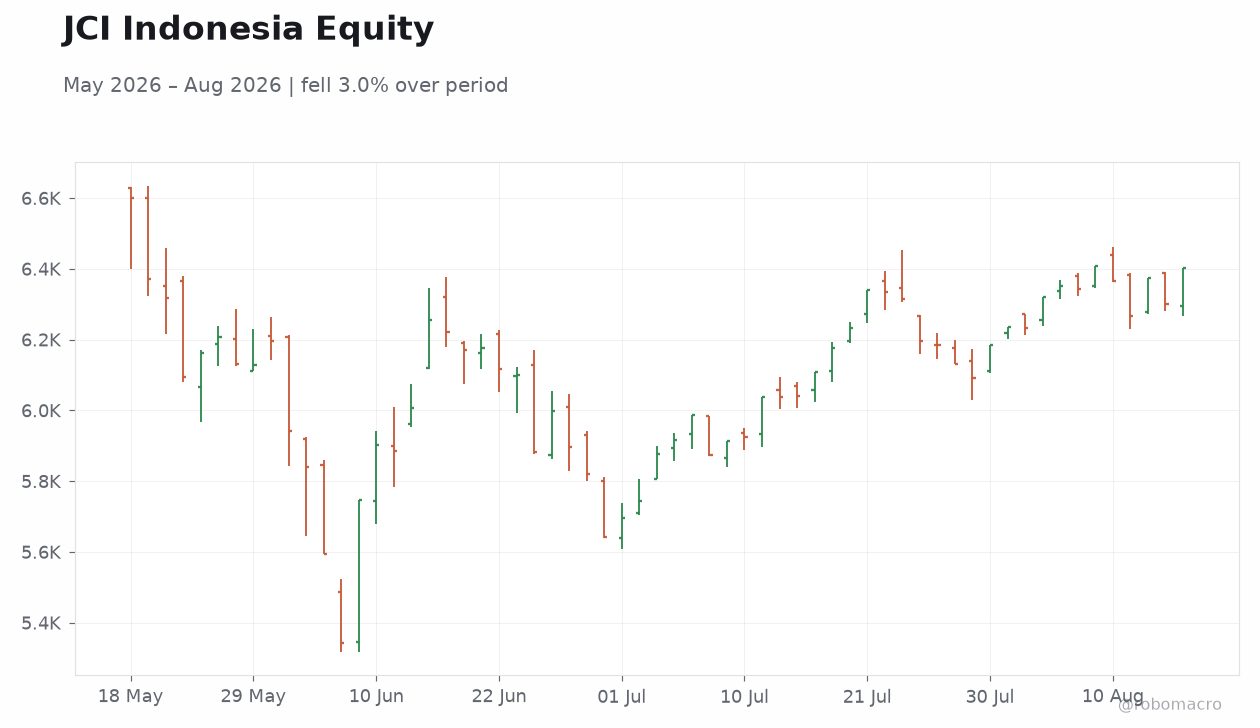
| JCI | 6,401.89 | +1.59% |
| KLCI | 1,725.89 | -0.09% |
| STI | 5,768.46 | +0.43% |
| USD/IDR | 17,851.00 | +0.12% |
| USD/THB | 33.08 | -0.15% |
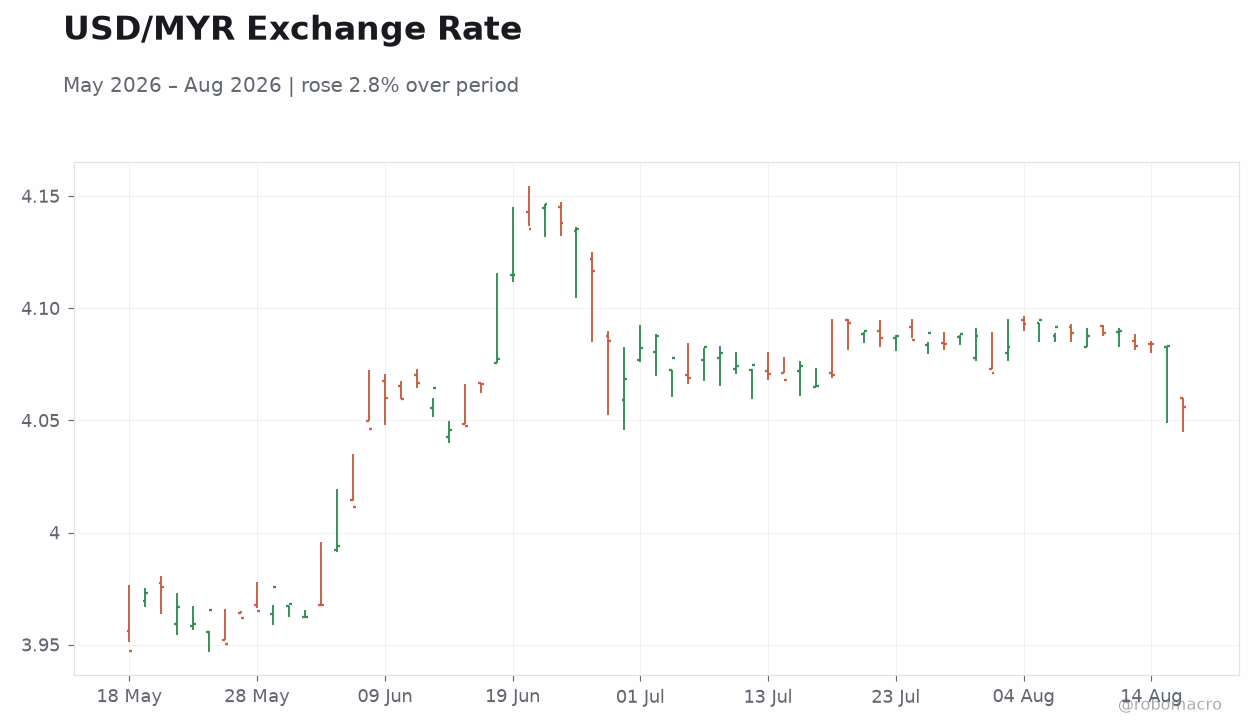
| USD/MYR | 4.06 | -0.67% |
| USD/PHP | 61.76 | +1.29% |
| USD/SGD | 1.28 | -0.06% |
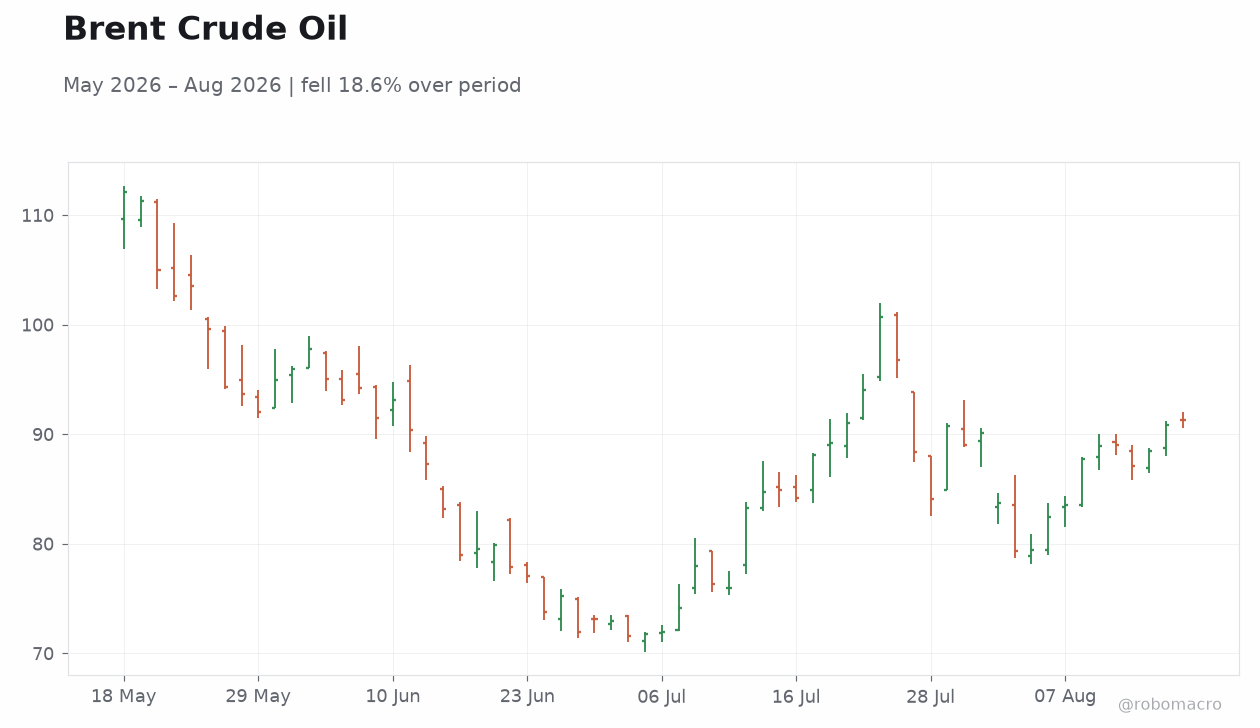
| Brent Crude | 91.27 | +0.44% |
| Gold | 4,389.50 | -0.64% |
| Bitcoin | 64,533.64 | +0.04% |
| Indonesia 10Y Govt Yield | - | - |
| Thailand 10Y Govt Yield | - | - |
Prior Economic Events
| Data | Prior | Cons | Actual |
|---|---|---|---|
| Inflation Rate Month-over-Month | 0 | - | 0 |
| Inflation Rate Year-over-Year | 1.90 | - | 1.80 |
| GDP Growth Quarter-over-Quarter | 0.60 | -0.60 | -0.20 |
| GDP Growth Year-over-Year | 2.80 | 1.70 | 1.90 |
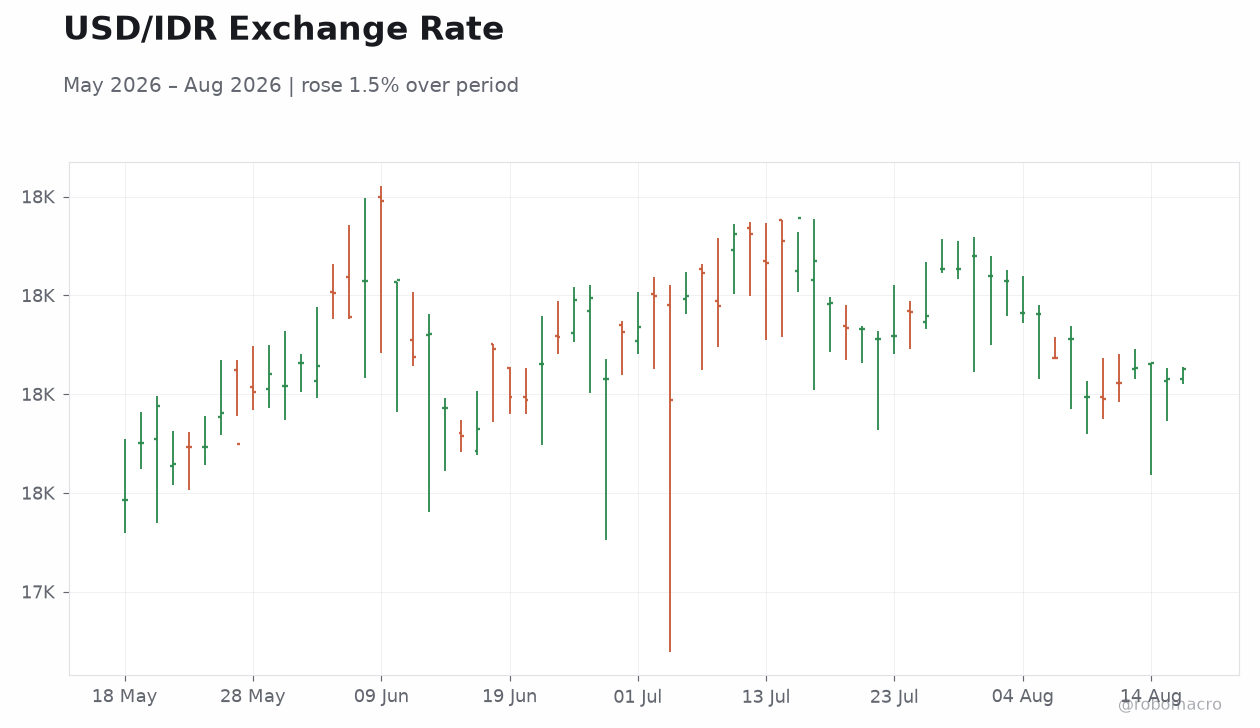 USD/IDR Exchange Rate | Type: market_hloc | Rate: 1.785e+04 (2026-08-18) | Range: 1.759e+04–1.819e+04 | Trend(6pt): 1.759e+04,1.819e+04,1.794e+04,1.792e+04,1.786e+04,1.785e+04
Today's Economic Events
| Data | Prior | Cons | Time |
|---|---|---|---|
| Central Bank Interest Rate Decision | 5.75 | 5.75 | 23:30 |
| Wednesday (2026-08-19) | |||
| Central Bank Interest Rate Decision | 5.75 | 5.75 | 23:30 |
- Bank Indonesia expected to hold the policy rate at 5.75% as the rupiah stabilizes near 17,851.
- Malaysia inflation eases to 1.8% YoY while Thailand GDP contracts 0.2% QoQ, missing forecasts.
- Ringgit extends gains on lower US rate-hike odds; regional equities close mixed with JCI up 1.59%.
Yesterday's Recap
Malaysia reported inflation at 0.0% MoM and 1.8% YoY, below the prior 1.9% reading and signaling contained price pressures. Thailand posted GDP growth of -0.2% QoQ against a consensus of -0.6% and 1.9% YoY versus 1.7% expected, confirming softer momentum in the second quarter. Indonesia’s rupiah traded near 17,851 per dollar with a modest 0.12% weakening, while external debt reached $453.4 billion.
Equity markets showed divergence: Indonesia’s JCI rose 1.59% to 6,401.89, Singapore’s STI gained 0.43% to 5,768.46, and Malaysia’s KLCI slipped 0.09%. The ringgit strengthened 0.67% to 4.06 per dollar on reduced Fed hike expectations, and the Thai baht firmed 0.15% to 33.08. Brent crude edged up 0.44% to 91.27 while gold fell 0.64% to 4,389.50.
Thailand’s second-quarter growth ranked lowest among major Southeast Asian peers as higher energy prices weighed on activity. Thai bank lending rose 2.0% in the quarter with bad loans edging lower, pointing to selective credit improvement.
The Day Ahead
Bank Indonesia’s monetary policy committee meets tonight with consensus pointing to a hold at 5.75%, extending the pause as external debt and rupiah stability remain focal points. No other high-impact data releases are scheduled across the six ASEAN economies today. Market participants will monitor any accompanying statement for signals on capital-flow management and reserve adequacy.
Thailand’s ongoing tourism and manufacturing softness may keep BoT commentary in focus later this week. Regional FX desks will track USD/IDR and USD/MYR reactions to the BI decision and any shifts in US rate expectations. The ringgit’s recent gains on easing Fed hike odds provide a supportive backdrop for BI’s steady stance.
Other Economic Notes
Indonesia’s July trade surplus widened on stronger nickel and coal shipments, supporting the external balance ahead of the BI meeting. Vietnam continues to attract FDI in electronics and semiconductors, with northern provinces recording record approvals driven by Taiwanese and Korean projects. Malaysia’s second-quarter lending growth reached 2.0% while non-performing loans edged lower, indicating improving credit conditions.
Thailand’s industrial production remained flat, highlighting persistent weakness in auto and electronics supply chains. <i>↓ p.2</i>