ASEAN Macro Daily(Beta Mode)
BI Holds Rates as Rupiah Weakens, Brent Spikes
Market Snapshot
| Asset | Level | Change |
|---|---|---|
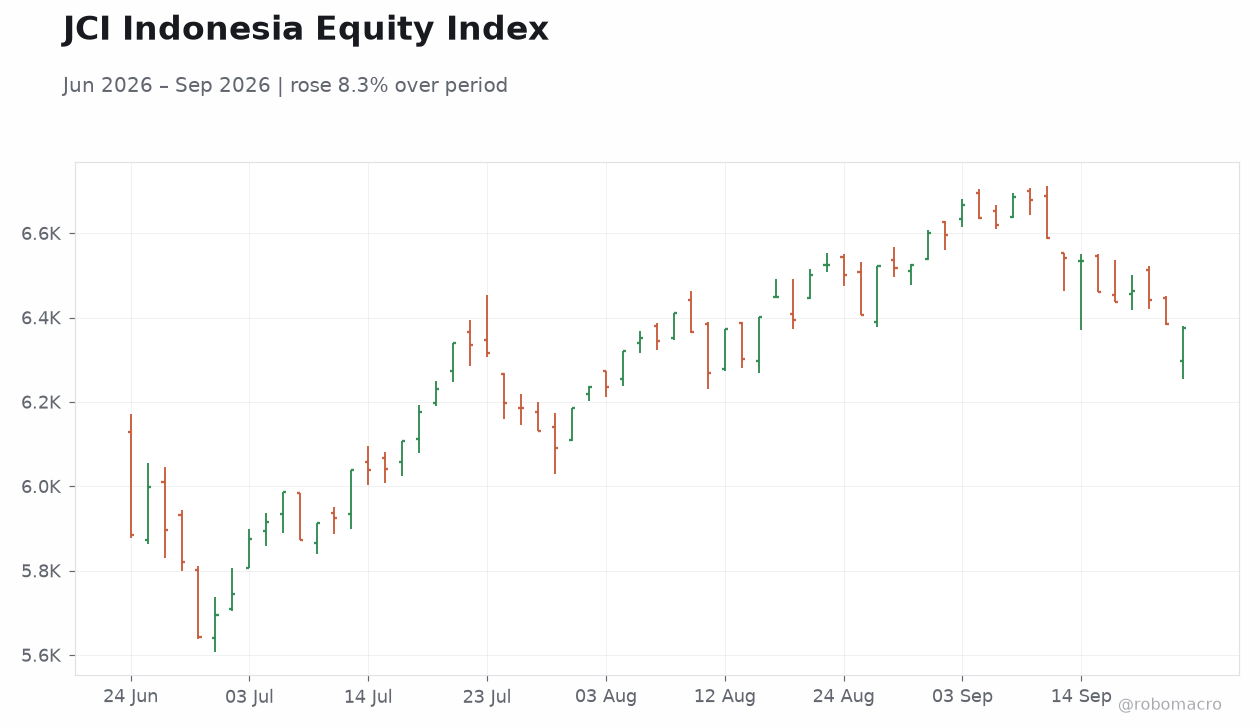
| JCI | 6,374.91 | -0.15% |
| KLCI | 1,676.43 | +0.57% |
| STI | 5,709.91 | +0.61% |
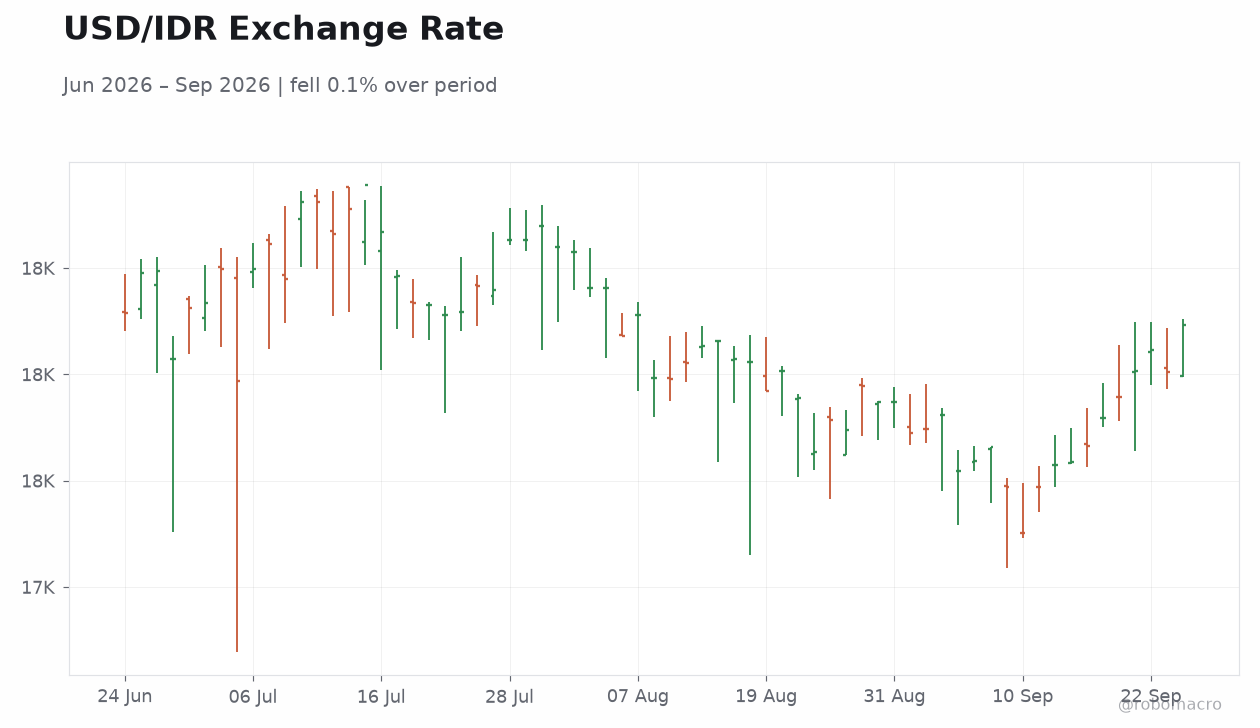
| USD/IDR | 17,893.00 | +0.49% |
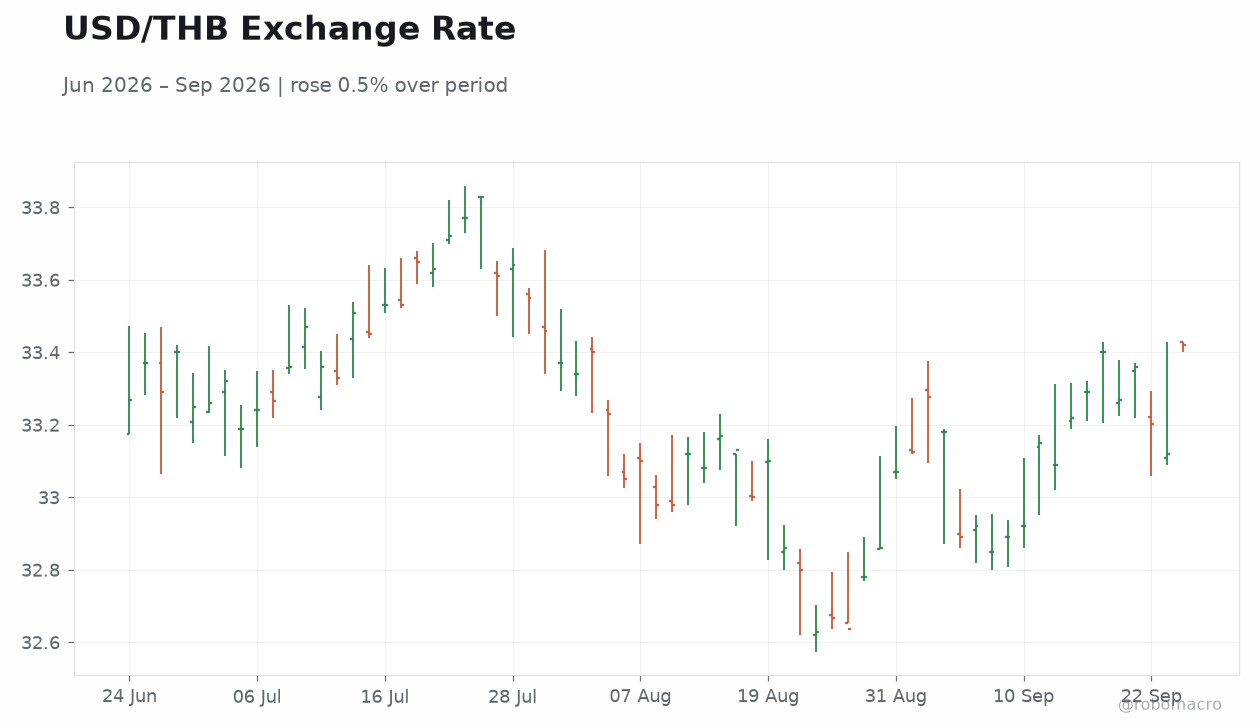
| USD/THB | 33.43 | +0.94% |
| USD/MYR | 4.08 | +0.28% |
| USD/PHP | 62.70 | +0.39% |
| USD/SGD | 1.28 | +0.30% |
| Brent Crude | 107.03 | +3.83% |
| Gold | 4,310.10 | -0.19% |
| Bitcoin | 84,287.03 | -0.11% |
| Indonesia 10Y Govt Yield | - | - |
| Thailand 10Y Govt Yield | - | - |
Prior Economic Events
| Data | Prior | Cons | Actual |
|---|---|---|---|
| No events available | |||
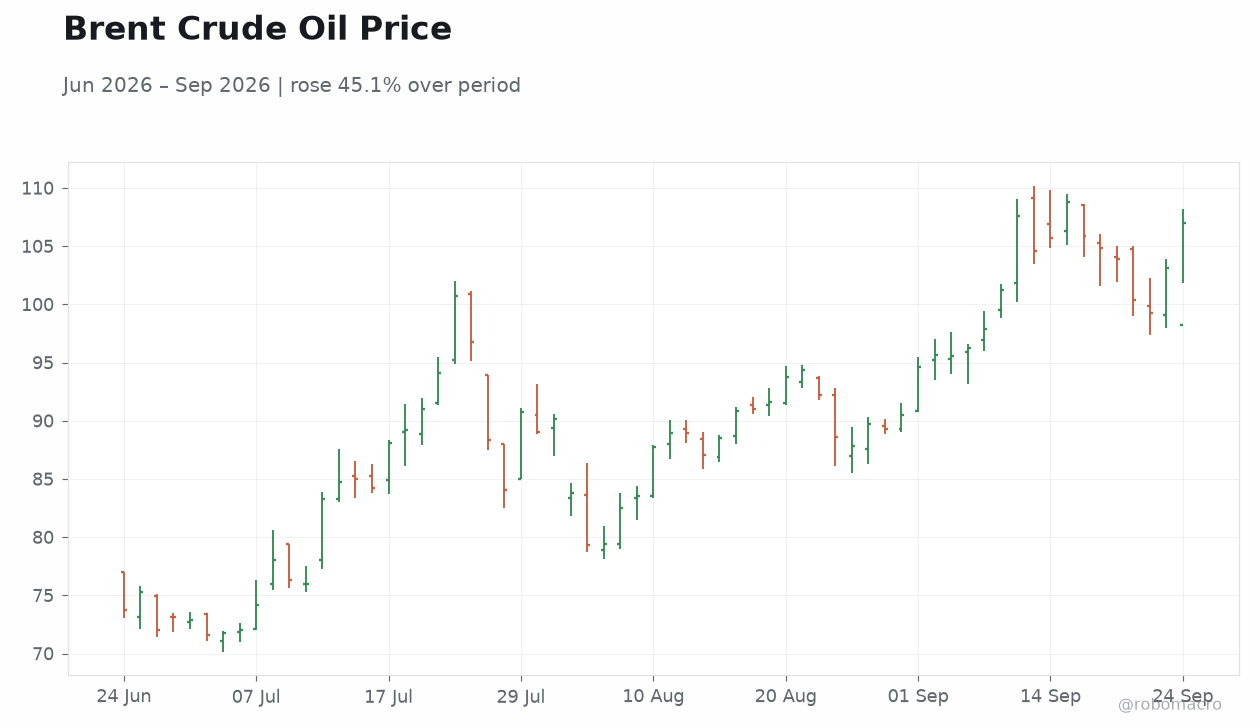 Brent Crude Oil Price | Type: market_hloc | Brent (USD/bbl): 107 (2026-09-24) | Range: 71.57–108.8 | Trend(5pt): 73.74,88.1,87.72,94.65,107
Today's Economic Events
| Data | Prior | Cons | Time |
|---|---|---|---|
| No events available | |||
- Bank Indonesia held its policy rate steady while adding hedging tools to support the rupiah amid rising US yields and Brent near $107.
- Regional equities posted mixed results with Singapore’s STI and Malaysia’s KLCI advancing while Indonesia’s JCI slipped 0.15%.
- ASEAN currencies depreciated across the board against the USD, led by a 0.94% rise in USD/THB to 33.43.
Yesterday's Recap
Indonesia dominated regional news flow as Bank Indonesia kept its benchmark rate unchanged and introduced fresh hedging incentives to defend the rupiah. The central bank explicitly cited elevated US Treasury yields and Brent crude prices near $107 as sources of pressure on IDR, which closed at 17,893 after a 0.49% daily loss. Foreign capital inflows reached IDR 140.7 trillion, providing some external financing relief, while Bank Indonesia signed an MoU with the Hong Kong Monetary Authority to expand cross-border QR payments.
Equity markets diverged: Jakarta’s JCI fell 0.15% to 6,374.91, Malaysia’s KLCI rose 0.57% to 1,676.43, and Singapore’s STI gained 0.61% to 5,709.91. Thailand advanced its semiconductor strategy targeting $80 billion in investment by 2050 and opened a new Pringles export facility in Chon Buri. All ASEAN currencies posted losses versus the dollar, with USD/MYR up 0.28% to 4.08 and USD/SGD up 0.30% to 1.28.
Thailand also launched a 2-billion-baht nano guarantee program to aid micro SMEs and faces an estimated $45.3 billion annual cost from PM2.5 pollution, or 3.89% of GDP.
The Day Ahead
No major data releases or central-bank meetings are scheduled across the six ASEAN economies for 24–25 September. Markets will focus on external drivers, particularly US Treasury yield movements and Brent crude price action near $107. Investors will also monitor any follow-through on Indonesia’s new hedging measures and Thailand’s semiconductor investment push.
Regional FX desks remain alert to further capital-flow volatility given the recent broad USD strength. Singapore’s MAS will continue to manage its NEER band in the absence of interest-rate tools.
Other Economic Notes
Indonesia recorded solid foreign direct investment inflows that offset some fiscal concerns weighing on the rupiah. Thailand’s economy faces an estimated $45.3 billion annual cost from PM2.5 pollution, equivalent to 3.89% of GDP, highlighting structural environmental risks to manufacturing and tourism. Malaysia’s central bank governor reaffirmed that growth should remain firmly inside the 4–5% range, supported by ongoing bilateral swap lines with Japan.
Supply-chain diversification continues to benefit both Thailand and Vietnam as firms seek alternatives to China. ↓ p.2