ASEAN Macro Daily(Beta Mode)
Indonesia Trade Surplus Beats Forecasts
Market Snapshot
| Asset | Level | Change |
|---|---|---|
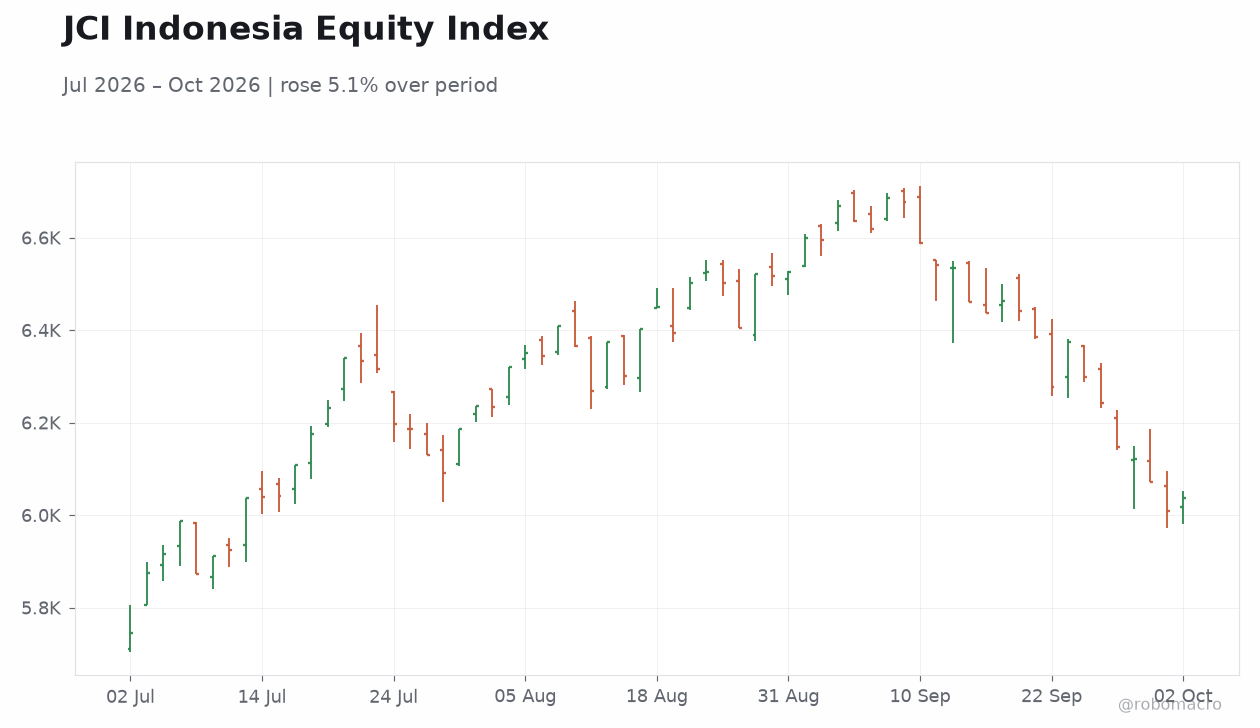
| JCI | 6,036.89 | +0.46% |
| KLCI | 1,630.87 | +0.03% |
| STI | 5,634.82 | -0.58% |
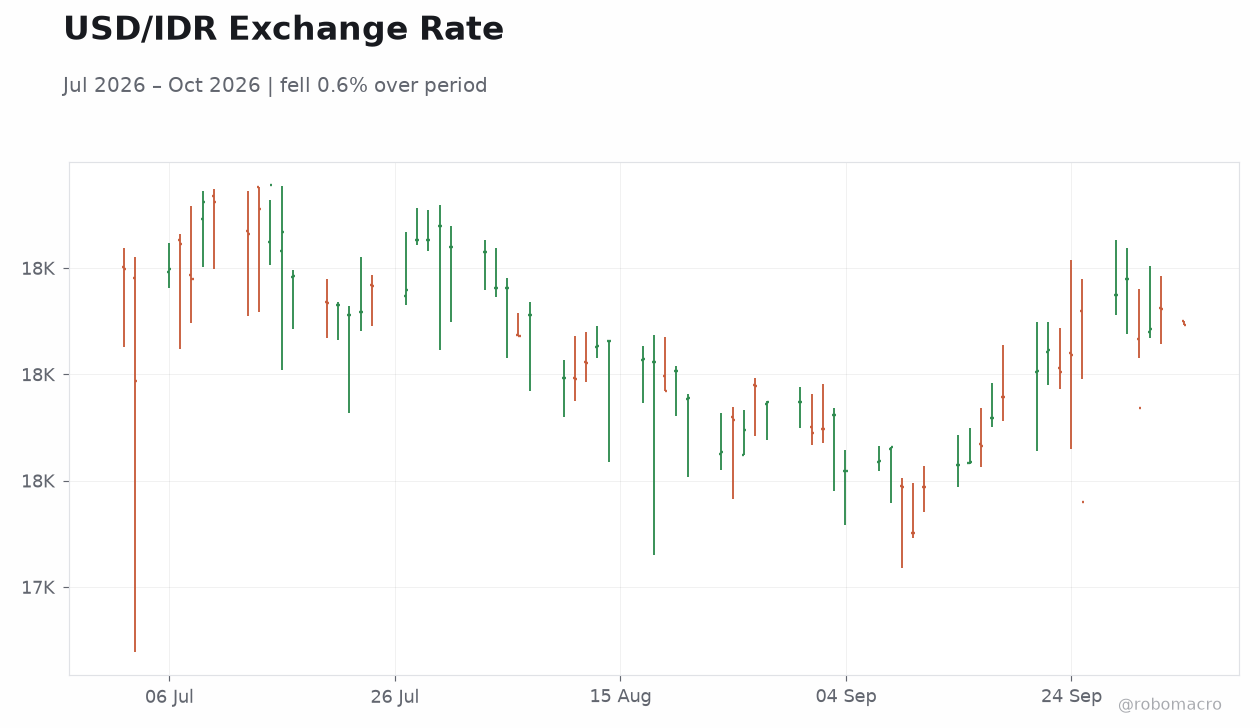
| USD/IDR | 17,893.00 | -0.17% |
| USD/THB | 33.53 | -0.33% |
| USD/MYR | 4.08 | -0.06% |
| USD/PHP | 62.50 | -0.28% |
| USD/SGD | 1.28 | -0.06% |
| Brent Crude | 102.25 | -0.06% |
| Gold | 4,162.30 | -0.95% |
| Bitcoin | 86,236.40 | +1.74% |
| Indonesia 10Y Govt Yield | - | - |
| Thailand 10Y Govt Yield | - | - |
Prior Economic Events
| Data | Prior | Cons | Actual |
|---|---|---|---|
| Inflation Rate Year-over-Year | 3.19 | 3.30 | 3.28 |
| Trade Balance | 130m | 600m | 3,550m |
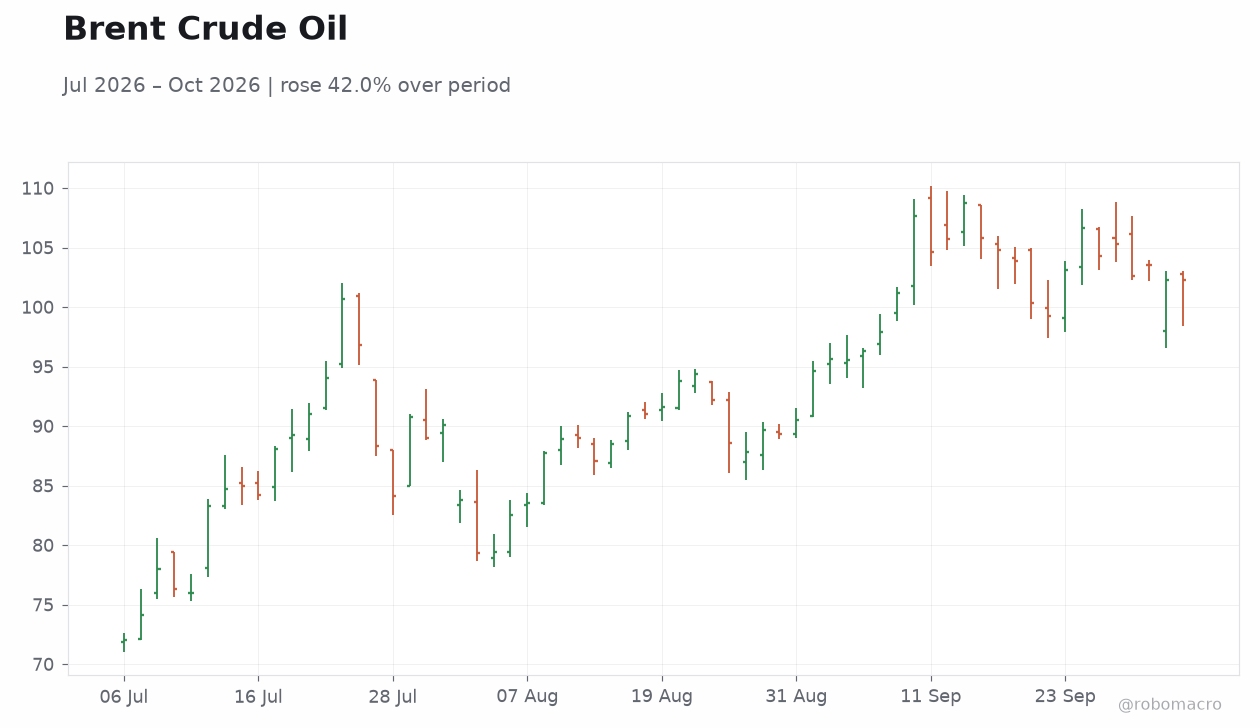 Brent Crude Oil | Type: market_hloc | USD/bbl: 102.2 (2026-10-02) | Range: 71.99–108.8 | Trend(5pt): 71.99,84.09,91.62,104.6,102.2
Today's Economic Events
| Data | Prior | Cons | Time |
|---|---|---|---|
| No events available | |||
- Indonesia September inflation printed 3.28% YoY, below 3.3% consensus, while trade surplus reached USD 3.55 billion.
- Regional currencies strengthened against the USD, led by IDR and THB gains on softer Fed hike expectations.
- Equity markets diverged with JCI rising 0.46% while STI fell 0.58%.
Yesterday's Recap
Indonesia released September inflation at 3.28% YoY, below the 3.3% consensus and up from 3.19%. The same day the country posted a USD 3.55 billion trade surplus, well above the USD 0.6 billion consensus and prior USD 0.13 billion, with manufacturing cited as the main driver. JCI advanced 0.46% to 6,036.89 while KLCI edged 0.03% higher; STI declined 0.58% to 5,634.82.
ASEAN currencies firmed, with USD/IDR falling 0.17% to 17,893 and USD/THB dropping 0.33% to 33.53. USD/MYR eased 0.06% to 4.08, USD/PHP fell 0.28% to 62.50 and USD/SGD declined 0.06% to 1.28. News flow linked rupiah strength to fading US rate-hike bets and highlighted Bank Indonesia’s continued focus on stability.
Brent crude slipped 0.06% to 102.25 while gold fell 0.95%. Bitcoin rose 1.74% to 86,236.40. Digital-rupiah initiatives advanced the payment ecosystem, supporting financial inclusion.
Bank Rakyat Indonesia was named best global bank for agriculture and rural SMEs. Thailand officials warned that serial economic shocks are eroding resilience, while the Bank of Thailand tightened deposit rules to curb money laundering. Malaysia’s ringgit posted modest gains in cautious trading amid tighter rules for non-bank lenders.
The Day Ahead
No macroeconomic releases, central-bank meetings or bond auctions are scheduled across Indonesia, Thailand, Malaysia, Philippines, Singapore or Vietnam on 4-5 October. Market participants will therefore monitor external drivers, including any follow-through from US data and Fed communications. Regional FX desks will track USD direction.
Equity and bond markets are expected to trade in narrow ranges absent fresh domestic catalysts. Thailand’s ongoing flood impact and any BoT commentary may still generate headlines. Broader ASEAN growth remains supported by manufacturing relocation trends away from China.
Other Economic Notes
Indonesia’s manufacturing-led trade surplus underscores the sector’s resilience amid global supply-chain shifts. Digital-rupiah initiatives continue to advance the country’s payment ecosystem and could support financial inclusion over time. Thailand faces repeated economic shocks that officials warn are eroding policy buffers.
Malaysia’s ringgit posted modest gains in cautious trading while non-bank lenders there face tighter regulatory constraints. ↓ p.2