RoboMacro ResearchAlso todaySee the Commodities Daily

ASEAN Macro Daily(Beta Mode)

November 10, 2026 robomacro.com

Rupiah Slides 3.4% as Regional Equities Diverge

JCI5,050.43+0.40%
KLCI1,616.58-1.18%
STI5,179.17-2.21%
USD/IDR18,070.00+3.38%

Market Snapshot

AssetLevelChange
JCI5,050.43+0.40%
KLCI1,616.58-1.18%
STI5,179.17-2.21%
USD/IDR18,070.00+3.38%
USD/THB33.41-0.07%
USD/MYR4.06+0.28%
USD/PHP63.06+0.50%
USD/SGD1.28-0.07%
Brent Crude92.17-6.26%
Gold4,149.50+1.83%
Bitcoin74,915.17+0.44%
Indonesia 10Y Govt Yield--
Thailand 10Y Govt Yield--

Prior Economic Events

Data Prior Cons Actual
No events available
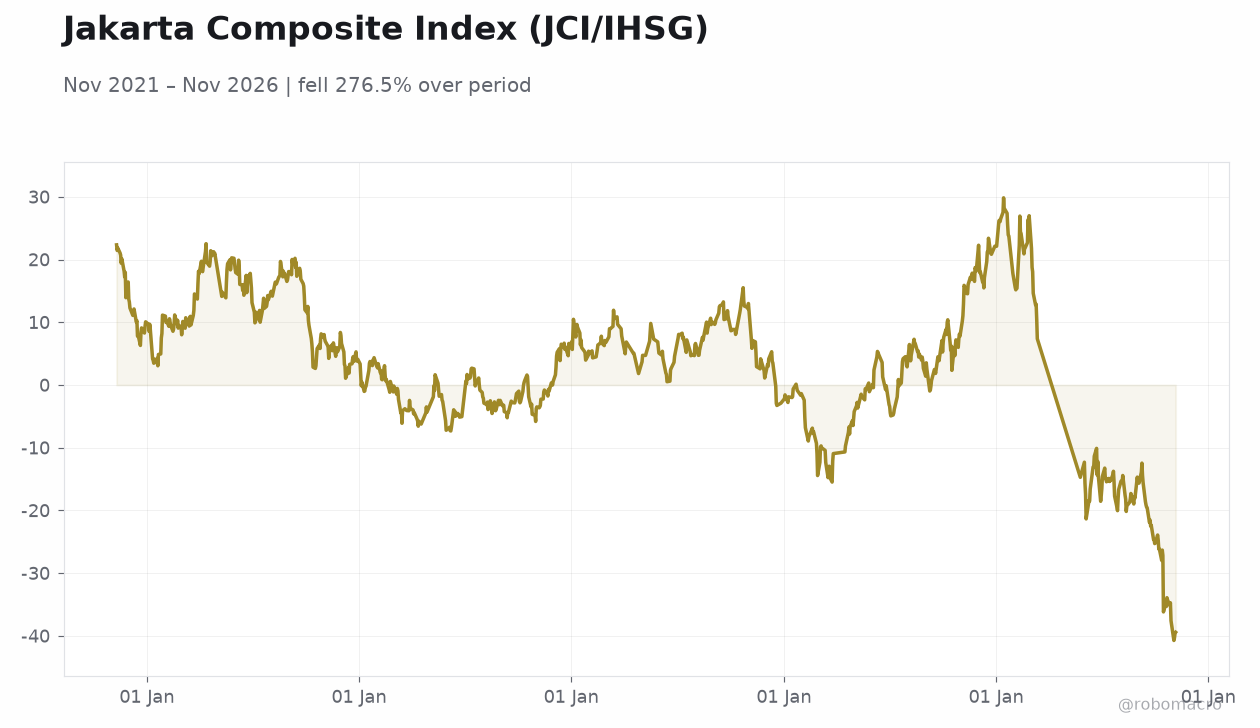
Jakarta Composite Index (JCI/IHSG)Jakarta Composite Index (JCI/IHSG) | Type: macro_line | Jakarta Composite Index (JCI/IHSG): -39.42 (2026-11-06) | Range: -40.73–29.84 | Trend(6pt): 22.34,1.896,4.946,3.692,-39.53,-39.42

Today's Economic Events

Data Prior Cons Time
No events available
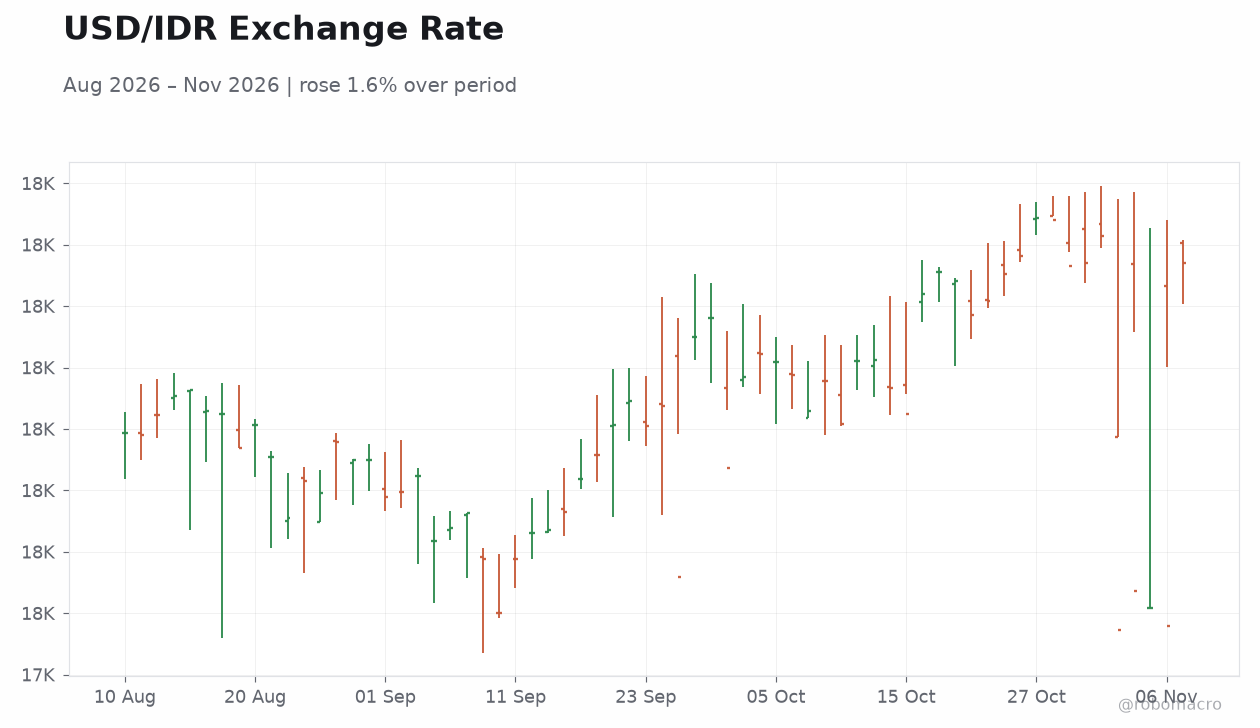
  • USD/IDR jumped 3.38% to 18,070, the sharpest single-day move among ASEAN currencies, even as Brent crude collapsed 6.26% to $92.17.
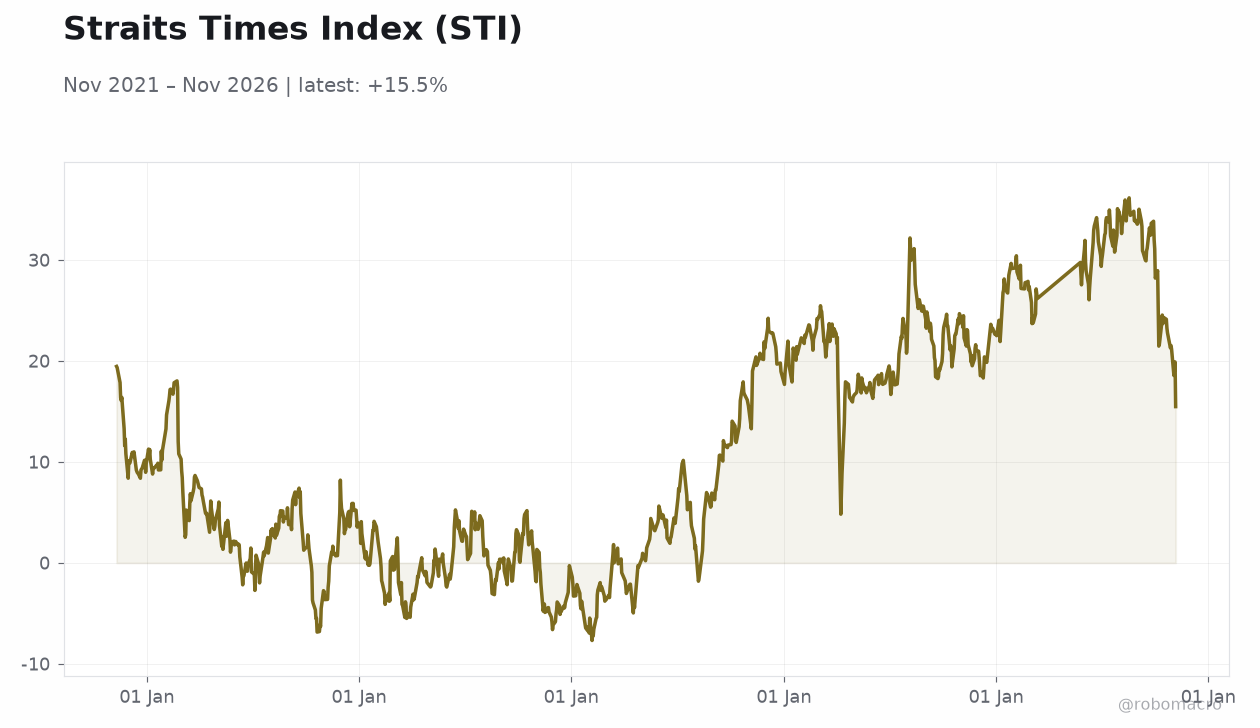
  • Singapore's STI fell 2.21% and Malaysia's KLCI dropped 1.18%, while Jakarta's JCI bucked the trend with a 0.40% gain.
  • Bank Indonesia's next policy meeting on 18 November looms large, with the rupiah's slide likely to dominate the agenda ahead of the decision.

Yesterday's Recap

Indonesian markets delivered the region's most striking divergence on 8 November, with the JCI eking out a 0.40% gain to 5,050.43 while the rupiah cratered 3.38% to 18,070 per dollar — an unusually large one-day depreciation for a currency that typically moves in fractions of a percent. The move came despite Brent crude tumbling 6.26% to $92.17, a development that should ordinarily support the rupiah given Indonesia's status as a net energy importer. Malaysian equities softened, with the KLCI shedding 1.18% to 1,616.58, though the ringgit firmed modestly after Bank Negara Malaysia's decision to hold the Overnight Policy Rate at 2.75%, with USD/MYR at 4.06.

Singapore bore the region's sharpest equity losses, the STI falling 2.21% to 5,179.17, a move consistent with the city-state's high beta to global risk sentiment; the Singapore dollar was essentially flat at 1.28. Thailand's baht held steady at 33.41, and the Philippine peso weakened 0.50% to 63.06. Gold's 1.83% rally to $4,149.50 alongside the rupiah's slide suggests a broad risk-off undertone rather than an Indonesia-specific story alone.

The Day Ahead

The calendar is light for 9 November, with no scheduled ASEAN statistical releases, leaving markets to digest the prior session's FX volatility. Attention turns to Bank Indonesia's 18 November policy meeting, now less than two weeks out, where the rupiah's recent weakness will be central to the deliberation. Thailand's next central bank meeting is not until 23 December, so baht traders will focus on oil-price pass-through into the kingdom's fuel-heavy inflation basket.

Malaysia's economists are already positioning for a potential BNM tightening cycle, with several forecasting a move to 3.0% in the first quarter of 2027. Singapore's MAS, which sets policy via the Singapore dollar NEER band rather than interest rates, will be watching the STI's sharp drawdown for signs of broader regional contagion.

Other Economic Notes

Indonesia's economy grew 5.47% on the year, according to reporting on the latest national accounts, yet anecdotal evidence of household strain persists — a disconnect worth monitoring as consumption forms the backbone of domestic demand. Thailand's October inflation rose to 3.9% on surging fuel prices, a print that sits well above the IMF's 2.53% August reading and complicates the BoT's accommodative stance. ↓ p.2
Page 1

ASEAN Macro Daily(Beta Mode)

November 10, 2026 robomacro.com
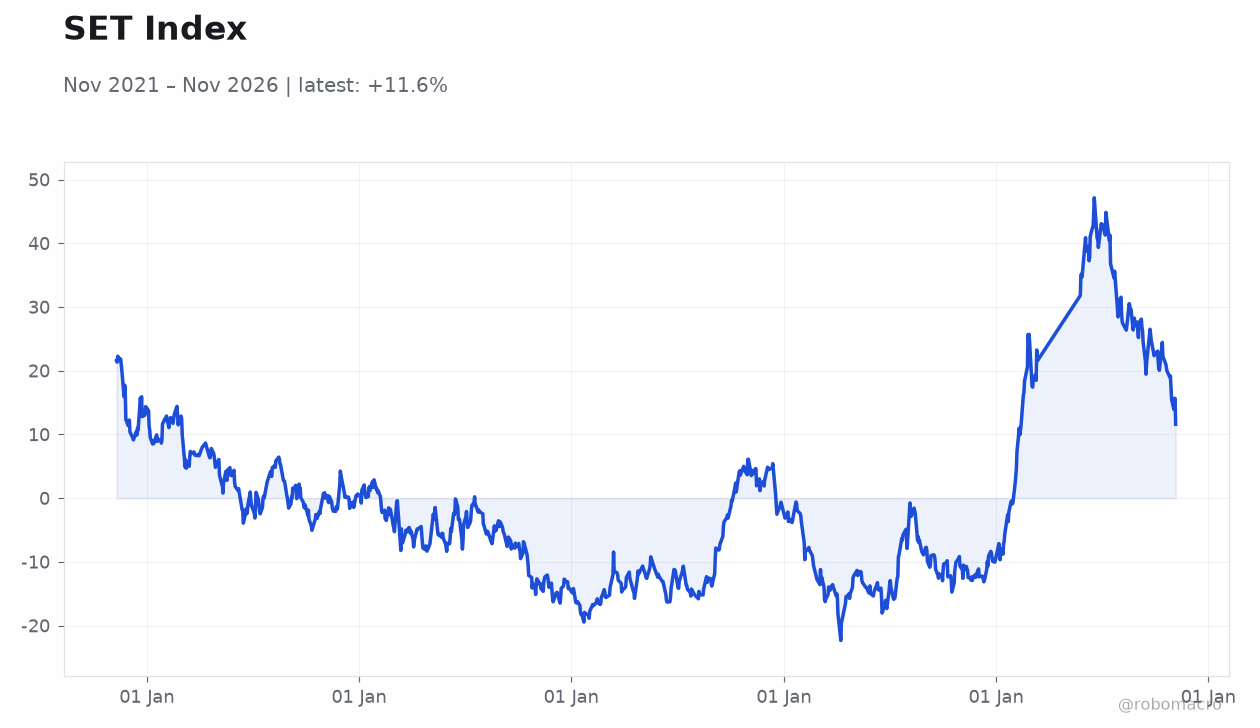
SET Index SET Index | Type: macro_line | SET Index: 11.6 (2026-11-06) | Range: -22.33–47.14 | Trend(5pt): 21.56,-1.457,-17.74,-17.77,11.6
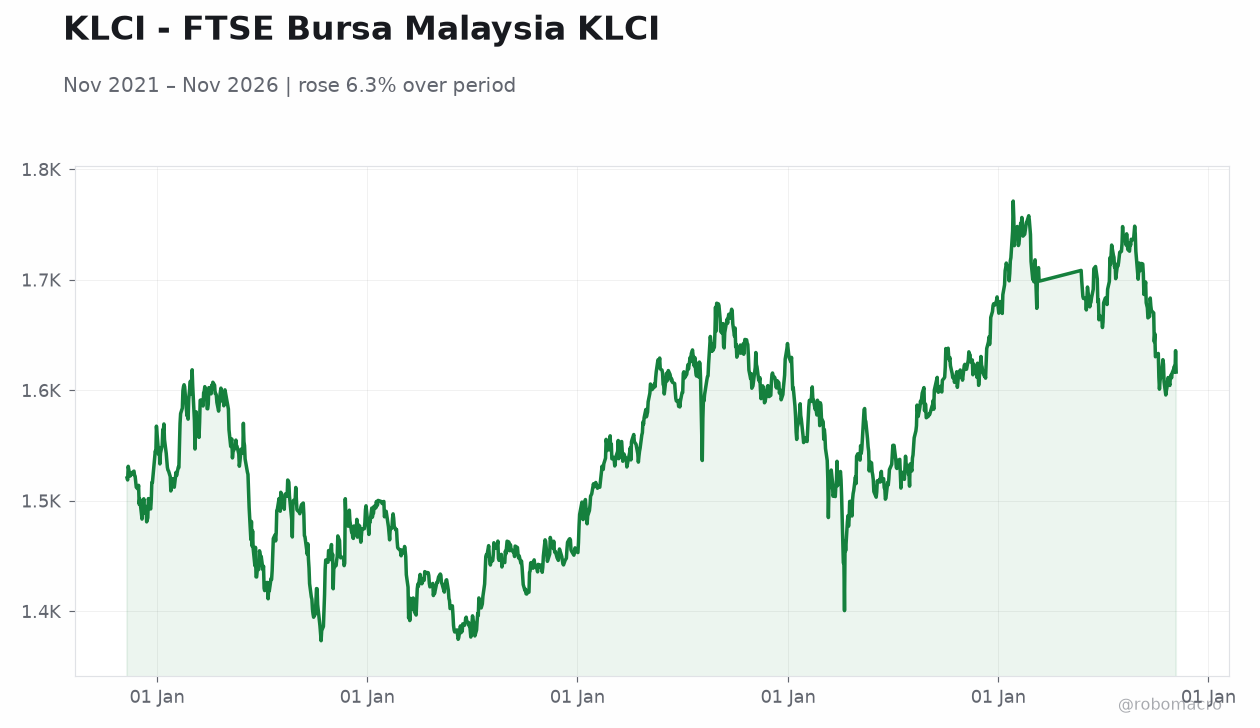
KLCI - FTSE Bursa Malaysia KLCI KLCI - FTSE Bursa Malaysia KLCI | Type: macro_line | KLCI - FTSE Bursa Malaysia KLCI: 1617 (2026-11-06) | Range: 1373–1771 | Trend(6pt): 1521,1499,1555,1501,1617,1617
Straits Times Index (STI) Straits Times Index (STI) | Type: macro_line | Straits Times Index (STI): 15.48 (2026-11-06) | Range: -7.686–36.16 | Trend(6pt): 19.46,5.895,-2.697,17.71,19.13,15.48
USD/IDR Exchange Rate USD/IDR Exchange Rate | Type: market_hloc | USD/IDR: 1.807e+04 (2026-11-09) | Range: 1.747e+04–1.814e+04 | Trend(6pt): 1.779e+04,1.769e+04,1.78e+04,1.782e+04,1.748e+04,1.807e+04

Other Economic Notes (continued)

Thailand's Board of Investment has logged 1.7 trillion baht in pledges but still characterizes the pipeline as insufficient, with semiconductors and EVs flagged as the next frontier. Bangkok's cabinet approved raising excise taxes on fully imported EVs from 10% to 35% effective January 2027, a protectionist pivot designed to nurture local production. Malaysia's ringgit is expected by sell-side strategists to trade in a consolidating range against the dollar through the fourth quarter.

Global Macro News

The 6.26% single-session collapse in Brent crude to $92.17 is the dominant global macro signal, and its transmission into ASEAN is uneven — supportive for energy importers like Thailand and the Philippines, but a headwind for Malaysia's oil-linked fiscal revenues. Gold's push to $4,149.50 reflects persistent demand for haven assets, a theme that typically coincides with dollar strength and pressure on emerging-market currencies such as the rupiah. Bitcoin's modest 0.44% gain to $74,915 suggests crypto markets are not yet pricing acute risk aversion, leaving the FX move looking more idiosyncratic than systemic.

US midterm election results are cited by Malaysian FX desks as a near-term driver of dollar direction, with the ringgit edging up as investors await outcomes. The broader theme of China-plus-one supply chain relocation continues to shape FDI flows into Vietnam and Malaysia, though Thailand's AI-linked manufacturing data has prompted economists to lift growth forecasts — albeit still trailing regional peers.

Sponsored by Arbitrage Search
Page 2

ASEAN Macro Daily(Beta Mode)

November 10, 2026 robomacro.com

Continuation

ASEAN Central Banks Watch

Bank Indonesia holds its policy rate at 5.75%, a level set at the 18 June 2026 decision and reaffirmed at the 21 October meeting; the next gathering on 18 November will be scrutinized for any signal that the rupiah's 3.38% slide has forced a shift in stance. BI has historically been the region's most interventionist central bank, and the scale of yesterday's currency move raises the probability of FX smoothing operations and reserve drawdowns in the interim. The Bank of Thailand holds at 1.00%, set at the 25 February decision and maintained on 28 October, with October inflation at 3.9% now testing the case for patience ahead of the 23 December meeting.

Bank Negara Malaysia held at 2.75% and the ringgit firmed in response, though economists increasingly expect a hike to 3.0% in the first quarter of 2027 — a divergence from Thailand's easing bias. The BSP has kept the peso's slide contained at 63.06, while MAS's NEER-band framework means Singapore's policy tightening operates through the currency rather than a headline rate, and the STI's 2.21% drop will inform its next review. The SBV in Vietnam remains the region's fastest-growing economy's steward, managing dong stability amid strong manufacturing FDI inflows.

Sponsored by Arbitrage Search
Page 3