ASEAN Macro Daily(Beta Mode)
Rupiah Record Low Puts BI in a Policy Bind
Market Snapshot
| Asset | Level | Change |
|---|---|---|
| JCI | 5,320.98 | -0.44% |
| KLCI | 1,588.03 | +0.34% |
| STI | 5,183.18 | -0.93% |
| USD/IDR | 18,240.00 | +0.10% |
| USD/THB | 33.78 | -0.21% |
| USD/MYR | 4.09 | +0.16% |
| USD/PHP | 63.56 | -0.47% |
| USD/SGD | 1.29 | -0.03% |
| Brent Crude | 93.07 | +0.68% |
| Gold | 3,851.90 | -0.03% |
| Bitcoin | 64,457.62 | -0.61% |
| Indonesia 10Y Govt Yield | - | - |
| Thailand 10Y Govt Yield | - | - |
Prior Economic Events
| Data | Prior | Cons | Actual |
|---|---|---|---|
| No events available | |||
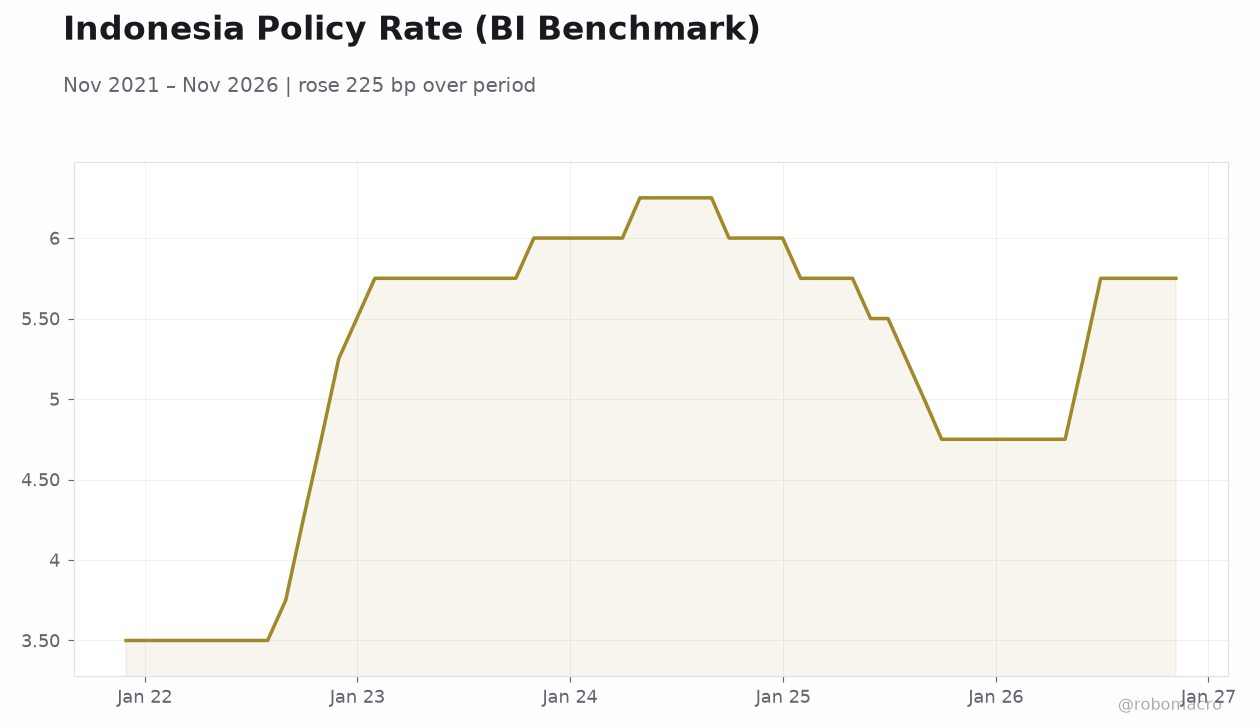 Indonesia Policy Rate (BI Benchmark) | Type: macro_line | BI policy rate (%): 5.75 (2026-11-06) | Range: 3.5–6.25 | Trend(5pt): 3.5,5.75,6.25,5,5.75
Today's Economic Events
| Data | Prior | Cons | Time |
|---|---|---|---|
| Wednesday (2026-11-18) | |||
| Central Bank Interest Rate Decision | 5.75 | - | 02:30 |
| Inflation Rate Month-over-Month | 0.10 | - | 23:00 |
| Inflation Rate Year-over-Year | 1.80 | - | 23:00 |
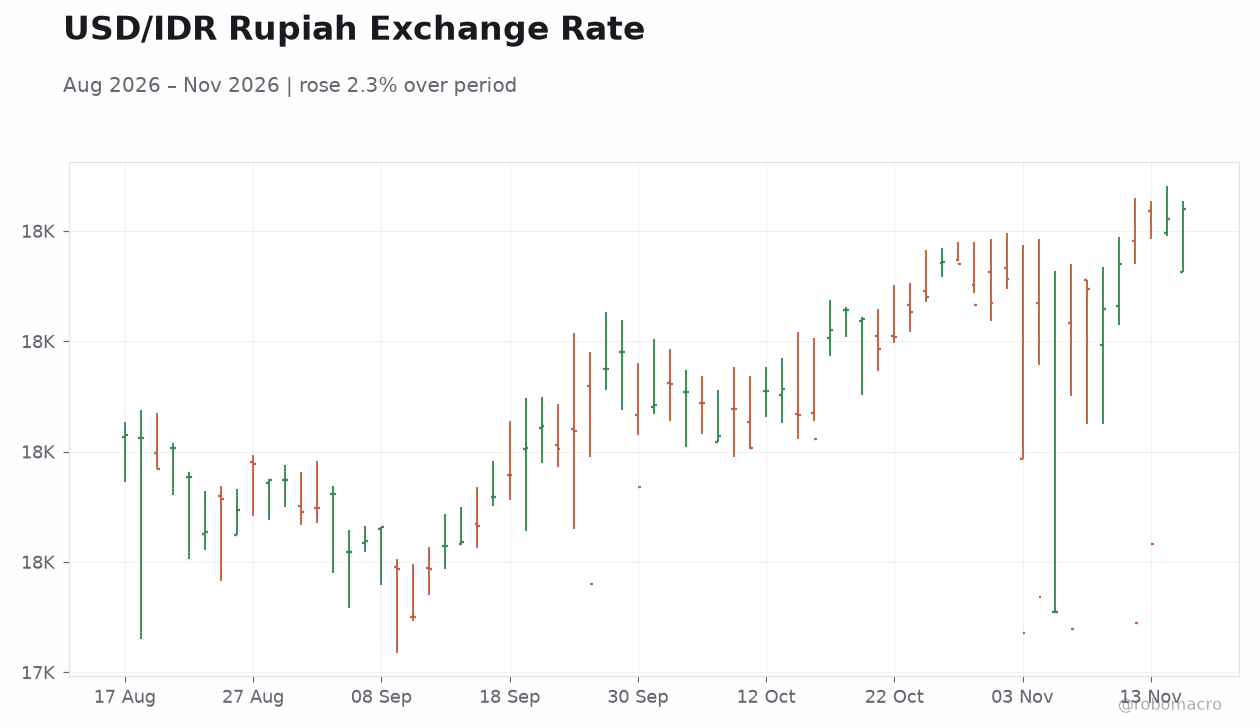
- Bank Indonesia faces a policy bind as the rupiah sits near record lows around 18,240/USD ahead of Wednesday's rate decision, with the benchmark held at 5.75% since the June hike.
- Regional equities diverged: Singapore's STI fell 0.93% and Jakarta's JCI slipped 0.44%, while Kuala Lumpur's KLCI gained 0.34%; ASEAN currencies were mixed against a firm dollar.
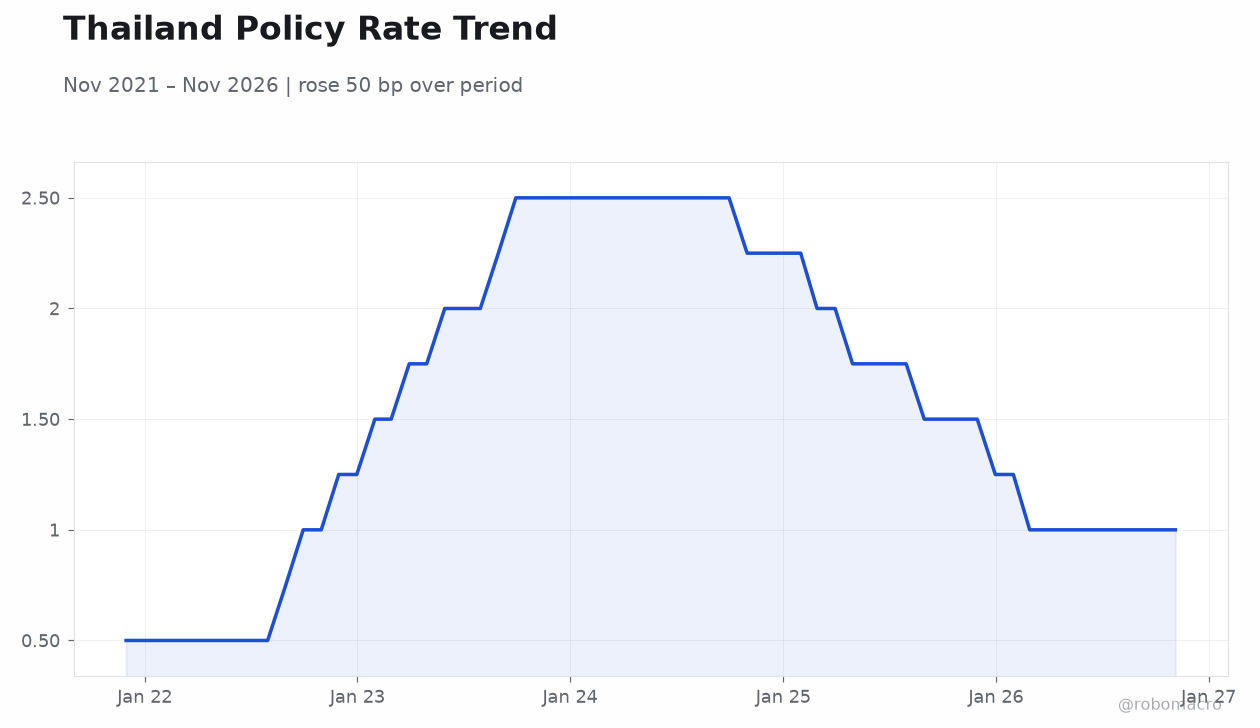
- Malaysia's October CPI is due Wednesday evening, with headline inflation previously at 1.8% YoY, as Bangkok moves closer to a US trade deal and joins a regional stablecoin arrangement with Singapore and Malaysia.
Yesterday's Recap
Indonesian markets dominated the session as the rupiah traded near record lows around 18,240/USD, up 0.10% on the day but still within striking distance of its weakest-ever levels, with analysts quoted by Bloomberg warning Jakarta faces an uphill battle to stem the slide. The JCI fell 0.44% to 5,320.98 as currency stress weighed on sentiment, and the rupiah's weakness has renewed focus on the hidden risks embedded in Indonesia's $458.9 billion debt stock. Elsewhere in ASEAN, Singapore's STI dropped 0.93% to 5,183.18, the region's sharpest equity decline, while Malaysia's KLCI edged up 0.34% to 1,588.03 and the ringgit opened marginally higher against the dollar.
The Philippine peso was the region's standout performer, with USD/PHP falling 0.47% to 63.56, while the baht strengthened 0.21% to 33.78 and the Singapore dollar was essentially flat at 1.29. Regional bond markets were quiet, with no fresh 10-year yield prints for Indonesia or Thailand in the data set. Brent crude rose 0.68% to $93.07, a reminder that energy costs remain a persistent inflation risk for the region's net importers.
The Day Ahead
The dominant event is Bank Indonesia's rate decision on Wednesday at 02:30 ET, with the benchmark expected to be held at 5.75% following the October hold and the June 25bp hike. Malaysia's October CPI releases Wednesday evening at 23:00 ET, with headline inflation previously running at 1.8% year-on-year and 0.1% month-on-month, a key input for BNM's policy stance. No other ASEAN data releases are scheduled, leaving markets to trade off the BI outcome and broader dollar dynamics.
Investors will watch the post-decision commentary closely for any signal on FX intervention intensity and reserve adequacy, given the rupiah's persistent weakness. Regional currency markets are likely to take their cue from the dollar's overnight direction and any shift in Fed rate expectations.
Other Economic Notes
Thailand and the US have nearly concluded months of trade negotiations after Bangkok made concessions to preserve access to its largest export market, with President Trump stating Thailand will eliminate tariffs on US exports and remove substantial nontariff barriers. ↓ p.2