ASEAN Macro Daily(Beta Mode)
BI Hikes to 6% as Rupiah Slides
Market Snapshot
| Asset | Level | Change |
|---|---|---|
| JCI | 5,247.88 | -1.07% |
| KLCI | 1,566.73 | -0.53% |
| STI | 5,054.89 | -1.06% |
| USD/IDR | 18,235.00 | +3.26% |
| USD/THB | 33.95 | +0.46% |
| USD/MYR | 4.11 | +0.47% |
| USD/PHP | 63.68 | +0.26% |
| USD/SGD | 1.29 | +0.16% |
| Brent Crude | 90.05 | -2.07% |
| Gold | 3,627.90 | -3.05% |
| Bitcoin | 61,752.95 | -1.96% |
| Indonesia 10Y Govt Yield | - | - |
| Thailand 10Y Govt Yield | - | - |
Prior Economic Events
| Data | Prior | Cons | Actual |
|---|---|---|---|
| Central Bank Interest Rate Decision | 5.75 | 5.75 | 6 |
| Inflation Rate Month-over-Month | 0.10 | - | 0.10 |
| Inflation Rate Year-over-Year | 1.80 | 2 | 1.90 |
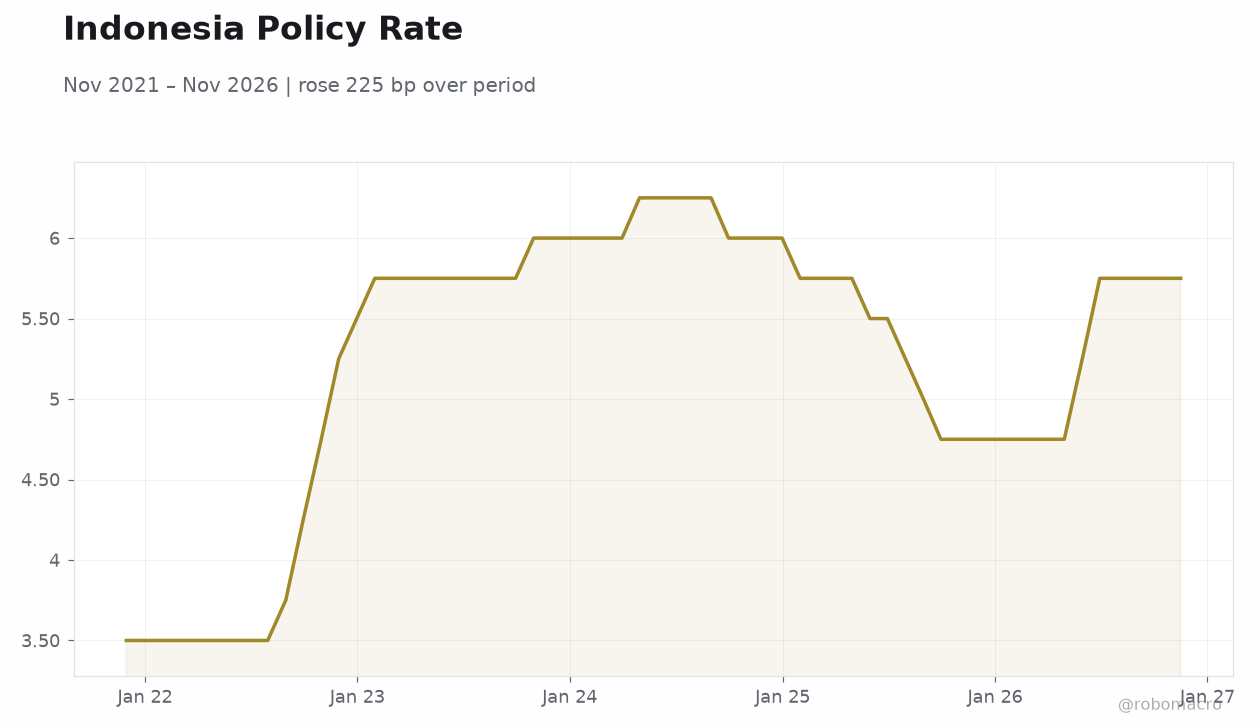 Indonesia Policy Rate | Type: macro_line | Policy rate (%): 5.75 (2026-11-16) | Range: 3.5–6.25 | Trend(5pt): 3.5,5.75,6.25,5,5.75
Today's Economic Events
| Data | Prior | Cons | Time |
|---|---|---|---|
| No events available | |||
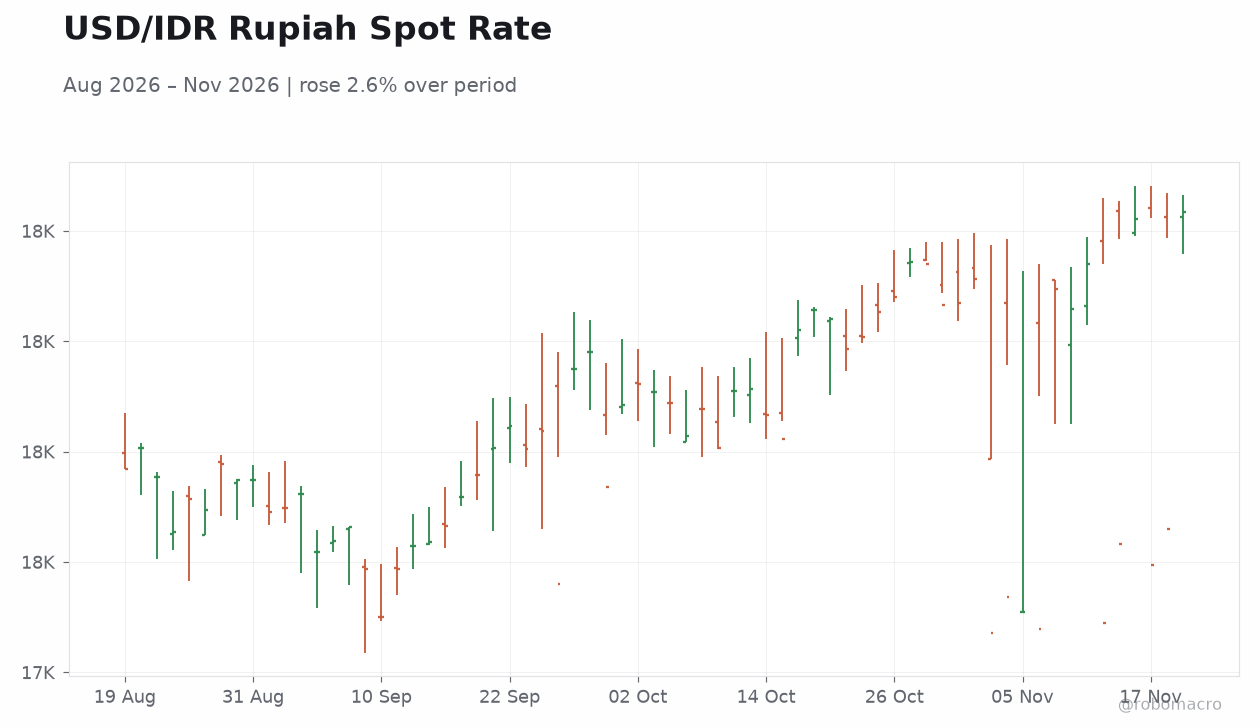
- Bank Indonesia delivered an unexpected 25bp hike to 6.00%, prioritising rupiah defence over growth as USD/IDR jumped 3.26% to 18,235.
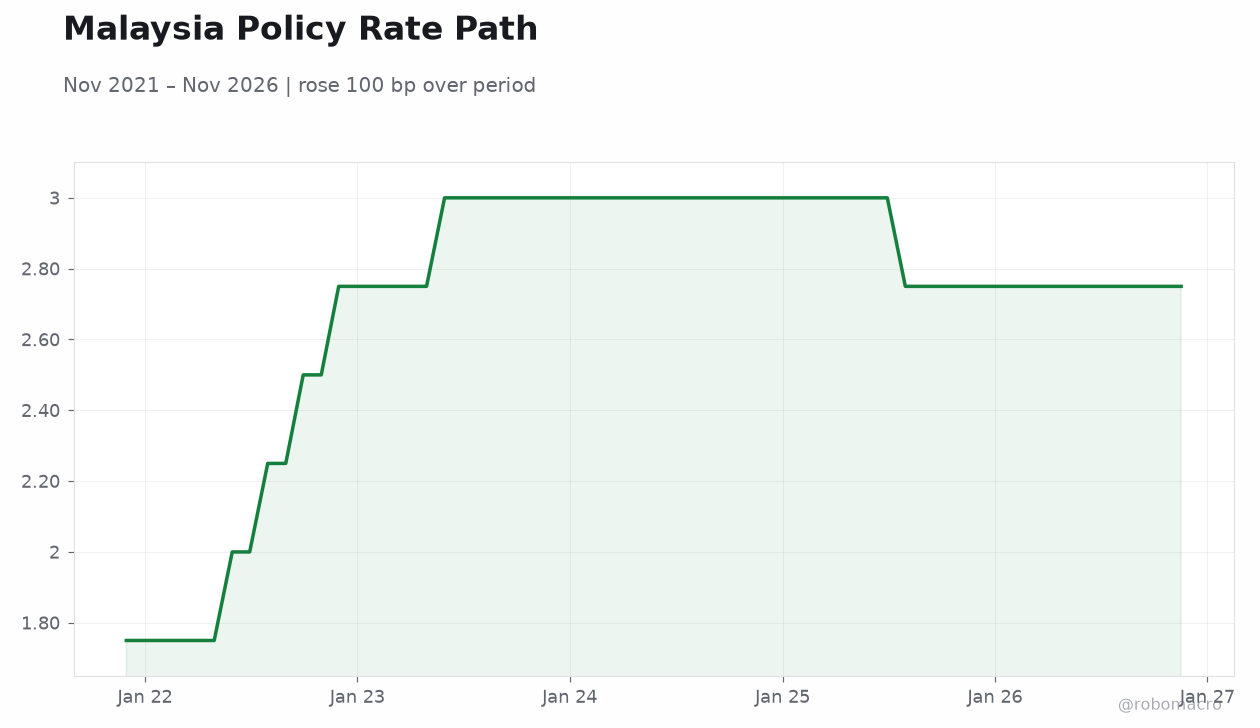
- Malaysia's October CPI printed at 1.90% y/y (0.10% m/m), with Q3 GDP growth of 5.5% underpinning BNM's confident 2027 outlook.
- Regional risk assets sold off broadly — JCI -1.07%, STI -1.06%, KLCI -0.53% — while Brent fell 2.07% and gold slumped 3.05%.
Yesterday's Recap
Bank Indonesia surprised markets with a 25bp hike to 6.00% against consensus for a hold at 5.75%, resuming its tightening cycle explicitly to shore up the rupiah, which had touched record lows. The move came alongside new hedging incentives for exporters, signalling a multi-tool defence of the currency. Despite the hike, USD/IDR still closed 3.26% higher at 18,235, underscoring the scale of depreciation pressure.
Indonesian equities bore the brunt, with the JCI down 1.07%. In Malaysia, October CPI came in at 1.90% y/y versus consensus of 2.0% and 0.10% m/m, a benign print that keeps BNM comfortably on hold. Malaysia's Q3 GDP growth of 5.5% — with 5.6% recorded across the first nine months — reinforced the ringgit's stability narrative, though USD/MYR still edged 0.47% higher to 4.11.
Singapore's STI fell 1.06%, and USD/SGD rose 0.16% to 1.29, with regional FX broadly softer against the dollar.
The Day Ahead
No scheduled ASEAN data releases fall today or tomorrow, leaving price action to be driven by the aftermath of the BI decision and regional FX dynamics. Markets will watch whether the rupiah stabilises following the hike and hedging measures, or whether further intervention is required. Singapore and Malaysian traders will focus on spillover from the regional equity selloff and any follow-through in the SGD and MYR crosses.
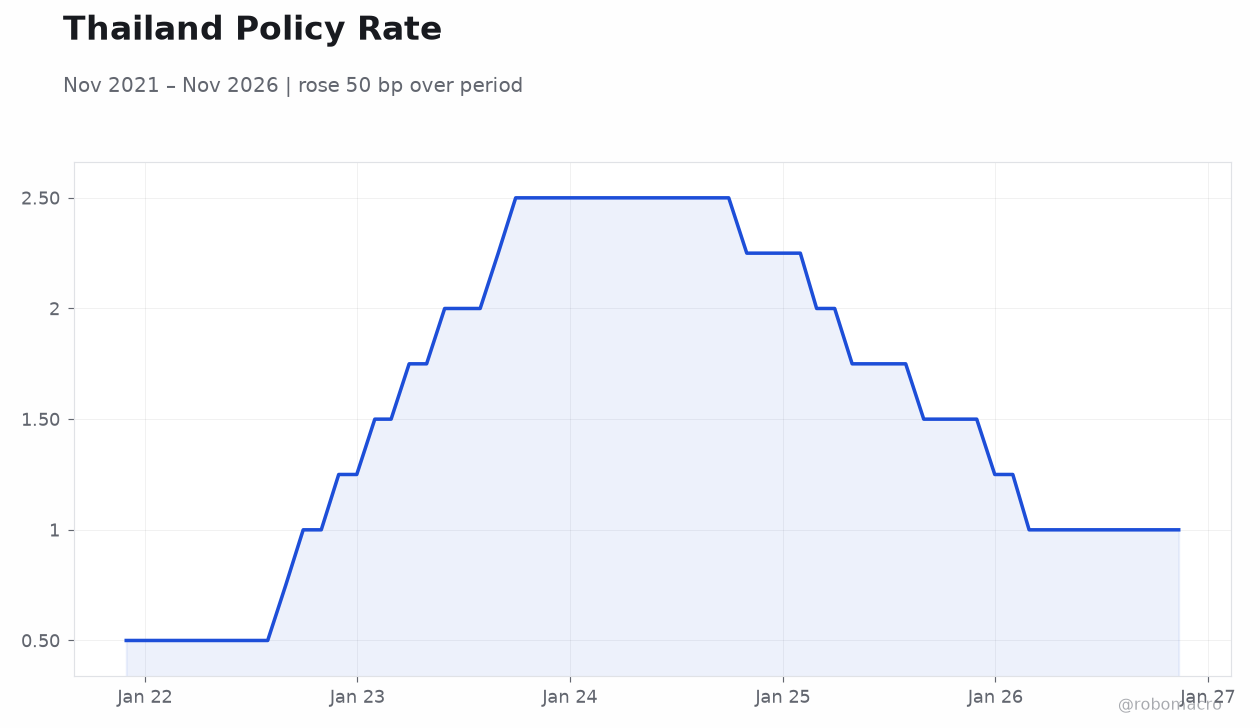
Attention also turns to positioning ahead of the weekend, with Thai and Philippine markets likely to track broader risk sentiment given the absence of domestic catalysts. With the BI decision now digested, the next focal point is December's BoT meeting on the 23rd.
Other Economic Notes
Malaysia's growth story remains the regional standout, with BNM's governor attributing resilience to a diversified economy less reliant on the AI-driven tech cycle than regional peers. The central bank also flagged healthy forex flows supporting the ringgit, which it expects to remain broadly stable near term despite global uncertainty. Indonesia's hike, by contrast, highlights the tension between inflation running at 3.23% y/y and a currency under severe strain.
Thailand's CPI at 3.90% y/y remains the highest in the region, complicating the BoT's low-rate stance. ↓ p.2