Argentina Macro Daily(Beta Mode)
MERVAL Slides 2.6% as Peso Weakens
Market Snapshot
| Asset | Level | Change |
|---|---|---|
| MERVAL | 3,188,971.00 | -2.61% |
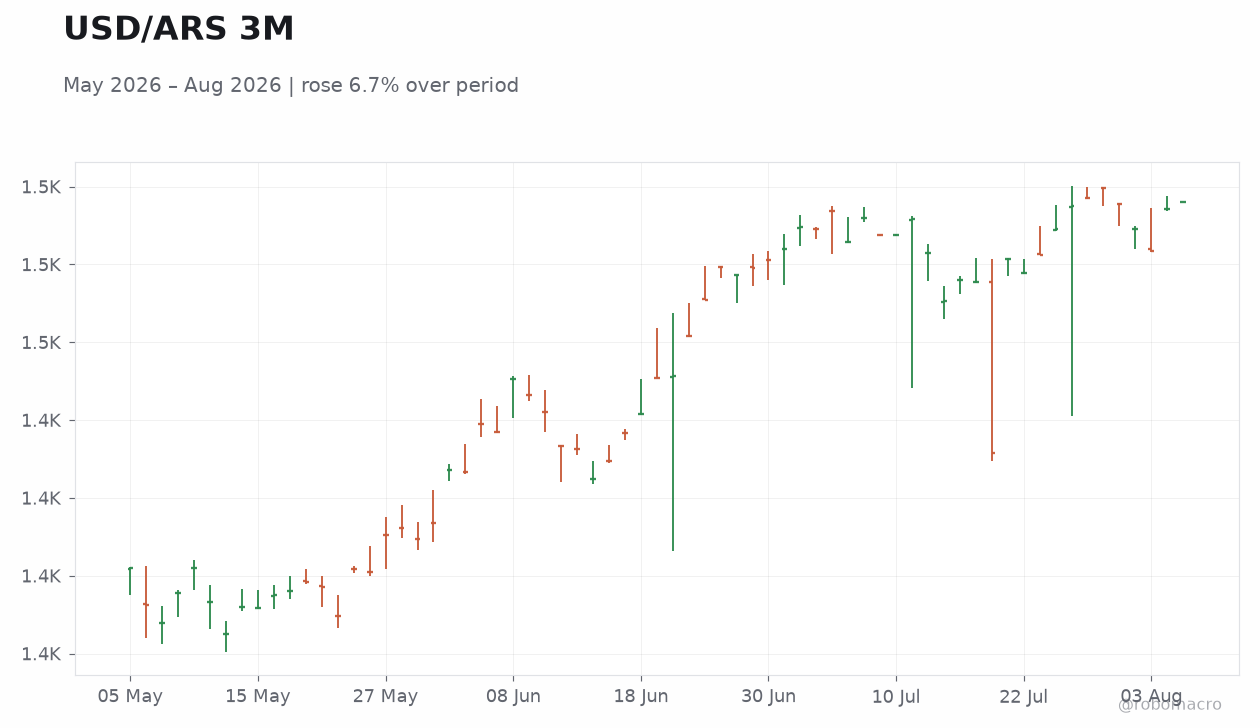
| USD/ARS | 1,496.00 | +0.12% |
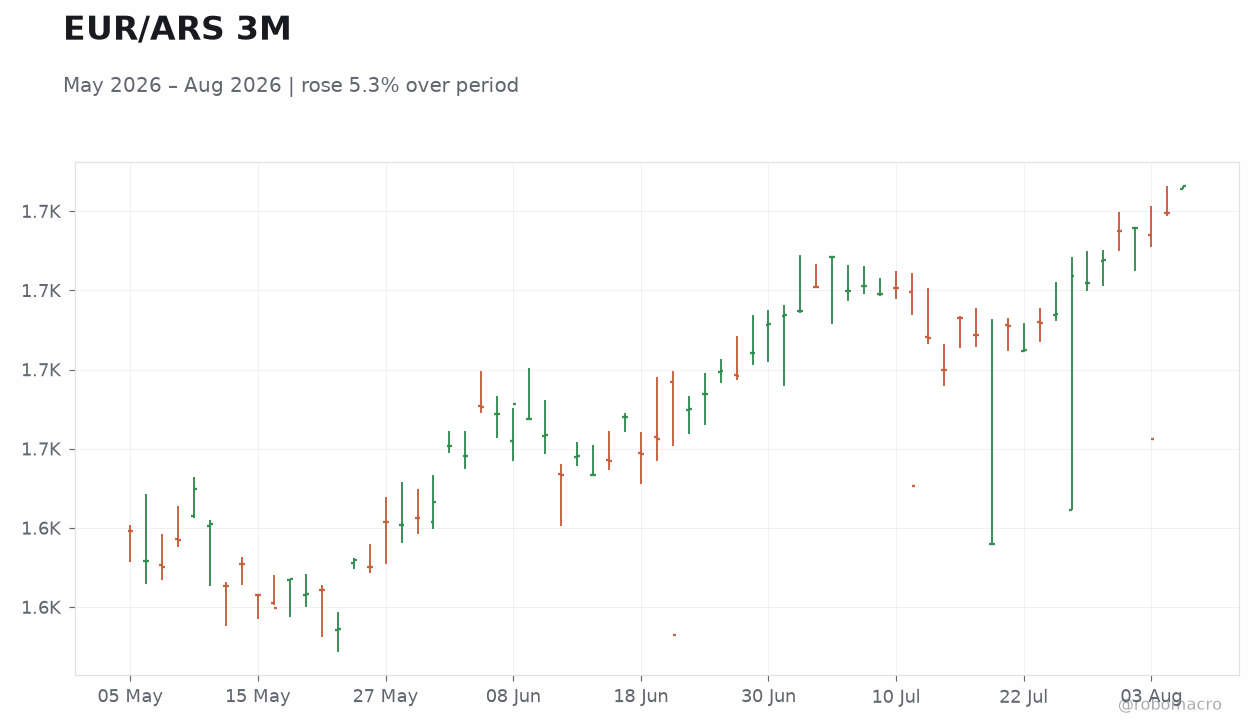
| EUR/ARS | 1,726.36 | +0.40% |
| Gold | 4,216.00 | +2.94% |
| Brent Crude | 80.36 | +1.26% |
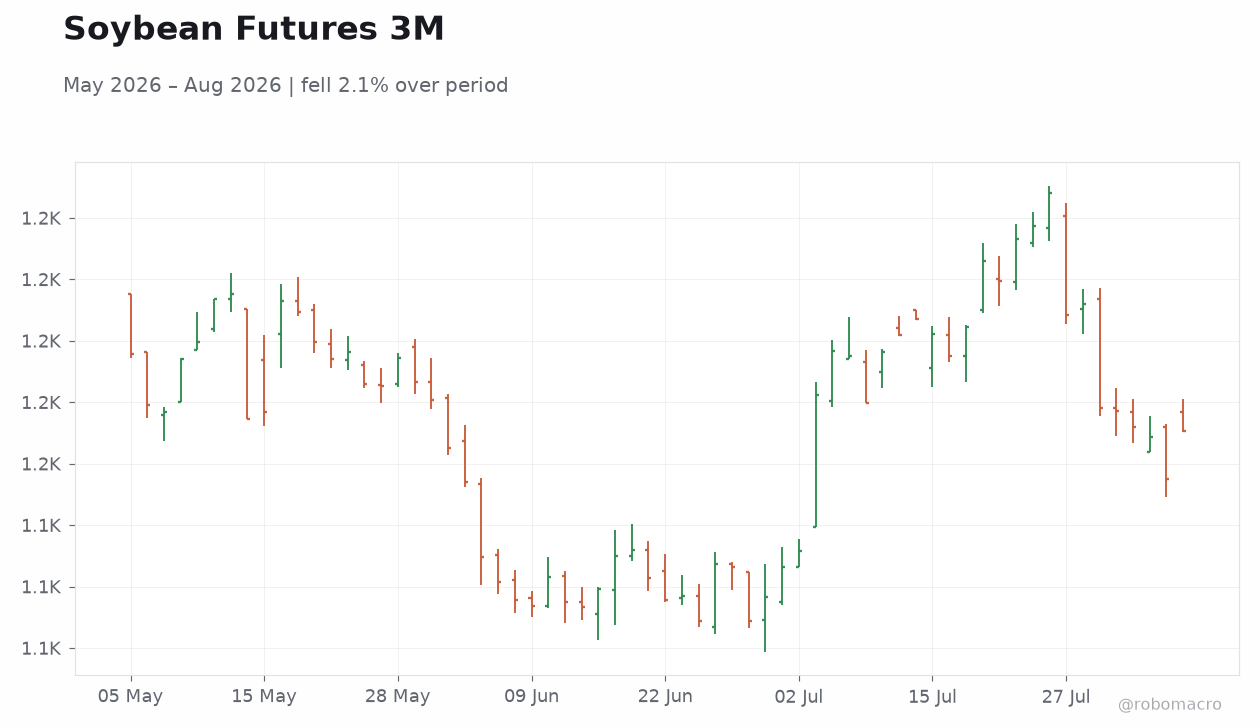
| Soybean | 1,170.50 | +1.34% |
| Bitcoin | 64,142.33 | +1.07% |
| Argentina 10Y | - | - |
Prior Economic Events
| Data | Prior | Cons | Actual |
|---|---|---|---|
| No events available | |||
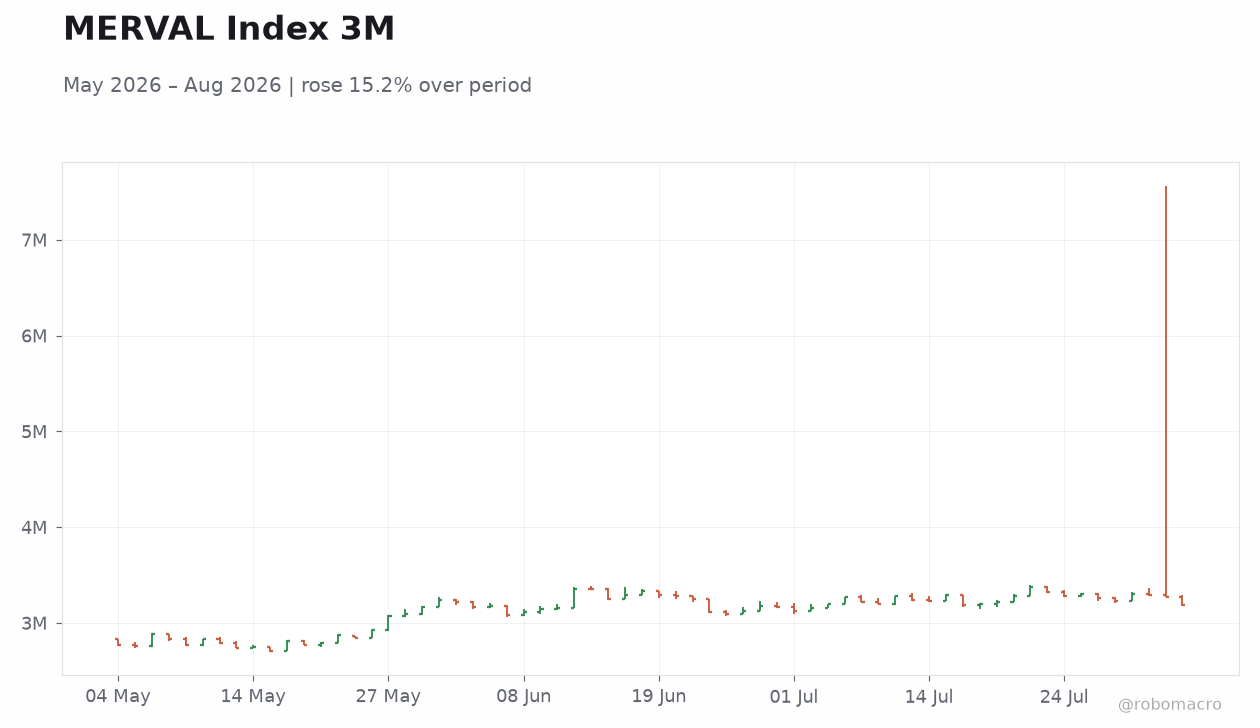 MERVAL Index 3M | Type: market_hloc | MERVAL: 3.189e+06 (2026-08-04) | Range: 2.708e+06–3.38e+06 | Trend(5pt): 2.767e+06,3.072e+06,3.291e+06,3.229e+06,3.189e+06
Today's Economic Events
| Data | Prior | Cons | Time |
|---|---|---|---|
| No events available | |||
- MERVAL falls 2.61% to 3,188,971 on thin volume
- USD/ARS rises 0.12% to 1,496 amid light BCRA intervention
- Soybean prices climb 1.34% to $1,170.50, bolstering export outlook
Yesterday's Recap
Argentine markets closed lower with the MERVAL declining 2.61% to 3,188,971 amid limited local catalysts and profit-taking in financial names. The official USD/ARS rate advanced 0.12% to 1,496 while the EUR/ARS pair gained 0.40% to 1,726.36, reflecting modest peso softening against major currencies. Gold rose 2.94% to $4,216 per ounce and Brent crude added 1.26% to $80.36 per barrel, providing indirect support to Argentine commodity-linked revenues.
No economic data releases occurred, leaving trading driven by global risk sentiment and positioning ahead of the quiet August calendar. President Javier Milei’s renewed accusations of external financing for anti-Argentina campaigns added political noise but elicited limited immediate market reaction. Bitcoin gained 1.07% to $64,142, consistent with broader crypto resilience observed across Latin America.
The Argentina 10Y bond remained unquoted, underscoring ongoing liquidity constraints in the local fixed-income market.
The Day Ahead
The domestic calendar stays empty through August 6, with no scheduled inflation prints, trade balances or fiscal releases. Attention will center on any BCRA foreign-exchange interventions and updates to reserve accumulation metrics. Global commodity moves, particularly soybean futures and Brent crude, will continue to influence export-tax receipts and the current-account trajectory.
Market participants will monitor speeches from ECB and Federal Reserve officials for signals on external financing conditions relevant to the IMF program. Treasury bill auctions later in the week may reveal demand for short-term peso instruments and any shifts in implied policy rates.
Other Economic Notes
Fiscal consolidation efforts remain on track following the latest IMF disbursement, with net reserves holding near recent highs despite limited new capital-control easing. Soybean export registrations continue to show modest improvement, supporting government revenue projections even as the crawling-peg band stays unchanged. Broader disinflation momentum appears intact, though sticky services prices and the absence of fresh wholesale data leave the pace of further BCRA easing uncertain.
Political rhetoric from the executive has not yet translated into legislative progress on structural reforms needed to sustain the IMF arrangement.