Argentina Macro Daily(Beta Mode)
Peso Firms as Soy Complex Diverges
Market Snapshot
| Asset | Level | Change |
|---|---|---|
| MERVAL | 2,848,945.00 | -0.35% |
| USD/ARS | 1,538.00 | -0.24% |
| EUR/ARS | 1,722.66 | +0.16% |
| Gold | 3,992.60 | -0.96% |
| Brent Crude | 112.91 | -1.71% |
| Soybean | 1,235.75 | +1.31% |
| Bitcoin | 77,925.77 | +0.19% |
| Argentina 10Y | - | - |
Prior Economic Events
| Data | Prior | Cons | Actual |
|---|---|---|---|
| No events available | |||
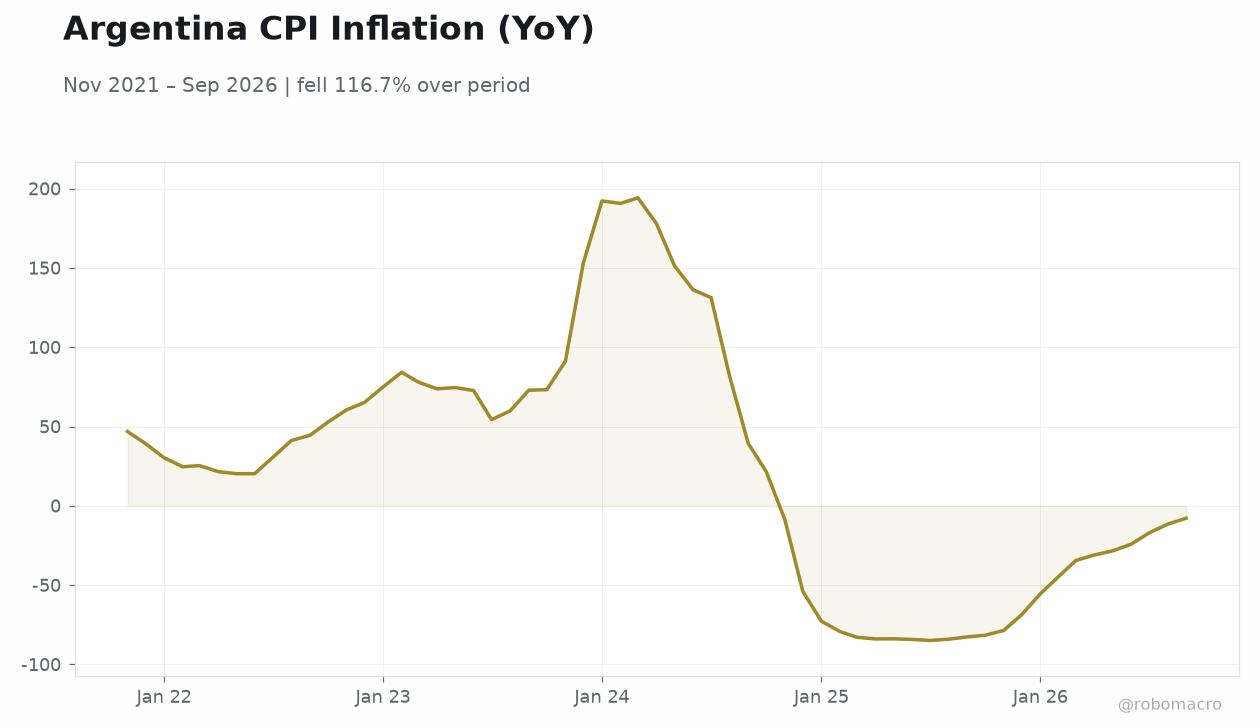 Argentina CPI Inflation (YoY) | Type: macro_line | CPI YoY %: -7.835 (2026-09-01) | Range: -84.92–194.2 | Trend(6pt): 46.82,74.96,194.2,-83.86,-17.16,-7.835
Today's Economic Events
| Data | Prior | Cons | Time |
|---|---|---|---|
| No events available | |||
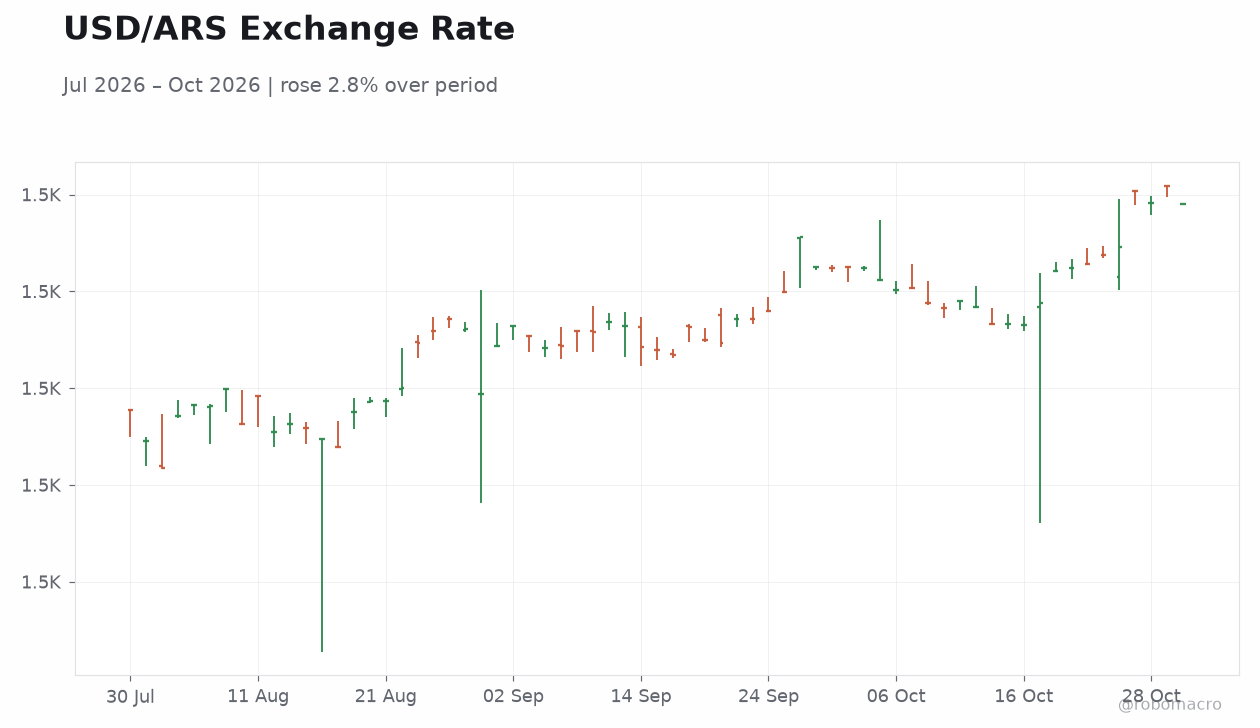
- USD/ARS slipped 0.24% to 1,538.00 while EUR/ARS edged up 0.16% to 1,722.66, a mixed FX tape with the peso firmer against the dollar.
- MERVAL eased 0.35% to 2,848,945, consolidating after recent gains; Argentina 10Y yield data unavailable in the feed.
- Soybeans jumped 1.31% to 1,235.75 while Brent fell 1.71% to 112.91 — a favorable terms-of-trade skew for Argentina's export complex.
Yesterday's Recap
Argentine markets delivered a subdued session with no domestic data releases on the calendar, leaving price action to external drivers. The MERVAL closed at 2,848,945, down 0.35%, a modest pullback that nonetheless keeps the index near recent highs. The peso strengthened against the dollar, with USD/ARS falling 0.24% to 1,538.00, while EUR/ARS rose 0.16% to 1,722.66 — the cross reflecting euro strength rather than peso weakness.
In commodities, soybean prices gained 1.31% to 1,235.75, a constructive signal for the Rosario export complex and forward FX liquidation. Brent crude dropped 1.71% to 112.91, trimming energy import costs at the margin. Gold fell 0.96% to 3,992.60, and Bitcoin was essentially flat at 77,925.77, up 0.19%.
The Argentina 10Y yield line was blank in the feed, so no basis-point read is available for the session.
The Day Ahead
The calendar is empty for Friday, October 30, with no scheduled Argentine data releases, so flows and positioning will dominate. Traders will watch the official wholesale FX market for any BCRA intervention signals and the parallel spread for stress cues. Soybean follow-through matters: a second consecutive gain would reinforce the export-dollar outlook into next week's settlement cycle.
Month-end portfolio rebalancing could amplify moves in the MERVAL and local fixed income. With no domestic catalysts, global risk appetite and US rates will set the tone for the peso and sovereign curve.
Other Economic Notes
The disinflation trajectory remains the anchor for Argentine asset pricing, with CPI at 33.4% year-on-year as of September 30, per DATOSAR — a level that keeps real-rate math favorable but leaves room for caution. Fiscal consolidation continues to underpin the sovereign credit narrative, and the IMF programme remains the structural backstop for reserve accumulation. Soybean strength is the key swing factor for hard-currency inflows, and the 1.31% gain offers a constructive marginal signal.
Energy import costs are easing with Brent down 1.71%, a small positive for the trade balance. The absence of domestic prints today means the market will lean on these slow-moving fundamentals rather than fresh data.