Argentina Macro Daily(Beta Mode)
Peso Slides as BCRA Holds Firm
Market Snapshot
| Asset | Level | Change |
|---|---|---|
| MERVAL | 2,848,945.00 | -0.35% |
| USD/ARS | 1,602.00 | +0.60% |
| EUR/ARS | 1,755.82 | +0.58% |
| Gold | 3,597.70 | +1.75% |
| Brent Crude | 90.06 | -4.81% |
| Soybean | 1,244.00 | +0.81% |
| Bitcoin | 60,809.30 | +0.71% |
| Argentina 10Y | - | - |
Prior Economic Events
| Data | Prior | Cons | Actual |
|---|---|---|---|
| No events available | |||
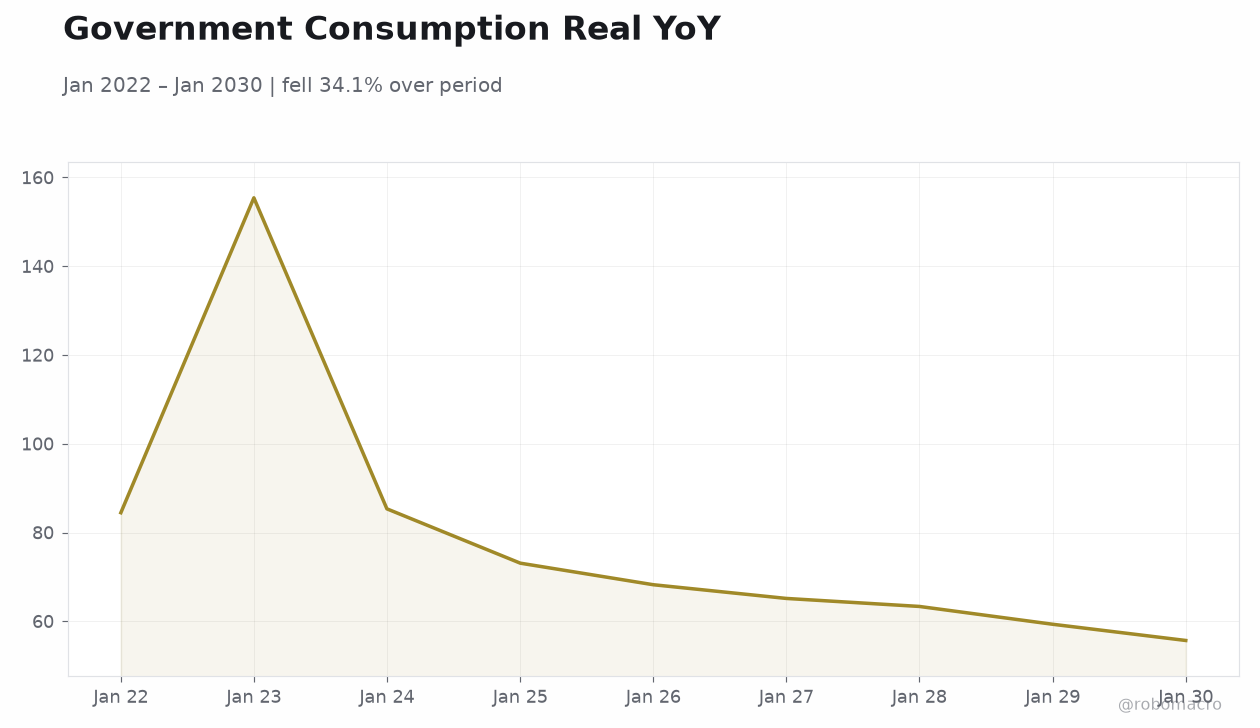 Government Consumption Real YoY | Type: macro_line | Government Consumption Real YoY: 55.67 (2030-01-01) | Range: 55.67–155.4 | Trend(5pt): 84.46,85.33,68.23,63.34,55.67
Today's Economic Events
| Data | Prior | Cons | Time |
|---|---|---|---|
| No events available | |||
- USD/ARS climbs 0.60% to 1,602 as peso softens despite high carry
- MERVAL slips 0.35% to 2,848,945; Brent collapse weighs on energy names
- Gold surges 1.75% to $3,597.70 as global risk-off accelerates
Yesterday's Recap
Argentine markets traded with a defensive tilt on Wednesday, with the MERVAL easing 0.35% to 2,848,945 points as energy names bore the brunt of a 4.81% collapse in Brent crude to $90.06. The peso weakened 0.60% to 1,602 per dollar, extending a gradual crawl that has persisted despite elevated local rates, while EUR/ARS rose 0.58% to 1,755.82. Soybean futures gained 0.81% to $1,244, offering a modest offset to the soft equity tape and supporting the export complex that anchors Argentina's FX generation.
Gold jumped 1.75% to $3,597.70, reflecting a broader flight to safety that has characterized global markets this week. Bitcoin edged up 0.71% to $60,809.30, though the crypto bid remains muted relative to bull-market highs. No official Argentine data releases were scheduled, leaving price action to reflect positioning and external drivers.
The 10-year sovereign yield was not quoted in the latest snapshot, limiting visibility on the bond complex.
The Day Ahead
The Argentine calendar is empty for Thursday, November 26, with no scheduled data releases from INDEC, the BCRA, or the Ministry of Economy. Market attention will therefore pivot entirely to external catalysts, most notably the US PCE and GDP prints that have already begun shaping EM FX positioning across Asia and Latin America. With no domestic prints to anchor the peso, traders will watch whether the crawl accelerates toward the 1,610-1,620 band or stabilizes on improved soybean demand.
The BCRA's daily FX intervention and reserve accumulation pattern will remain the key tell for near-term peso direction. Local equity flows should stay thin given the US holiday-adjacent liquidity drain.
Other Economic Notes
Argentina's disinflation trajectory remains the central macro anchor, with CPI at 33.1% year-over-year as of October 31, a level that keeps real rates deeply positive and sustains the carry trade appeal of peso assets. Fiscal consolidation under the Milei program continues to compress primary spending, though the social and political cost of subsidy removal remains a live risk. Soybean export receipts are the swing factor for reserve accumulation, and the 0.81% gain in soybean futures offers a constructive signal for the export complex.
The Brent collapse is a double-edged sword: it lowers energy import costs but pressures the Vaca Muerta investment thesis and weighs on MERVAL energy constituents. Reserve adequacy remains the binding constraint on any easing of capital controls.


