Brazil Macro Daily(Beta Mode)
BCB Minutes Signal Inflation Caution as Real Slumps
Market Snapshot
| Asset | Level | Change |
|---|---|---|
| Bovespa | 171,337.00 | -0.52% |
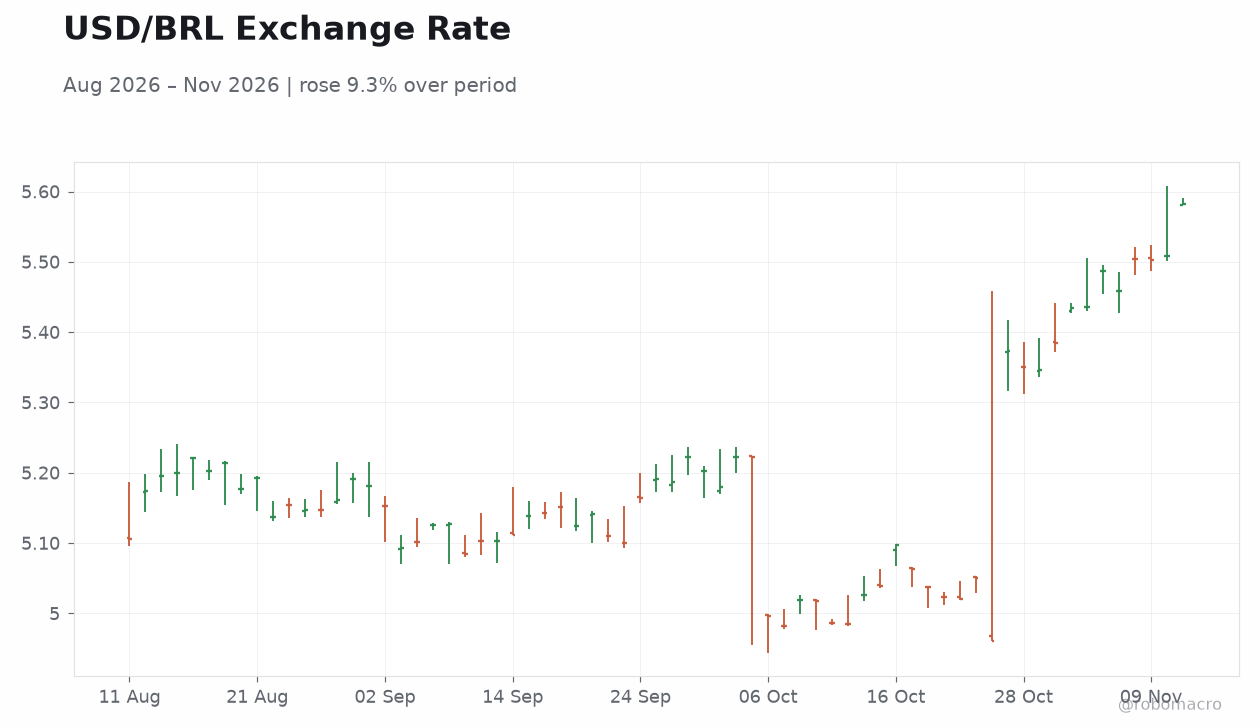
| USD/BRL | 5.58 | +1.35% |
| EUR/BRL | 6.23 | +0.80% |
| Vale | 11.58 | -3.26% |
| Petrobras | 18.28 | -0.38% |
| WTI Crude | 86.18 | +0.16% |
| Gold | 4,065.50 | +0.88% |
| Bitcoin | 73,600.00 | -0.16% |
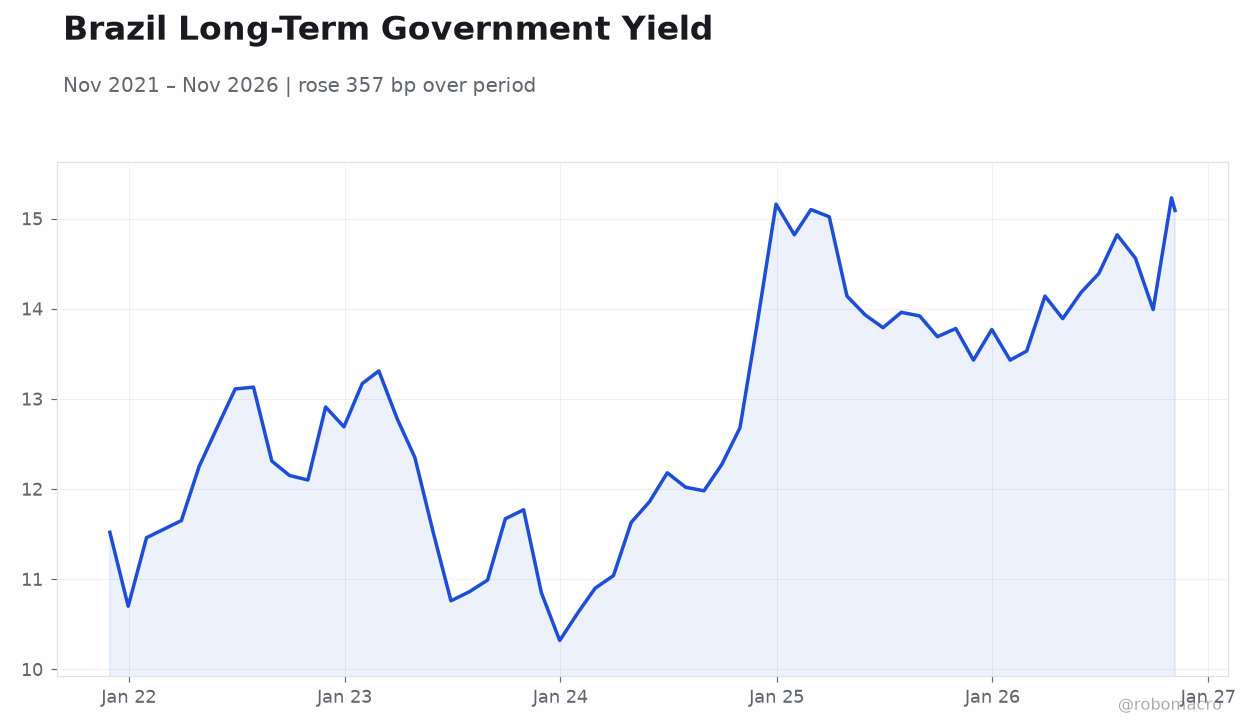
| Brazil 5Y Govt Yield | 14.99% | -9 bp |
| Brazil 10Y Govt Yield | 15.09% | -12 bp |
Prior Economic Events
| Data | Prior | Cons | Actual |
|---|---|---|---|
| BCB Focus Market Readout | - | - | "" |
| BCB Copom Meeting Minutes | - | - | - |
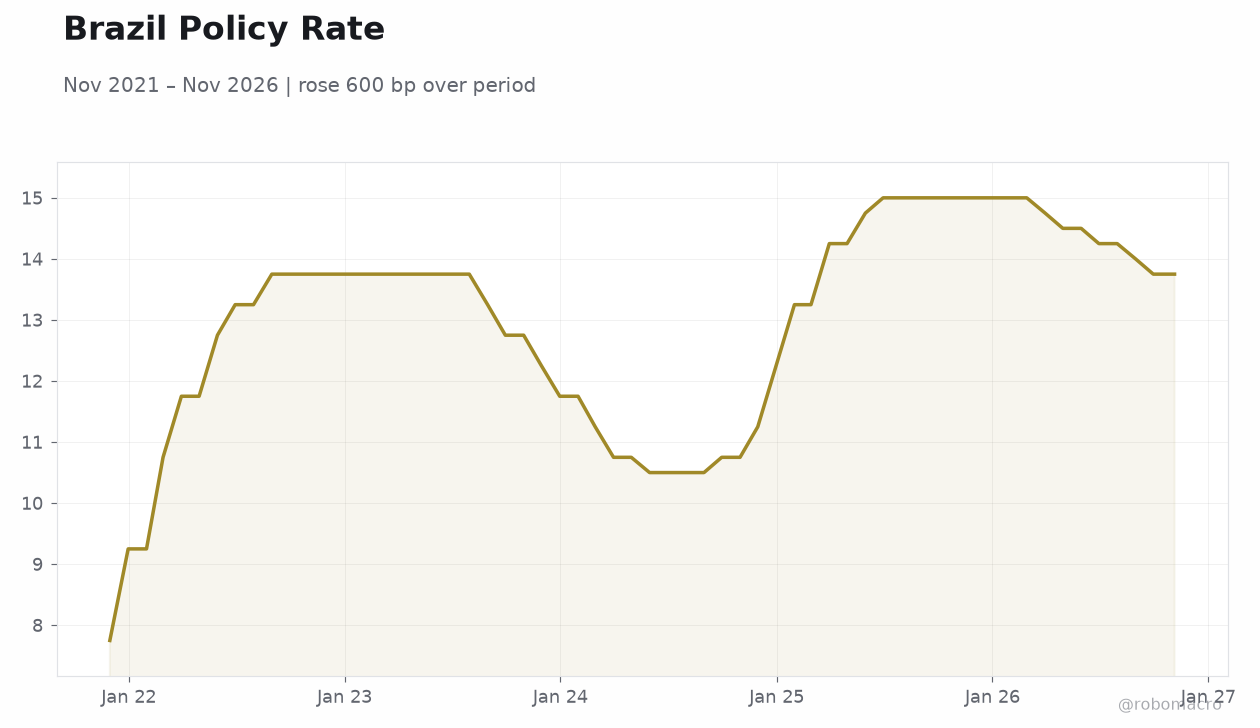 Brazil Policy Rate | Type: macro_line | Selic Policy Rate (%): 13.75 (2026-11-05) | Range: 7.75–15 | Trend(5pt): 7.75,13.75,10.5,15,13.75
Today's Economic Events
| Data | Prior | Cons | Time |
|---|---|---|---|
| Thursday (2026-11-12) | |||
| Inflation Rate Month-over-Month | 0.82 | 0.26 | 07:00 |
| Inflation Rate Year-over-Year | 4.58 | 4.74 | 07:00 |
| Friday (2026-11-13) | |||
| Retail Sales Month-over-Month | 0.10 | -0.20 | 07:00 |
| Business Confidence Index | 46.20 | - | 09:00 |
- BCB Copom minutes signal caution on price pressures and activity slowdown, keeping the Selic path data-dependent at 13.75%
- Real slumps 1.35% to 5.58/USD as risk-off hits Brazilian assets; Bovespa falls 0.52% to 171,337
- October IPCA due Thursday: consensus 0.26% m/m and 4.74% y/y versus 0.82% and 4.58% prior
Yesterday's Recap
Brazil's Copom meeting minutes headlined the session, with the BCB striking a cautious tone on both inflation persistence and slowing activity, reinforcing a data-dependent stance after the 4 November hold. The BCB Focus Market Readout was also released. Markets traded risk-off: the real weakened 1.35% to 5.58/USD and the Bovespa slipped 0.52% to 171,337, with Vale down 3.26% on iron ore softness while Petrobras eased 0.38%.
The curve rallied despite the cautious minutes, with the 5-year yield easing 9 bp to 14.99% and the 10-year down 12 bp to 15.09%, suggesting the market read the guidance as consistent with an eventual resumption of easing. Gold gained 0.88% to $4,065.50 and WTI edged up 0.16% to $86.18, while Bitcoin slipped 0.16%.
The Day Ahead
Attention shifts to Thursday's October IPCA release, with consensus at 0.26% m/m and 4.74% y/y against 0.82% and 4.58% previously — a print near consensus would keep headline inflation above the tolerance band's midpoint and validate the BCB's caution. Friday brings October retail sales, where consensus of -0.2% m/m follows a 0.1% prior, pointing to softer household demand under restrictive rates. The Business Confidence Index for November is also due Friday, with the prior at 46.2 still in pessimistic territory.
No Brazilian releases are scheduled for today, leaving positioning ahead of the inflation print to drive the session.
Other Economic Notes
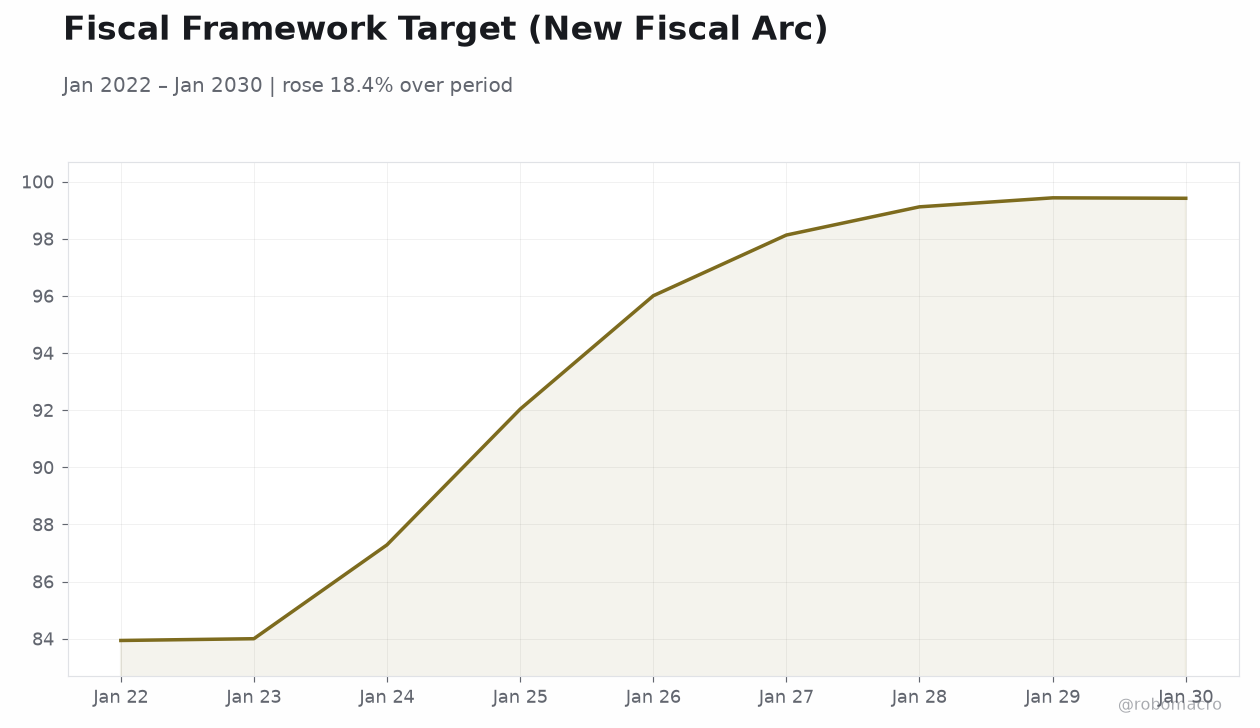
Fiscal and structural themes are gaining traction in the local press, with Valor reporting that public-sector pay loopholes are drawing fresh reform demands — a reminder that spending rigidities remain a key rating and curve risk. Productivity is being framed as Brazil's biggest economic challenge, underscoring the growth constraints that keep potential output modest and complicate the disinflation path. Petrobras is seeking a transition period to understand the tax reform's impact, highlighting implementation uncertainty for large corporates.
These themes matter for the medium-term fiscal trajectory and the credibility of the inflation-targeting framework.