Canada Macro Daily(Beta Mode)
BoC Hike Odds Jump on Oil and Trade Pressures
Market Snapshot
| Asset | Level | Change |
|---|---|---|
| S&P/TSX | 35,874.30 | +1.08% |
| USD/CAD | 1.40 | +0.15% |
| EUR/CAD | 1.61 | +0.10% |
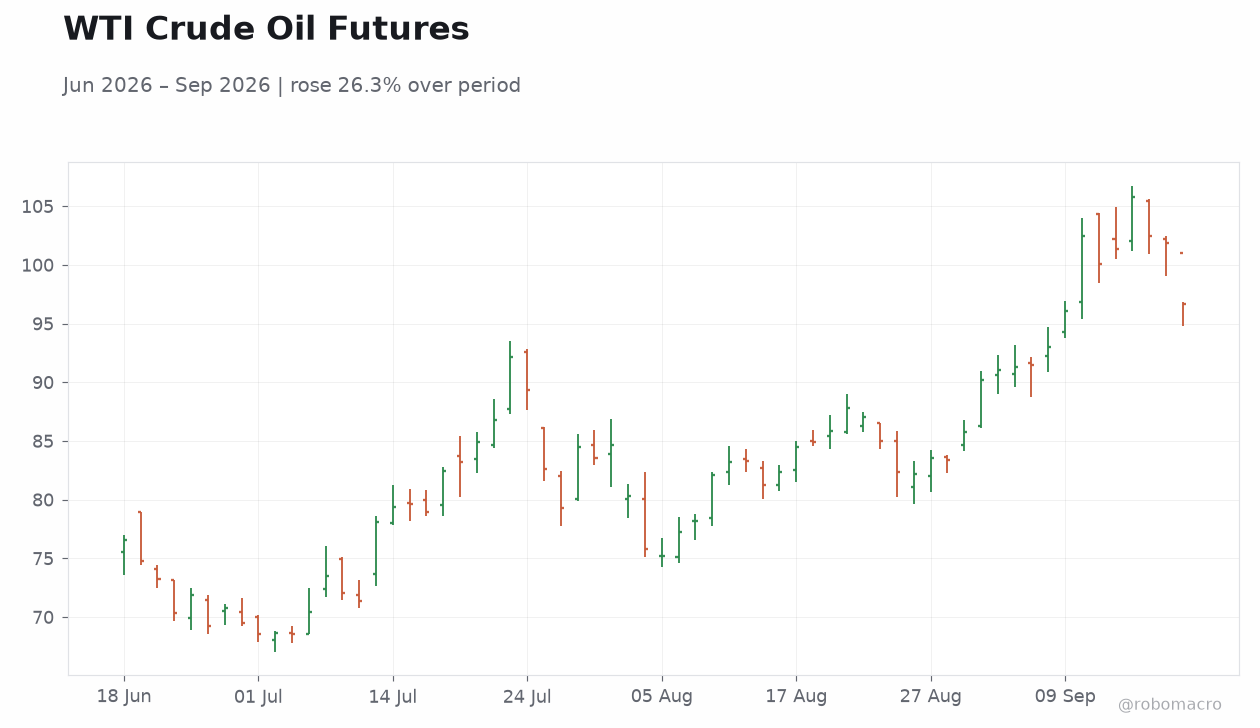
| WTI Crude | 96.71 | -5.10% |
| Natural Gas | 2.91 | +0.45% |
| Gold | 4,396.40 | -0.08% |
| Brent Crude | 98.94 | -5.61% |
| Bitcoin | 78,049.73 | +2.15% |
| Canada 2Y Govt Yield | 3.35% | 0 bp |
| Canada 10Y Govt Yield | 3.92% | -3 bp |
Prior Economic Events
| Data | Prior | Cons | Actual |
|---|---|---|---|
| Inflation Rate Year-over-Year | 3 | 3 | 3 |
| Core Inflation Rate Year-over-Year | 2.30 | - | 2.40 |
| Inflation Rate Month-over-Month | 0.50 | 0 | -0.10 |
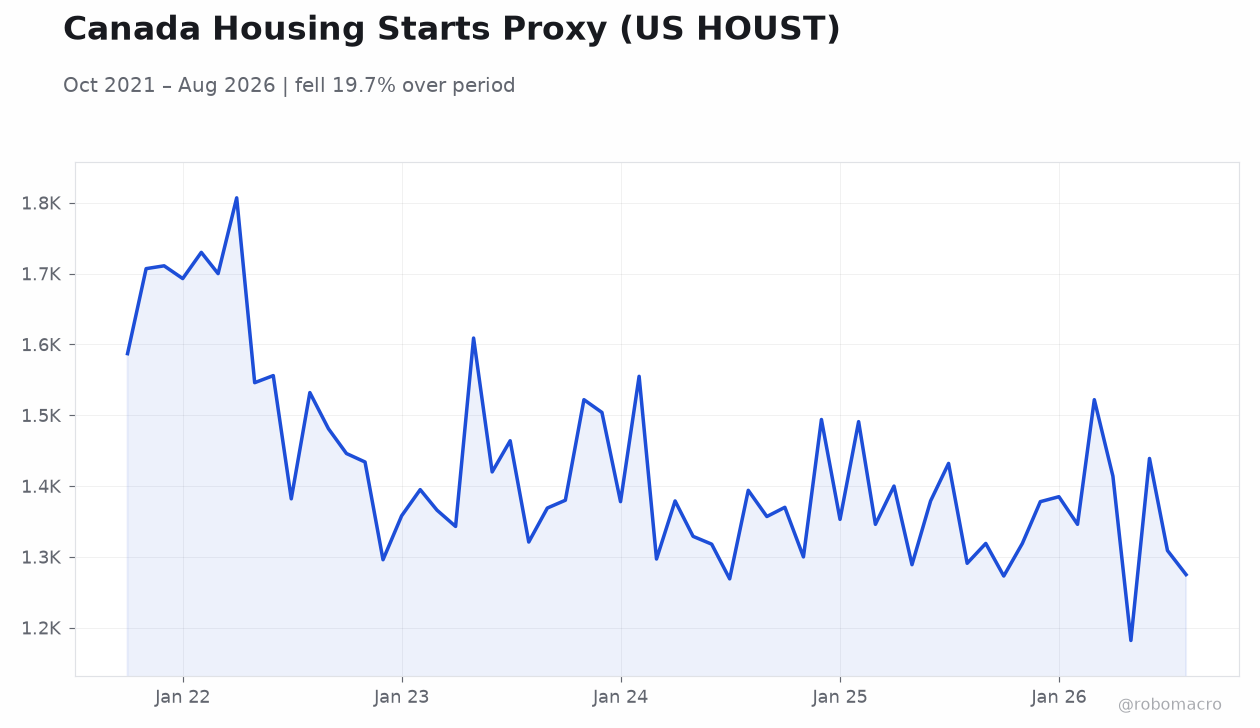
| Housing Starts Level | 229,400 | 240,000 | 229,000 |
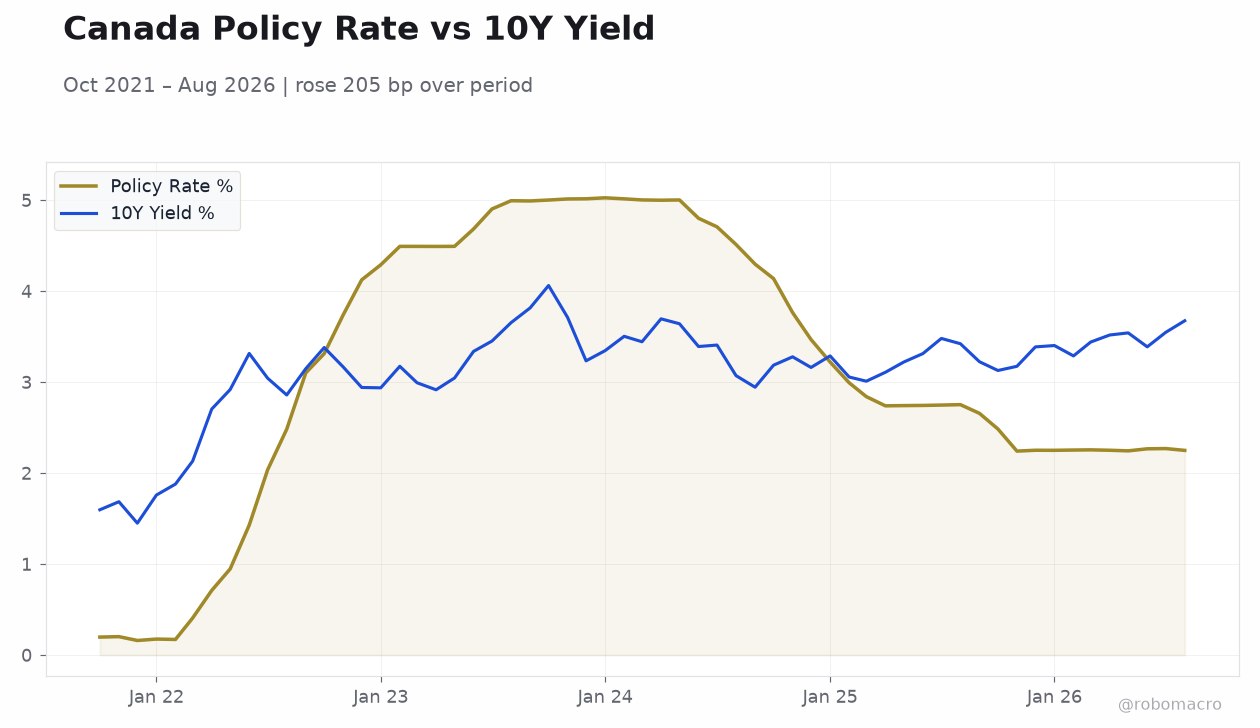 Canada Policy Rate vs 10Y Yield | Type: macro_line | Policy Rate %: 2.25 (2026-08-01) | Range: 0.1604–5.026 | Trend(6pt): 0.1977,4.125,5.015,2.74,2.267,2.25 | 10Y Yield %: 3.675 (2026-08-01) | Range: 1.45–4.062 | Trend(6pt): 1.597,2.942,3.504,3.109,3.388,3.675
Today's Economic Events
| Data | Prior | Cons | Time |
|---|---|---|---|
| No events available | |||
- CPI holds at 3.0% YoY while core rises to 2.4%; housing starts miss at 229,000
- TSX gains 1.08% to 35,874.30 as WTI crude falls 5.10% to 96.71
- USD/CAD edges up 0.15% to 1.40; 10-year yield eases 3 bp to 3.92%
Yesterday's Recap
Canadian inflation data for August showed headline CPI year-over-year steady at 3.00% against a 3.0% consensus, while core CPI year-over-year increased to 2.4% from 2.3%. The month-over-month CPI print surprised to the downside at -0.1% versus a flat consensus. Housing starts for the latest reading came in at 229,000, below the 240,000 expected and slightly softer than the prior 229,400.
Equity markets responded positively, with the S&P/TSX Composite advancing 1.08% to close at 35,874.30. Energy prices led the commodity move lower, as WTI crude declined 5.10% to 96.71 and Brent fell 5.61% to 98.94. The Canadian dollar weakened modestly, with USD/CAD rising 0.15% to 1.40 and EUR/CAD up 0.10% to 1.61.
Government bond yields showed limited movement, as the 2-year held at 3.35% and the 10-year eased 3 bp to 3.92%. Sector performance diverged, with National Bank of Canada shares rising 0.594% while Royal Bank of Canada declined 0.405% on September 16.
The Day Ahead
No Canadian economic data releases are scheduled for September 18 or 19. Market participants will monitor ongoing developments in U.S.-Canada trade negotiations and any further signals from federal officials on tariff exposure. Energy price volatility remains a key driver for CAD crosses and inflation expectations.
Equity flows into the TSX may stay supported by the recent commodity repricing. Fixed-income investors will watch for any shift in BoC forward guidance that could alter the pricing of near-term rate hikes.
Other Economic Notes
Trade-war concerns continue to weigh on Canada’s mortgage and housing markets, with analysts noting heightened sensitivity to U.S. tariff actions. Broader economic resilience persists despite uneven growth, as capital sourcing remains intact even after recent summits.
The Canadian dollar trades near its August 7 low amid the persistent U.S.-Canada rate differential and tariff risks. Canada’s economy remains resilient but growth has become increasingly uneven with the outlook highly sensitive to U.S. trade policy.
Global Macro News
The Bank of England held rates at 3.75% and flagged potential hikes if inflation pressures intensify. ↓ p.2