Canada Macro Daily(Beta Mode)
Ivey Slumps, Trade Surges; Loonie Steadies
Market Snapshot
| Asset | Level | Change |
|---|---|---|
| S&P/TSX | 35,649.50 | +0.37% |
| USD/CAD | 1.42 | -0.18% |
| EUR/CAD | 1.59 | -0.50% |
| WTI Crude | 90.33 | +1.00% |
| Natural Gas | 3.18 | +2.02% |
| Gold | 4,144.90 | -1.01% |
| Brent Crude | 102.18 | +1.59% |
| Bitcoin | 83,572.31 | -2.32% |
| Canada 2Y Govt Yield | 3.26% | +1 bp |
| Canada 10Y Govt Yield | 3.96% | +3 bp |
Prior Economic Events
| Data | Prior | Cons | Actual |
|---|---|---|---|
| Trade Balance | 790m | 1,700m | 4,200m |
| Ivey PMI Seasonally Adjusted | 64.30 | 65.20 | 58.20 |
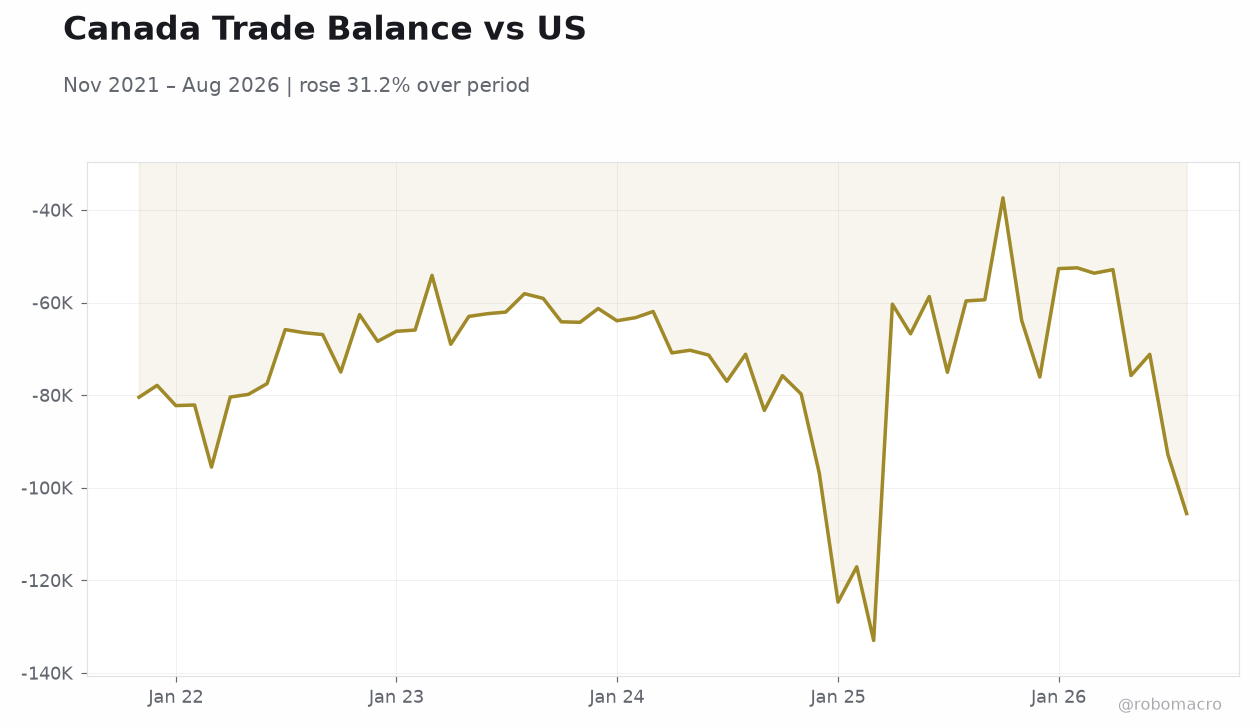 Canada Trade Balance vs US | Type: macro_line | Trade Balance (USD bn): -1.056e+05 (2026-08-01) | Range: -1.33e+05–-3.738e+04 | Trend(6pt): -8.044e+04,-6.621e+04,-6.192e+04,-6.675e+04,-9.283e+04,-1.056e+05
Today's Economic Events
| Data | Prior | Cons | Time |
|---|---|---|---|
| Friday (2026-10-09) | |||
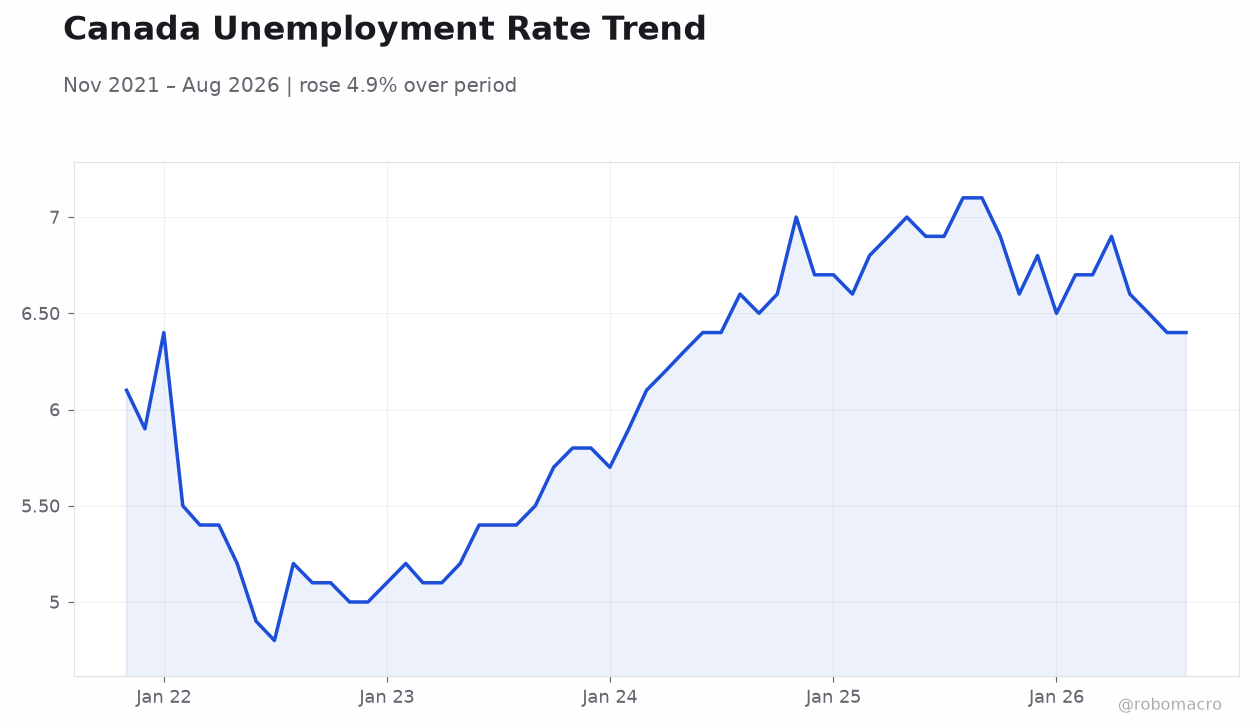
| Headline Unemployment Rate | 6.40 | 6.50 | 08:30 |
| Employment Change | -41,700 | 7,000 | 08:30 |
| Full-Time Employment Change | -35,900 | - | 08:30 |
| Labor Force Participation | 65 | - | 08:30 |
| Part-Time Employment Change | -5,800 | - | 08:30 |
- Ivey PMI fell to 58.2 from 64.3, missing the 65.2 consensus, though the reading still signals solid expansion in Canadian business activity.
- The trade surplus ballooned to C$4.2B, far above the C$1.7B consensus and more than double the prior C$790M, as exports outperformed.
- Attention turns to Friday's labour report, with consensus at a 7K employment gain and the jobless rate edging to 6.5% from 6.4%.
Yesterday's Recap
Canadian data delivered a mixed but net-positive picture on Tuesday. The trade balance swung to a C$4.2B surplus, crushing the C$1.7B consensus and more than doubling the prior C$790M surplus, a print that Reuters flagged as a key driver of loonie strength intraday. The Ivey PMI seasonally adjusted index, however, retreated sharply to 58.2 from 64.3, undershooting the 65.2 consensus — still comfortably in expansion territory but suggesting momentum cooled at the end of Q3.
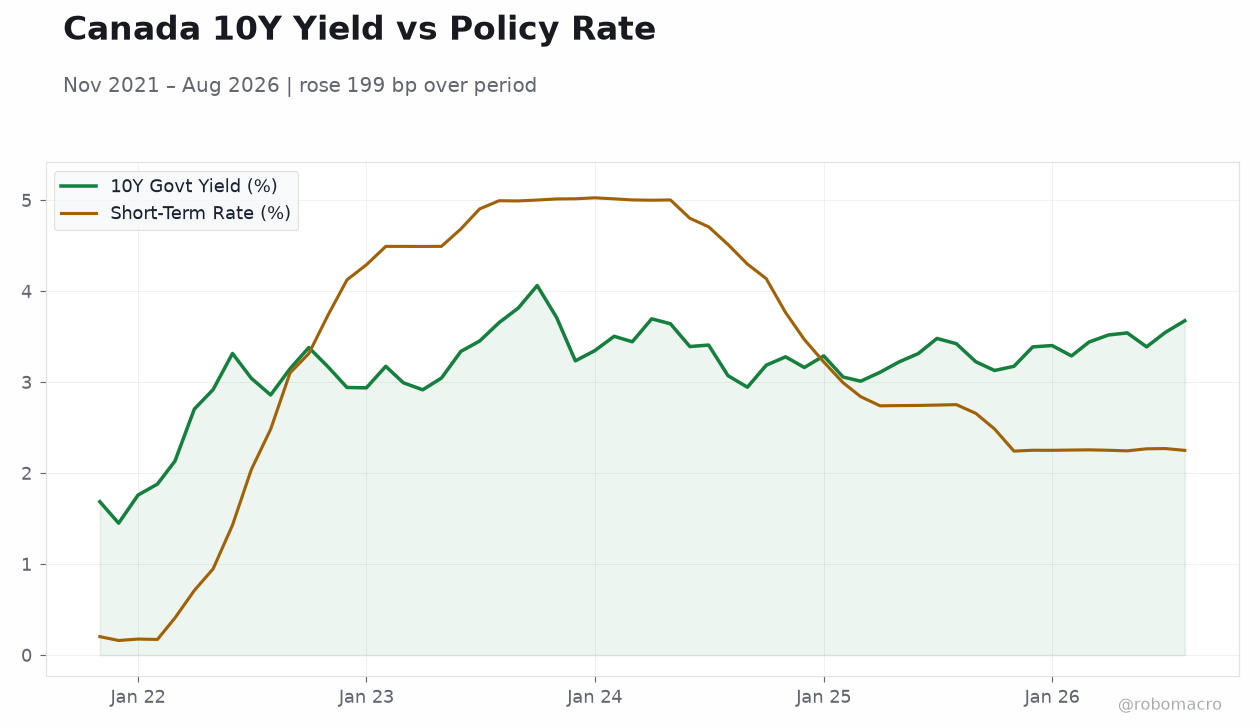
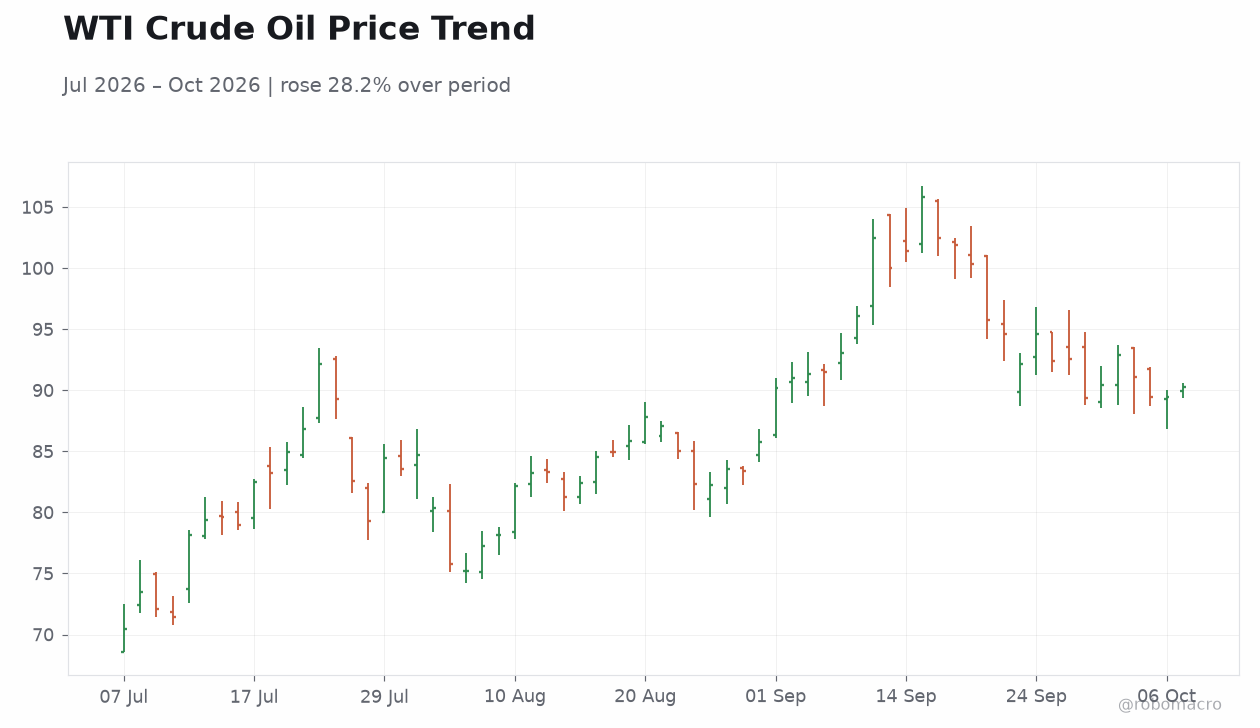
In rates, the Canada 2-year yield ticked up 1 bp to 3.26% and the 10-year rose 3 bp to 3.96%, tracking a broader developed-market bond selloff. Equities found support: the S&P/TSX advanced 0.37% to 35,649.50, buoyed by energy strength. Crude rallied hard, with WTI up 1.00% to $90.33 and Brent climbing 1.59% to $102.18, while natural gas surged 2.02% to $3.18.
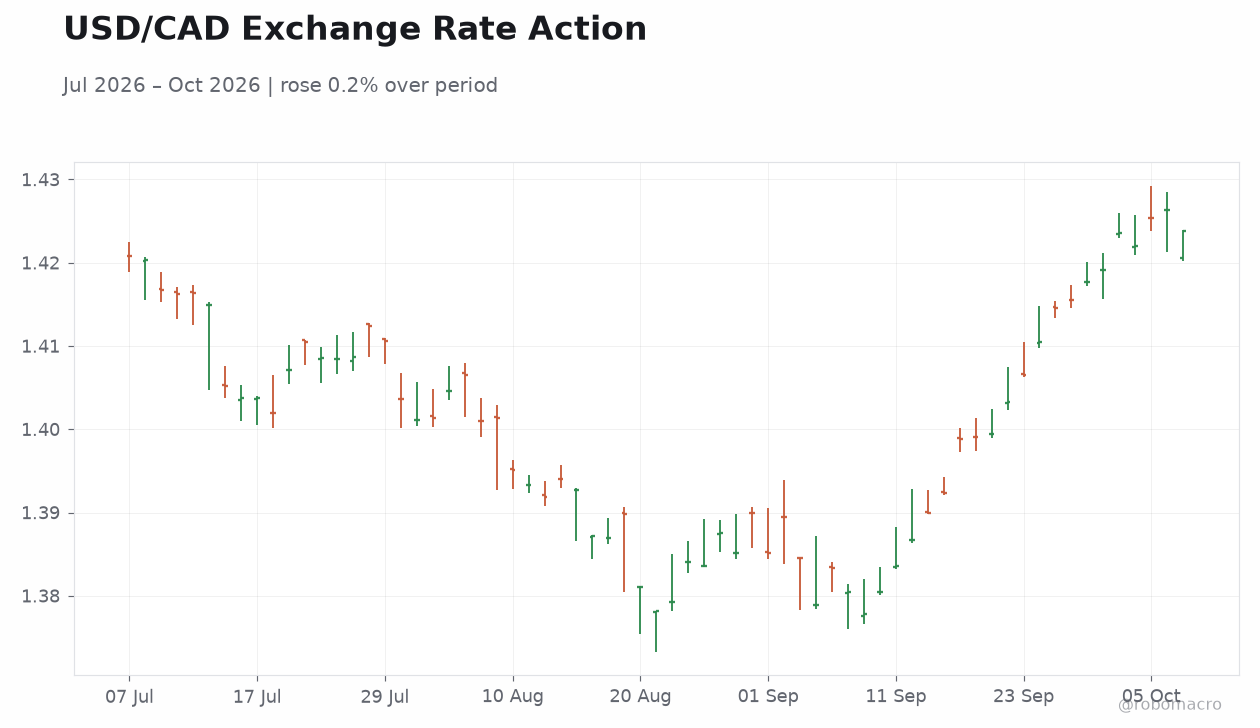
Gold slipped 1.01% to $4,144.90 and Bitcoin fell 2.32% to $83,572. In FX, USD/CAD eased 0.18% to 1.42 and EUR/CAD dropped 0.50% to 1.59, leaving the loonie firmer against both majors.
The Day Ahead
The calendar is quiet until Friday, when Statistics Canada releases the September Labour Force Survey at 8:30 ET — the week's marquee domestic event. Consensus looks for headline employment growth of just 7K following August's disappointing 41.7K decline, with the unemployment rate expected to tick up to 6.5% from 6.4%. Full-time employment fell 35.9K last month and part-time dropped 5.8K, so composition will matter as much as the headline.
The participation rate, last at 65%, will be scrutinized for signs of discouraged-worker dynamics. A third consecutive soft print would sharpen the case for further BoC easing, while an upside surprise could validate the more hawkish wing of the market. With no domestic releases Wednesday or Thursday, CAD traders will take cues from oil and the USD backdrop.
Other Economic Notes
The commodity complex is doing heavy lifting for the Canadian terms of trade, with Brent above $102 and WTI near $90 providing a tailwind for energy-linked provincial revenues and the loonie. ↓ p.2