Eurozone Macro Daily(Beta Mode)
Bunds Sell Off as German Trade Surplus Shrinks
Market Snapshot
| Asset | Level | Change |
|---|---|---|
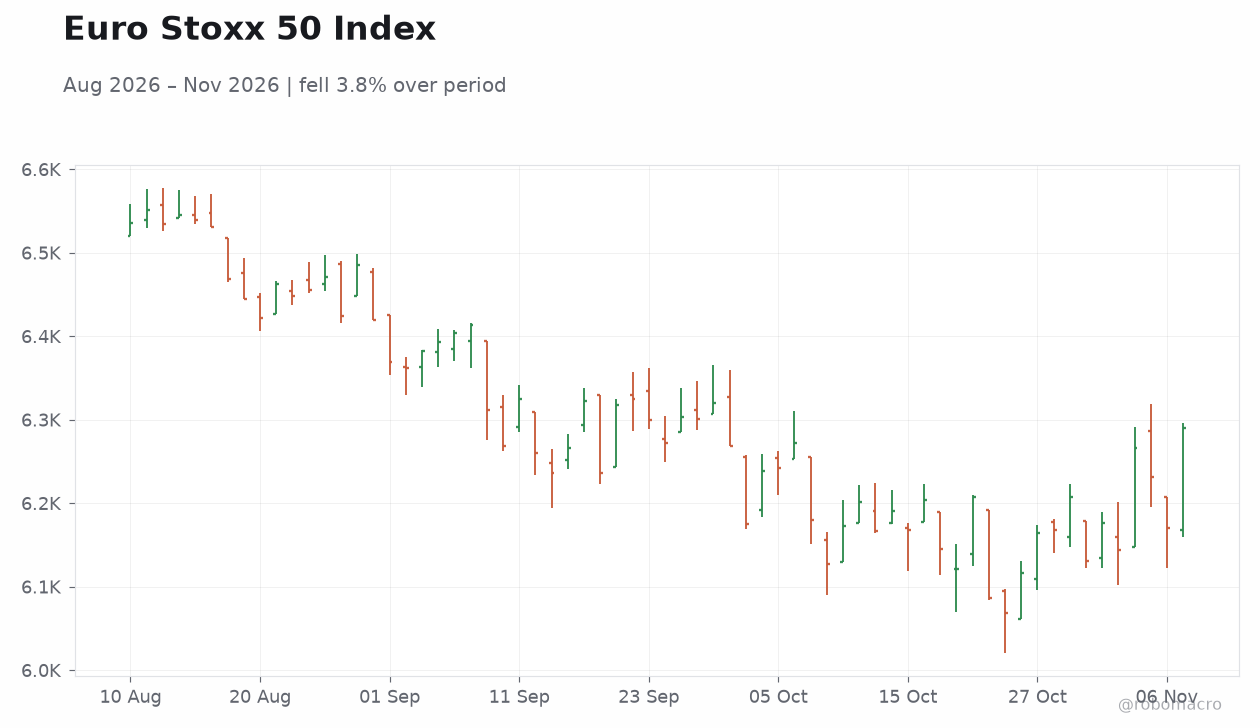
| Euro Stoxx 50 | 6,290.45 | +1.94% |
| DAX | 25,820.36 | -1.92% |
| CAC 40 | 8,233.30 | +1.16% |
| EUR/USD | 1.12 | +0.75% |
| EUR/GBP | 0.83 | +0.06% |
| EUR/JPY | 177.36 | +0.52% |
| Gold | 4,114.50 | +0.97% |
| Brent Crude | 92.57 | -5.85% |
| Bitcoin | 74,686.69 | +0.14% |
| German 2Y Bund | 3.00% | +5 bp |
| German 10Y Bund | 3.33% | +4 bp |
Prior Economic Events
| Data | Prior | Cons | Actual |
|---|---|---|---|
| Trade Balance | 17,800m | 19,200m | 15,600m |
| Exports Month-over-Month | -0.40 | - | 2 |
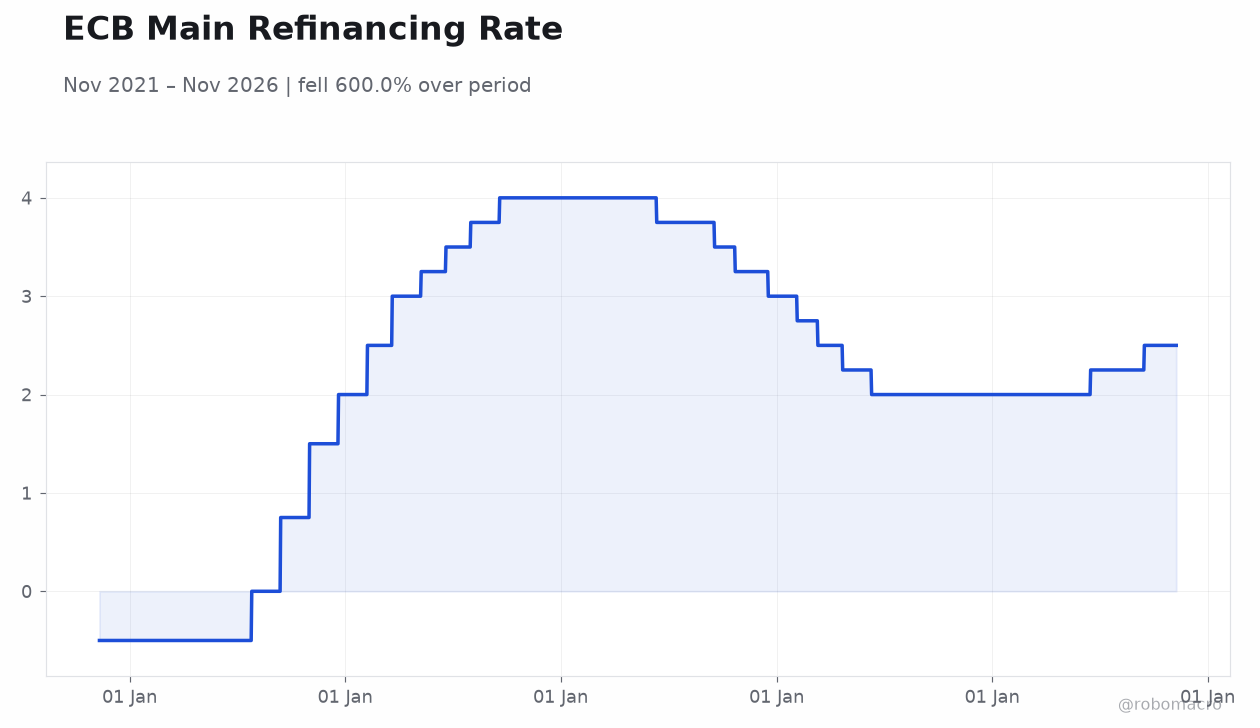
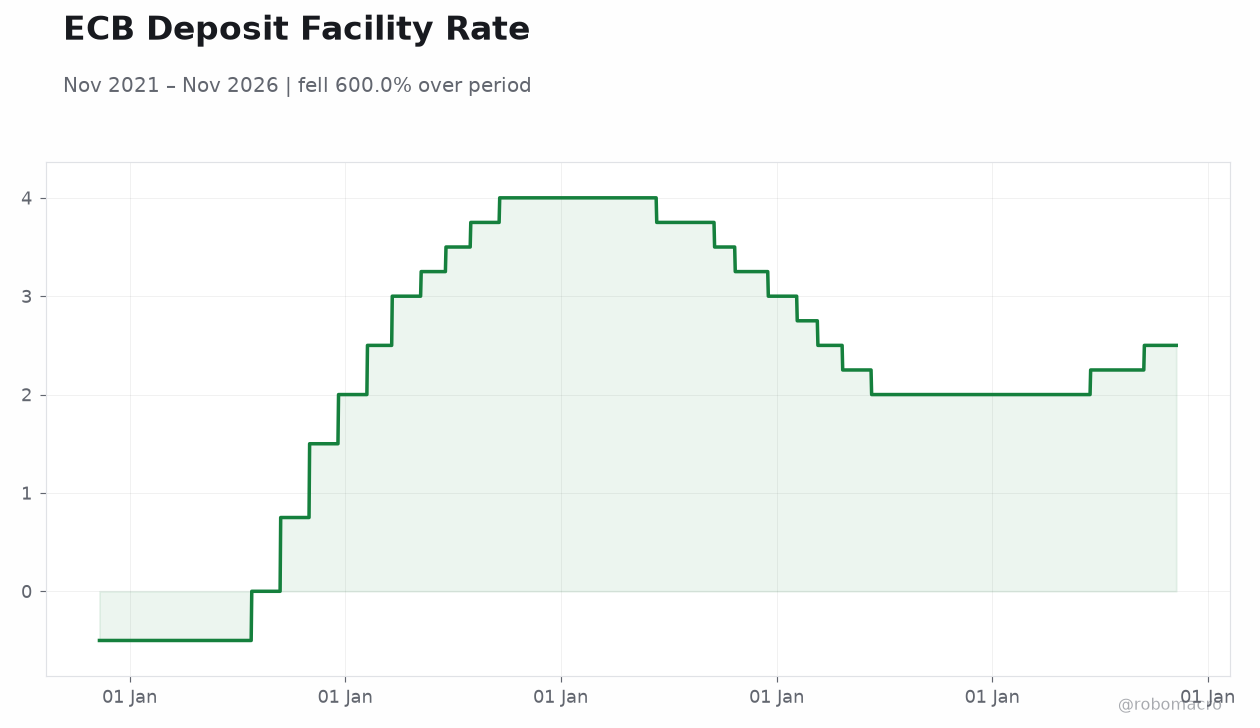
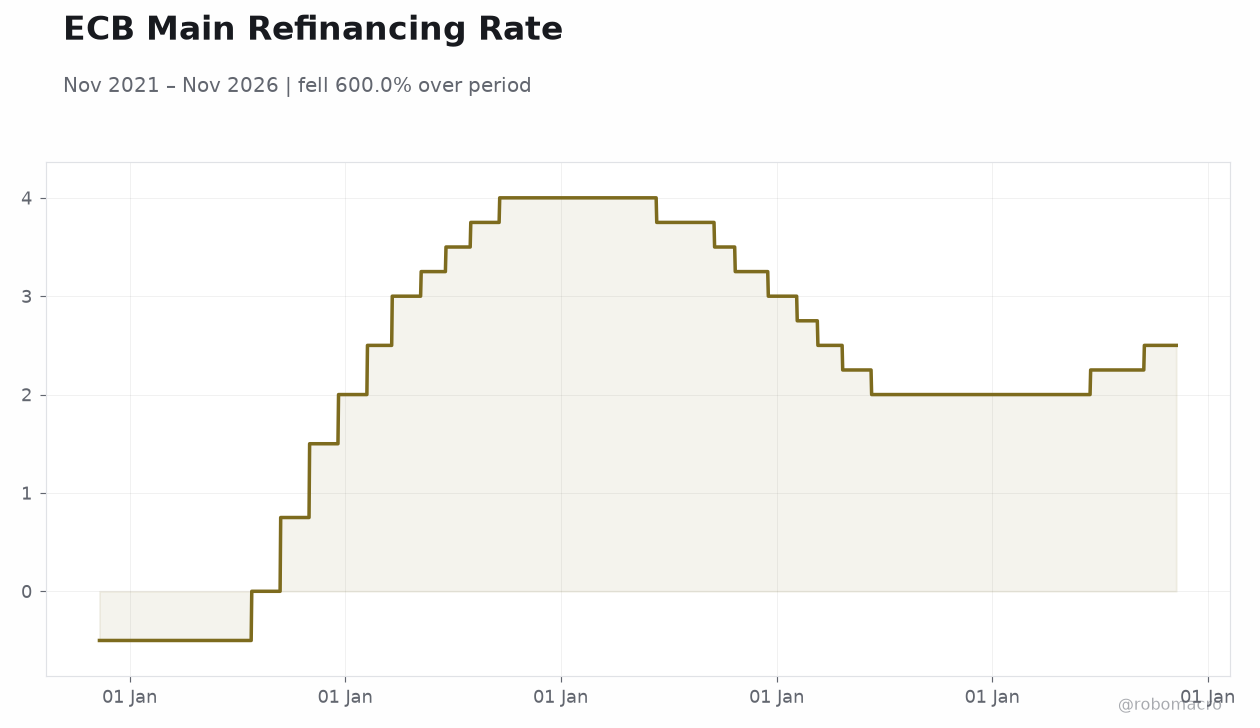
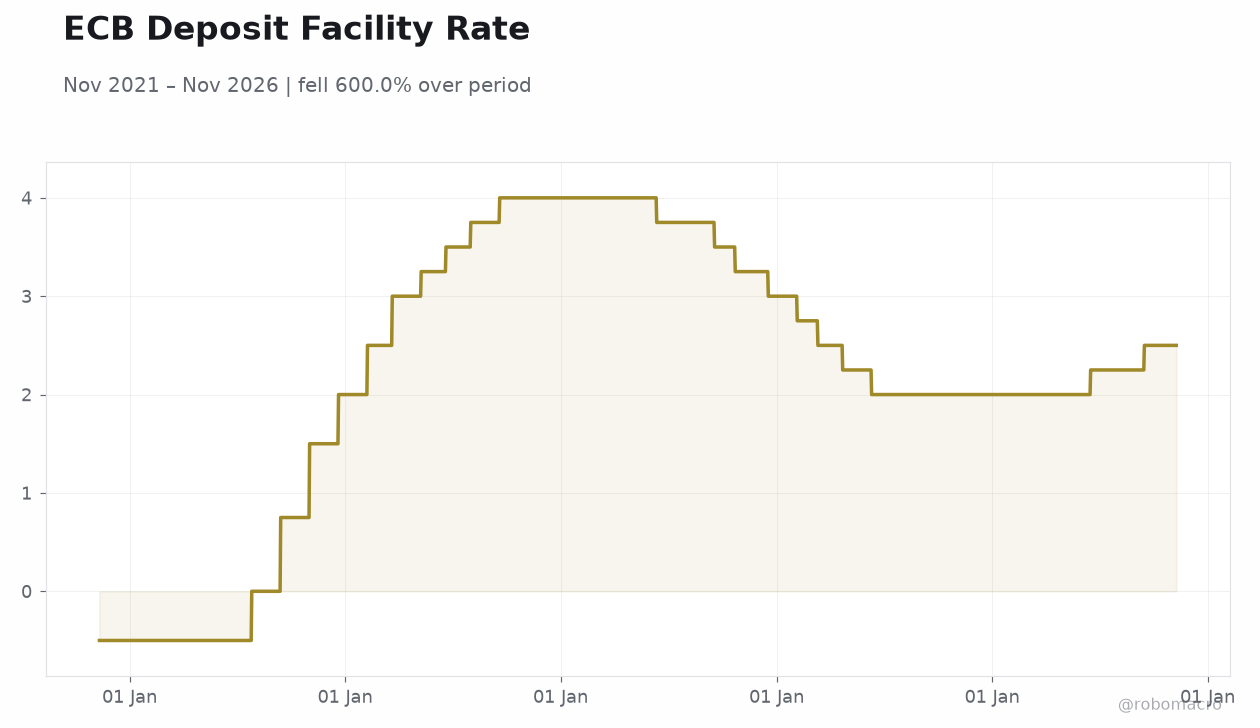 ECB Deposit Facility Rate | Type: macro_line | ECB Deposit Facility Rate: 2.5 (2026-11-09) | Range: -0.5–4 | Trend(5pt): -0.5,2.5,4,2,2.5
Today's Economic Events
| Data | Prior | Cons | Time |
|---|---|---|---|
| Headline Unemployment Rate | 8.30 | - | 01:30 |
| Wednesday (2026-11-11) | |||
| Industrial Production Month-over-Month | -1.30 | 1 | 04:00 |
- German exports rebounded 2.0% m/m in November, but the trade surplus narrowed sharply to €15.6bn versus €19.2bn consensus as import growth outpaced shipments.
- Bunds sold off across the curve, with the 2-year yield up 5 bp to 3.00% and the 10-year up 4 bp to 3.33%, as markets positioned for ECB commentary and US inflation data.
- Eurozone investor confidence unexpectedly fell to 2.4 in November, underscoring fragile sentiment even as the Bank of France sees modest Q4 growth and no year-end recession.
Yesterday's Recap
German trade data dominated the Eurozone calendar on Monday, with exports rising 2.0% m/m in November — a rebound from the prior 0.4% contraction — but the trade balance printed at €15.6bn against a €19.2bn consensus and €17.8bn prior, signaling that import demand is running ahead of export momentum. The miss on the surplus is a cautionary signal for German net trade contributions to Q4 GDP. Separately, Eurozone investor confidence unexpectedly fell to 2.4 in November, a reminder that sentiment remains brittle despite stabilizing German activity indicators.
Rates markets reacted to the firmer export print and the looming ECB commentary by selling Bunds: the German 2-year yield rose 5 bp to 3.00% and the 10-year added 4 bp to 3.33%. Equities were mixed with notable dispersion — the Euro Stoxx 50 gained 1.94% and the CAC 40 rose 1.16%, while the DAX fell 1.92%, a divergence likely tied to sector composition and single-stock moves such as UniCredit's strong quarter. In FX, EUR/USD advanced 0.75% to 1.12, EUR/JPY rose 0.52% to 177.36, and EUR/GBP was essentially flat at 0.83.
The Day Ahead
France's headline unemployment rate for Q3 is due at 01:30 ET, with the prior reading at 8.3%; the print will be scrutinized for signs that the labor market is softening as growth struggles. On Wednesday, Italian industrial production m/m for September is scheduled at 04:00 ET, with consensus at 1.0% following a 1.3% decline in the prior month — a rebound would offer some relief for Italy's manufacturing base. Beyond the calendar, markets will watch ECB commentary closely ahead of US inflation figures later in the week, with EUR crosses and Bunds likely to trade directionally on any policy signals.
The Bank of France's assessment that the economy will avoid a year-end recession provides a modest counterweight to the soft sentiment data.
Other Economic Notes
The Bank of France expects the economy to return to growth at a moderate pace in Q4 but flagged unusually high uncertainty, and explicitly said France should dodge the threat of a year-end recession. ↓ p.2