GCC Macro Daily(Beta Mode)
Hormuz Risks Lift Gold as Oil Slips
Market Snapshot
| Asset | Level | Change |
|---|---|---|
| Saudi Aramco | 26.60 | +0.00% |
| MSCI Saudi | 37.81 | +0.05% |
| MSCI UAE | 19.61 | +0.11% |
| MSCI Qatar | 17.69 | +0.16% |
| MSCI Kuwait | 37.32 | +0.23% |
| Brent Crude | 87.91 | -1.12% |
| WTI Crude | 82.13 | -1.29% |
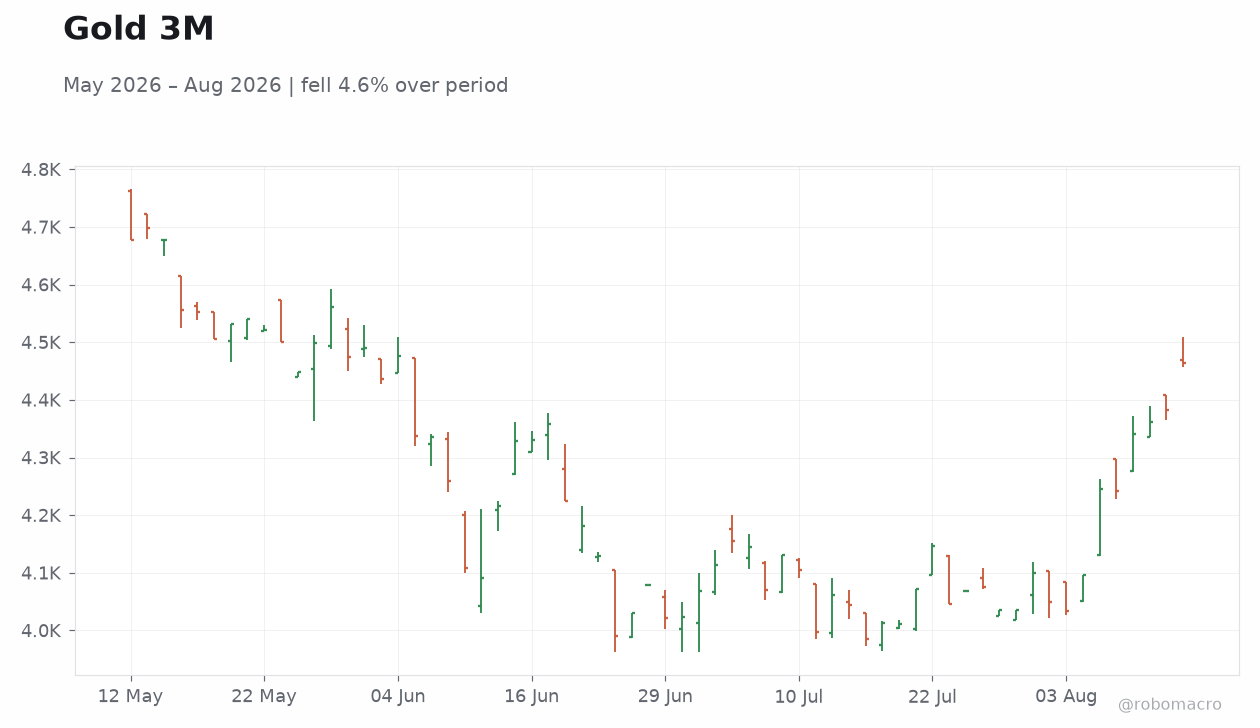
| Gold | 4,468.80 | +1.96% |
| USD/SAR | 3.75 | +3.33% |
| USD/AED | 3.67 | +0.03% |
| USD/KWD | 0.31 | -0.39% |
| Bitcoin | 63,500.41 | -0.08% |
Prior Economic Events
| Data | Prior | Cons | Actual |
|---|---|---|---|
| No events available | |||
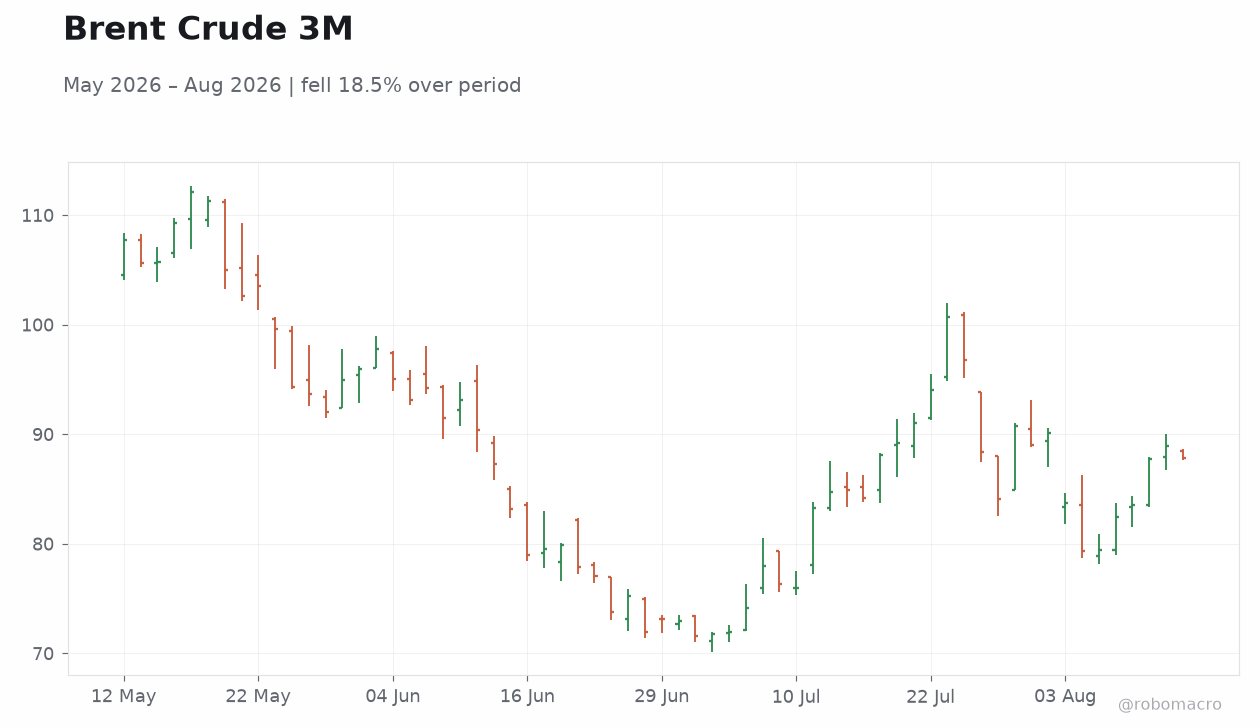 Brent Crude 3M | Type: market_hloc | USD/bbl: 87.87 (2026-08-12) | Range: 71.57–112.1 | Trend(5pt): 107.8,95.03,73.15,94.07,87.87
Today's Economic Events
| Data | Prior | Cons | Time |
|---|---|---|---|
| No events available | |||
- Brent falls 1.12% to $87.91 amid Red Sea rerouting and Hormuz concerns
- MSCI Kuwait leads GCC equities with +0.23% gain; Saudi Aramco flat at 26.60
- UAE advances $6.2bn gas project while Saudi-Turkey-Pakistan pact bolsters regional defense
Yesterday's Recap
Saudi Arabia doubled oil exports via Egypt’s Sidi Kerir Mediterranean pipeline to bypass Red Sea threats, according to Kpler data. UAE maintained crude loadings through the Strait of Hormuz at the highest regional rate despite elevated risk premia. MSCI UAE rose 0.11% to 19.61 while MSCI Qatar added 0.16% to 17.69 on modest bank buying.
Gold surged 1.96% to $4,468.80 as investors sought safe-haven assets amid Iran-Oman Hormuz talks. Brent and WTI crude declined 1.12% and 1.29% respectively on demand-destruction warnings from the IEA. Saudi equities showed resilience with MSCI Saudi up 0.05% to 37.81.
No major macroeconomic data prints emerged from any GCC state on August 11. Regional refinery utilization held near 88% in July, aided by summer power demand in Saudi Arabia and UAE. Non-oil diversification under Vision 2030 and UAE 2050 gained incremental traction despite elevated security spending.
Sovereign CDS spreads across GCC remained stable despite the elevated geopolitical backdrop.
The Day Ahead
Markets will monitor Iranian statements on Hormuz access following Oman negotiations. UAE ADNOC continues execution of the Umm Shaif gas-cap development valued at $6.2 billion. Saudi Arabia faces ongoing choices between deterrence and de-escalation in regional tensions.
OPEC+ compliance with 5.86 mb/d cuts remains under watch through September. Kuwait International Airport operates with terminal restrictions due to airspace concerns. Broader attention stays on any Houthi activity near Bab al-Mandeb that could further disrupt flows.
Saudi Arabia’s long-haul oil routing to Asia proves economically viable yet exposes vessels to additional Ansar Allah escalation risk. UAE sovereign funds continue scaling renewable and hydrogen allocations alongside conventional energy expansion. Qatar’s North Field LNG phases advance on schedule, supporting fiscal buffers across the currency pegs.
Other Economic Notes
IEA projects 1.6 mb/d oil-demand destruction in 2026 from high prices and Hormuz disruptions. Iran signaled a near-term Hormuz control deal with Oman but ruled out unilateral reopening. US-Iran tensions constrain Saudi Arabia’s room to maneuver between deterrence and dialogue.
<i>↓ p.2</i>