| Asset | Level | Change |
|---|---|---|
| Saudi Aramco | 25.84 | +0.16% |
| MSCI Saudi | 36.65 | -0.69% |
| MSCI UAE | 19.68 | -0.28% |
| MSCI Qatar | 16.21 | -0.58% |
| MSCI Kuwait | 35.96 | -0.02% |
| Brent Crude | 102.37 | +1.78% |
| WTI Crude | 89.91 | +0.53% |
| Gold | 4,157.60 | -0.70% |
| USD/SAR | 3.75 | +3.39% |
| USD/AED | 3.67 | +0.03% |
| USD/KWD | 0.31 | -0.31% |
| Bitcoin | 82,991.96 | -3.00% |
| Data | Prior | Cons | Actual |
|---|---|---|---|
| No events available | |||
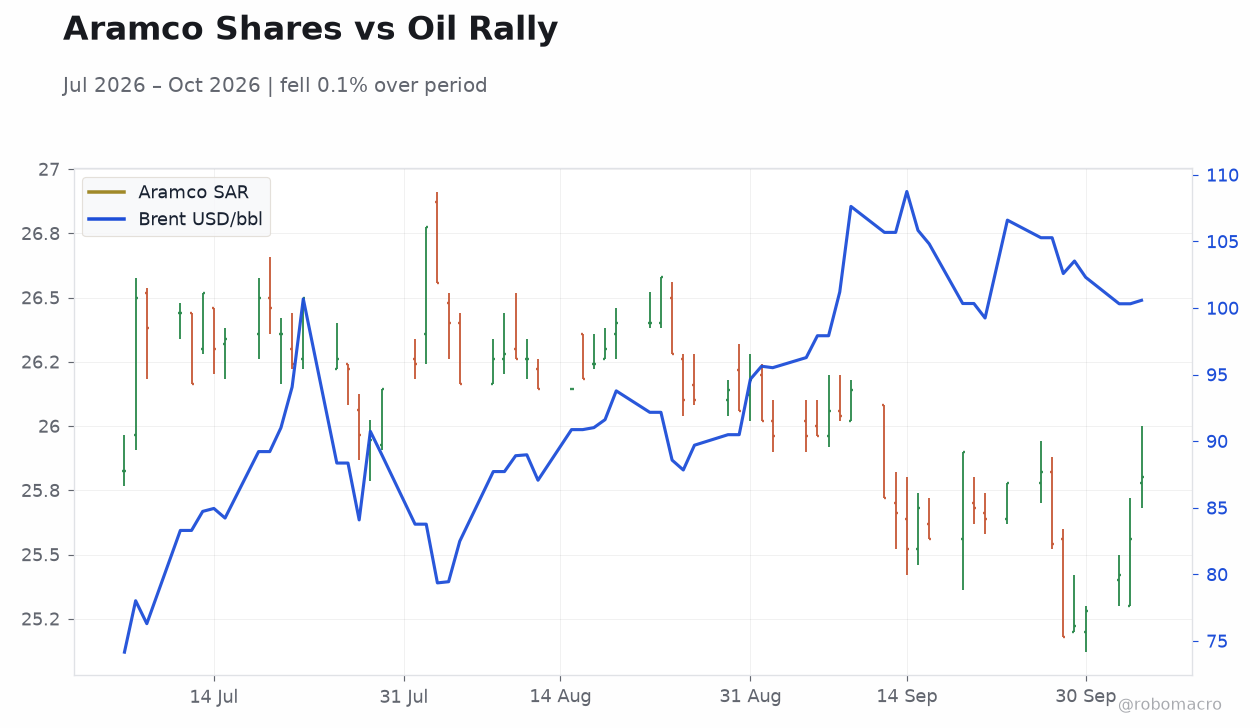
Aramco Shares vs Oil Rally | Type: market_hloc | Aramco SAR: 25.8 (2026-10-06) | Range: 25.18–26.77 | Trend(5pt): 25.83,25.95,26.4,25.72,25.8 | Brent USD/bbl: 102.3 (2026-10-07) | Range: 74.16–108.8 | Trend(6pt): 74.16,90.74,93.78,105.7,100.6,102.3
| Data | Prior | Cons | Time |
|---|---|---|---|
| No events available | |||
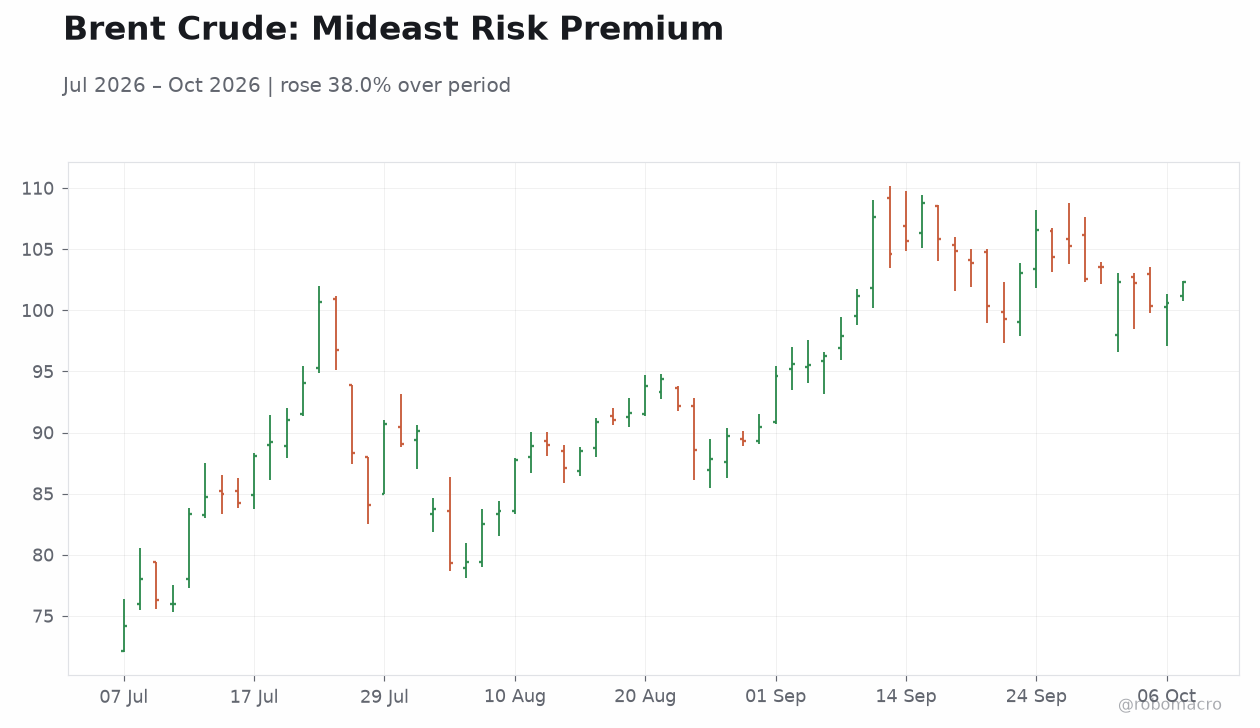
Geopolitics dominated the Gulf tape. Iran-backed Houthi militants claimed fresh attacks on Saudi territory, while a tanker off Qatar reported multiple projectile hits with casualties, per UKMTO — both developments reinforcing the risk premium embedded in Brent's move to $102.37, up 1.78%. WTI followed higher at $89.91, gaining 0.53%.
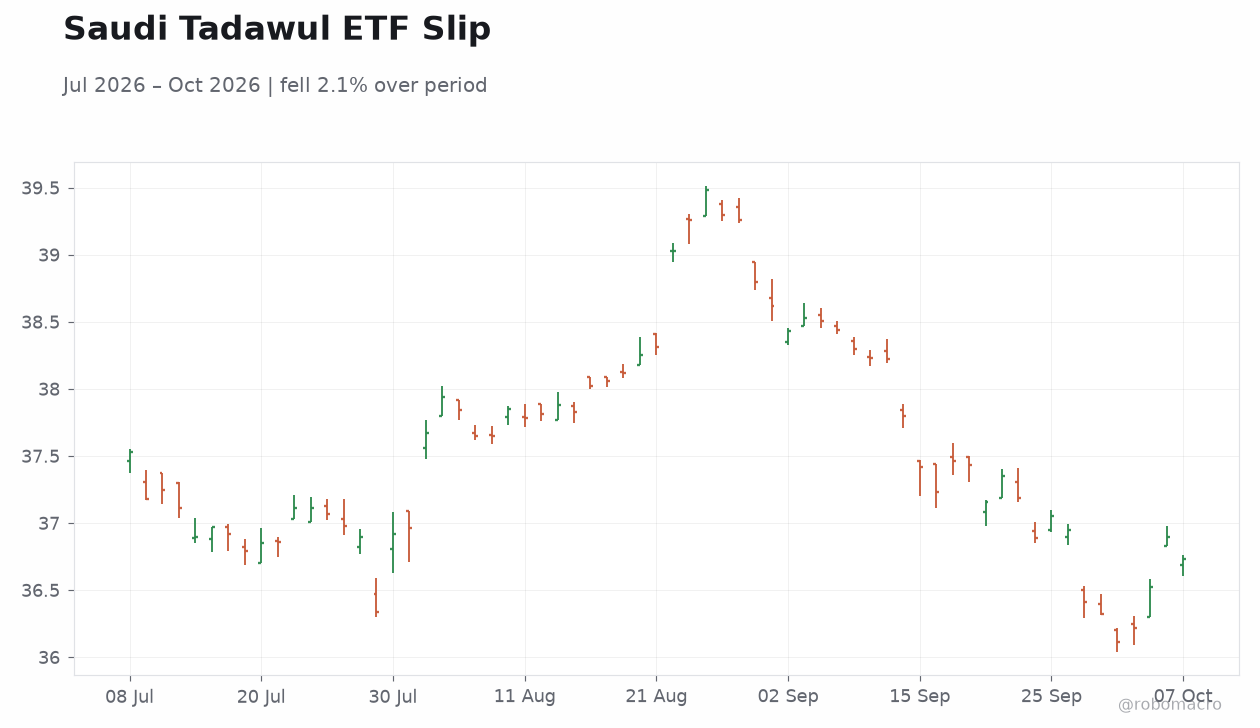
Equity markets diverged from the crude strength: MSCI Saudi fell 0.69% to 36.65, MSCI Qatar lost 0.58% to 16.21, and MSCI UAE shed 0.28% to 19.68, with MSCI Kuwait flat at 35.96. Saudi Aramco shares, however, added 0.16% to 25.84, supported by the firmer oil complex. Gold eased 0.70% to $4,157.60 and Bitcoin dropped 3.00% to $82,992, signaling a broader risk-off tone.
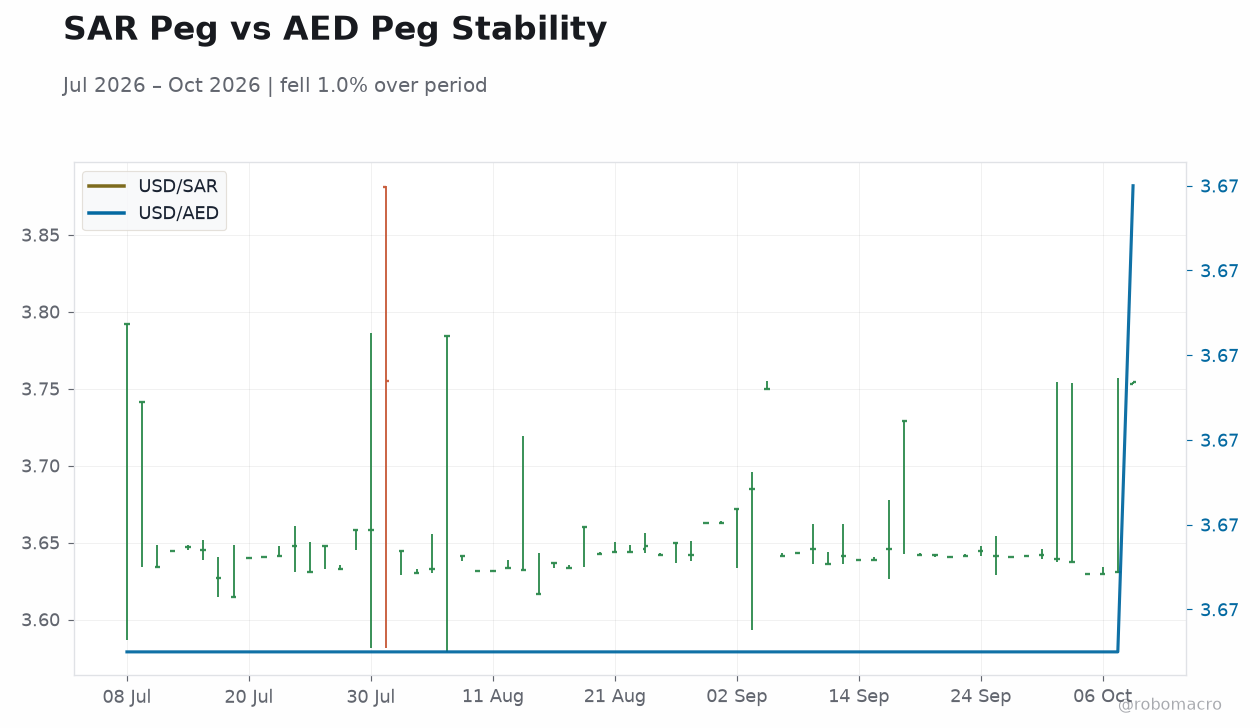
On the currency side, USD/SAR printed 3.75, a 3.39% move that bears watching for peg mechanics, while USD/AED held steady at 3.67 and USD/KWD slipped 0.31% to 0.31. Credit and ratings news added texture: S&P argued Saudi Arabia's non-oil transition builds long-term resilience even as banks seek new funding, and Fitch flagged Iran-war fiscal pressures in Riyadh's 2027 pre-budget statement.
Attention stays fixed on the security picture, with Qatar mediating continued US-Iran talks aimed at ending the conflict — any breakthrough would compress the oil risk premium quickly. Saudi Arabia's 2027 pre-budget statement will be parsed further for fiscal trajectory clues after Fitch's read on war-related spending pressures. Watch for follow-through on the World Bank's 7.9% growth forecast for Saudi in 2027 and whether it shifts sentiment toward the kingdom's longer-dated credit.
QatarEnergy's $3bn syndicated loan from Chinese banks underscores the region's deepening financing ties with Asia and may prompt similar mandates from peers. Regional equity markets will take their cue from overnight Brent and the durability of the Houthi ceasefire question. US weapons-sale notifications worth over $2bn to Kuwait and the UAE, cleared via Congress, support defense procurement pipelines across the Gulf.
Subscribe to GCC Macro Daily and get each new issue delivered to your inbox.
Already a member? Visit robomacro.com to log in and manage subscriptions, or use Forgot Password to set a password.
Brent Crude: Mideast Risk Premium | Type: market_hloc | Brent USD/bbl: 102.3 (2026-10-07) | Range: 74.16–108.8 | Trend(6pt): 74.16,90.74,93.78,105.7,100.6,102.3
Saudi Tadawul ETF Slip | Type: market_hloc | KSA ETF USD: 36.73 (2026-10-07) | Range: 36.11–39.48 | Trend(5pt): 37.53,36.92,38.31,37.42,36.73
SAR Peg vs AED Peg Stability | Type: market_hloc | USD/SAR: 3.754 (2026-10-08) | Range: 3.615–3.792 | Trend(6pt): 3.792,3.658,3.644,3.638,3.63,3.754 | USD/AED: 3.673 (2026-10-08) | Range: 3.671–3.673 | Trend(6pt): 3.671,3.671,3.671,3.671,3.671,3.673
The structural story remains diversification. S&P's assessment that Saudi Arabia's non-oil shift builds long-term resilience aligns with the World Bank's projection of a 7.9% growth rebound in 2027, though both flag financing needs — Saudi banks are actively seeking new funding to support the credit expansion underpinning Vision 2030 giga-projects. The fiscal side is more nuanced: Fitch's note on the 2027 pre-budget statement highlights how war-related pressures complicate Riyadh's consolidation path even as non-oil revenue broadens.
Elsewhere, Qatar's circular-economy conference signals policy interest in sustainability agendas, and the UAE's accession as the first Arab member of the Antarctic research body reflects soft-power diversification. Sudan's affirmed commitment to deepening economic ties with Saudi Arabia points to Riyadh's growing role as a regional creditor and investor.
The global energy complex is being reshaped by trade geopolitics. China continues to import no US LNG but remains engaged in negotiations, and a potential Trump-Xi deal could revive American energy exports to the Chinese market — a development with direct implications for Qatar's LNG market share in Asia. Saudi Arabia and the UAE are reportedly working to expand their oil reserve presence in Asia, per Nikkei, reinforcing the Gulf's strategic pivot eastward.
Iran's economy is under mounting pressure, with the rial weakening and oil exports constrained, yet Tehran publicly insists conditions are holding. ↓ p.3
Pakistan's winter gas load-planning amid LNG shortages illustrates how tight supply cascades into South Asian demand that Gulf exporters traditionally serve. The US State Department's notification of over $2bn in weapons sales to Egypt, Kuwait and the UAE reflects the broader militarization of regional policy. Gold's pullback from $4,157.60 and Bitcoin's 3% slide suggest investors are rotating toward energy and defensives as the Middle East conflict dominates macro narratives.
Monetary conditions across the Gulf remain anchored to the Federal Reserve, with all six currencies pegged — Kuwait's dinar to a basket, the rest to the dollar. The USD/SAR print at 3.75, up 3.39%, is the notable outlier and warrants scrutiny of forward-market positioning around the Saudi riyal peg, though SAMA's substantial reserve buffers provide ample defense capacity. USD/AED's stability at 3.67 and USD/KWD's 0.31% dip to 0.31 confirm orderly FX conditions elsewhere; the Kuwaiti dinar's basket composition continues to cushion it from pure-dollar volatility.
With no regional central-bank meetings on the immediate calendar, the six councils — SAMA, CBUAE, QCB, CBK, CBO and CBB — are in coordination mode, tracking Fed signals for the next rate adjustment cycle. Interbank benchmarks SAIBOR and EIBOR should firm modestly if the Fed's tightening bias persists, supporting bank net interest margins but raising funding costs for project sponsors — a dynamic S&P explicitly flagged in its Saudi banking note. Qatar's QCB retains flexibility given the current-account surplus from LNG receipts, while Oman's CBO and Bahrain's CBB remain most sensitive to US rate paths given narrower external buffers.
Any Fed pause would immediately widen the carry advantage of holding GCC fixed income versus dollar assets, a dynamic regional treasurers are already positioning for.