GCC Macro Daily(Beta Mode)
Houthi Strikes Test Saudi Economic Ambitions
Market Snapshot
| Asset | Level | Change |
|---|---|---|
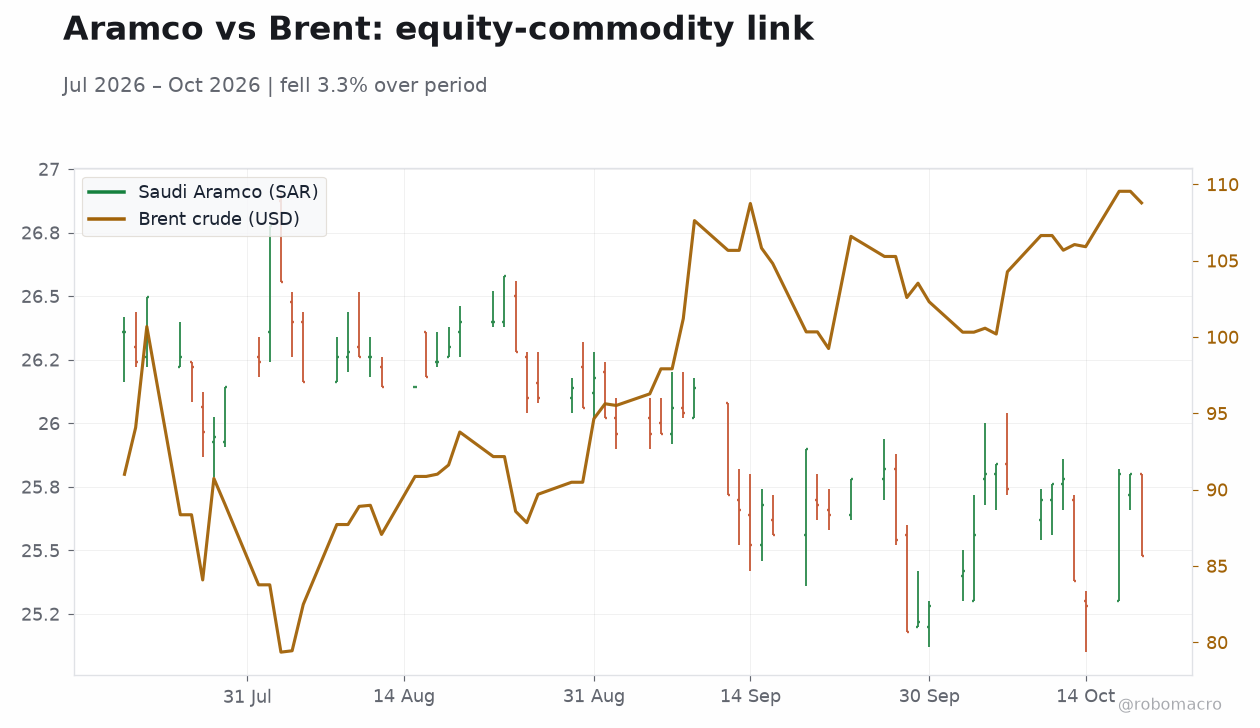
| Saudi Aramco | 25.58 | +0.39% |
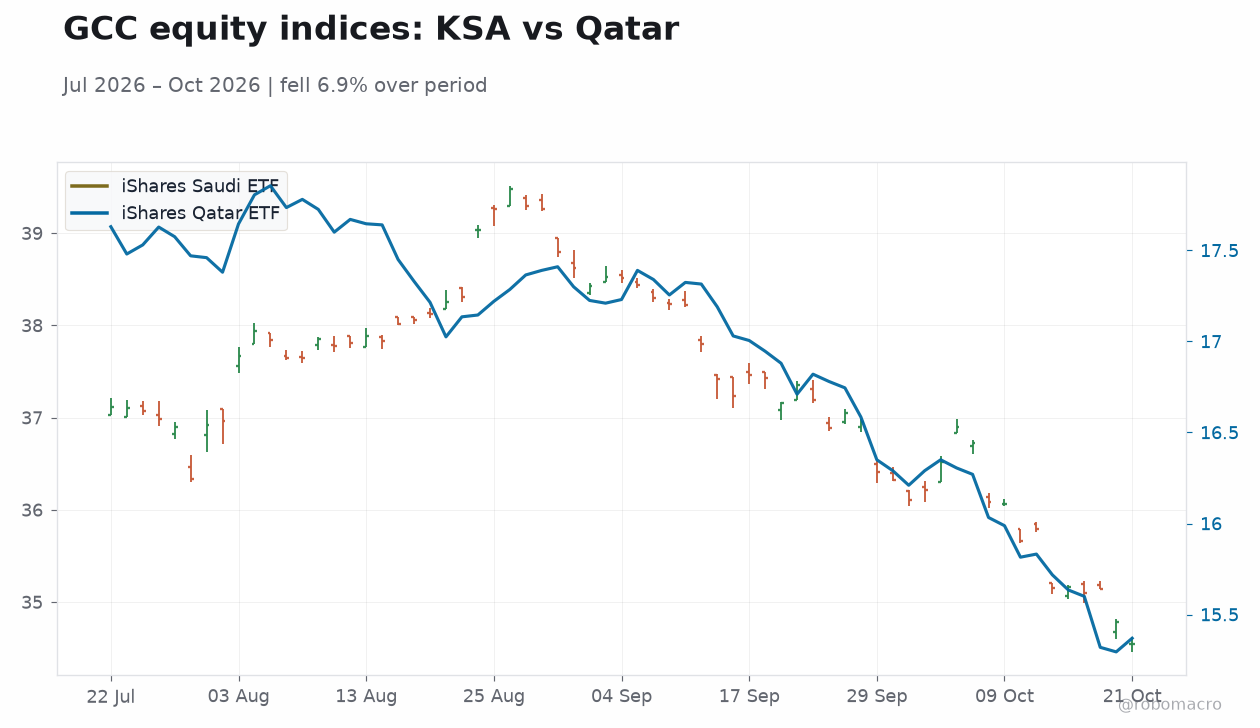
| MSCI Saudi | 34.58 | -0.58% |
| MSCI UAE | 19.68 | +0.00% |
| MSCI Qatar | 15.41 | +0.75% |
| MSCI Kuwait | 35.04 | +0.00% |
| Brent Crude | 110.64 | +1.70% |
| WTI Crude | 98.49 | -3.24% |
| Gold | 4,128.00 | -0.35% |
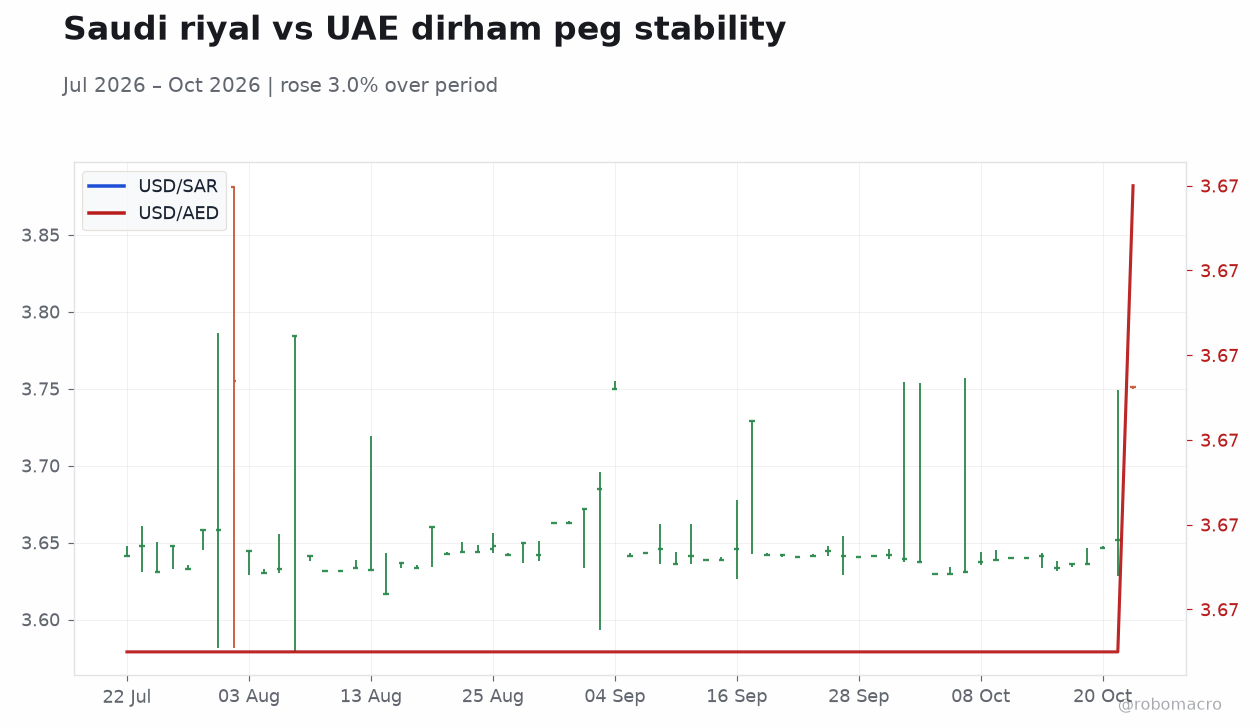
| USD/SAR | 3.75 | +2.71% |
| USD/AED | 3.67 | +0.03% |
| USD/KWD | 0.31 | -0.43% |
| Bitcoin | 82,740.75 | -0.24% |
Prior Economic Events
| Data | Prior | Cons | Actual |
|---|---|---|---|
| No events available | |||
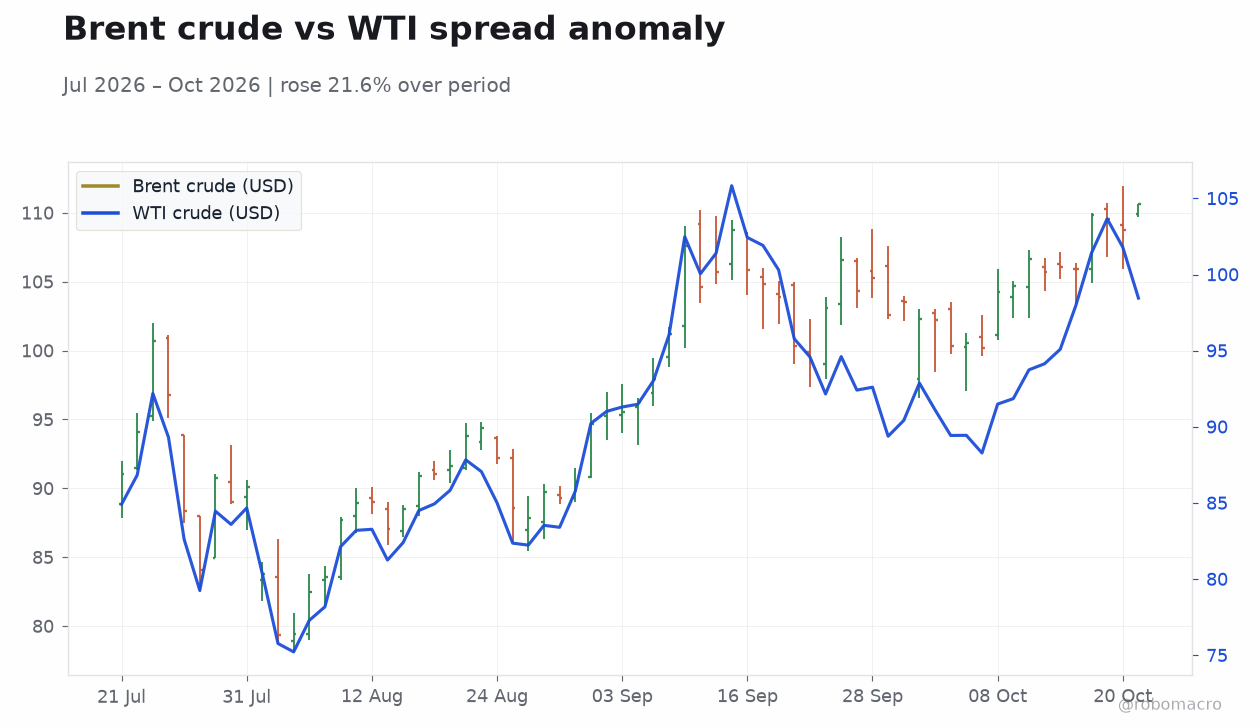 Brent crude vs WTI spread anomaly | Type: market_hloc | Brent crude (USD): 110.6 (2026-10-21) | Range: 79.36–110.6 | Trend(6pt): 91.01,88.98,95.52,105.3,108.8,110.6 | WTI crude (USD): 98.45 (2026-10-21) | Range: 75.22–105.8 | Trend(6pt): 84.91,83.27,91.3,92.6,101.8,98.45
Today's Economic Events
| Data | Prior | Cons | Time |
|---|---|---|---|
| No events available | |||
- Houthi attacks on a Saudi airport and oil facility kill three, lifting Brent 1.7% to $110.64 as Gulf security risk premium rebuilds
- Saudi Arabia postpones flagship investment conference to 2027; Finance Minister Al-Sayari insists economy remains resilient
- Kuwait Petroleum reports output above 2 million b/d; Qatar deepens LNG ties with France amid Hormuz passage concerns
Yesterday's Recap
Saudi Arabia absorbed a fresh security shock as Houthi attacks on an airport and an oil facility in the Kingdom's east killed three people, according to Arab News, prompting the US to order diplomats to leave the country and Brent crude to settle 1.7% higher at $110.64. The strikes landed alongside a decision to postpone Saudi Arabia's flagship investment conference to 2027, a signal that Riyadh is recalibrating its capital-raising calendar around regional risk. Saudi equities reflected the strain: the MSCI Saudi index fell 0.58% while Saudi Aramco eked out a 0.39% gain to 25.58 riyals, a defensive bid in the state oil champion.
Finance Minister Mohammed Al-Sayari publicly maintained that the Saudi economy remains resilient despite regional uncertainty, though Al-Monitor's framing that "the Saudi economy feels the squeeze" captures the tension between official messaging and market pricing. Elsewhere in the Gulf, Qatar was the standout performer with MSCI Qatar up 0.75%, helped by a 20-year LNG supply arrangement with France and plans for two power plants for Lebanon. Kuwaiti and UAE equity benchmarks were flat, with MSCI Kuwait at 35.04 and MSCI UAE unchanged at 19.68, while the Kuwait Petroleum Corporation CEO said crude deliveries to customers have been held largely at pre-conflict levels with output above 2 million barrels a day.
The Day Ahead
No scheduled GCC macro data releases appear on the calendar for Wednesday, leaving markets to trade the geopolitical tape and oil price volatility. Attention centers on whether Brent's $110 handle holds after the US diplomatic withdrawal from Saudi Arabia, with WTI's 3.24% decline to $98.49 suggesting divergent crude benchmarks and unusual spread behavior. Saudi official commentary will be scrutinized for further reassurance on Vision 2030 spending commitments after the investment conference postponement.
Qatar's LNG diplomacy continues with France, and the UAE's DIP Holding IPO — the country's first listing of 2026 — will be watched as a bellwether for Dubai capital markets confidence. Gulf equity desks will also monitor for any spillover into Saudi banking names if the security premium persists.
Other Economic Notes
The attacks underscore a structural vulnerability: Gulf fiscal and diversification plans are priced off stable oil logistics, and any disruption to Abqaiq-style infrastructure immediately feeds through to sovereign risk premia. ↓ p.2