GCC Macro Daily(Beta Mode)
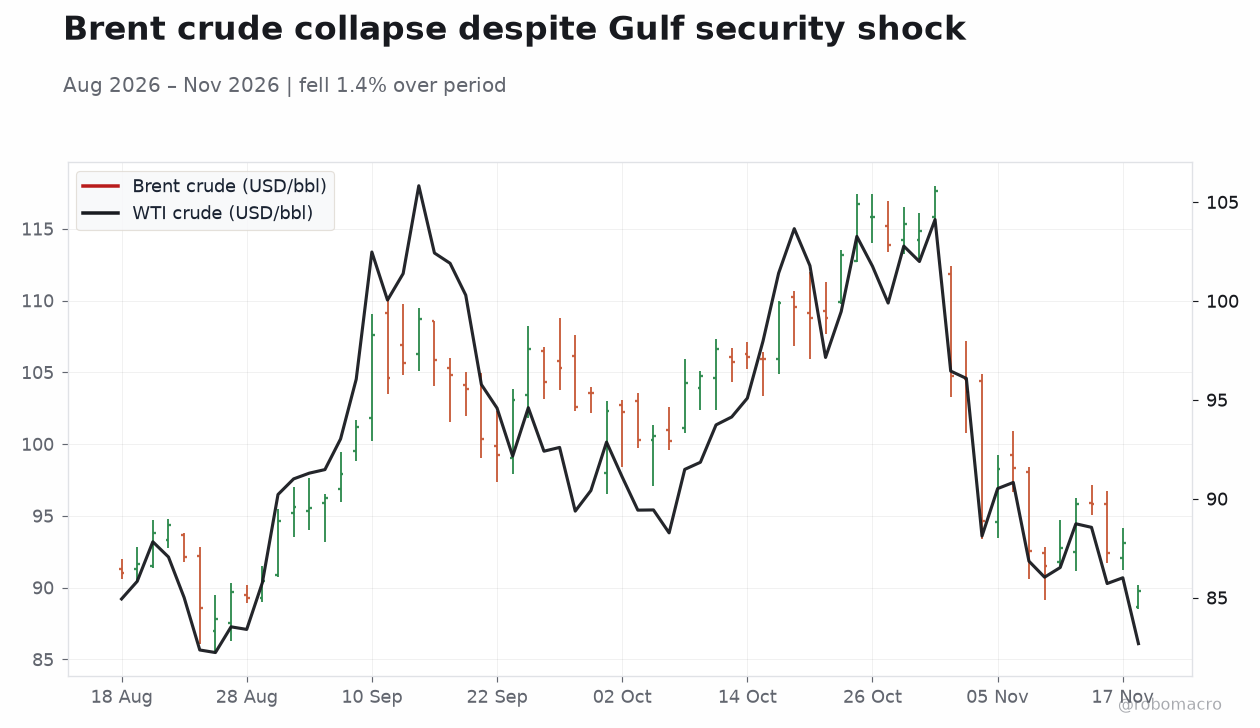
Oil Plunges 3.5% Despite Gulf Security Shock
Market Snapshot
| Asset | Level | Change |
|---|---|---|
| Saudi Aramco | 26.44 | +0.23% |
| MSCI Saudi | 35.67 | -0.71% |
| MSCI UAE | 21.18 | +0.28% |
| MSCI Qatar | 17.85 | +0.34% |
| MSCI Kuwait | 36.44 | +0.00% |
| Brent Crude | 89.86 | -3.52% |
| WTI Crude | 82.67 | -3.88% |
| Gold | 3,748.90 | -2.98% |
| USD/SAR | 3.75 | +2.99% |
| USD/AED | 3.67 | +0.03% |
| USD/KWD | 0.31 | +0.03% |
| Bitcoin | 62,836.09 | -3.17% |
Prior Economic Events
| Data | Prior | Cons | Actual |
|---|---|---|---|
| No events available | |||
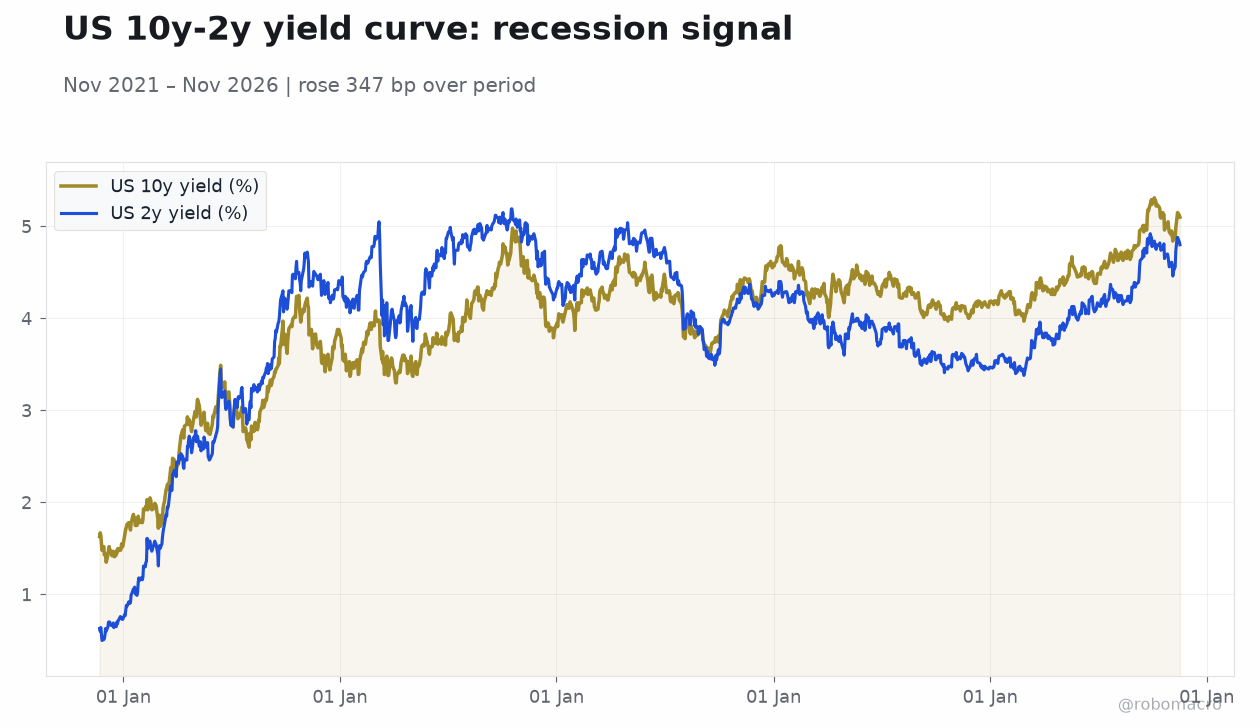 US 10y-2y yield curve: recession signal | Type: macro_line | US 10y yield (%): 5.1 (2026-11-17) | Range: 1.35–5.31 | Trend(6pt): 1.63,3.93,4.42,4.34,5.12,5.1 | US 2y yield (%): 4.8 (2026-11-17) | Range: 0.5–5.19 | Trend(6pt): 0.63,4.66,4.83,3.77,4.83,4.8
Today's Economic Events
| Data | Prior | Cons | Time |
|---|---|---|---|
| No events available | |||
- Iranian drone and aerial attacks hit Kuwait and Bahrain; Kuwait's foreign ministry condemns strikes on its territory as Gulf security risk escalates
- Brent crude collapses 3.52% to $89.86 and WTI 3.88% to $82.67 despite supply-risk headlines, signaling demand fears dominate
- IMF upgrades UAE 2026 economic outlook; Saudi Arabia issues 9,851 investment licences in Q3 led by construction
Yesterday's Recap
Gulf markets diverged on November 17 as security headlines collided with a sharp oil selloff. Brent fell 3.52% to $89.86 and WTI dropped 3.88% to $82.67, an unusual move given simultaneous supply-risk escalation in the region. Saudi equities weakened, with the MSCI Saudi index down 0.71% and Saudi Aramco off 0.23% to SAR 26.44, while the UAE and Qatar benchmarks posted modest gains of 0.28% and 0.34% respectively.
Kuwait's MSCI gauge was flat at 0.00%. Gold slid 2.98% to $3,748.90 and Bitcoin fell 3.17% to $62,836, pointing to broad risk-asset deleveraging rather than a pure Gulf story. The USD/SAR print at 3.75 (+2.99%) reflects a data artifact rather than a genuine peg move, as the riyal remains firmly anchored.
No GCC macro releases were recorded for the session, leaving markets to trade on geopolitics and energy flows.
The Day Ahead
The calendar is empty across November 18 and 19, so flow will be driven by security headlines and oil price action rather than scheduled data. Traders will watch whether Brent stabilizes above $89 or extends losses, given the direct fiscal sensitivity across Saudi Arabia, Kuwait, and Oman. UAE flight cancellations by Etihad and flydubai into Saudi Arabia will be monitored as a real-economy signal of the security disruption.
Qatar's announced meeting with Iran and its continued mediation efforts are worth tracking for any de-escalation signal that could support crude. With no prints due, interbank rates and CDS spreads will be the cleanest read on sentiment.
Other Economic Notes
Saudi Arabia issued 9,851 investment licences in Q3, with construction leading activity, underscoring non-oil diversification momentum under Vision 2030. The IMF upgraded the UAE's 2026 economic outlook, reinforcing the Emirates' relatively resilient non-oil growth trajectory. Saudi Arabia's PIF retained its status as the world's most valuable sovereign fund brand for a third consecutive year, highlighting the scale of deployed capital.
Gallagher research flagged rising commercial crime risk for businesses in the UAE and Saudi Arabia, a reminder of governance costs as private-sector activity expands. ↓ p.2