| Asset | Level | Change |
|---|---|---|
| Saudi Aramco | 26.26 | -0.15% |
| MSCI Saudi | 34.90 | +0.23% |
| MSCI UAE | 21.82 | +0.81% |
| MSCI Qatar | 17.74 | +0.06% |
| MSCI Kuwait | 35.74 | +0.00% |
| Brent Crude | 90.69 | -0.78% |
| WTI Crude | 83.94 | +2.30% |
| Gold | 3,589.40 | +0.77% |
| USD/SAR | 3.63 | +0.18% |
| USD/AED | 3.67 | +0.03% |
| USD/KWD | 0.31 | -0.03% |
| Bitcoin | 60,668.76 | +1.54% |
| Data | Prior | Cons | Actual |
|---|---|---|---|
| No events available | |||
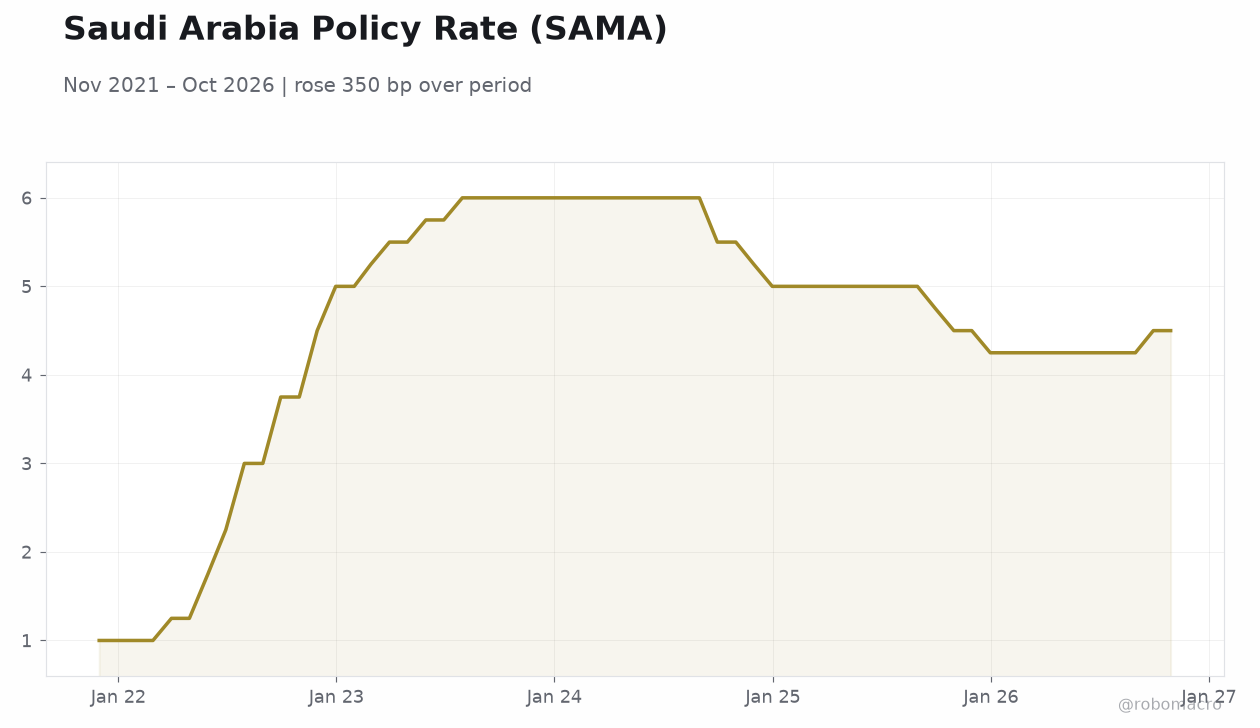
Saudi Arabia Policy Rate (SAMA) | Type: macro_line | Policy rate (%): 4.5 (2026-10-29) | Range: 1–6 | Trend(5pt): 1,5.25,6,5,4.5
| Data | Prior | Cons | Time |
|---|---|---|---|
| No events available | |||
Geopolitical risk dominated GCC macro flows on Tuesday, with Yemen's Houthis claiming strikes on Saudi Arabia's largest oil refinery and a projectile hitting Jazan Port, while the Saudi-led coalition reported intercepting two drones over the Eastern Region. The attacks injected a fresh supply-risk premium into crude, with WTI settling up 2.30% at $83.94 and Brent at $90.69, a -0.78% print that nonetheless sits near multi-month highs. Saudi Arabia's cabinet approved the 2027 budget, projecting total revenue of $320bn and a deficit of roughly $50.6bn, a fiscal stance that implies continued borrowing and draws on the Public Investment Fund's capacity.
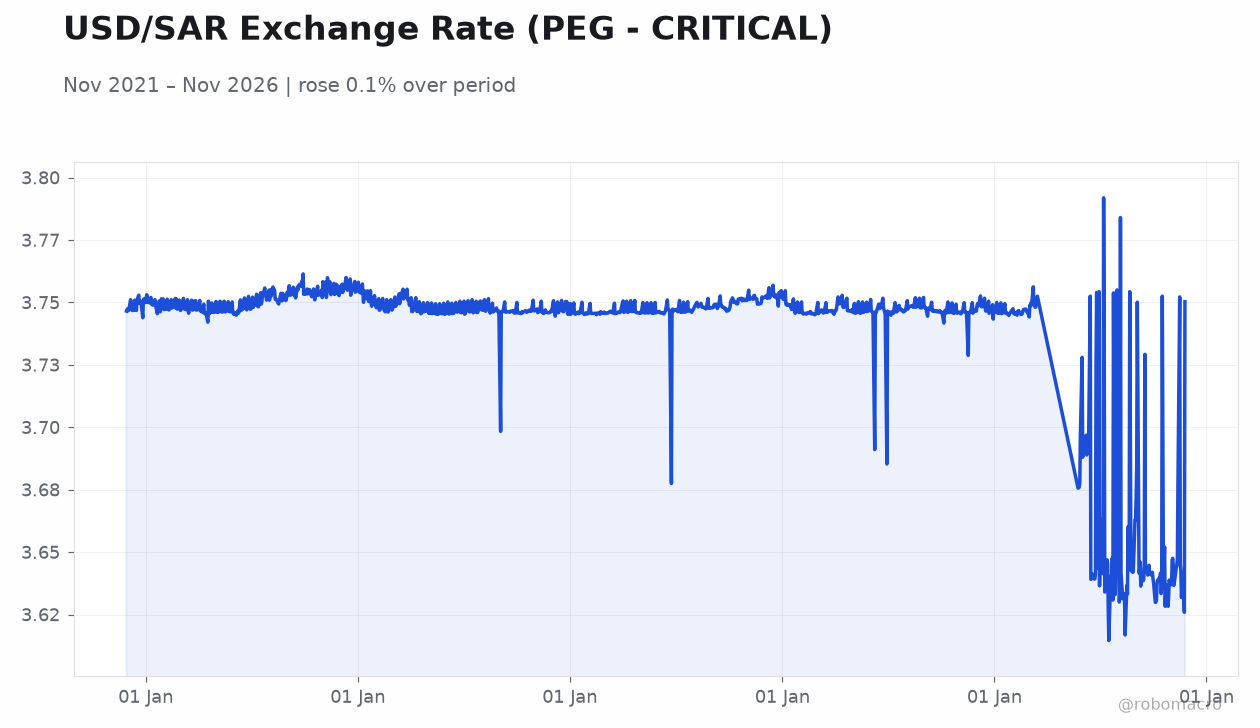
Reports that Riyadh cancelled projects worth $266bn tempered the Vision 2030 capex narrative, even as the economy minister flagged $1trn in infrastructure investment opportunities over coming years. GCC equity performance was bifurcated: MSCI UAE led at +0.81%, MSCI Saudi added +0.23%, MSCI Qatar +0.06%, and MSCI Kuwait was unchanged, while Saudi Aramco eased -0.15%. In FX, the USD/SAR edged +0.18% to 3.63 and USD/AED +0.03% to 3.67, with USD/KWD -0.03% at 0.31, all consistent with peg stability.
Regional security headlines also included a UKMTO-reported explosion near a tanker west of Dubai.
The GCC calendar is light on Wednesday, November 25, with no scheduled tier-one data releases across the six member states, leaving markets to digest the Saudi budget arithmetic and the security escalation. Traders will watch whether the Houthi strikes translate into sustained crude strength or a fade, given the divergence between WTI's +2.30% and Brent's -0.78% print. Saudi equity reaction to the $266bn project cancellation and the 2027 deficit will be the key domestic signal, with Aramco and MSCI Saudi positioning in focus.
UAE markets will track the clean-energy target upgrade to 35% by 2031 and the Dubai-Poland non-oil trade expansion. Qatar remains in the spotlight ahead of the weekend F1 event and ongoing Iran mediation diplomacy.
Subscribe to GCC Macro Daily and get each new issue delivered to your inbox.
Already a member? Visit robomacro.com to log in and manage subscriptions, or use Forgot Password to set a password.
USD/SAR Exchange Rate (PEG - CRITICAL) | Type: macro_line | USD/SAR Exchange Rate (PEG - CRITICAL): 3.75 (2026-11-25) | Range: 3.615–3.792 | Trend(5pt): 3.747,3.747,3.746,3.746,3.75
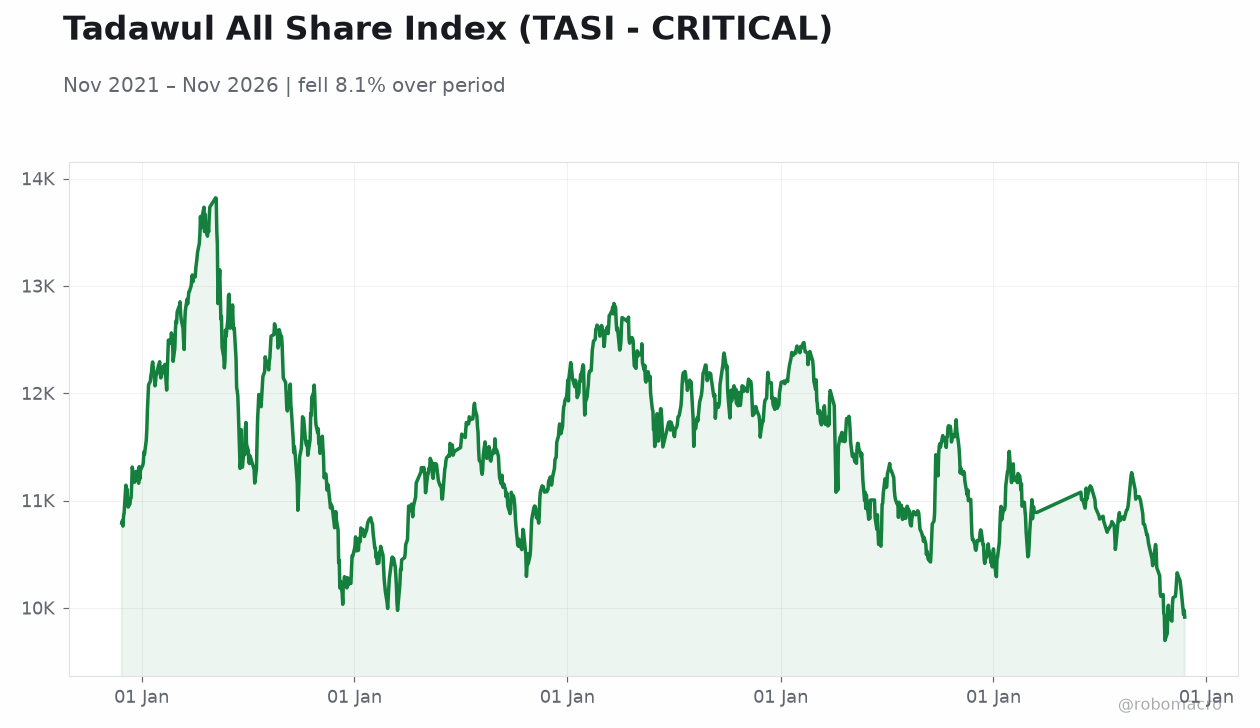
Tadawul All Share Index (TASI - CRITICAL) | Type: macro_line | Tadawul All Share Index (TASI - CRITICAL): 9914 (2026-11-25) | Range: 9696–1.382e+04 | Trend(6pt): 1.079e+04,1.084e+04,1.284e+04,1.108e+04,9977,9914
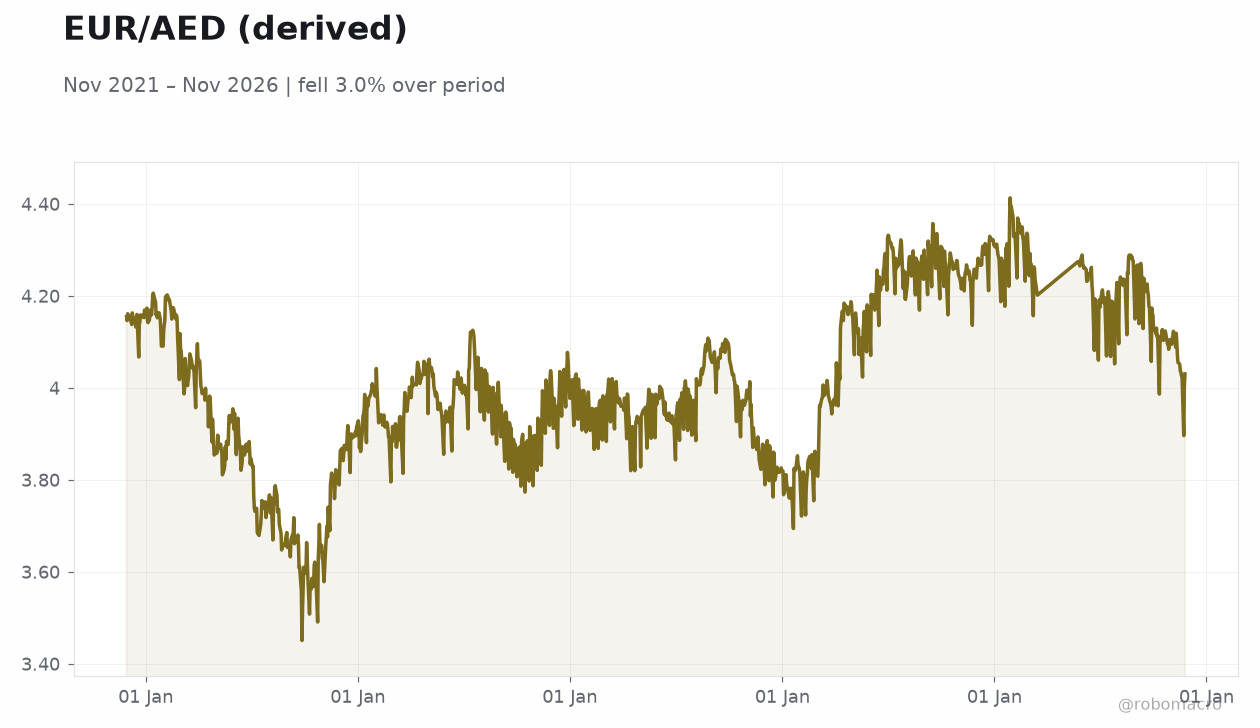
EUR/AED (derived) | Type: macro_line | EUR/AED (derived): 4.031 (2026-11-25) | Range: 3.451–4.413 | Trend(6pt): 4.155,3.938,3.906,4.32,3.897,4.031
Aramco vs Brent: Equity-Energy Linkage | Type: market_hloc | Aramco (SAR): 26.3 (2026-11-24) | Range: 24.86–26.48 | Trend(5pt): 25.95,25.35,25.37,25.77,26.3 | Brent (USD/bbl): 90.69 (2026-11-25) | Range: 87.84–117.6 | Trend(6pt): 88.58,104.8,104.7,104.8,91.4,90.69
Saudi Arabia's non-oil revenue tripling underpins the $1trn investment narrative, but the $266bn project cancellation signals a recalibration of capex priorities toward fiscal sustainability. The 2027 budget's $50.6bn deficit implies continued sovereign issuance and reliance on PIF financing, keeping Saudi credit spreads in focus. The UAE's raised clean-energy target to 35% by 2031 reflects accelerating diversification and could attract incremental green finance.
Dubai's non-oil trade with Poland rising 14% to $1.91bn illustrates intra-GCC trade diversification beyond hydrocarbons.
Oil markets are the transmission channel for GCC macro, and the Houthi refinery strike has reintroduced a geopolitical premium just as OPEC+ prepares its most consequential supply decision of the year at month-end. Iraq's rejection of the OPEC+ production-capacity assessment sets up a potential quota dispute that could complicate the group's supply path. US natural gas futures softened on mild weather and near-record output, a reminder that energy price dynamics are diverging across commodities.
Gold's 0.77% rise to $3,589.40 reflects safe-haven demand tied to Middle East escalation. Bitcoin's +1.54% to $60,668.76 suggests risk appetite remains selective rather than broad. The Fed's trajectory remains the dominant external constraint on GCC monetary policy given the dollar pegs.
All six GCC central banks remain anchored to the Fed via their dollar pegs, with SAMA, CBUAE, QCB, CBO, and CBB policy rates mechanically tracking US moves, while Kuwait's dinar is pegged to a basket rather than the dollar alone, giving CBK marginally more flexibility. With no GCC data on the calendar today, interbank rates — SAIBOR and EIBOR — will be the key domestic liquidity signal, and any drift should be read against Fed expectations rather than local policy intent. FX reserve adequacy across the bloc remains comfortable, and peg stability is evident in the muted USD/SAR, USD/AED, and USD/KWD moves.
Divergences are structural rather than cyclical: Kuwait's basket peg and Bahrain's thinner reserve buffer versus Saudi and UAE's ample cushions. No GCC central bank has signaled a departure from Fed-correlated policy, and today's empty calendar means no rate decisions to report.