Greater China Macro Daily(Beta Mode)
HK GDP Surges, CN Services PMI Eyed
Market Snapshot
| Asset | Level | Change |
|---|---|---|
| Shanghai Composite | 3,592.70 | -1.25% |
| CSI 300 | 4,008.87 | +0.59% |
| Hang Seng | 23,393.32 | +0.42% |
| TAIEX | 44,920.14 | -0.65% |
| USD/CNY | 6.66 | -0.01% |
| USD/HKD | 7.85 | +0.03% |
| Copper | 6.41 | -2.08% |
| Brent Crude | 104.46 | -0.30% |
| Gold | 3,939.20 | -0.77% |
| Bitcoin | 77,799.25 | +1.46% |
| China 2Y Govt Yield | - | - |
| China 10Y Govt Yield | - | - |
Prior Economic Events
| Data | Prior | Cons | Actual |
|---|---|---|---|
| No events available | |||
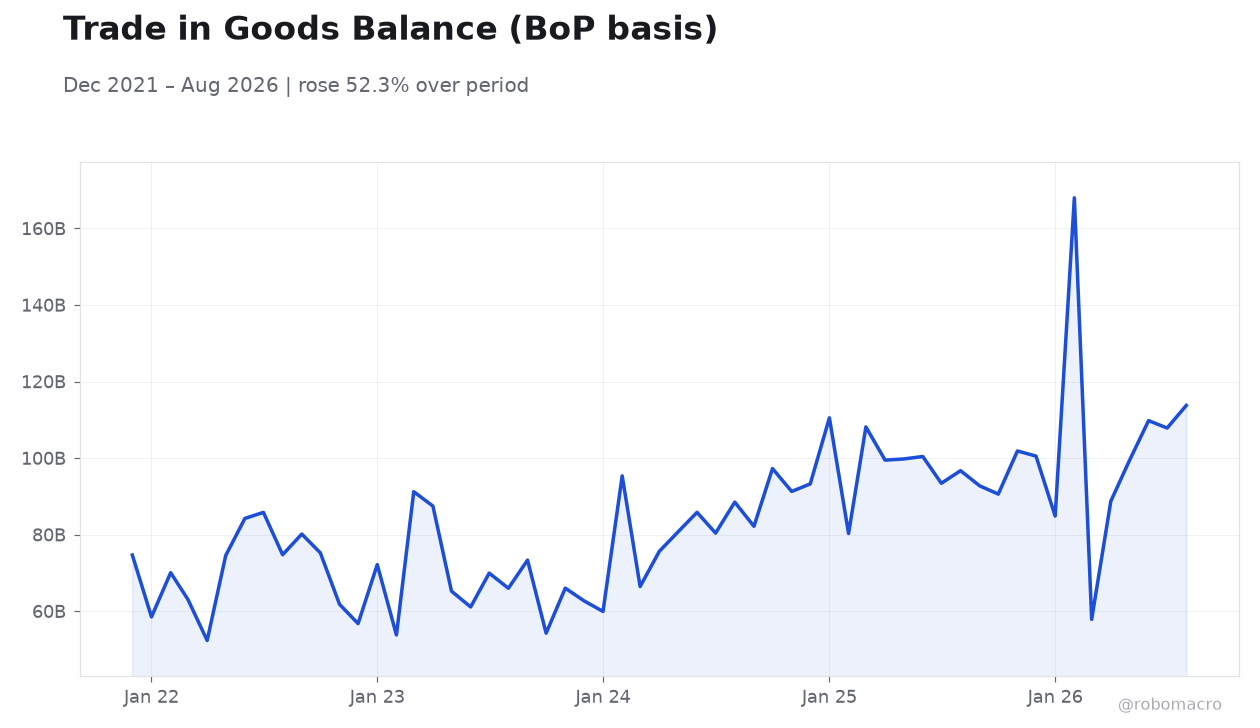
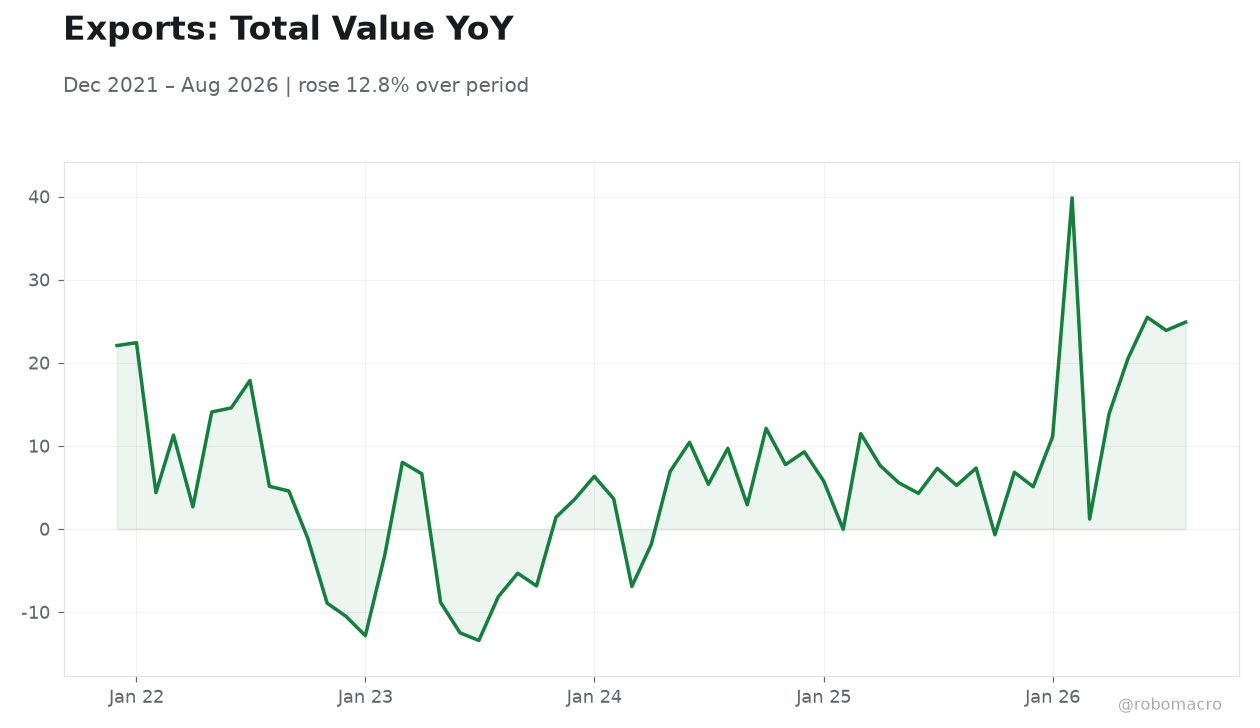
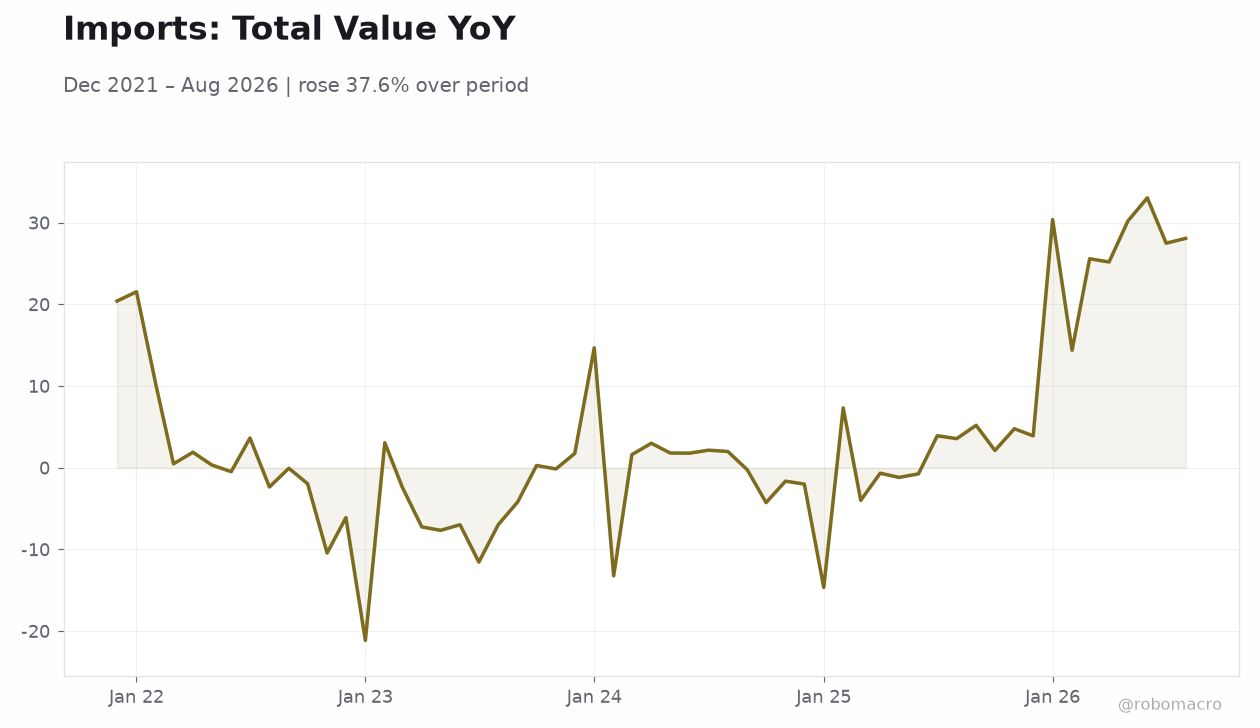
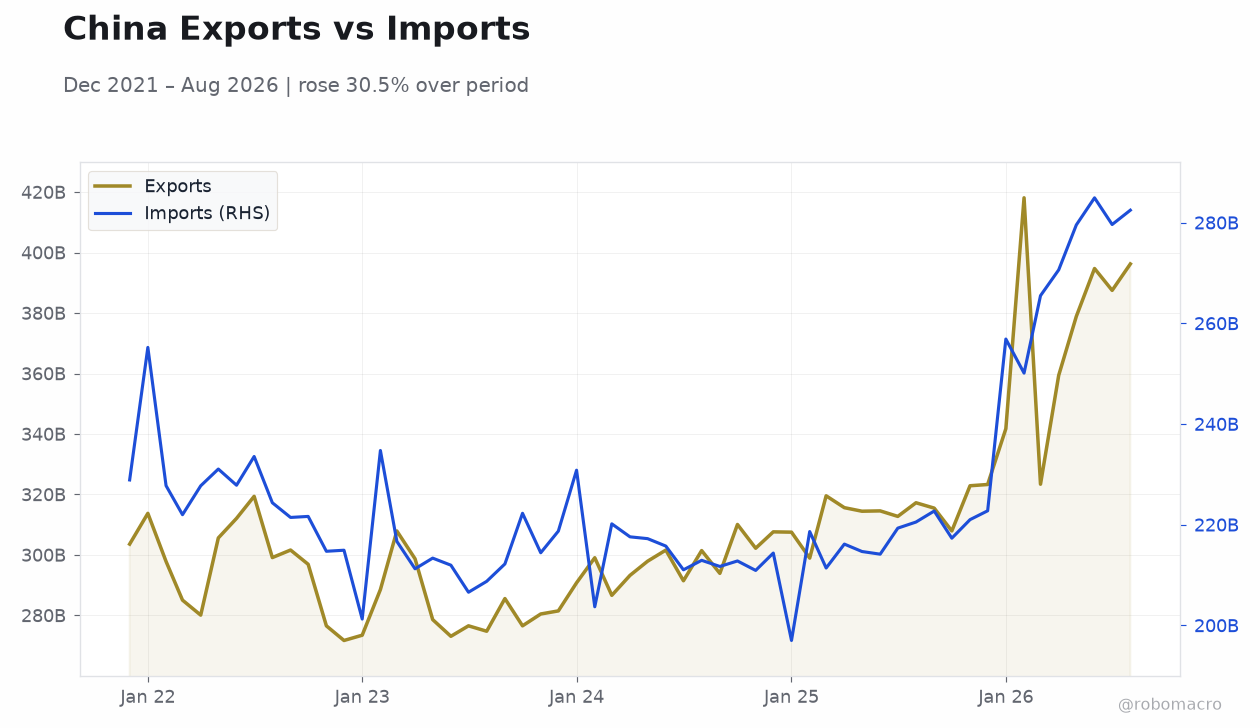 China Exports vs Imports | Type: macro_line | Exports: 3.963e+11 (2026-08-01) | Range: 2.717e+11–4.181e+11 | Trend(5pt): 3.036e+11,2.886e+11,2.933e+11,3.146e+11,3.963e+11 | Imports: 2.825e+11 (2026-08-01) | Range: 1.97e+11–2.85e+11 | Trend(5pt): 2.289e+11,2.348e+11,2.176e+11,2.142e+11,2.825e+11
Today's Economic Events
| Data | Prior | Cons | Time |
|---|---|---|---|
| RatingDog Services PMI | 51.60 | 51.50 | 20:45 |
- Hong Kong Q3 GDP expanded 5.2% year-on-year, a standout print supporting the city's recovery narrative as Beijing leans on Hong Kong for offshore yuan and fintech expansion.
- Mainland China's RatingDog Services PMI is due tonight at 20:45 ET, with consensus at 51.5 versus a prior 51.6 — a marginal softening consistent with the broader growth slowdown debate.
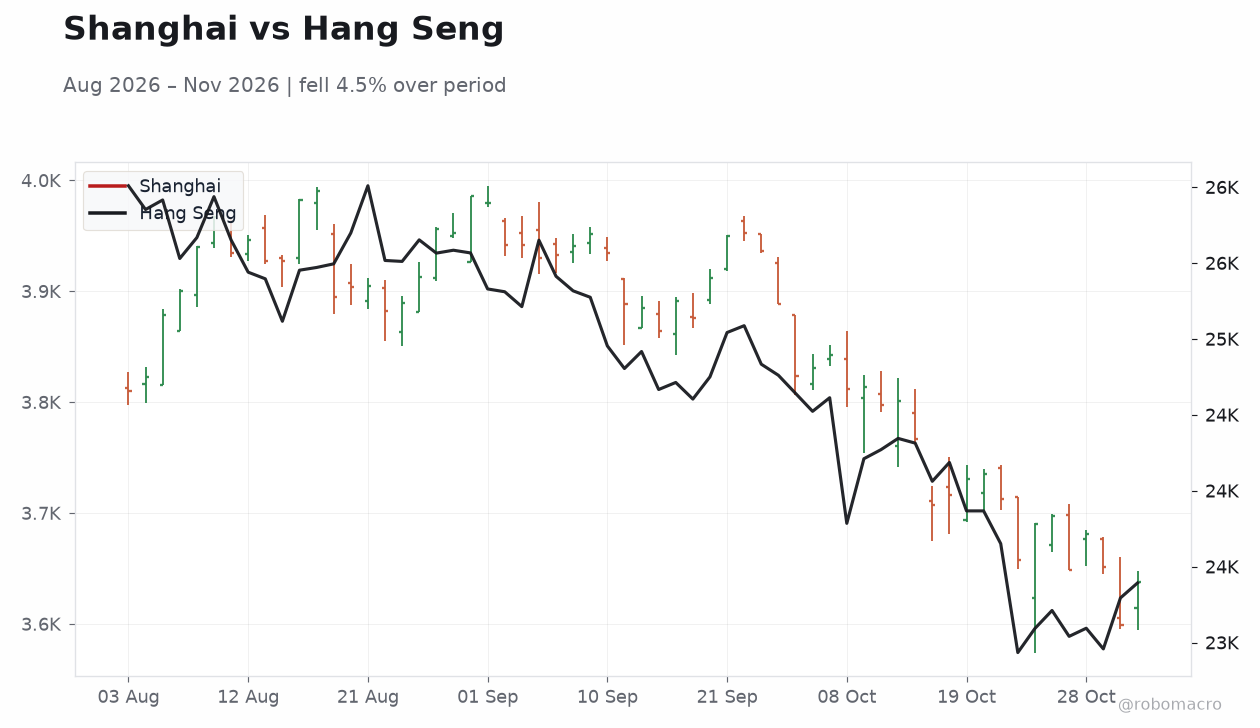
- Mainland equities diverged sharply: CSI 300 rose 0.59% while the Shanghai Composite fell 1.25%, and copper's 2.08% drop signals lingering industrial demand concerns.
Yesterday's Recap
Hong Kong was the dominant macro story, with Q3 GDP expanding 5.2% year-on-year — a robust print that reinforces the city's role as a growth and financial-services hub even as mainland momentum cools. Mainland China's equity market showed a striking divergence: the CSI 300 gained 0.59% to 4,008.87 while the Shanghai Composite dropped 1.25% to 3,592.70, suggesting rotation rather than broad risk appetite. Hong Kong's Hang Seng added 0.42% to 23,393.32, tracking the positive GDP surprise.
Taiwan's TAIEX slipped 0.65% to 44,920.14, with semiconductor sentiment still the swing factor. In FX, USD/CNY held near 6.66 (down 0.01%) and USD/HKD edged up 0.03% to 7.85, sitting at the weak end of the convertibility band. Commodities offered a cautionary signal: copper fell 2.08% to 6.41, a key China growth proxy flashing weakness, while Brent eased 0.30% to 104.46 and gold slipped 0.77% to 3,939.20.
The Day Ahead
The sole scheduled Greater China release is mainland China's RatingDog Services PMI at 20:45 ET, with consensus at 51.5 versus the prior 51.6 — a print below 51 would sharpen the narrative of decelerating services activity. No Hong Kong or Taiwan data is scheduled, leaving Hong Kong's GDP surprise and the HKMA's FinTech Week announcements to carry the regional narrative. Markets will also watch whether the CSI 300's outperformance versus the Shanghai Composite persists, and whether copper's slide stabilizes.
With no major central bank decisions on the calendar, positioning will likely be driven by the services print and global risk sentiment.
Other Economic Notes
The debate over mainland China's official statistics is intensifying, with WSJ commentary arguing that rosy GDP figures mask unproductive investment clogging banks and local governments — a theme that matters for anyone pricing credit risk. Foreign investor access remains a structural concern, with reporting noting that offshore investors receive a different "truth" on China's market data than domestic participants. On the trade front, the "China Shock 2.0" narrative is building, with ABN AMRO questioning whether a second wave of Chinese export capacity could trigger an EU-China trade war.
↓ p.2