Greater China Macro Daily(Beta Mode)
LPR Hold, TAIEX Plunge, FDI Slump Narrows
Market Snapshot
| Asset | Level | Change |
|---|---|---|
| Shanghai Composite | 3,533.79 | -1.22% |
| CSI 300 | 3,954.56 | -0.76% |
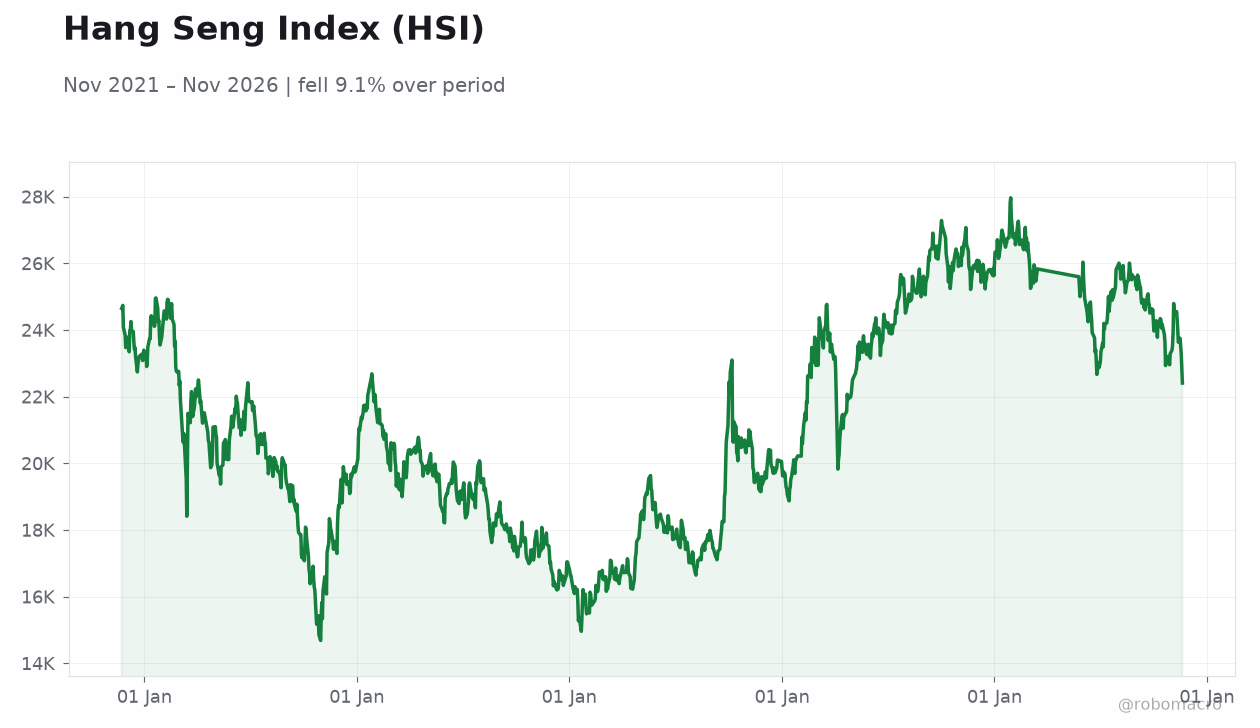
| Hang Seng | 22,410.80 | -1.89% |
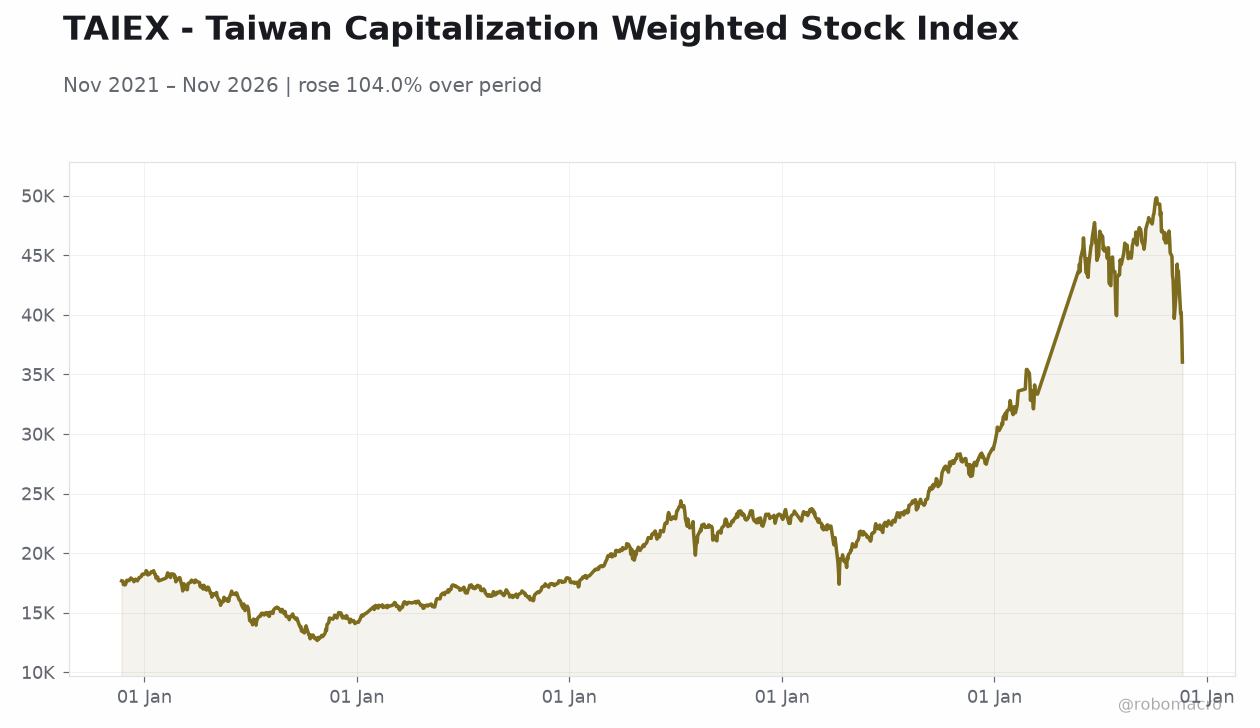
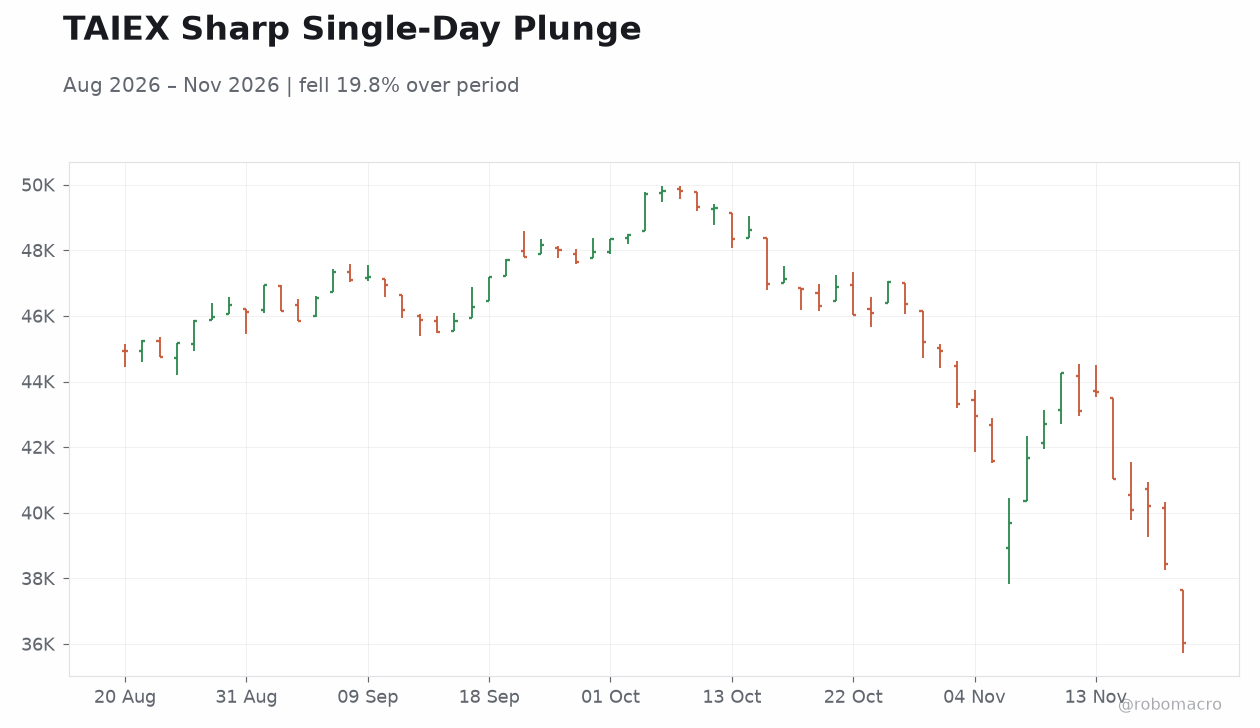
| TAIEX | 36,033.29 | -6.23% |
| USD/CNY | 6.66 | -0.06% |
| USD/HKD | 7.84 | -0.05% |
| Copper | 5.49 | -2.49% |
| Brent Crude | 89.95 | -2.21% |
| Gold | 3,515.40 | -4.62% |
| Bitcoin | 60,829.61 | +1.22% |
| China 2Y Govt Yield | - | - |
| China 10Y Govt Yield | - | - |
Prior Economic Events
| Data | Prior | Cons | Actual |
|---|---|---|---|
| Loan Prime Rate 1Y | 3 | 3 | 3 |
| Loan Prime Rate 5Y | 3.50 | 3.50 | 3.50 |
| FDI (YTD) Year-over-Year | -4.30 | - | -2.40 |
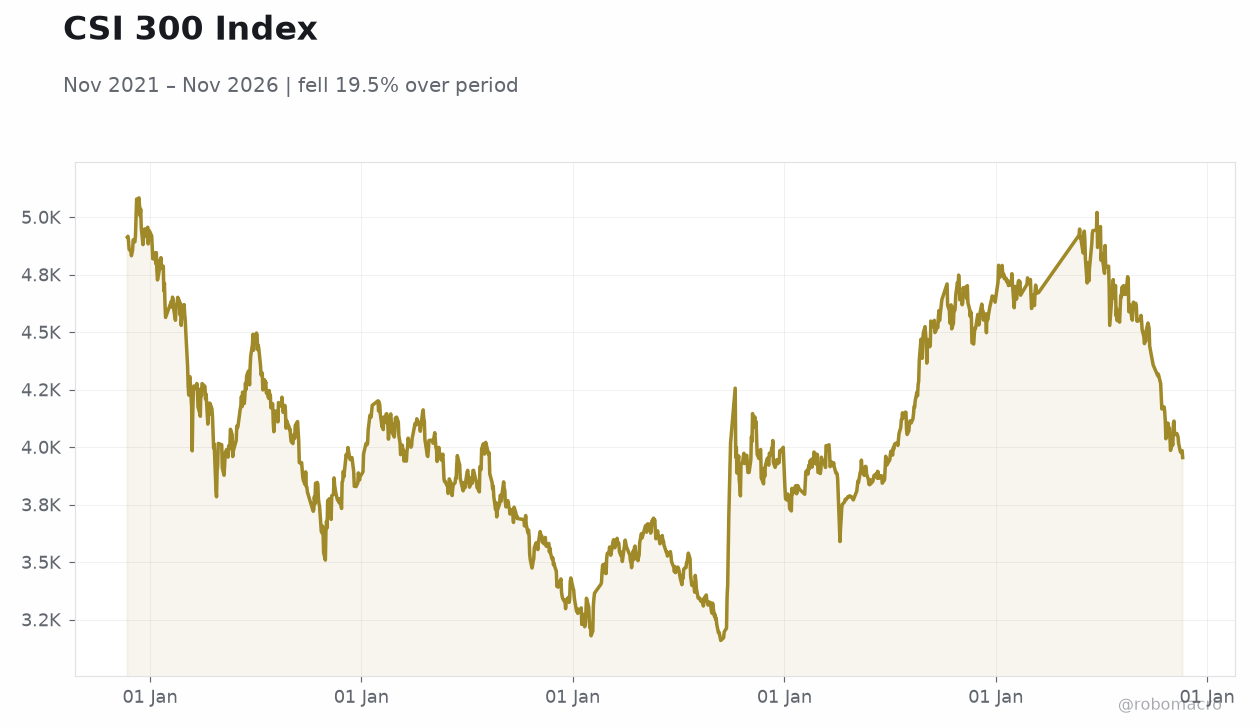 CSI 300 Index | Type: macro_line | CSI 300 Index: 3955 (2026-11-20) | Range: 3159–5084 | Trend(6pt): 4913,4157,3581,3895,3976,3955
Today's Economic Events
| Data | Prior | Cons | Time |
|---|---|---|---|
| No events available | |||
- PBoC held the 1Y and 5Y LPR at 3.00% and 3.50% respectively, signaling policy patience amid a stabilizing growth backdrop.
- Taiwan's TAIEX crashed 6.23% to 36,033, the sharpest single-day decline in the region, as Fed hike bets hammered tech-heavy Asian bourses.
- China's FDI (YTD) contraction narrowed to -2.4% YoY from -4.3%, suggesting foreign capital outflows are moderating.
Yesterday's Recap
The PBoC left both the 1-year and 5-year Loan Prime Rates unchanged at 3.00% and 3.50% on November 19, matching consensus and reinforcing expectations that Beijing will hold policy steady into year-end. China's FDI (YTD) print for November 20 came in at -2.4% YoY, an improvement from the prior -4.3% reading, indicating that the pace of foreign direct investment outflows has slowed though the stock remains in contraction. Mainland equity benchmarks weakened, with the Shanghai Composite falling 1.22% to 3,533.79 and the CSI 300 down 0.76% to 3,954.56, as risk appetite soured across the region.
Hong Kong's Hang Seng dropped 1.89% to 22,410.80, tracking the broader Asia selloff. Taiwan's TAIEX bore the brunt of the risk-off move, plunging 6.23% to 36,033.29, its steepest one-day loss in recent memory, as semiconductor-heavy names bore the brunt of Fed tightening fears. The yuan was marginally firmer, with USD/CNY at 6.66, down 0.06%, while USD/HKD held at 7.84, down 0.05%, keeping the peg comfortably within its band.
The Day Ahead
The Greater China calendar is empty for today, November 22, with no scheduled data releases across mainland China, Hong Kong, or Taiwan. Market attention will therefore pivot to external catalysts, particularly US rate expectations and any weekend policy commentary from Beijing. Hong Kong's HKMA is slated to hold a tender for 1-year RMB HKSAR government bonds on November 26, a modest but relevant signal of continued RMB-denominated sovereign issuance activity.
Taiwan investors will watch for any follow-through in semiconductor names after the TAIEX's sharp reversal, with global tech sentiment likely to dictate direction. With no domestic prints to digest, positioning flows and cross-asset moves will dominate the session.
Other Economic Notes
China's CPI held at 0.70% YoY as of October, keeping inflation well below target and preserving room for further easing should growth falter. The FDI contraction narrowing to -2.4% suggests that Beijing's efforts to attract foreign capital may be gaining modest traction, though the stock remains negative. China's AI ambitions are running into a funding gap, with domestic champions struggling to match the capital-raising pace of Silicon Valley peers, a theme that could weigh on the tech investment pipeline.
↓ p.2