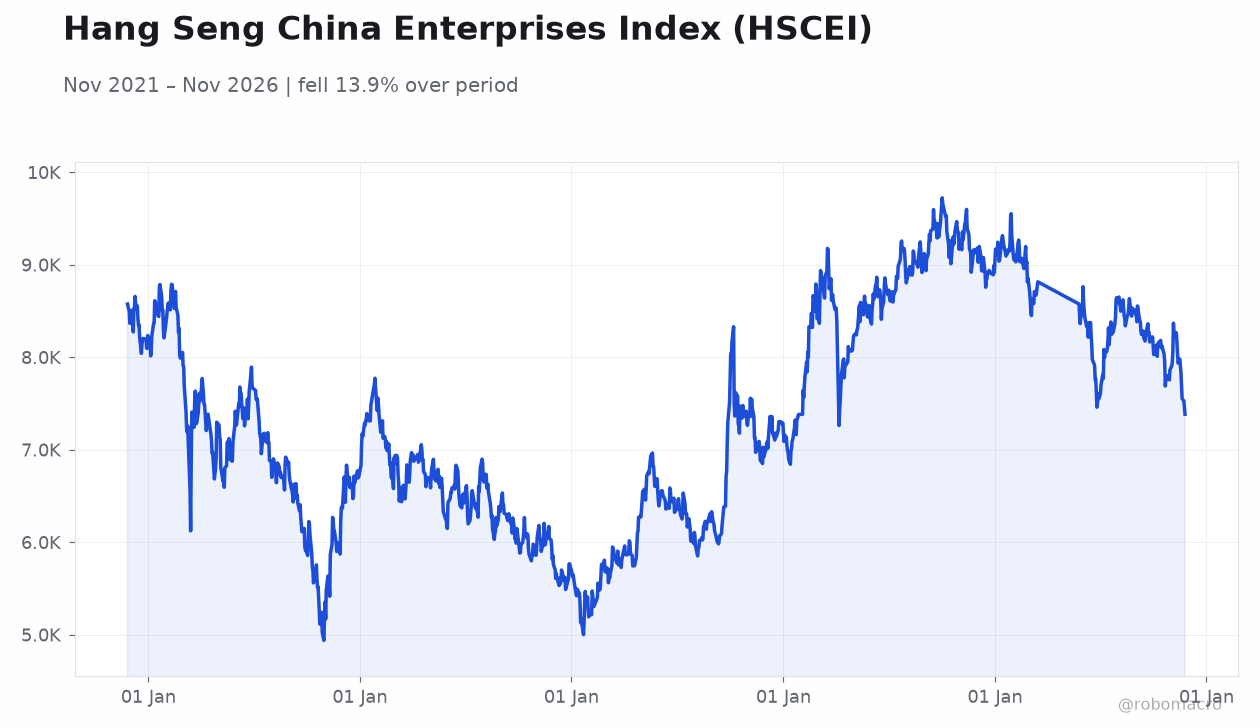
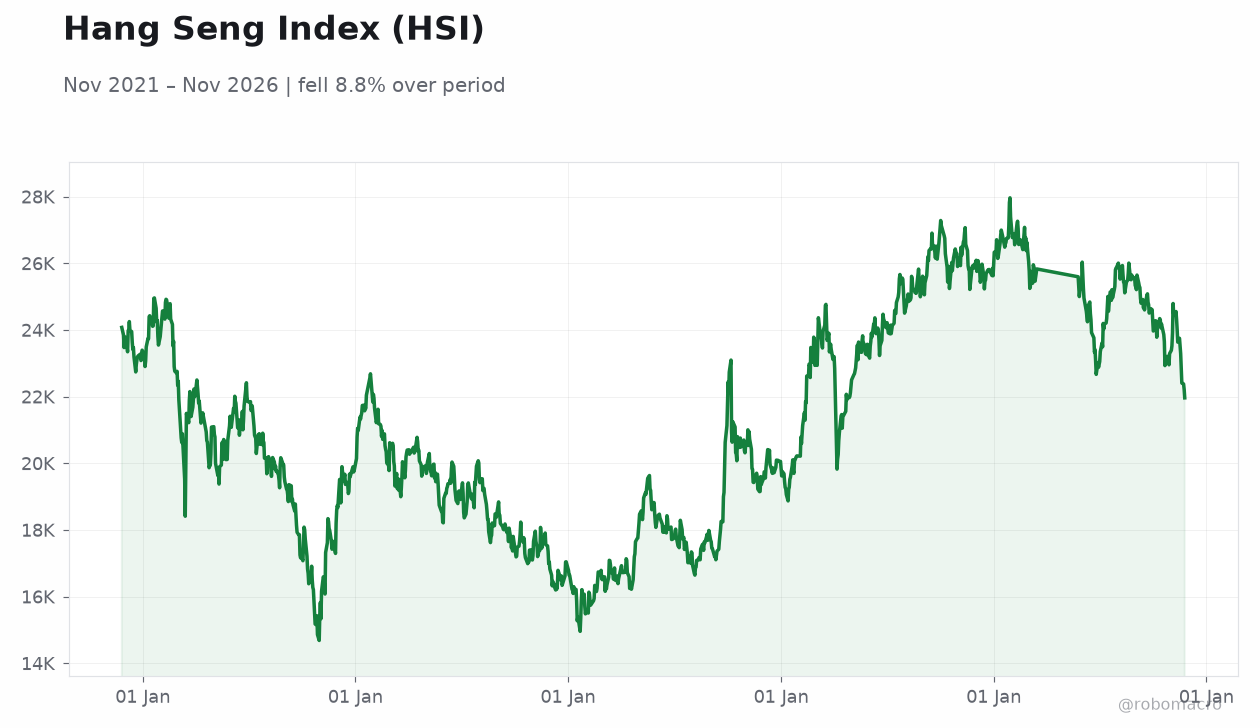
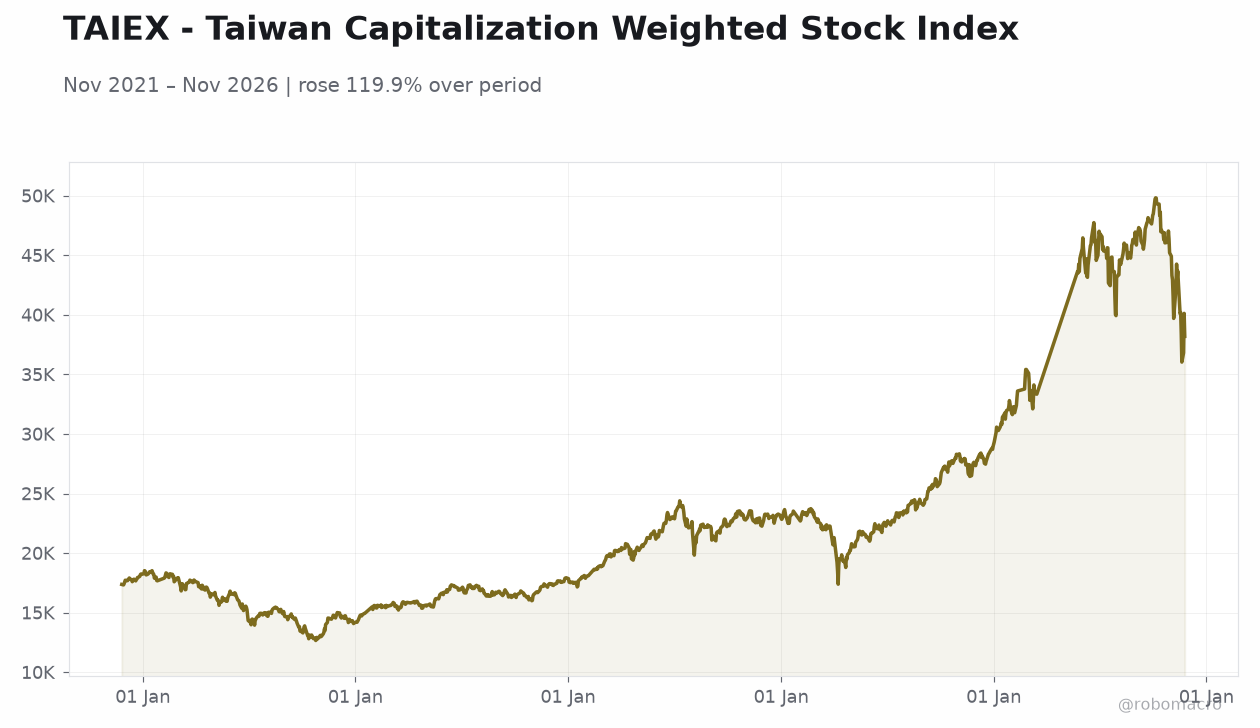
TAIEX Surges 9% on Nvidia Return; China Stocks Drop
Shanghai Composite3,488.13-1.70%
CSI 3003,898.24-1.65%
Hang Seng22,219.65-0.73%
TAIEX40,122.35+8.99%
Market Snapshot
| Asset | Level | Change |
|---|
| Shanghai Composite | 3,488.13 | -1.70% |
| CSI 300 | 3,898.24 | -1.65% |
| Hang Seng | 22,219.65 | -0.73% |
| TAIEX | 40,122.35 | +8.99% |
| USD/CNY | 6.67 | +0.16% |
| USD/HKD | 7.84 | -0.03% |
| Copper | 5.48 | +2.22% |
| Brent Crude | 90.77 | -0.69% |
| Gold | 3,608.60 | +1.31% |
| Bitcoin | 60,085.31 | +0.56% |
| China 2Y Govt Yield | - | - |
| China 10Y Govt Yield | - | - |
Prior Economic Events
| Data |
Prior |
Cons |
Actual |
| No events available |
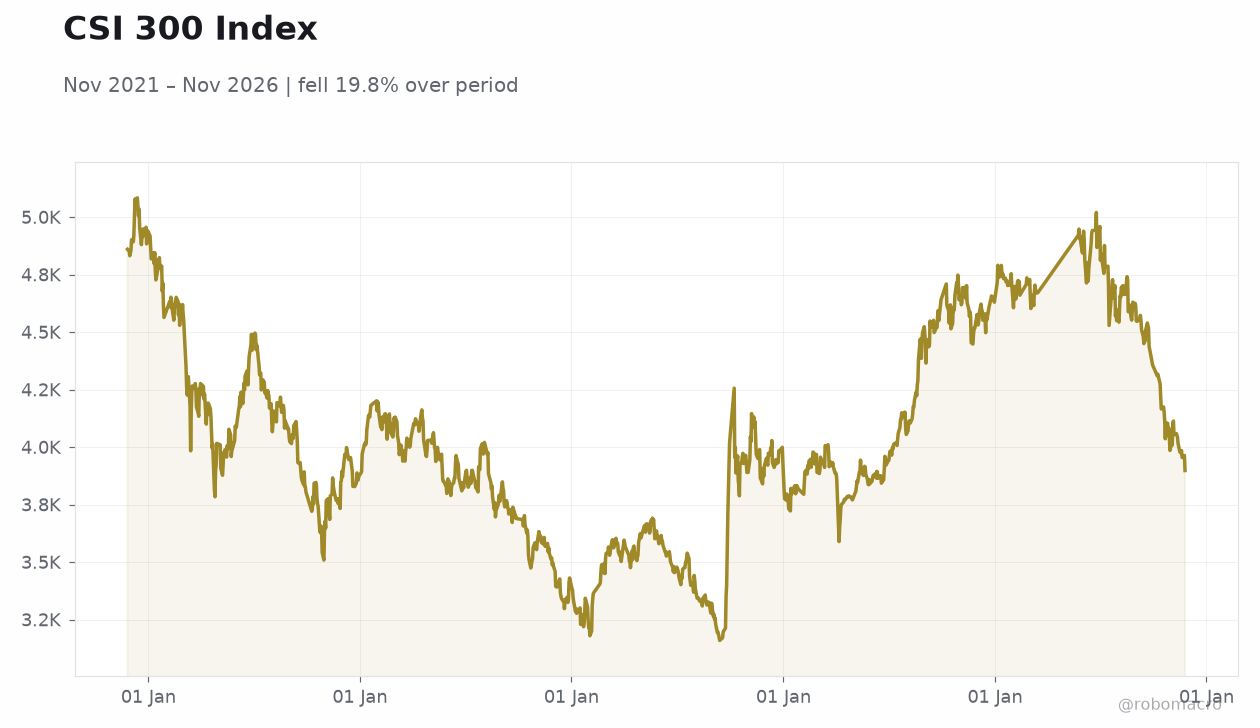 CSI 300 Index | Type: macro_line | CSI 300 Index: 3898 (2026-11-25) | Range: 3159–5084 | Trend(6pt): 4860,4142,3533,3874,3958,3898
Today's Economic Events
| Data |
Prior |
Cons |
Time |
| No events available |
- Taiwan equities soared 8.99% as Nvidia CEO Jensen Huang's return reignited AI/semiconductor optimism, though some regional chip names later pared gains.
- Mainland China equities fell sharply (CSI 300 -1.65%, Shanghai Composite -1.70%) as Washington proposed fresh tariffs on China and 12 other economies; Beijing dismissed the move as "political maneuvering."
- China extended its suspension of critical-material export curbs to the U.S. through January, a de-escalation signal after the Shenzhen summit; the HKMA launched its CMU Digital Asset Platform for bond tokenization.
Yesterday's Recap
Taiwan dominated Greater China markets on Tuesday, with the TAIEX surging 8.99% to 40,122.35 as investors celebrated Nvidia CEO Jensen Huang's return, a move read in Taipei as easing U.S.-China chip-tension risk. The rally was not uniform, however — reports noted several Asian chip names later fell back below pre-rally levels, and a former central banker warned of further turbulence. Mainland China moved the other way: the CSI 300 dropped 1.65% to 3,898.24 and the Shanghai Composite fell 1.70% to 3,488.13 after the Trump administration proposed new tariffs on China, the EU and 12 other economies over policies it says distort trade.
Beijing responded that the tariff prospect is "political maneuvering," urging joint efforts to preserve the truce. In Hong Kong, the Hang Seng slipped 0.73% to 22,219.65, while the HKMA announced results of a PBoC RMB bill tender and unveiled its CMU Digital Asset Platform for tokenized debt securities. China also extended its suspension of critical-material export restrictions to the U.S.
until January, reinforcing the post-Shenzhen detente. The yuan weakened modestly, with USD/CNY at 6.67 (+0.16%), while USD/HKD held at 7.84 (-0.03%) near the strong side of the peg band.
The Day Ahead
The Greater China calendar is light, with no scheduled mainland, Hong Kong or Taiwan data releases. Market attention will center on follow-through from the TAIEX's outsized move and whether semiconductor names can hold gains after the initial Huang-driven euphoria faded in some regional chip stocks. Traders will watch for any official Chinese response to the proposed U.S.
tariff round and for signals on the durability of the critical-materials export suspension through January. Hong Kong flows and the HKD's position near 7.84 remain in focus given the HKMA's digital-asset infrastructure push. With no domestic prints, global risk sentiment and U.S.
data will likely drive direction across Shanghai, Hong Kong and Taipei.
Page 1
Never miss an issue
Subscribe to Greater China Macro Daily and get each new issue delivered to your inbox.
Already a member? Visit robomacro.com
to log in and manage subscriptions, or use Forgot Password to set a password.