Japan Macro Daily(Beta Mode)
Nikkei Slides as 10Y Yield Jumps Sharply
Market Snapshot
| Asset | Level | Change |
|---|---|---|
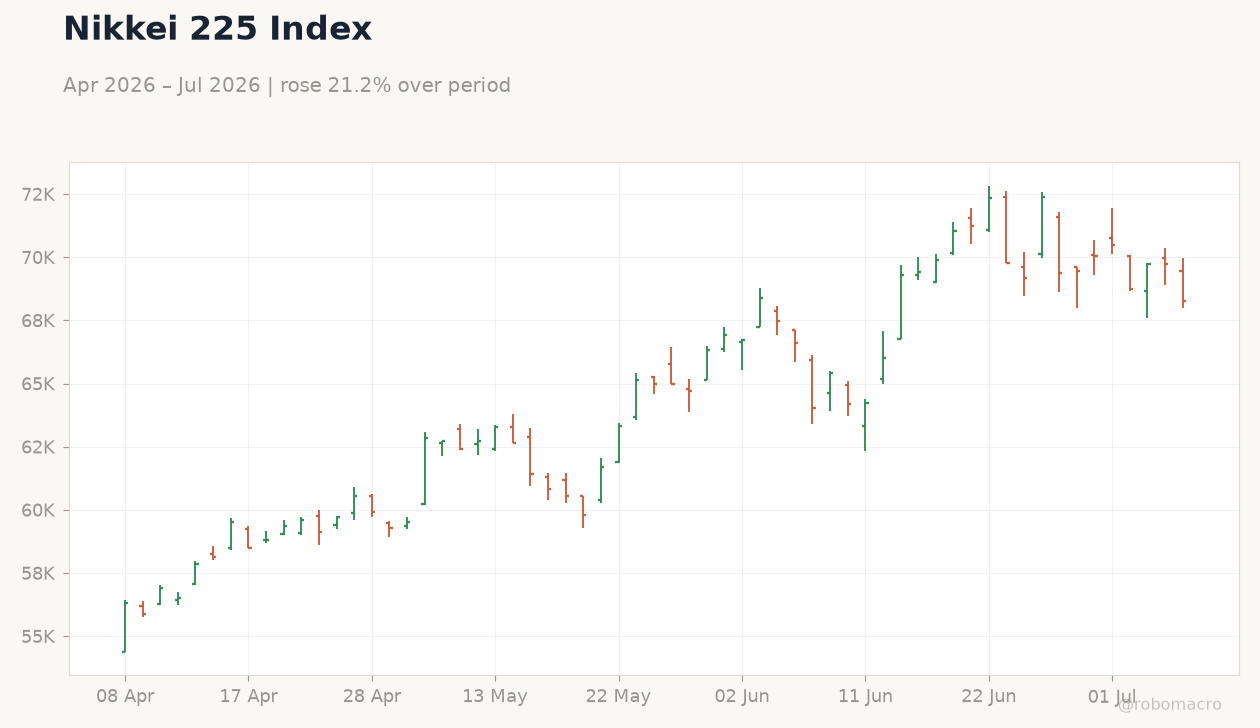
| Nikkei 225 | 68,256.96 | -2.12% |
| USD/JPY | 162.51 | +0.09% |
| EUR/JPY | 185.64 | +0.28% |
| GBP/JPY | 217.67 | +0.26% |
| Gold | 4,086.80 | -1.41% |
| Brent Crude | 79.16 | +6.74% |
| Bitcoin | 62,048.99 | -1.97% |
| Japan 2Y Govt Yield | 0.73% | +0.00% |
| Japan 10Y Govt Yield | 2.65% | +5.37% |
Prior Economic Events
| Data | Prior | Cons | Actual |
|---|---|---|---|
| Household Spending Month-over-Month | 1.60 | 1.40 | 3.70 |
| Household Spending Year-over-Year | -0.50 | -2.50 | -0.40 |
| Current Account Balance | 3,908,000m | 4,121,300m | 3,968,000m |
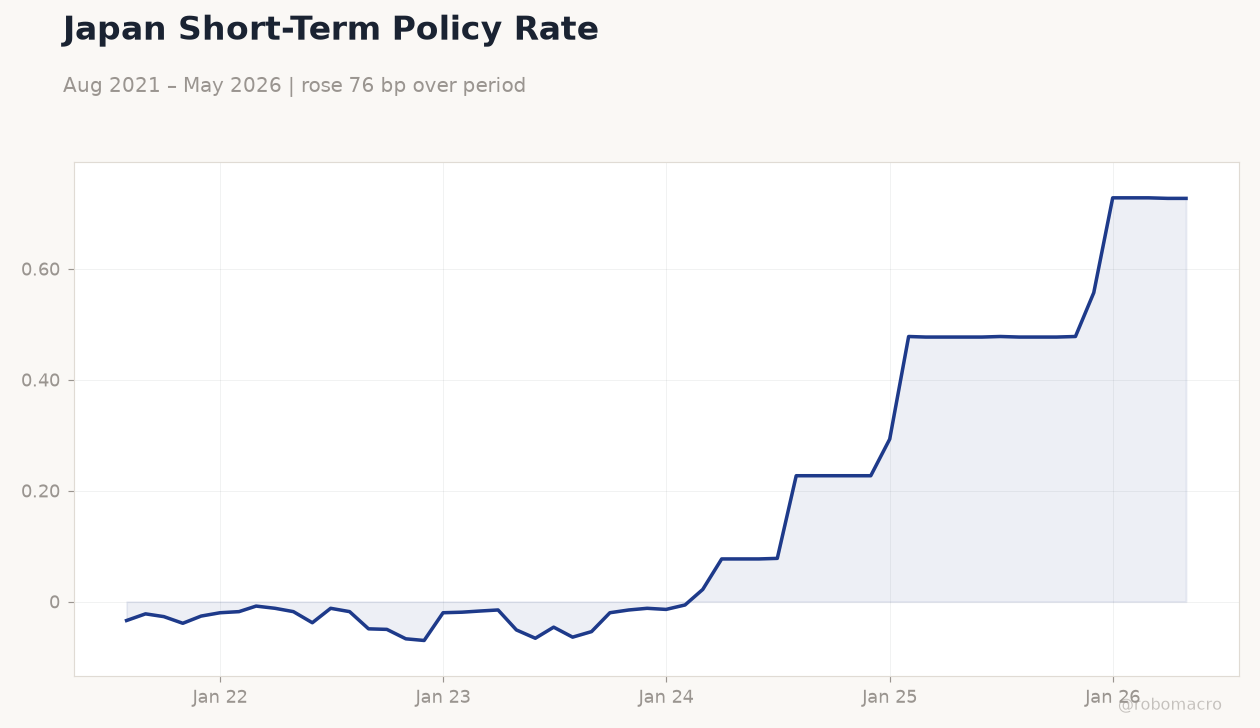 Japan Short-Term Policy Rate | Type: macro_line | Rate %: 0.727 (2026-05-01) | Range: -0.07–0.728 | Trend(5pt): -0.034,-0.05,-0.012,0.478,0.727
Today's Economic Events
| Data | Prior | Cons | Time |
|---|---|---|---|
| No events available | |||
- Household spending beat forecasts sharply while current account came in below consensus, highlighting resilient consumption amid external surplus pressure.
- Nikkei 225 fell 2.12% to 68,256.96 as the 10-year JGB yield surged 5.37% to 2.65%, widening the rate differential with the BoJ's 0.73% policy rate.
- Yen held near 162.51 against the dollar despite intervention signals, with bank lending growth slowing to 5.7% reinforcing a cautious BoJ stance.
Yesterday's Recap
Japanese household spending rose 3.7% month-over-month in June, well above the 1.4% consensus, while the year-over-year reading improved to -0.4% from -2.5% expected. The current account surplus printed at 3.968 trillion yen, missing the 4.121 trillion consensus. Equity markets reacted negatively, with the Nikkei 225 declining 2.12% to close at 68,256.96 amid the sharp rise in the 10-year JGB yield to 2.65%.
USD/JPY edged 0.09% higher to 162.51 as Middle East tensions supported the dollar. Gold fell 1.41% while Brent crude gained 6.74% on supply concerns. Bank lending growth decelerated to 5.7% in June, tempering expectations for aggressive BoJ tightening.
The Day Ahead
No major Japanese data releases are scheduled for the next two days, leaving markets to digest yesterday's consumption strength and yield spike. Focus will remain on any government statements regarding the annual economic blueprint and potential tweaks to monetary policy phrasing. Traders will monitor USD/JPY for signs of official intervention as the pair lingers near multi-decade lows.
Equity sentiment may stay pressured by the rapid 10-year yield increase and ongoing yen carry trade concerns. Global oil moves will influence inflation expectations ahead of the next BoJ policy meeting.
Other Economic Notes
Slower bank lending growth at 5.7% supports the BoJ's patient approach to normalisation given the 1.50% CPI reading. The government is revising fiscal blueprint language to emphasise central bank independence amid market concerns over political interference. External surpluses remain vulnerable to yen weakness, with the current account missing expectations despite solid domestic demand.
Broader themes include risks from yen-funded carry trades unwinding and their potential spillover to global asset prices.