Japan Macro Daily(Beta Mode)
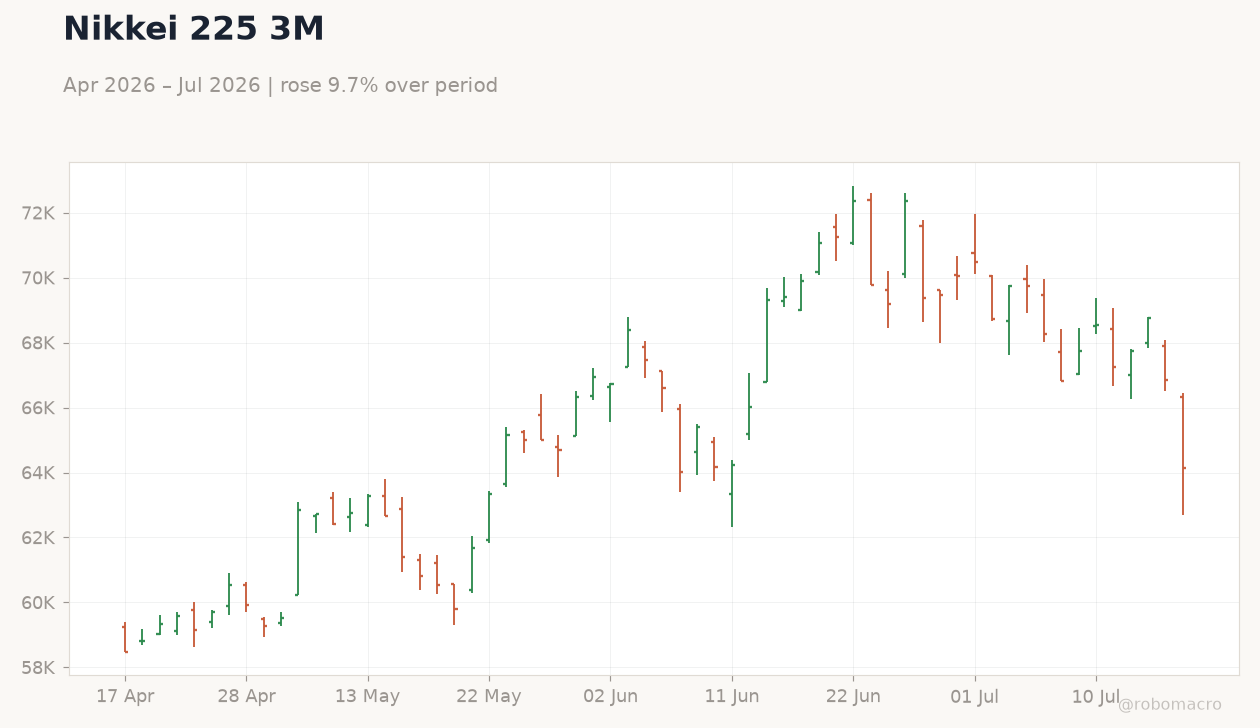
Nikkei Slides as Yen Weakness Persists
Market Snapshot
| Asset | Level | Change |
|---|---|---|
| Nikkei 225 | 64,141.12 | -4.03% |
| USD/JPY | 162.41 | +0.02% |
| EUR/JPY | 185.64 | -0.10% |
| GBP/JPY | 218.31 | -0.23% |
| Gold | 4,018.80 | +0.83% |
| Brent Crude | 88.10 | +4.59% |
| Bitcoin | 64,490.33 | -0.47% |
| Japan 2Y Govt Yield | 0.84% | +15.68% |
| Japan 10Y Govt Yield | 2.67% | +0.75% |
Prior Economic Events
| Data | Prior | Cons | Actual |
|---|---|---|---|
| No events available | |||
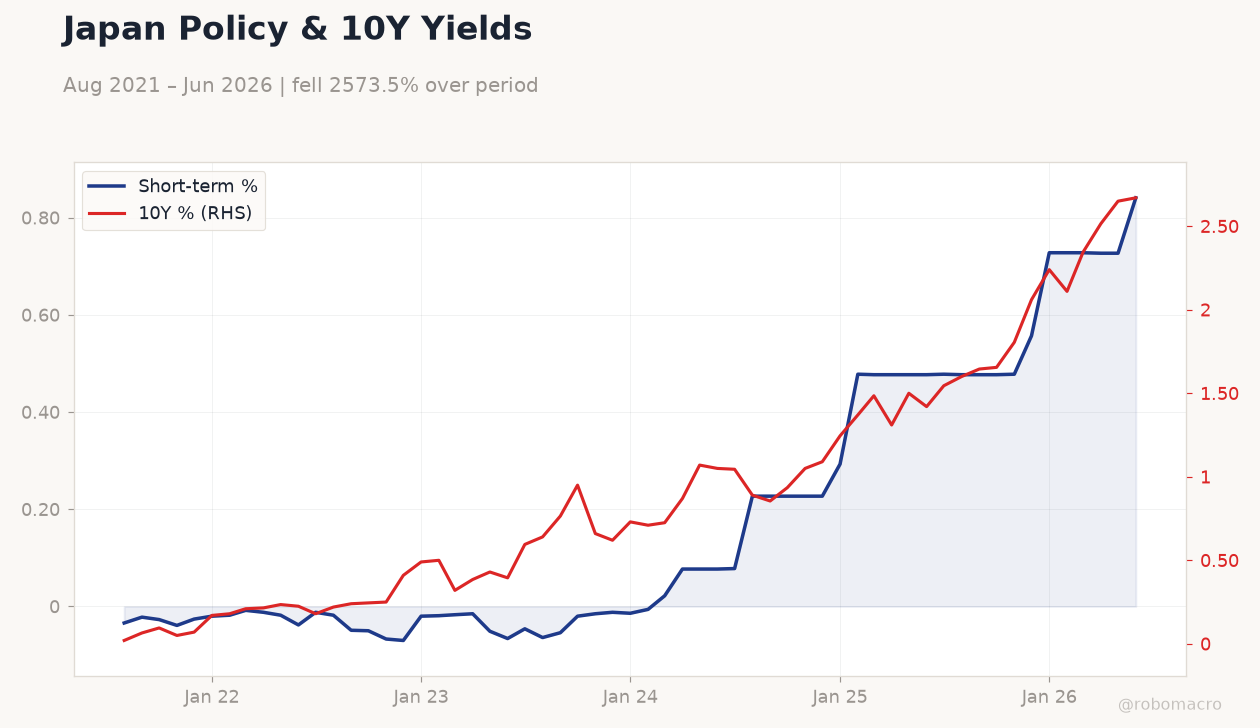 Japan Policy & 10Y Yields | Type: macro_line | Short-term %: 0.841 (2026-06-01) | Range: -0.07–0.841 | Trend(6pt): -0.034,-0.05,-0.012,0.478,0.727,0.841 | 10Y %: 2.67 (2026-06-01) | Range: 0.02–2.67 | Trend(6pt): 0.02,0.245,0.62,1.37,2.515,2.67
Today's Economic Events
| Data | Prior | Cons | Time |
|---|---|---|---|
| Tuesday (2026-07-21) | |||
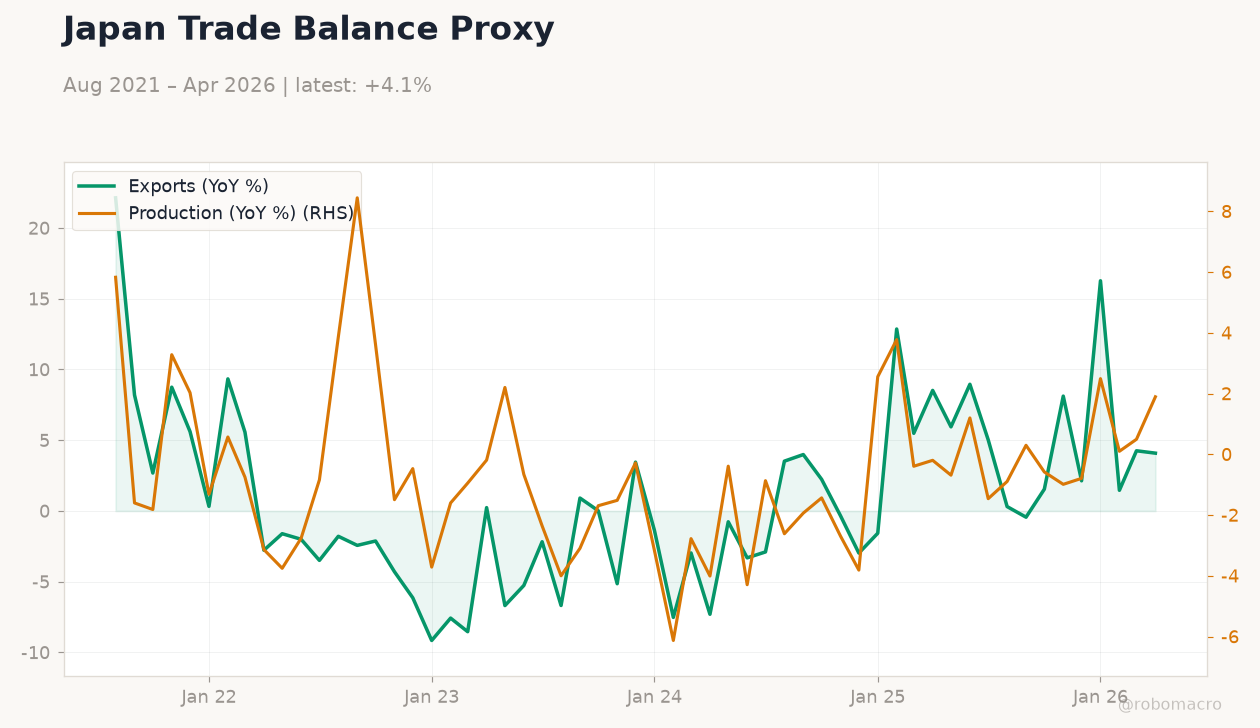
| Trade Balance | -378,700m | -120,000m | 19:50 |
| Exports Year-over-Year | 17 | 18.60 | 19:50 |
| Thursday (2026-07-23) | |||
| Inflation Rate Year-over-Year | 1.50 | - | 19:30 |
| Core Inflation Rate Year-over-Year | 1.40 | 1.60 | 19:30 |
| Friday (2026-07-24) | |||
| S&P Global Manufacturing PMI Flash | - | 54.50 | 20:30 |
| S&P Global Services PMI Flash | - | - | 20:30 |
- Nikkei 225 falls 4.03% to 64,141.12 as chip rout intensifies and yen volatility persists.
- BoJ policy rate holds at 0.84% while 10Y JGB yield reaches 2.72%, signalling gradual normalisation.
- Upcoming trade balance and CPI prints test export resilience amid sustained USD/JPY near 162.41.
Yesterday's Recap
Equity markets closed sharply lower with the Nikkei 225 declining 4.03 percent to 64,141.12 on deepening semiconductor losses and thin volume. The 10-year JGB yield edged to 2.67 percent while the 2-year yield jumped 15.68 percent to 0.84 percent, reflecting repricing of near-term policy expectations. USD/JPY traded little changed at 162.41 as yen bears shrugged off renewed “decisive action” rhetoric from officials.
Brent crude surged 4.59 percent to 88.10 dollars per barrel, lifting energy-related names but failing to support broader sentiment. Gold advanced 0.83 percent to 4,018.80 dollars per ounce as investors sought hedges against currency swings. Japanese CFO surveys highlighted mounting difficulty managing volatility after the BoJ’s 31-year rate peak.
No data releases occurred, leaving price action driven by global risk-off flows and ongoing yen depreciation concerns.
The Day Ahead
Attention turns to the 21 July trade balance and export figures, with consensus pointing to a narrower deficit of 120 billion yen and export growth of 18.6 percent year-over-year. Markets will parse these prints for evidence that yen weakness continues to support shipments despite fading traditional advantages. On 23 July, national CPI is scheduled alongside core inflation, where consensus expects the latter to reach 1.6 percent against the prior 1.4 percent.
Flash S&P Global manufacturing and services PMIs follow the same evening, offering fresh readings on demand momentum. Any upside surprise in inflation could reinforce expectations for further BoJ adjustments later this year. Thin holiday-affected liquidity may amplify moves around the releases.
Other Economic Notes
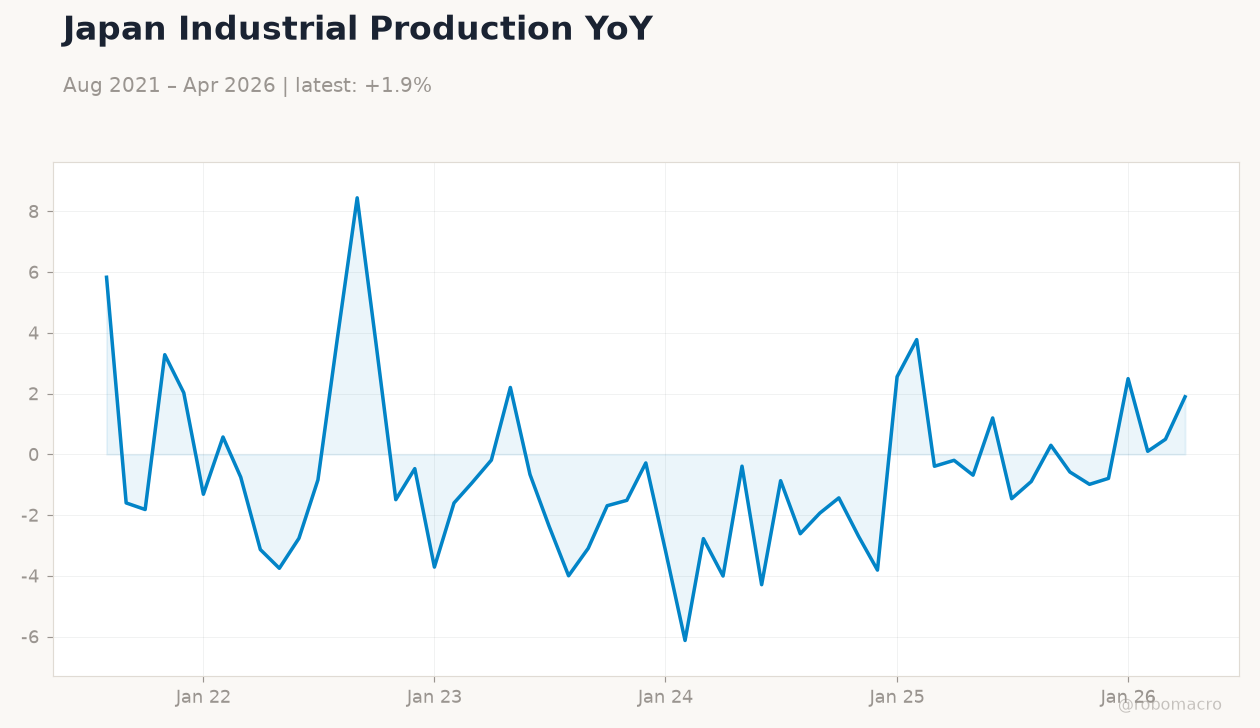
Yen depreciation no longer reliably boosts export earnings as firms absorb higher input costs and shift production overseas. Apple’s 10 percent iPhone price increase in Japan underscores how sustained currency weakness transmits directly to consumers. Industrial production data from June showed solid gains, yet analysts caution that momentum may fade without clearer policy support.
<i>↓ p.2</i>