Japan Macro Daily(Beta Mode)
Yen Intervention Meets Hawkish BoJ Signals
Market Snapshot
| Asset | Level | Change |
|---|---|---|
| Japan 2Y Govt Yield | - | - |
| Japan 10Y Govt Yield | - | - |
Prior Economic Events
| Data | Prior | Cons | Actual |
|---|---|---|---|
| No events available | |||
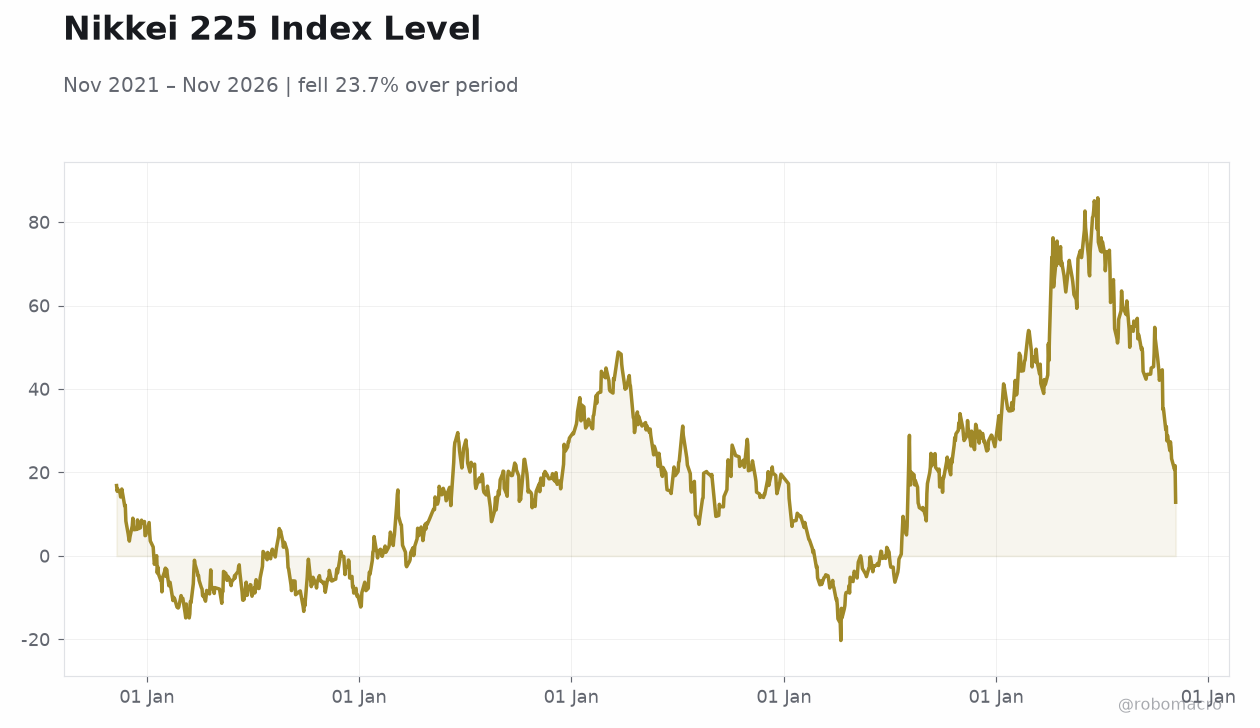 Nikkei 225 Index Level | Type: macro_line | Nikkei 225 Index Level: 12.87 (2026-11-06) | Range: -20.26–85.83 | Trend(5pt): 16.87,-5.189,39.96,11.24,12.87
Today's Economic Events
| Data | Prior | Cons | Time |
|---|---|---|---|
| Household Spending Month-over-Month | 0.10 | 0.30 | 18:30 |
| Household Spending Year-over-Year | -3.10 | -3.10 | 18:30 |
| BoJ Summary of Opinions | - | - | 18:50 |
| Current Account Balance | 4,062,000m | 3,354,400m | 18:50 |
| Wednesday (2026-11-11) | |||
| BOJ Asada Speech | - | - | 20:30 |
| Sunday (2026-11-15) | |||
| GDP Growth Quarter-over-Quarter Preliminary | 0.40 | 0.10 | 18:50 |
| GDP Growth Annualized Prel | 1.40 | 0.30 | 18:50 |
- Japan disclosed a record ¥7.98 trillion single-day yen intervention, underscoring Tokyo's intensified defense of the currency.
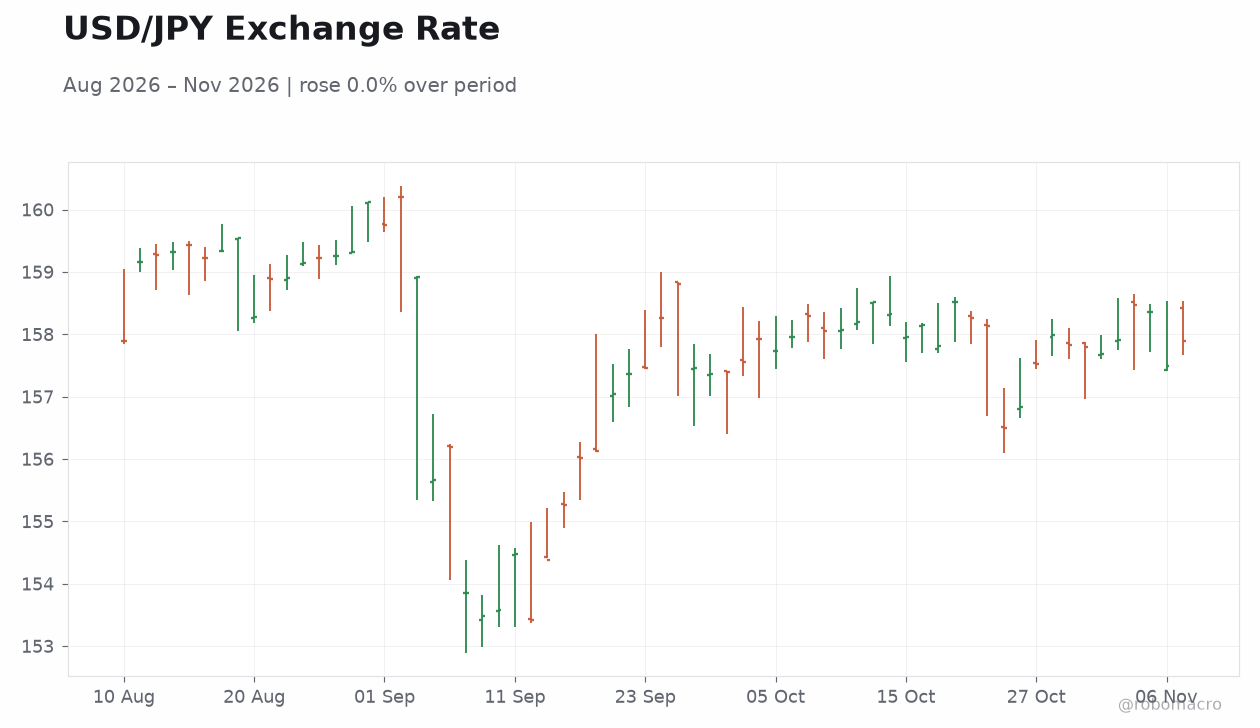
- Hawkish BoJ minutes and Ueda's IMF remarks keep a December rate-hike debate alive, with USD/JPY pinned near seven-week resistance.
- Household spending and the BoJ Summary of Opinions headline today's calendar, with Q3 GDP preliminary due Sunday.
Yesterday's Recap
Japan's calendar was empty on November 8, leaving markets to digest a heavy news flow. The Ministry of Finance confirmed a record ¥7.98 trillion (roughly $50 billion) single-day intervention, part of a three-day operation to prop up the yen — an unusually large escalation in Tokyo's FX defense. The yen nonetheless advanced, with reports noting that robust US jobs data failed to halt its gains, a sign markets are pricing a more hawkish BoJ path.
That view was reinforced by hawkish BoJ minutes signaling a potential December rate hike, and by Governor Ueda's IMF remarks framing overseas investment income as the mainstay of Japan's current account surplus. JGB yield data were unavailable in the supplied feed, so no level or change can be quoted for the 2Y or 10Y. Equity sentiment was supported by reports that manufacturers are lifting profit outlooks on price hikes and the weak yen.
The Day Ahead
Today's Japanese docket is medium-impact but policy-relevant. Household Spending month-over-month is due at 18:30 ET with consensus at 0.3% versus 0.1% prior, while the year-over-year series is seen holding at -3.1%. At 18:50 ET the BoJ publishes its Summary of Opinions, which will be scrutinized for the breadth of support for a December move, alongside the Current Account Balance, where consensus of ¥3.354 trillion sits well below the prior ¥4.062 trillion.
Wednesday brings a high-impact BOJ Asada speech at 20:30 ET, and Sunday's Q3 GDP preliminary is the week's key risk event, with consensus at 0.1% quarter-over-quarter versus 0.4% prior and annualized growth seen at 0.3% versus 1.4%.
Other Economic Notes
The consumption picture remains fragile: household spending is still contracting year-over-year, and price hikes are proving a tough sell to Japanese consumers despite inflation running at 2.10% year-over-year as of September 30. Manufacturers are offsetting domestic demand weakness by raising prices and benefiting from the weak yen, lifting profit outlooks. Household balance sheets are shifting — unprotected deposits have reached roughly $890 billion as inheritances inflate accounts, while retail government bonds are selling at a record pace as the 1.25% policy rate pulls money out of deposits.
↓ p.2