Japan Macro Daily(Beta Mode)
Yen Intervention Fails as Spending Plummets
Market Snapshot
| Asset | Level | Change |
|---|---|---|
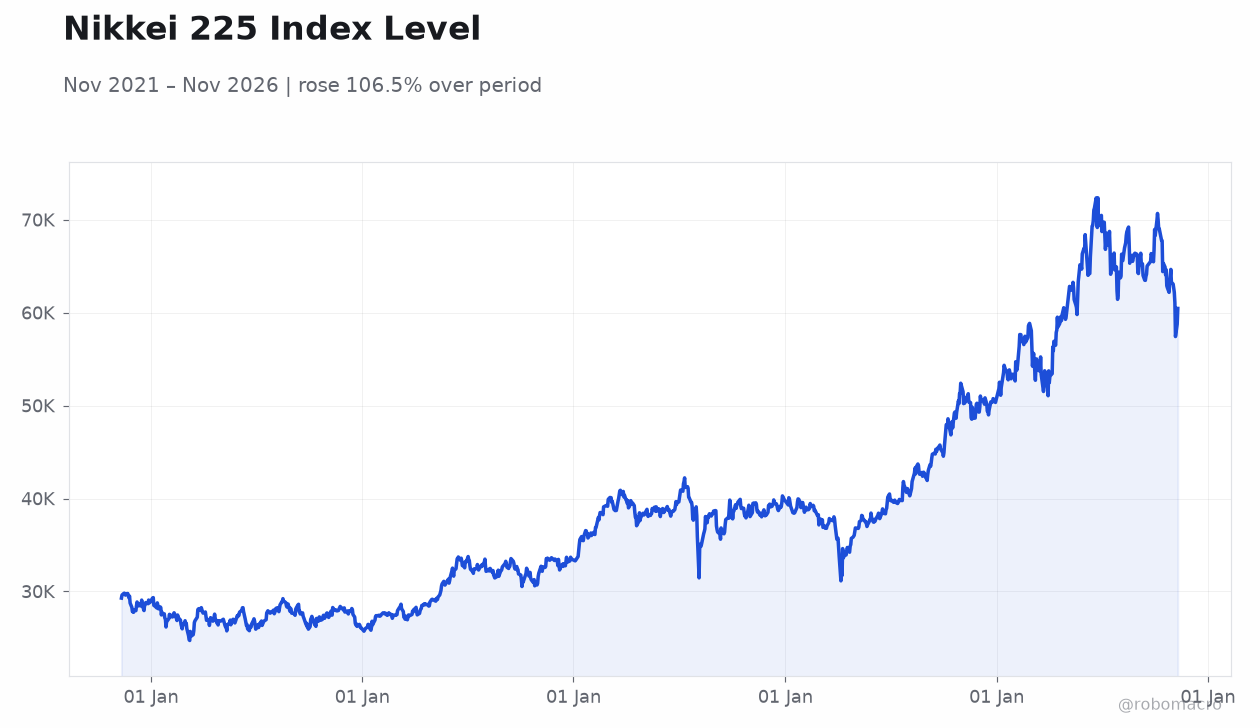
| Nikkei 225 | 58,775.50 | +2.33% |
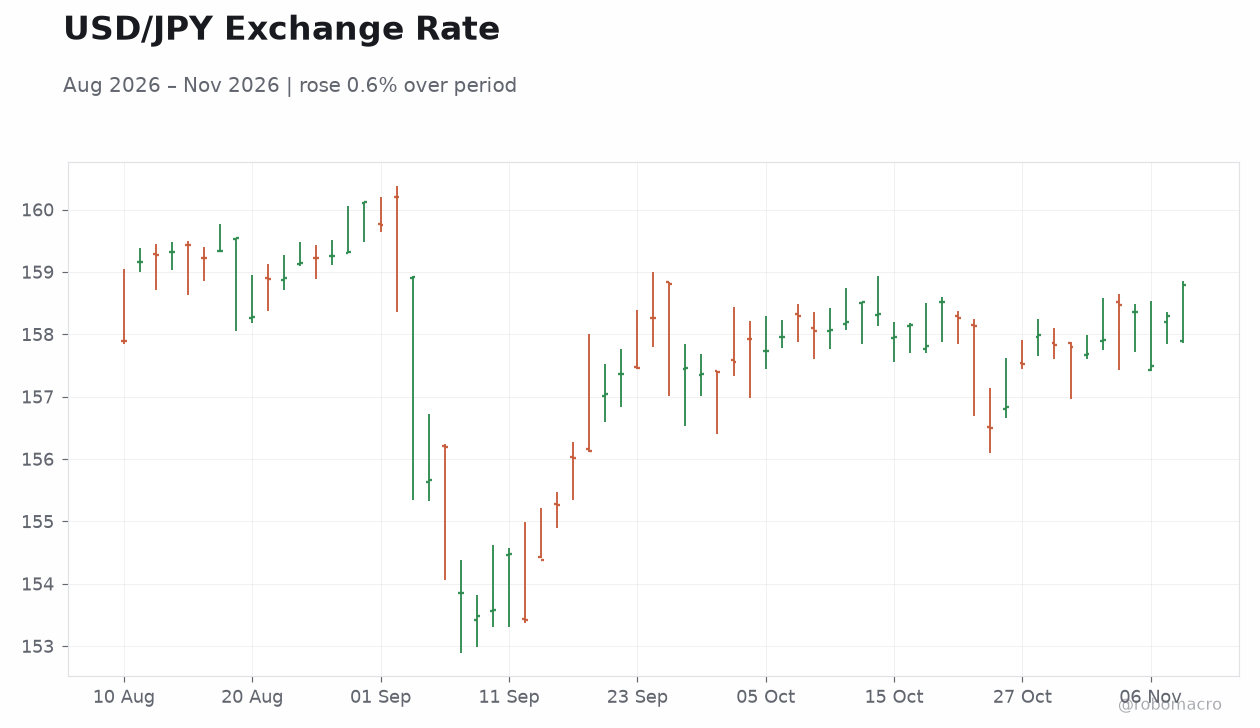
| USD/JPY | 158.81 | +0.32% |
| EUR/JPY | 177.28 | +0.47% |
| GBP/JPY | 211.90 | +0.20% |
| Gold | 4,043.10 | -1.74% |
| Brent Crude | 91.96 | -0.66% |
| Bitcoin | 73,793.94 | -1.90% |
| Japan 2Y Govt Yield | 1.78% | +5 bp |
| Japan 10Y Govt Yield | 2.72% | +2 bp |
Prior Economic Events
| Data | Prior | Cons | Actual |
|---|---|---|---|
| Household Spending Month-over-Month | 0.10 | 0.30 | -2.80 |
| Household Spending Year-over-Year | -3.10 | -3.10 | -6.80 |
| BoJ Summary of Opinions | - | - | - |
| Current Account Balance | 3,993,000m | 3,354,400m | 2,372,000m |
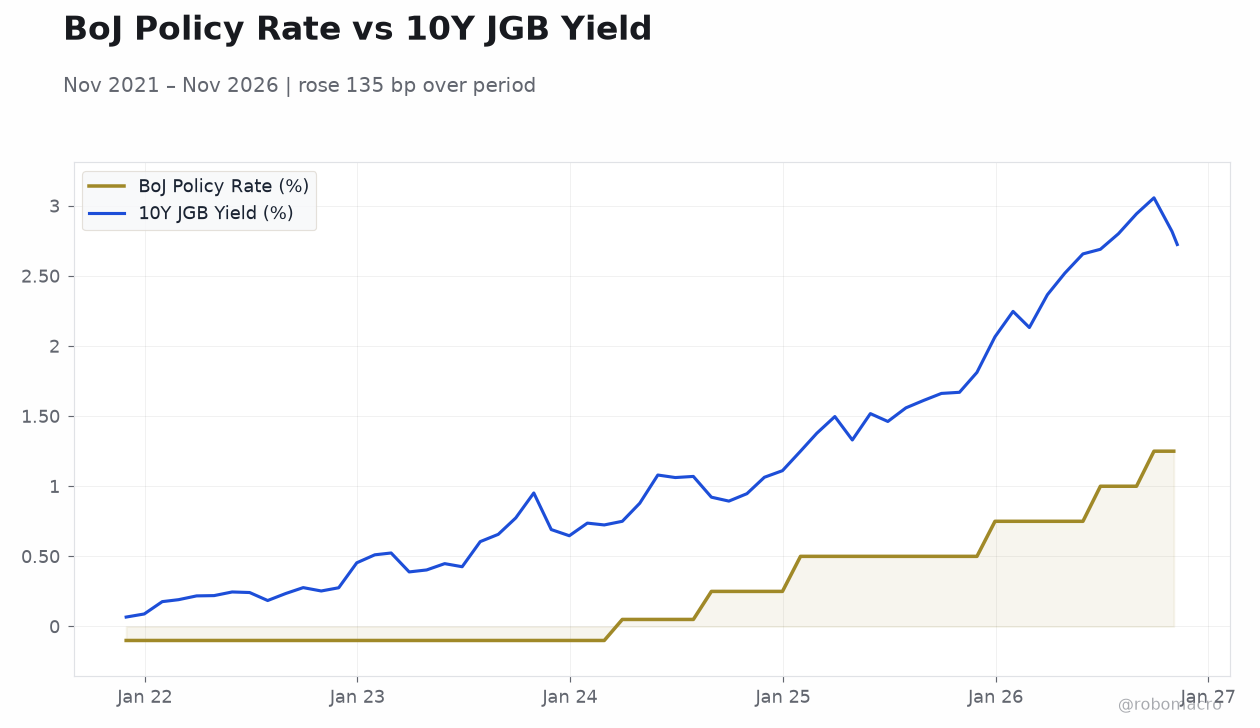 BoJ Policy Rate vs 10Y JGB Yield | Type: macro_line | BoJ Policy Rate (%): 1.25 (2026-11-03) | Range: -0.1–1.25 | Trend(5pt): -0.1,-0.1,0.05,0.5,1.25 | 10Y JGB Yield (%): 2.724 (2026-11-09) | Range: 0.067–3.057 | Trend(5pt): 0.067,0.524,1.08,1.613,2.724
Today's Economic Events
| Data | Prior | Cons | Time |
|---|---|---|---|
| Wednesday (2026-11-11) | |||
| BOJ Asada Speech | - | - | 20:30 |
| Sunday (2026-11-15) | |||
| GDP Growth Quarter-over-Quarter Preliminary | 0.40 | 0.10 | 18:50 |
| GDP Growth Annualized Prel | 1.40 | 0.30 | 18:50 |
- Household spending collapsed 6.8% YoY and 2.8% MoM in the November 9 release, far below consensus of -3.1% and +0.3% respectively, underscoring fragile domestic demand even as inflation runs at 2.10%.
- The yen remains pinned near 158.81 despite a record ¥7.98 trillion single-day intervention, with markets squarely focused on looming US CPI data.
- JGB curve bear-flattened as the 2-year yield jumped 5 bp to 1.78% while the 10-year added 2 bp to 2.72%, reflecting hawkish BoJ October minutes pushing for faster rate hikes.
Yesterday's Recap
Japan's household spending data delivered a severe downside shock, printing -6.8% year-over-year against consensus of -3.1% and a prior of -3.1%, while month-over-month fell 2.8% versus expectations of +0.3%. The current account balance also disappointed at ¥2.37 trillion against a ¥3.35 trillion consensus, well below the prior ¥3.99 trillion. The BoJ's October Summary of Opinions revealed members debating the need for faster rate hikes, with some calling for an early move.
Markets responded with a risk-on tilt in equities even as bonds sold off — the Nikkei 225 surged 2.33% to 58,775.50, while the 2-year JGB yield rose 5 bp to 1.78% and the 10-year added 2 bp to 2.72%. USD/JPY edged 0.32% higher to 158.81, EUR/JPY rose 0.47% to 177.28, and GBP/JPY gained 0.20% to 211.90. Gold fell 1.74% to $4,043.10, Brent crude slipped 0.66% to $91.96, and Bitcoin dropped 1.90% to $73,793.94.
The Day Ahead
The calendar is light for Japan on Tuesday, with no domestic data releases scheduled. Attention shifts to Wednesday's BoJ Asada speech at 20:30 ET, a high-impact event that markets will parse for signals on the pace of policy normalisation following the hawkish October minutes. The next major data point arrives Sunday with preliminary Q3 GDP, where consensus points to just 0.1% quarter-over-quarter growth versus a prior 0.4%, and annualised growth of 0.3% against 1.4% previously.
That GDP print will be critical for validating or challenging the BoJ's tightening trajectory. With the yen hovering near 158, traders will also keep a close watch on any verbal intervention from the Finance Ministry.
Other Economic Notes
The collapse in household spending is a troubling signal for an economy already grappling with persistent inflation at 2.10%, suggesting real income erosion is biting consumption. Government debt fell by ¥23 trillion in Q3 2026, a modest fiscal positive, though Japan's debt burden remains the highest among advanced economies. ↓ p.2