Korea Macro Daily(Beta Mode)
GDP Beat Fuels Won Rally, Rate-Hike Bets Rise
Market Snapshot
| Asset | Level | Change |
|---|---|---|
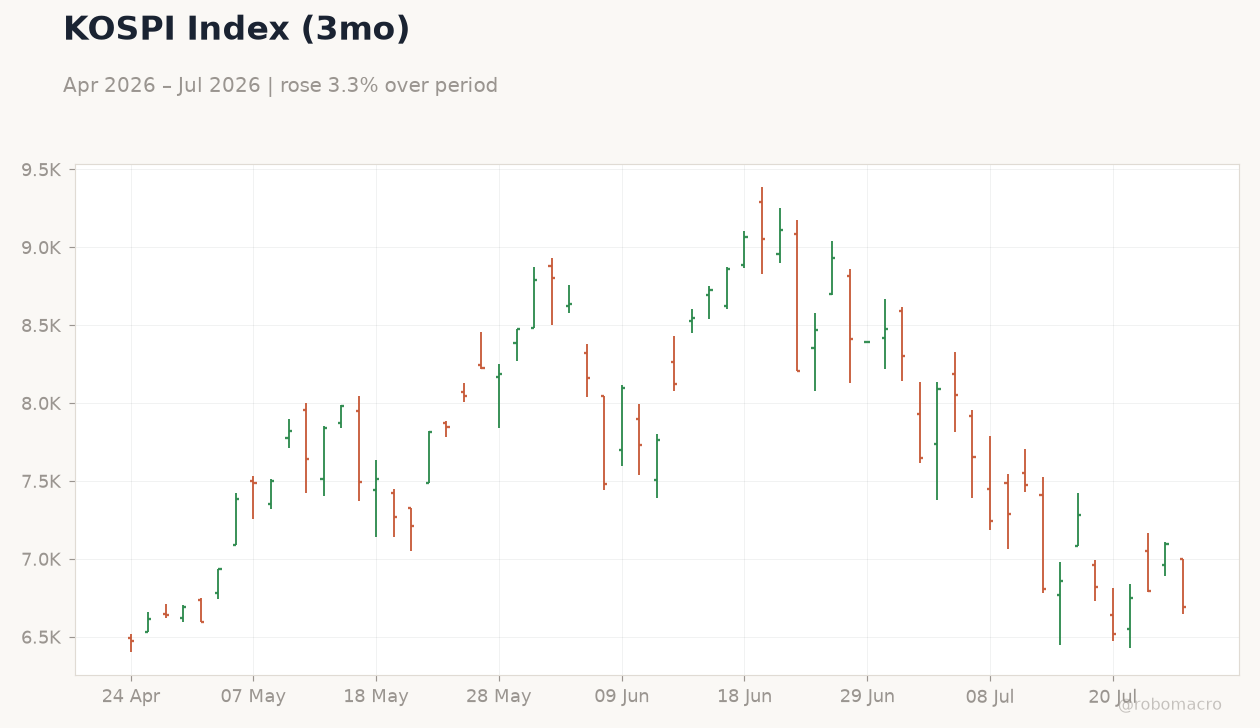
| KOSPI | 6,690.62 | -5.72% |
| KOSDAQ | 748.22 | -5.32% |
| USD/KRW | 1,459.42 | -0.99% |
| Samsung | 249,500.00 | -7.59% |
| SK Hynix | 1,759,000.00 | -8.34% |
| Brent Crude | 96.78 | -3.88% |
| Gold | 4,070.80 | +0.60% |
| Bitcoin | 64,618.00 | +0.48% |
| Korea Short-term Rate | 2.54% | +0.00% |
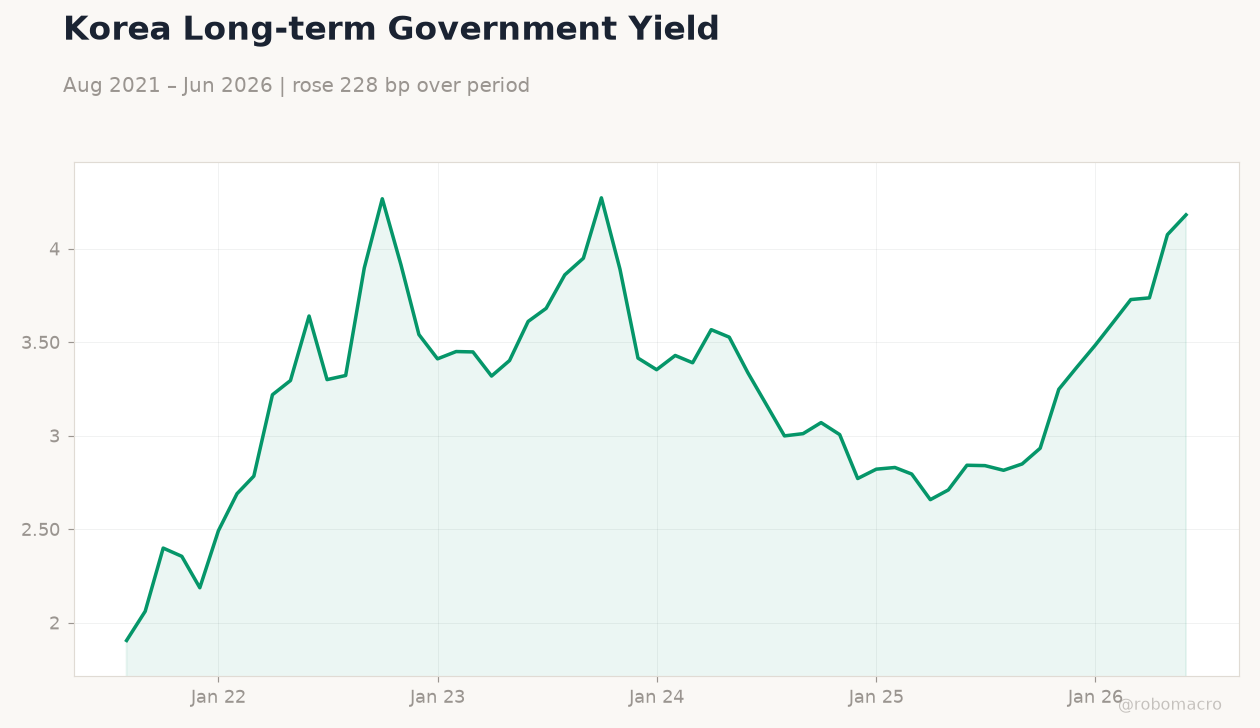
| Korea Long-term Rate | 4.18% | +2.60% |
Prior Economic Events
| Data | Prior | Cons | Actual |
|---|---|---|---|
| No events available | |||
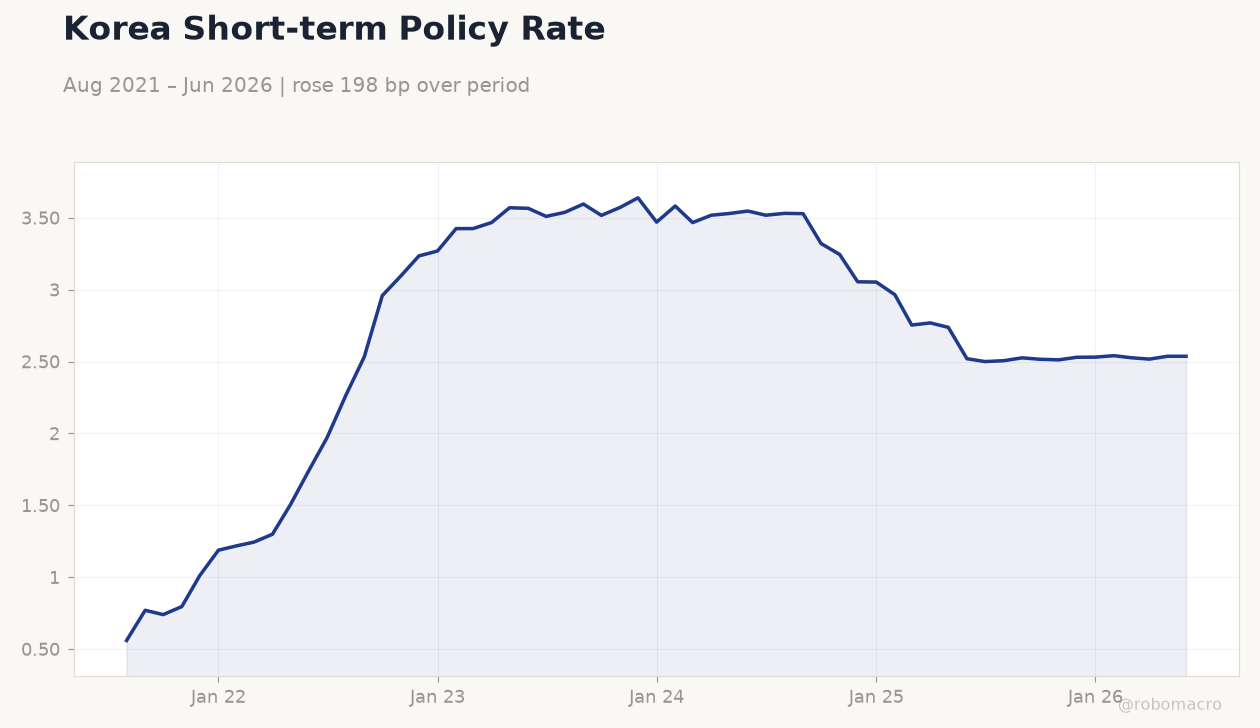 Korea Short-term Policy Rate | Type: macro_line | Policy Rate (%): 2.537 (2026-06-01) | Range: 0.56–3.639 | Trend(6pt): 0.56,2.959,3.639,2.965,2.517,2.537
Today's Economic Events
| Data | Prior | Cons | Time |
|---|---|---|---|
| Monday (2026-07-27) | |||
| Consumer Confidence Index | 106.60 | - | 17:00 |
| Wednesday (2026-07-29) | |||
| Business Confidence Index | 79 | - | 17:00 |
| Saturday (2026-08-01) | |||
| Exports Year-over-Year | 70.90 | - | 20:00 |
- Q2 GDP surprise lifts won and raises BoK rate-hike odds amid inflows
- KOSPI and chip stocks fall sharply while long-term yields climb
- Consumer confidence release and export data set near-term focus
Yesterday's Recap
South Korea’s Q2 GDP beat expectations, triggering immediate upward revisions to growth forecasts and prompting Commerzbank to highlight sustained capital inflows supporting the won. The currency strengthened 0.99 percent to 1,459.42 against the dollar, reversing part of its 17-year real effective exchange-rate low. Equity markets sold off sharply, with the KOSPI dropping 5.72 percent to 6,690.62 and KOSDAQ falling 5.32 percent to 748.22 as Samsung and SK Hynix declined 7.59 percent and 8.34 percent respectively.
Long-term Korean government bond yields rose 2.60 percent to 4.18 percent while the short-term rate held at 2.54 percent. The Bank of Korea’s base rate remains 2.54 percent and June CPI stood at 3.16 percent year-over-year, leaving real rates negative. Fuel-price caps were frozen to contain inflation pass-through.
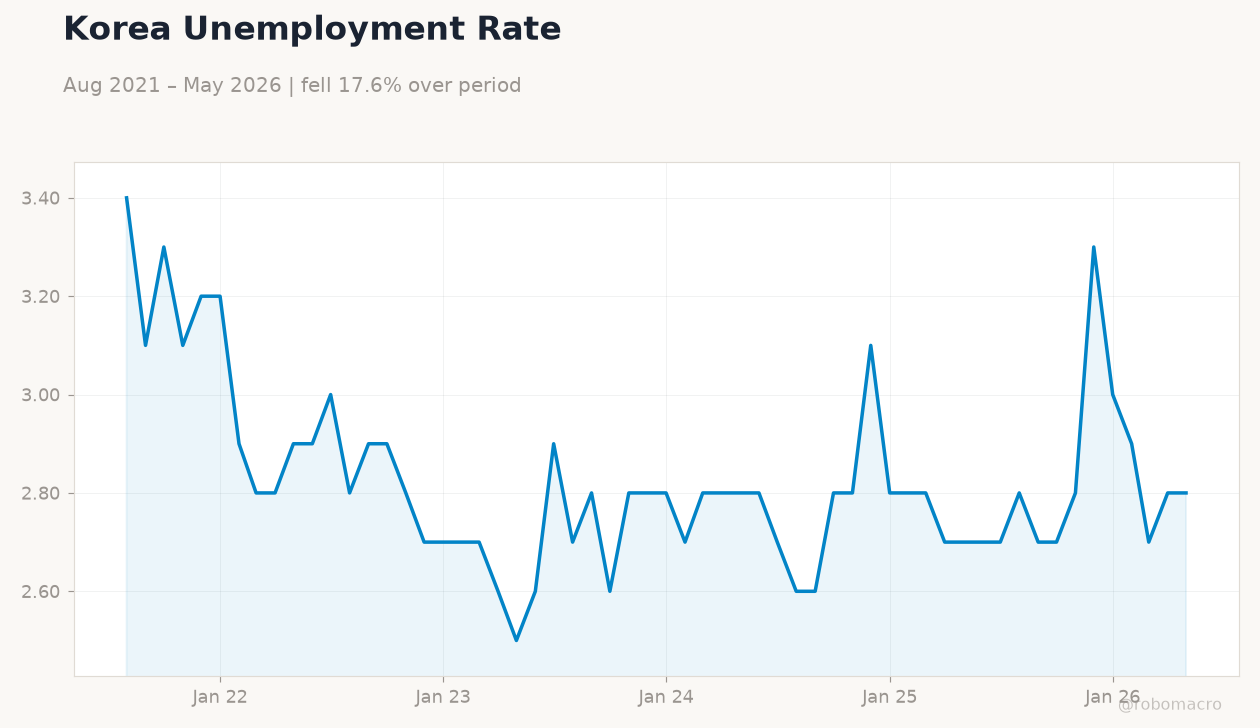
Market participants interpreted the GDP print as evidence that chip-driven profits are not yet translating into broad employment gains.
The Day Ahead
Markets will monitor tomorrow’s Consumer Confidence Index, last printed at 106.6, for signs of household resilience after the GDP surprise. Wednesday’s Business Confidence Index, previously 79, will provide a forward-looking gauge of corporate sentiment in manufacturing and services. Export data due Saturday will test whether the won’s recent strength is eroding competitiveness in shipments.
Traders also await any further signals from the new BoK governor on CBDC development and the absence of stablecoin support. Oil-price volatility and the upcoming FOMC meeting remain key external variables for USD/KRW and KTB curves. Positioning for the mid- to upper-1,400 won range is expected to dominate FX flows.
Other Economic Notes
The economy is exhibiting classic “growth without jobs” characteristics as semiconductor profits surge while employment gains lag. SK Hynix’s planned $40 billion FX conversion and Nvidia-related supply agreements underscore the sector’s capital intensity. The real effective exchange rate at its weakest level since 2009 has improved export price competitiveness even as the nominal won rebounds.
Government measures to freeze fuel-price caps aim to limit second-round inflation effects while preserving purchasing power. These dynamics reinforce the export-led growth model but highlight structural challenges in translating chip-led gains into domestic demand.