Korea Macro Daily(Beta Mode)
CPI Cools to 2.8% as Equities Rebound
Market Snapshot
| Asset | Level | Change |
|---|---|---|
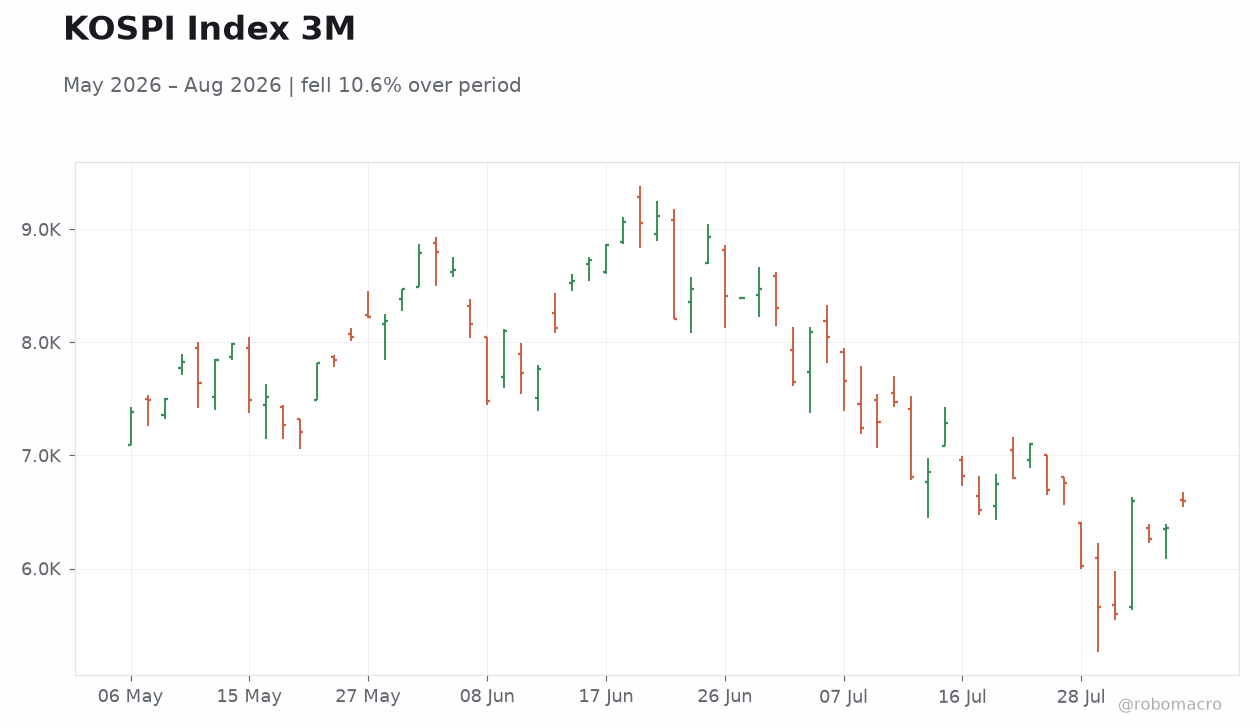
| KOSPI | 6,598.26 | +3.76% |
| KOSDAQ | 799.59 | +2.42% |
| USD/KRW | 1,423.21 | -0.37% |
| Samsung | 230,500.00 | -6.30% |
| SK Hynix | 1,495,000.00 | -10.37% |
| Brent Crude | 83.50 | +5.10% |
| Gold | 4,298.90 | +1.25% |
| Bitcoin | 64,444.95 | -0.24% |
| Korea Short-term Rate | 2.54% | +0.00% |
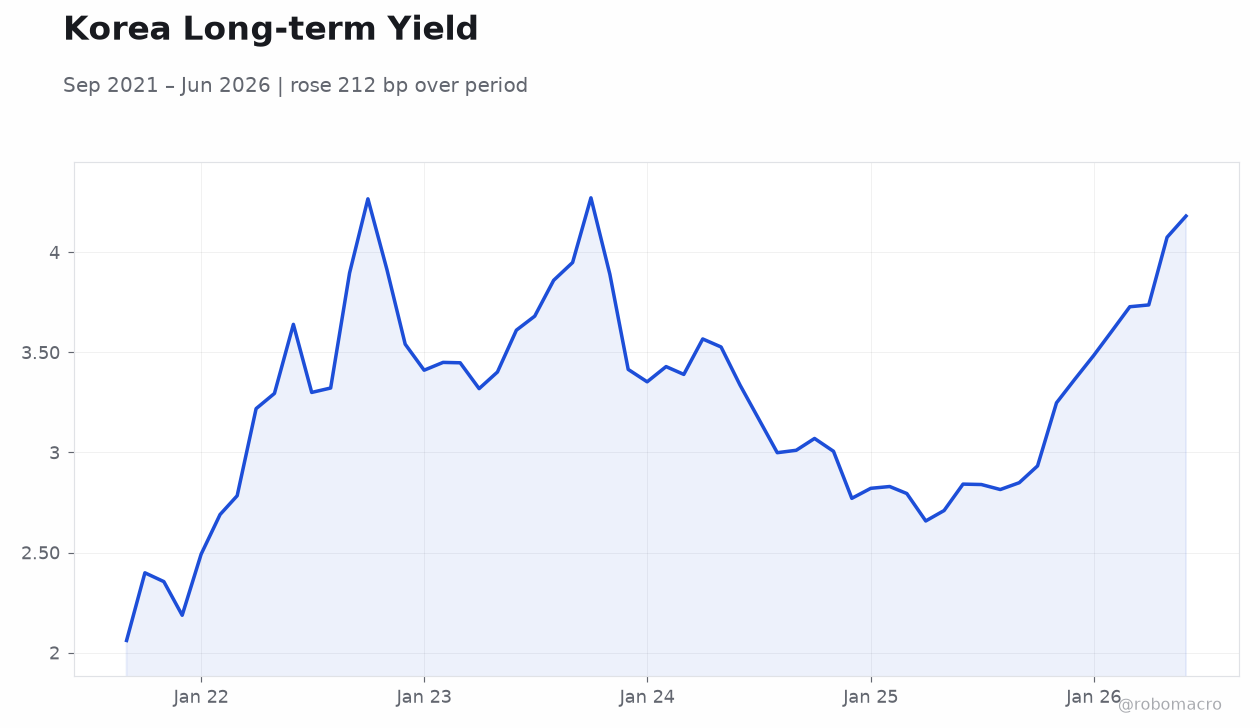
| Korea Long-term Rate | 4.18% | +2.60% |
Prior Economic Events
| Data | Prior | Cons | Actual |
|---|---|---|---|
| Inflation Rate Year-over-Year | 3.20 | 3 | 2.80 |
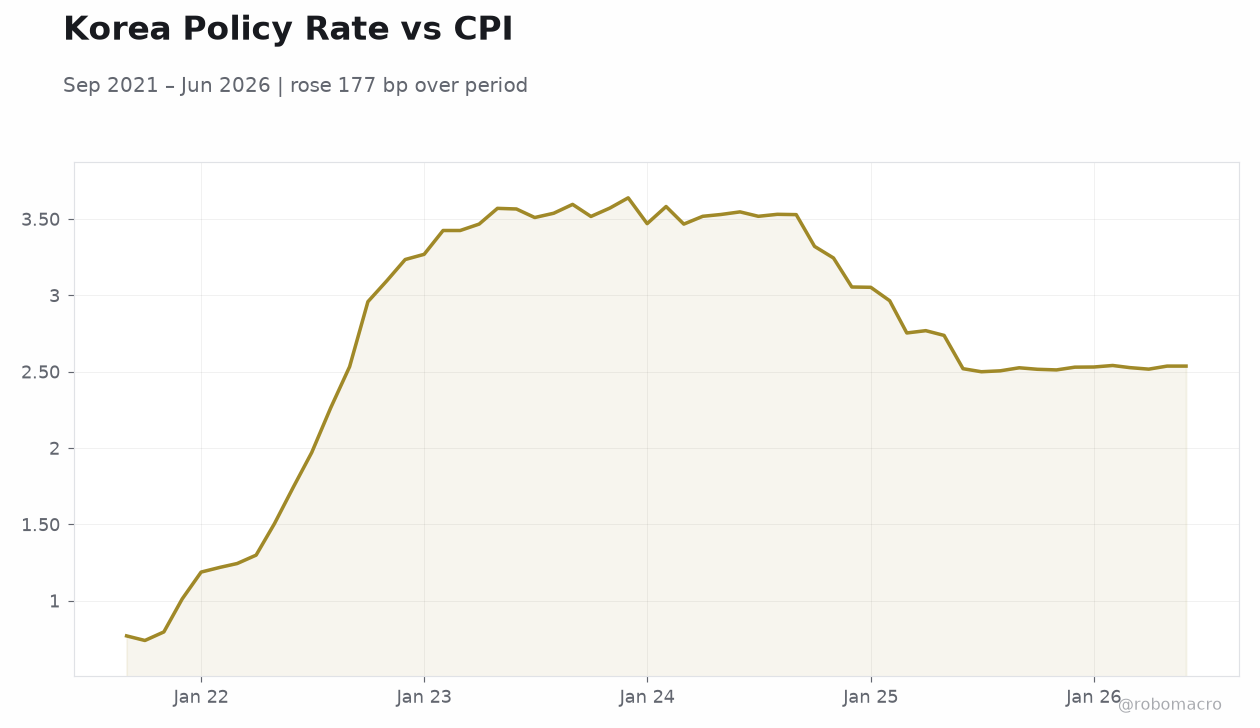 Korea Policy Rate vs CPI | Type: macro_line | Short-term Rate %: 2.537 (2026-06-01) | Range: 0.74–3.639 | Trend(5pt): 0.77,3.096,3.47,2.754,2.537
Today's Economic Events
| Data | Prior | Cons | Time |
|---|---|---|---|
| No events available | |||
- Korea CPI YoY fell to 2.8% in July, below 3.0% consensus, easing price pressures.
- KOSPI rose 3.76% to 6,598.26 while Samsung and SK Hynix fell sharply on profit-taking.
- USD/KRW declined 0.37% to 1,423.21 as the won strengthened amid softer inflation.
Yesterday's Recap
Korea’s July inflation rate printed at 2.8% YoY, undershooting the 3.0% consensus and marking the lowest reading since early 2025. The softer print reinforced expectations that price pressures are moderating after the prior 3.2% outcome. Equity markets staged a broad rebound, with the KOSPI climbing 3.76% to close at 6,598.26 and the KOSDAQ advancing 2.42% to 799.59.
Chip names diverged sharply, however, as Samsung Electronics dropped 6.30% to 230,500 won and SK Hynix fell 10.37% to 1,495,000 won amid rotation out of recent leaders. The won gained ground, pushing USD/KRW down 0.37% to 1,423.21 while the short-term policy rate held steady at 2.54%. Long-term yields rose 2.60% to 4.18%, reflecting modest steepening after the inflation data.
Brent crude climbed 5.10% to 83.50, adding an external inflation vector for Korean importers.
The Day Ahead
No major Korean data releases are scheduled for August 6 or 7, leaving markets to digest yesterday’s CPI print and global risk signals. Focus will remain on semiconductor earnings momentum and export order flows reported by major chaebol. The absence of fresh indicators should keep attention on USD/KRW direction and any follow-through in long-term yields.
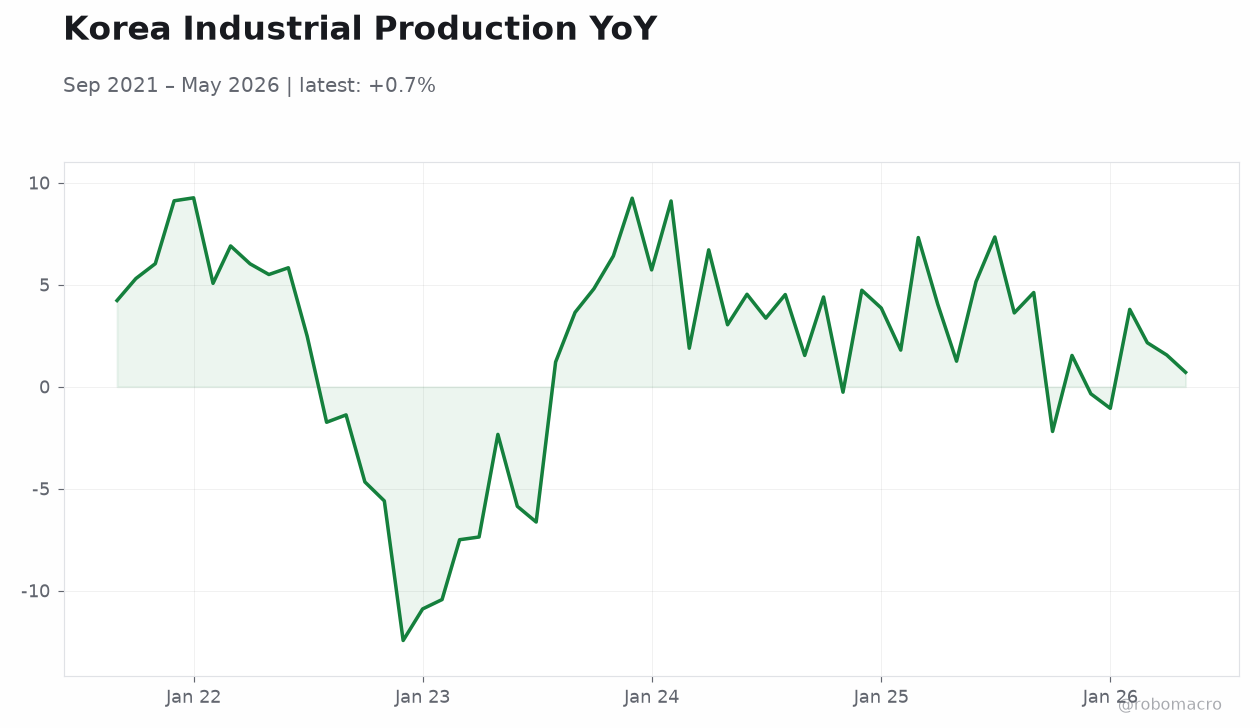
Regional equity sentiment will hinge on overnight moves in U.S. tech futures and any updates on U.S.-Iran tensions that could affect oil prices. Traders will also monitor positioning ahead of next week’s potential export and industrial production prints.
Other Economic Notes
Korea’s export-driven growth model continues to hinge on semiconductor demand, with AI-related capital spending providing the main offset to softening domestic consumption. The 2.8% CPI reading supports the view that external cost pressures from energy have eased enough to allow real wage gains without immediate policy tightening. Long-term yields at 4.18% signal that markets still price in gradual normalization even as the short-term rate sits at 2.54%.
Export competitiveness remains sensitive to won strength, which could trim margins for chipmakers if the currency continues to appreciate. <i>↓ p.2</i>