Korea Macro Daily(Beta Mode)
KOSPI Gains as Won Weakens on Fed Pressure
Market Snapshot
| Asset | Level | Change |
|---|---|---|
| KOSPI | 6,717.97 | +1.37% |
| KOSDAQ | 815.98 | +0.44% |
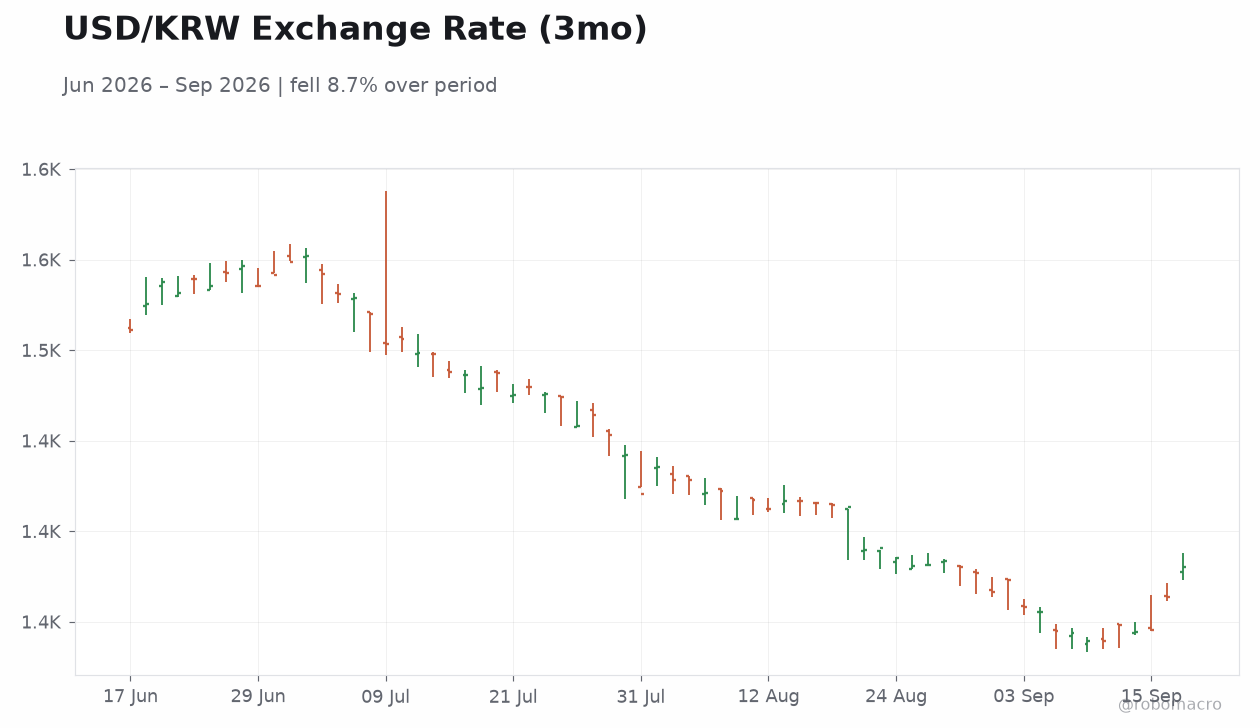
| USD/KRW | 1,380.21 | +1.22% |
| Samsung | 252,500.00 | -0.39% |
| SK Hynix | 1,745,000.00 | -0.80% |
| Brent Crude | 104.07 | -1.66% |
| Gold | 4,381.60 | -0.13% |
| Bitcoin | 76,456.94 | +0.40% |
| Korea 3Y Govt Yield | 4.05% | +2 bp |
| Korea 10Y Govt Yield | 4.55% | +1 bp |
Prior Economic Events
| Data | Prior | Cons | Actual |
|---|---|---|---|
| No events available | |||
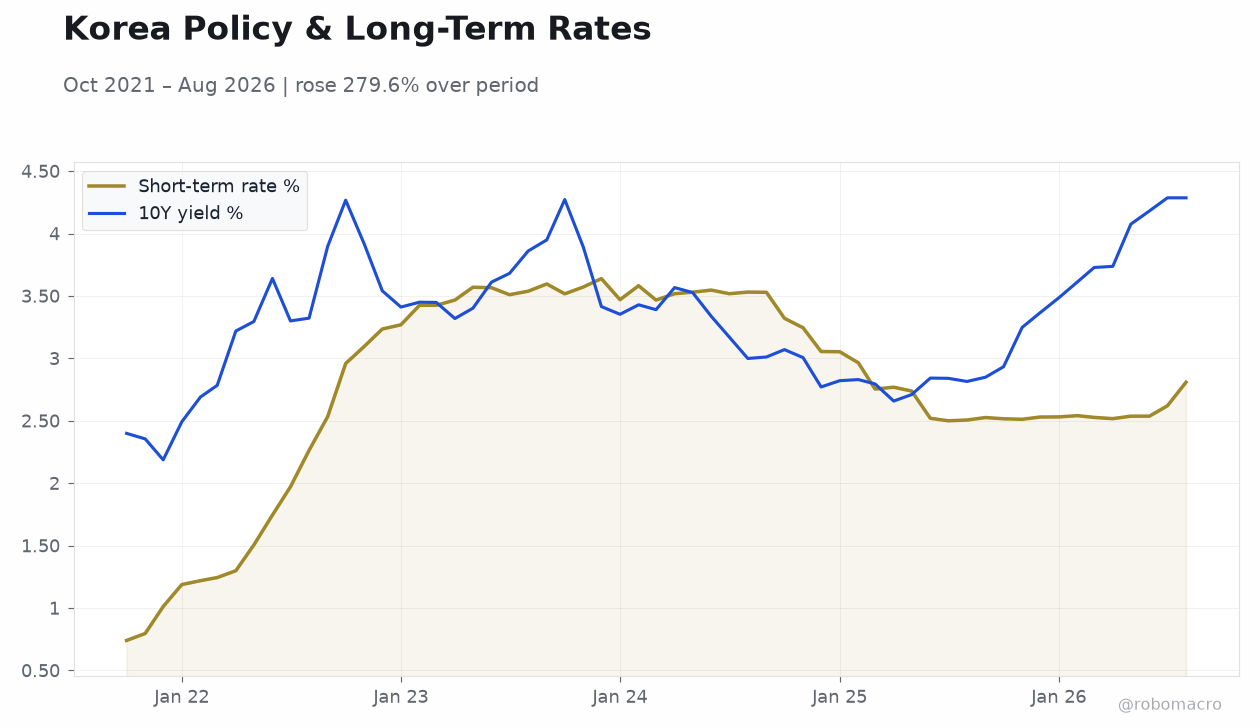 Korea Policy & Long-Term Rates | Type: macro_line | Short-term rate %: 2.809 (2026-08-01) | Range: 0.74–3.639 | Trend(6pt): 0.74,3.235,3.582,2.769,2.537,2.809 | 10Y yield %: 4.286 (2026-08-01) | Range: 2.187–4.286 | Trend(6pt): 2.399,3.541,3.429,2.658,4.181,4.286
Today's Economic Events
| Data | Prior | Cons | Time |
|---|---|---|---|
| Tuesday (2026-09-22) | |||
| Consumer Confidence Index | 104.50 | - | 17:00 |
- KOSPI rose 1.37% to 6,717.97 while USD/KRW climbed 1.22% to 1,380.21, with 3Y yields up 2 bp to 4.05%.
- Government released RFI-K guidelines and eased won convertibility rules to advance currency internationalization.
- BoK shifted outsourced reserves toward global bonds as authorities pledged bond-market stabilization measures.
Yesterday's Recap
Equity markets advanced on 16 September despite external headwinds. KOSPI closed at 6,717.97, up 1.37%, while KOSDAQ gained 0.44% to 815.98. Samsung fell 0.39% to 252,500 and SK Hynix declined 0.80% to 1,745,000.
The won weakened sharply, with USD/KRW rising 1.22% to 1,380.21. Korea 3Y government yields increased 2 bp to 4.05% and the 10Y yield added 1 bp to 4.55%. Brent crude fell 1.66% to 104.07.
No economic data were released. Officials reiterated plans to stabilize the bond market amid ongoing Fed rate-hike pressure and published guidelines for RFI-K under the won-internationalization strategy. The BoK announced a shift in outsourced reserves toward global bonds, while yen deposits at major banks surged.
The Day Ahead
No data releases are scheduled for 17 September. The next indicator is the Consumer Confidence Index on 22 September, previously 104.5. That medium-impact survey may offer early signals on household spending but rarely moves markets materially.
Focus will remain on won internationalization measures and any further bond-stabilization steps. External drivers, including Fed policy signals and AI-related semiconductor demand, will continue to influence equity and currency flows. Traders will monitor yen deposit trends at the big-five banks for shifts in FX positioning.
Other Economic Notes
Authorities are accelerating won internationalization through eased convertibility rules and RFI-K guidelines to reduce dollar dependence. The strategy coincides with a sharp recent rally in the won that State Street expects to partially reverse. Officials also committed to bond-market stabilization measures as higher U.S.
yields exert pressure on Korean fixed-income assets. Yen deposits at the five largest banks rose ¥47.8 billion in a month, signaling a pivot in FX trading away from the dollar. These steps aim to enhance currency resilience while preserving export competitiveness in semiconductors and autos.