Korea Macro Daily(Beta Mode)
Won Extends Rally as KOSDAQ Outperforms
Market Snapshot
| Asset | Level | Change |
|---|---|---|
| KOSPI | 6,941.39 | -0.89% |
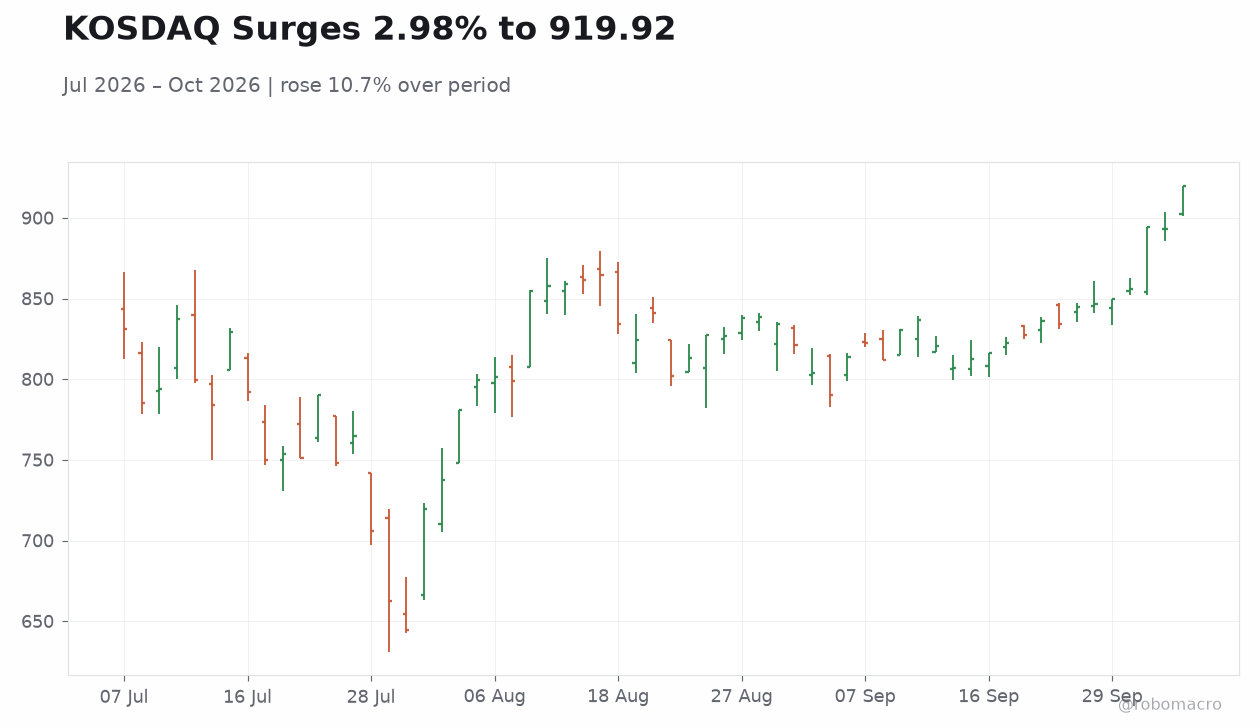
| KOSDAQ | 919.92 | +2.98% |
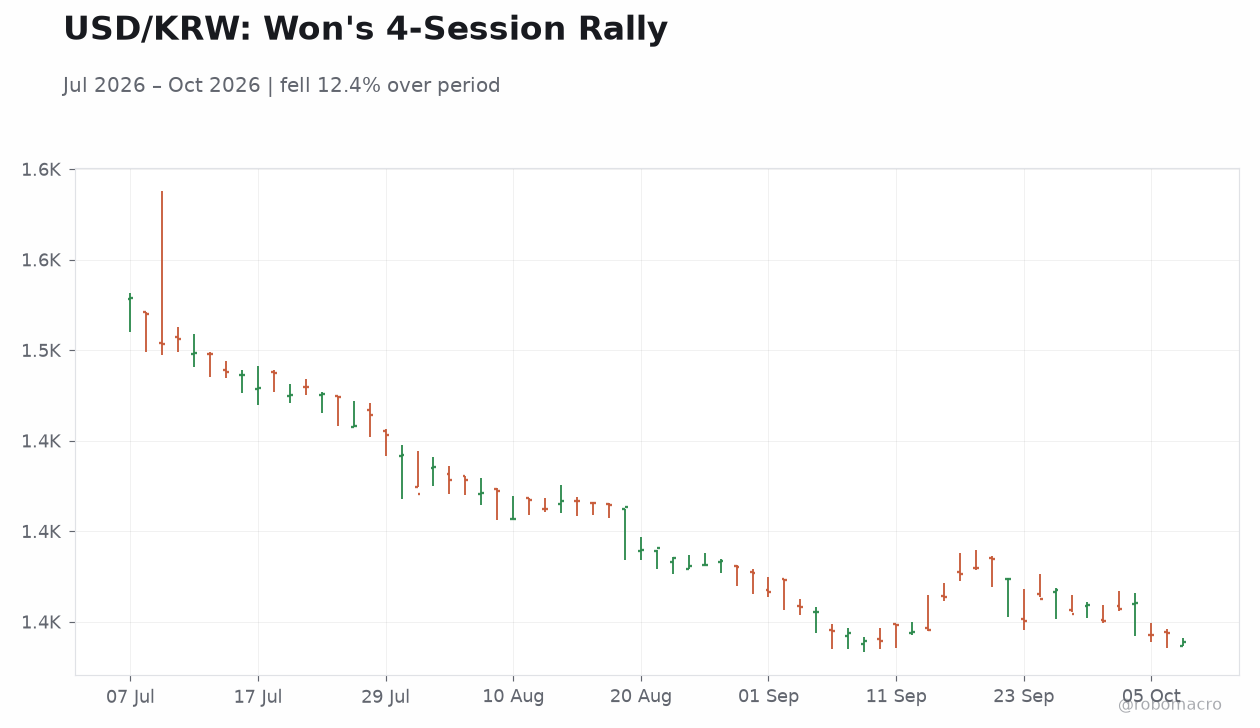
| USD/KRW | 1,339.33 | -0.33% |
| Samsung | 268,500.00 | -1.29% |
| SK Hynix | 1,723,000.00 | -2.82% |
| Brent Crude | 100.92 | +0.34% |
| Gold | 4,136.30 | -1.21% |
| Bitcoin | 83,319.11 | -2.62% |
| Korea 3Y Govt Yield | 3.93% | -1 bp |
| Korea 10Y Govt Yield | 4.37% | 0 bp |
Prior Economic Events
| Data | Prior | Cons | Actual |
|---|---|---|---|
| No events available | |||
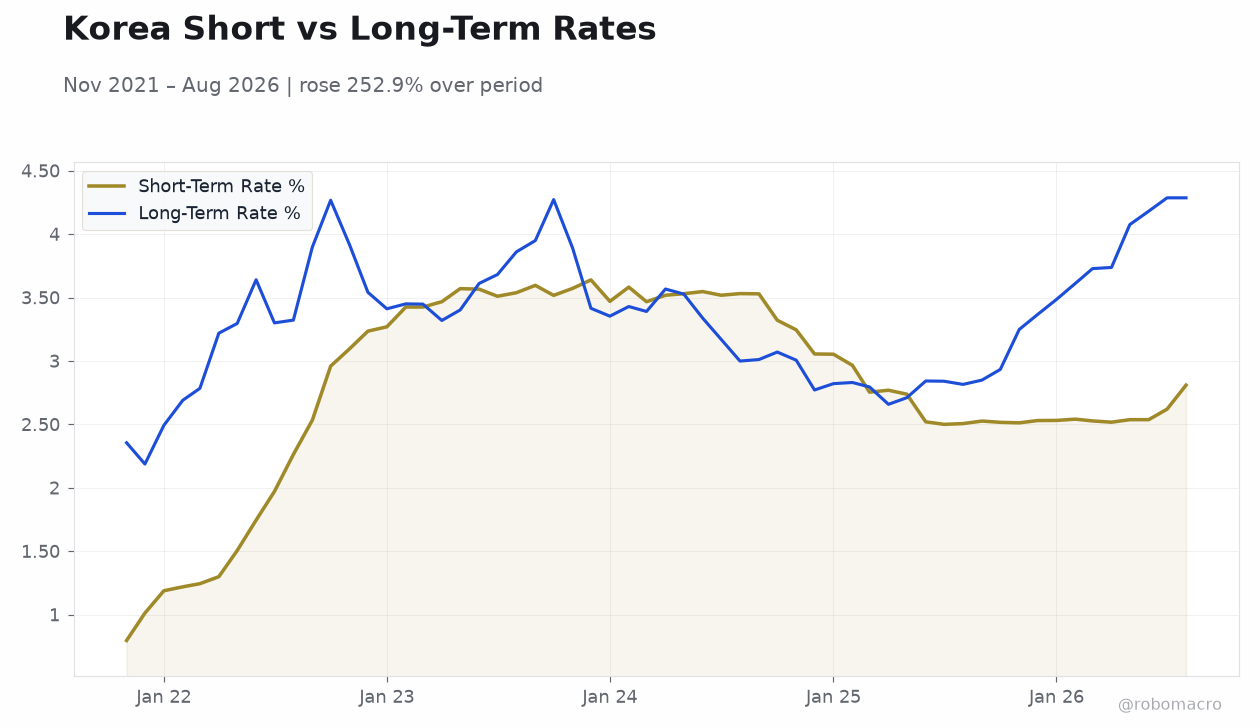 Korea Short vs Long-Term Rates | Type: macro_line | Short-Term Rate %: 2.809 (2026-08-01) | Range: 0.796–3.639 | Trend(6pt): 0.796,3.269,3.467,2.738,2.62,2.809 | Long-Term Rate %: 4.286 (2026-08-01) | Range: 2.187–4.286 | Trend(5pt): 2.355,3.411,3.39,2.71,4.286
Today's Economic Events
| Data | Prior | Cons | Time |
|---|---|---|---|
| No events available | |||
- Won firms for a fourth straight session despite broad dollar strength, hitting an 18-year high versus the yen on chip export momentum
- KOSDAQ jumps 2.98% to 919.92 while KOSPI slips 0.89% to 6,941.39, with Samsung and SK Hynix both lower
- Korea 3Y yield eases 1 bp to 3.93%; 10Y holds at 4.37% as curve flattens
Yesterday's Recap
Korean equities diverged sharply, with the KOSDAQ surging 2.98% to 919.92 while the benchmark KOSPI slipped 0.89% to 6,941.39, a striking gap given semiconductors now represent roughly 43% of KOSPI market capitalization per the World Bank. Samsung fell 1.29% to 268,500 and SK Hynix dropped 2.82% to 1,723,000, yet the small-cap index powered higher. The won extended its winning streak to a fourth session, gaining 0.33% to 1,339.33 against the dollar, and struck an 18-year high versus the Japanese yen on booming chip exports.
Fixed income was quiet, with the 3-year government yield easing 1 bp to 3.93% and the 10-year flat at 4.37%. Corporate fundamentals remained robust: Korea's current account surplus hit a record 67 trillion won on the chip boom, while the household debt ratio fell to a 10-year low. In policy news, the Bank of Korea appointed Choi Young-joo as Deputy Governor and reshuffled its international and FX leadership.
Separately, former BoK Governor Rhee criticized the 52-hour workweek system, adding his voice to labor reform debates. Brent crude edged up 0.34% to $100.92, keeping imported energy costs elevated.
The Day Ahead
Markets turn to the finance minister's commitments on taming inflation while boosting growth, with details on fiscal priorities likely to guide rate expectations. Attention stays on won dynamics after four sessions of gains, particularly whether the currency's strength versus the yen prompts official commentary given export competitiveness sensitivities. Semiconductor sector flows will be scrutinized after the KOSDAQ's outsized rally, with investors assessing whether the small-cap move broadens beyond memory chip names.
BoK communications remain in focus following the leadership reshuffle, as markets look for signals on the policy path from newly appointed officials. Global oil near $100 keeps imported inflation a live theme for the price outlook.
Other Economic Notes
Korea's record 67 trillion won corporate surplus underscores the extraordinary profitability of the semiconductor cycle, though the accompanying fall in household debt to a decade-low ratio highlights a two-speed economy where corporate strength has yet to translate into broad-based consumption. ↓ p.2