| Asset | Level | Change |
|---|---|---|
| KOSPI | nan | +nan% |
| KOSDAQ | 898.43 | -2.34% |
| USD/KRW | 1,343.09 | +0.25% |
| Samsung | 262,000.00 | -2.42% |
| SK Hynix | 1,681,000.00 | -2.44% |
| Brent Crude | 103.92 | +3.71% |
| Gold | 4,158.70 | +0.43% |
| Bitcoin | 81,584.84 | -2.03% |
| Korea 3Y Govt Yield | 3.96% | +3 bp |
| Korea 10Y Govt Yield | 4.38% | +1 bp |
| Data | Prior | Cons | Actual |
|---|---|---|---|
| No events available | |||
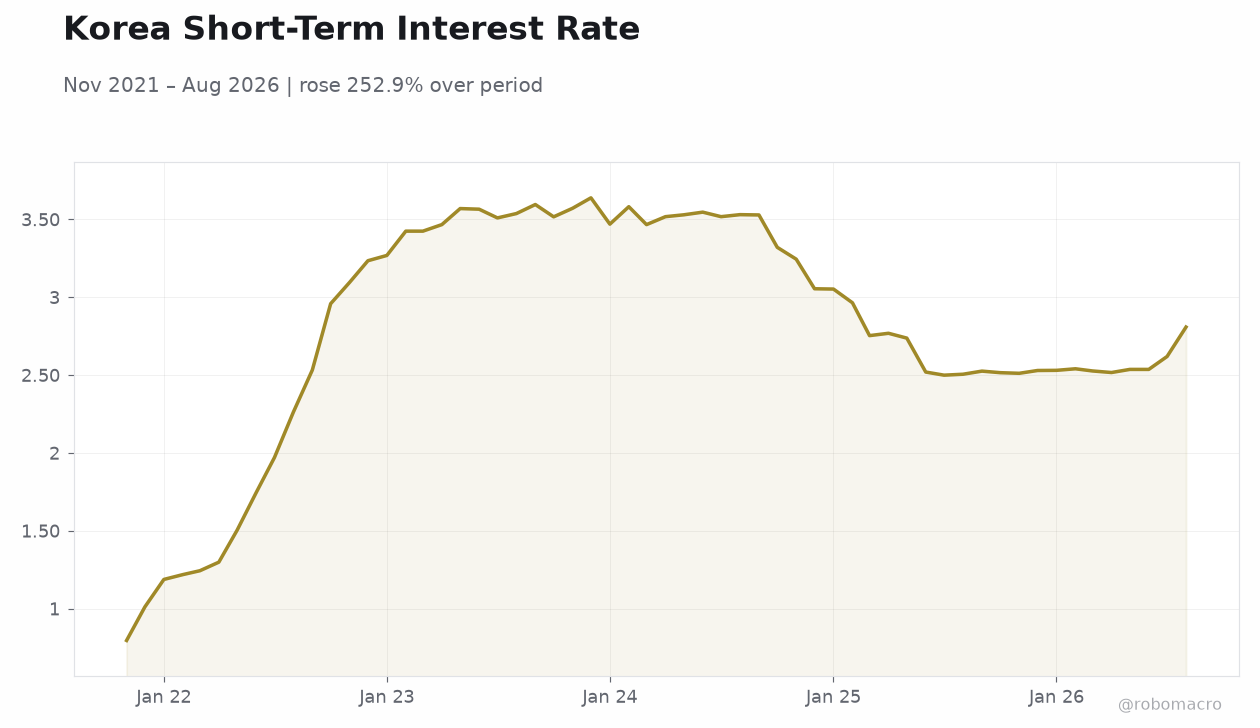
Korea Short-Term Interest Rate | Type: macro_line | Short-term rate %: 2.809 (2026-08-01) | Range: 0.796–3.639 | Trend(6pt): 0.796,3.269,3.467,2.738,2.62,2.809
| Data | Prior | Cons | Time |
|---|---|---|---|
| No events available | |||
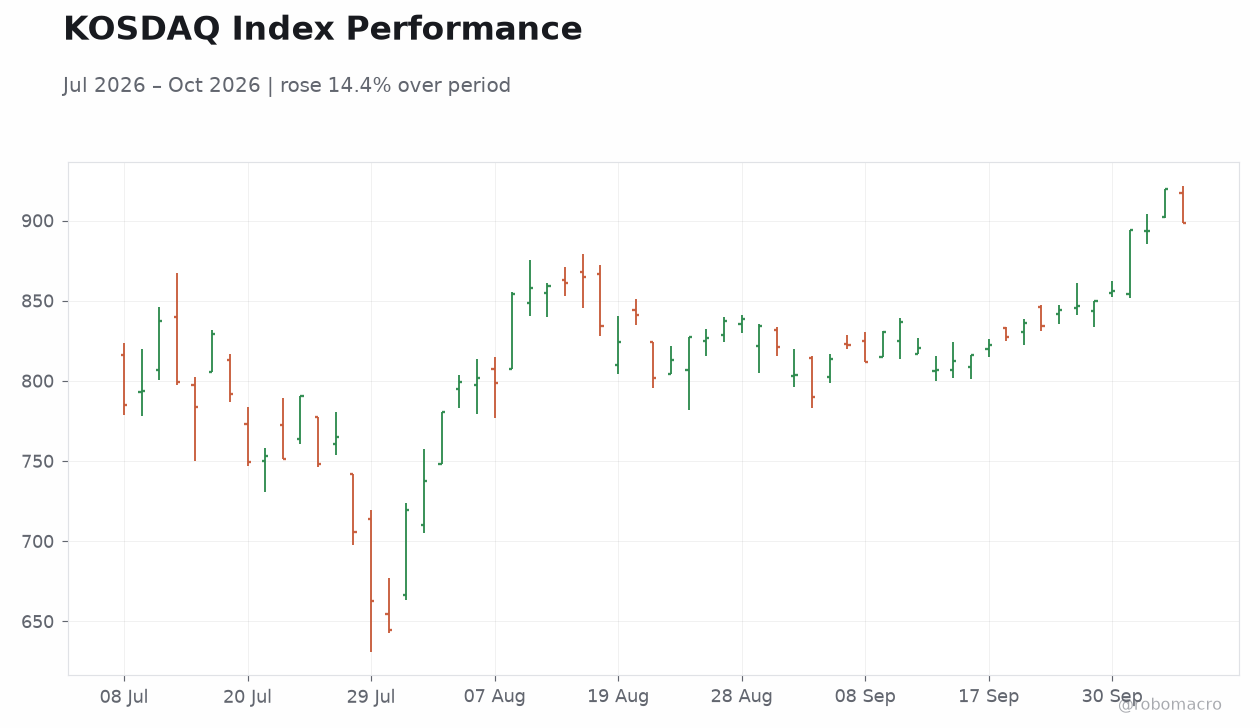
Seoul equities extended losses for a third consecutive session on October 7, with the KOSDAQ falling 2.34% to 898.43 amid persistent inflation worries. Samsung Electronics dropped 2.42% to 262,000 won and SK Hynix lost 2.44% to 1,681,000 won, pulling the tech-heavy index lower despite the chipmakers' record earnings momentum. The currency market told a different story: the won rose against the dollar for a fourth day, with USD/KRW closing at 1,343.09, up 0.25%, and hitting an 18-year high against the Japanese yen on booming semiconductor exports.
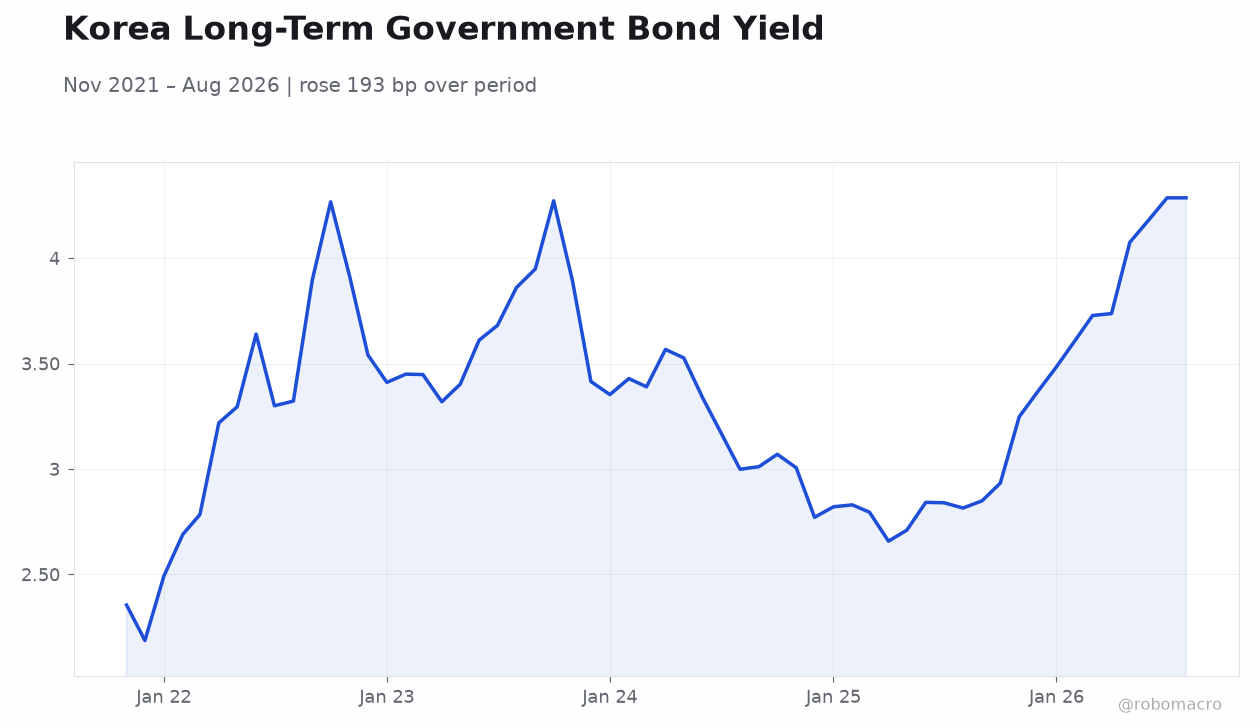
Fixed income saw modest pressure, with the 3-year yield rising 3 bp to 3.96% and the 10-year adding 1 bp to 4.38%. Brent crude surged 3.71% to $103.92, adding to imported-inflation concerns that have kept Seoul shares under pressure. Gold gained 0.43% to $4,158.70 as a haven bid persisted, while Bitcoin fell 2.03% to $81,584.84.
The contrast between record corporate profits and softening equities framed the session, with investors weighing chip-driven earnings against rate-path uncertainty.
Today's calendar shows no scheduled data releases, leaving markets to trade on earnings momentum and external signals. Attention stays on Samsung's earnings follow-through after the company projected quarterly profit above 100 trillion won, a world first for a technology company, on nearly nine-fold growth. Currency watchers will track whether the won's four-day rally extends, particularly its strength against the yen, which has implications for export competitiveness.
Bond desks will monitor whether the recent yield creep extends, with the 3-year at 3.96% approaching levels that could test BoK comfort. Equity investors will look for stabilization signs after three down sessions, with financial holding companies' record 17.6 trillion won profit offering a potential rotation target. Any commentary from Bank of Korea officials on inflation dynamics would move the market given the absence of scheduled data.
Subscribe to Korea Macro Daily and get each new issue delivered to your inbox.
Already a member? Visit robomacro.com to log in and manage subscriptions, or use Forgot Password to set a password.
Korea Long-Term Government Bond Yield | Type: macro_line | Long-term yield %: 4.286 (2026-08-01) | Range: 2.187–4.286 | Trend(5pt): 2.355,3.411,3.39,2.71,4.286
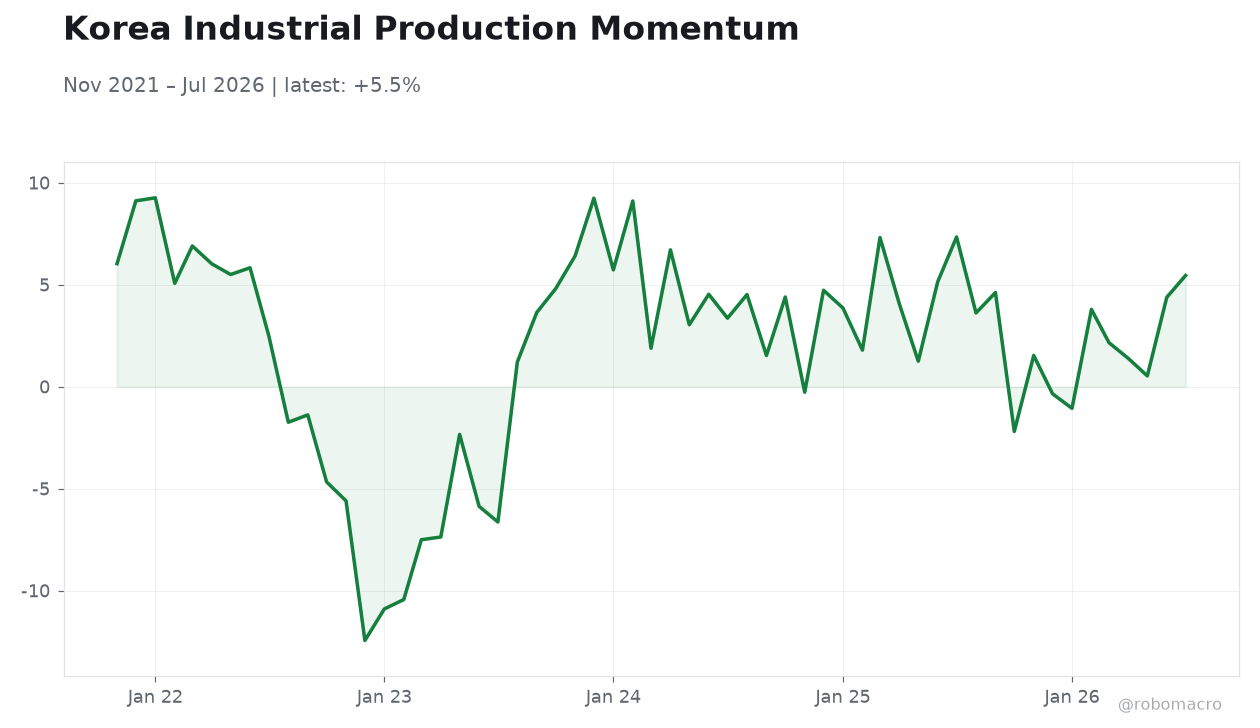
Korea Industrial Production Momentum | Type: macro_line | Industrial Production (YoY %): 5.455 (2026-07-01) | Range: -12.45–9.263 | Trend(5pt): 6.034,-10.9,1.887,1.251,5.455
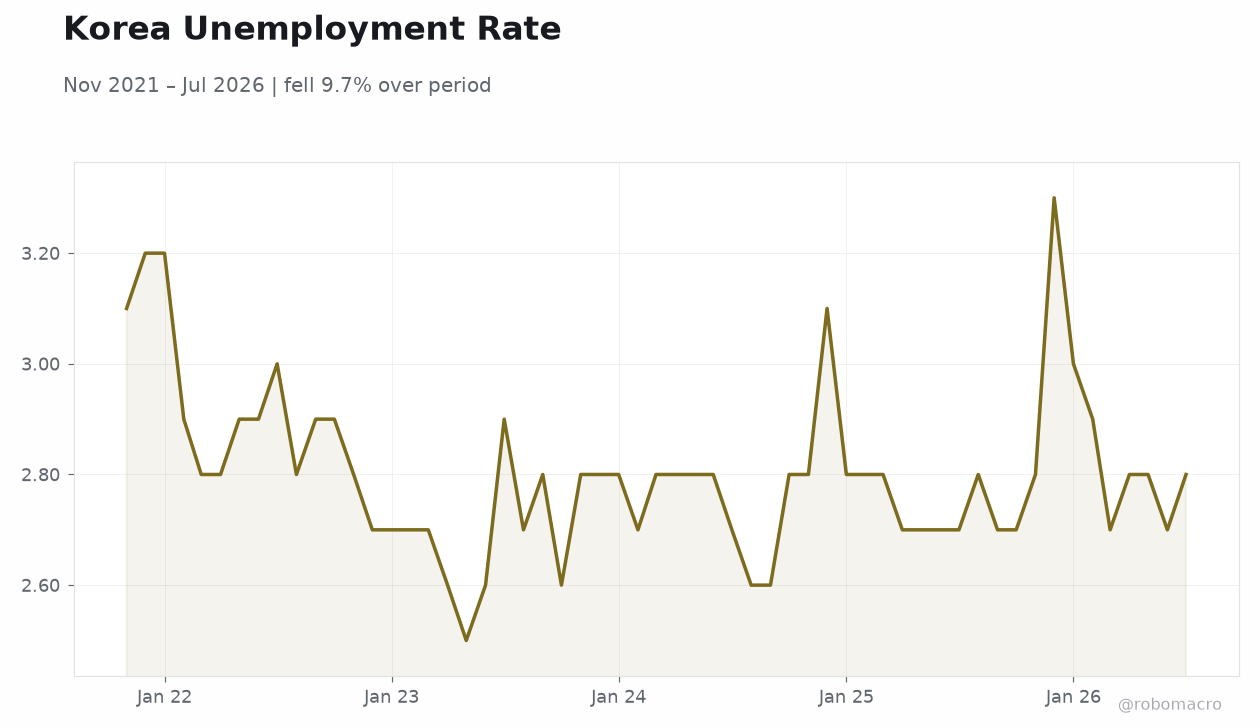
Korea Unemployment Rate | Type: macro_line | Unemployment %: 2.8 (2026-07-01) | Range: 2.5–3.3 | Trend(5pt): 3.1,2.7,2.8,2.7,2.8
KOSDAQ Index Performance | Type: market_hloc | KOSDAQ: 898.4 (2026-10-07) | Range: 644.8–919.9 | Trend(5pt): 785,644.8,801.9,820.6,898.4
Korea's corporate surplus hit a record 67 trillion won on the chip boom, while the household debt ratio fell to a 10-year low — a striking divergence in the economy's balance sheets. Corporate strength is funding an ambitious state pledge of 1,000 trillion won for green transition by 2035, signaling fiscal ambition alongside private-sector vigor. A state think tank cautioned that single-stock leveraged ETFs cannot be concluded to stabilize the won, tempering enthusiasm for synthetic demand tools.
Meanwhile, a 172 trillion won dementia asset freeze has sparked family conflicts, highlighting demographic pressures on household wealth management. Financial holding firms' record 17.6 trillion won profit suggests the financial sector is capturing upside from both corporate lending and market activity.
The AI capex supercycle continues to reshape global tech supply chains, with SpaceX reportedly borrowing $40 billion to purchase Nvidia chips — a signal that demand for memory and logic semiconductors remains insatiable. Samsung's projected 100 trillion won quarterly profit, flagged as a world first for a technology company, validates the memory supercycle thesis that has underpinned Korean export growth. Brent crude's 3.71% surge to $103.92 raises imported inflation risks for energy-importing Korea, complicating the BoK's price stability mandate.
Gold's advance to $4,158.70 reflects persistent haven demand amid geopolitical and monetary uncertainty. ↓ p.3
Bitcoin's 2.03% decline to $81,584.84 suggests risk appetite is cooling in speculative corners even as institutional crypto adoption broadens. The dollar's broad strength, against which the won has bucked the trend, underscores Korea's idiosyncratic export-driven appeal. European coverage of Samsung's record profit — described as the highest ever for a tech company — confirms the global resonance of Korea's chip dominance.
The Bank of Korea's base rate stands at 2.81%, and recent yield action suggests markets are pricing a cautious hold-and-assess stance. The appointment of Choi and Yoon to key BoK posts merits attention for signals on the composition and direction of the Monetary Policy Committee. With CPI at 2.88% year-on-year, inflation sits near the upper bounds of comfort, explaining why the 3-year yield backed up 3 bp even as equities sold off — markets read the inflation prints as sticky rather than transitory.
The BoK faces a delicate balance: surging oil prices threaten to push headline inflation above 3%, while the won's strength provides a partial offset through cheaper imports. Financial stability considerations have improved markedly, with household debt ratios at decade lows reducing the urgency for restrictive policy. The record corporate surplus and chip-driven export boom give the BoK room to remain patient, but the committee's communications suggest vigilance on second-round effects from energy and services prices.
For bond investors, the message is that yields near 4% on the 3-year reflect a central bank unwilling to preemptively ease while inflation risks skew to the upside.