Korea Macro Daily(Beta Mode)
Won Surges, Stocks Rebound as AI Fears Ease
Market Snapshot
| Asset | Level | Change |
|---|---|---|
| KOSPI | 5,668.05 | +2.05% |
| KOSDAQ | 794.78 | +4.46% |
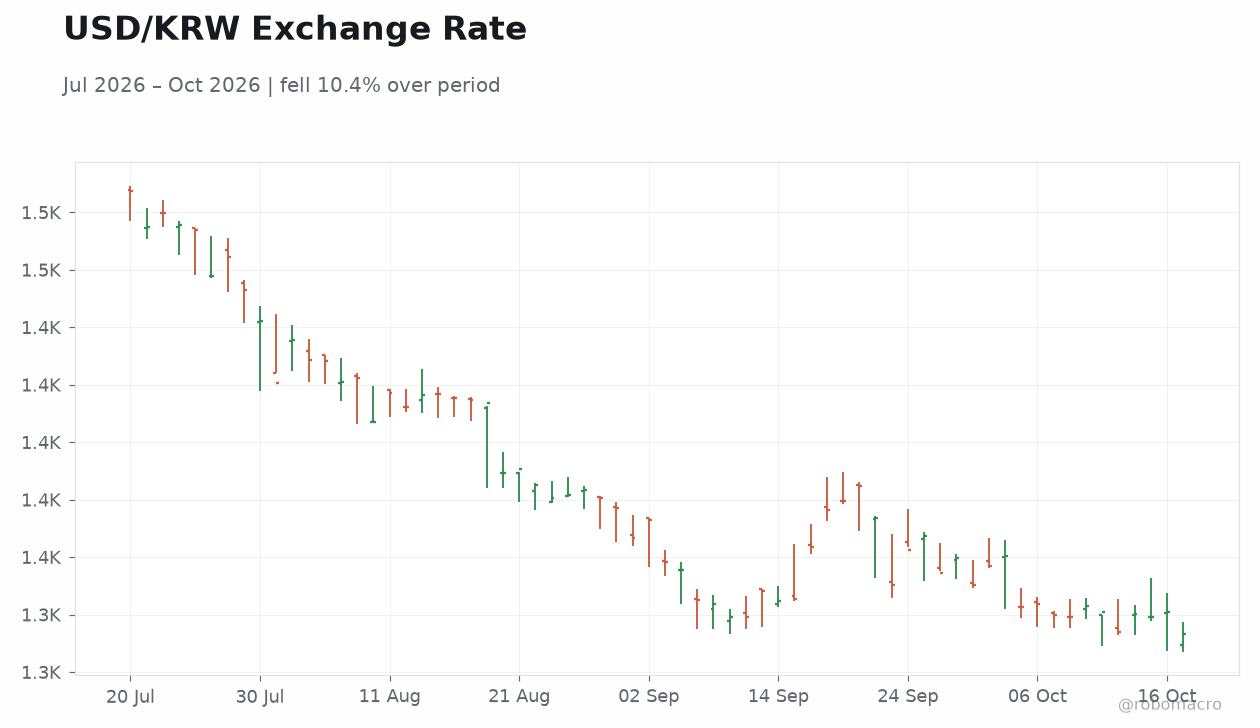
| USD/KRW | 1,332.36 | -0.64% |
| Samsung | 215,500.00 | +2.62% |
| SK Hynix | 1,272,000.00 | +0.79% |
| Brent Crude | 109.23 | -0.57% |
| Gold | 4,159.90 | -0.51% |
| Bitcoin | 81,926.56 | -0.11% |
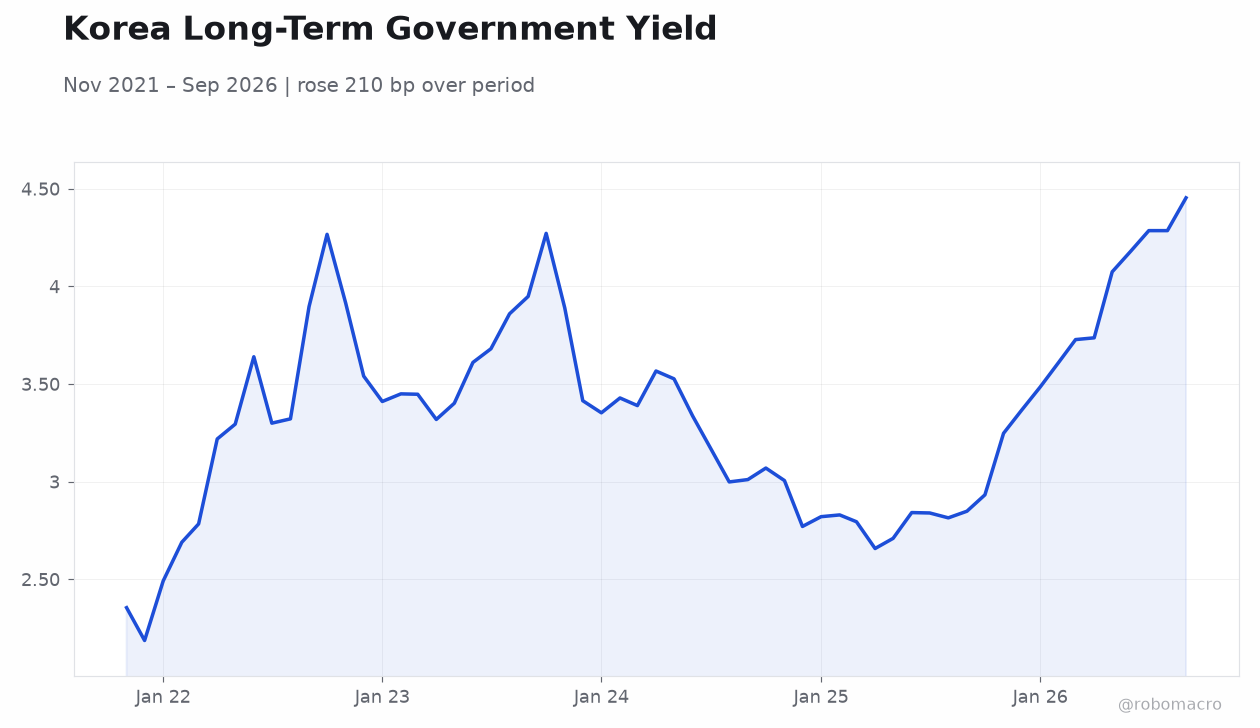
| Korea 3Y Govt Yield | 3.85% | -2 bp |
| Korea 10Y Govt Yield | 4.18% | -1 bp |
Prior Economic Events
| Data | Prior | Cons | Actual |
|---|---|---|---|
| No events available | |||
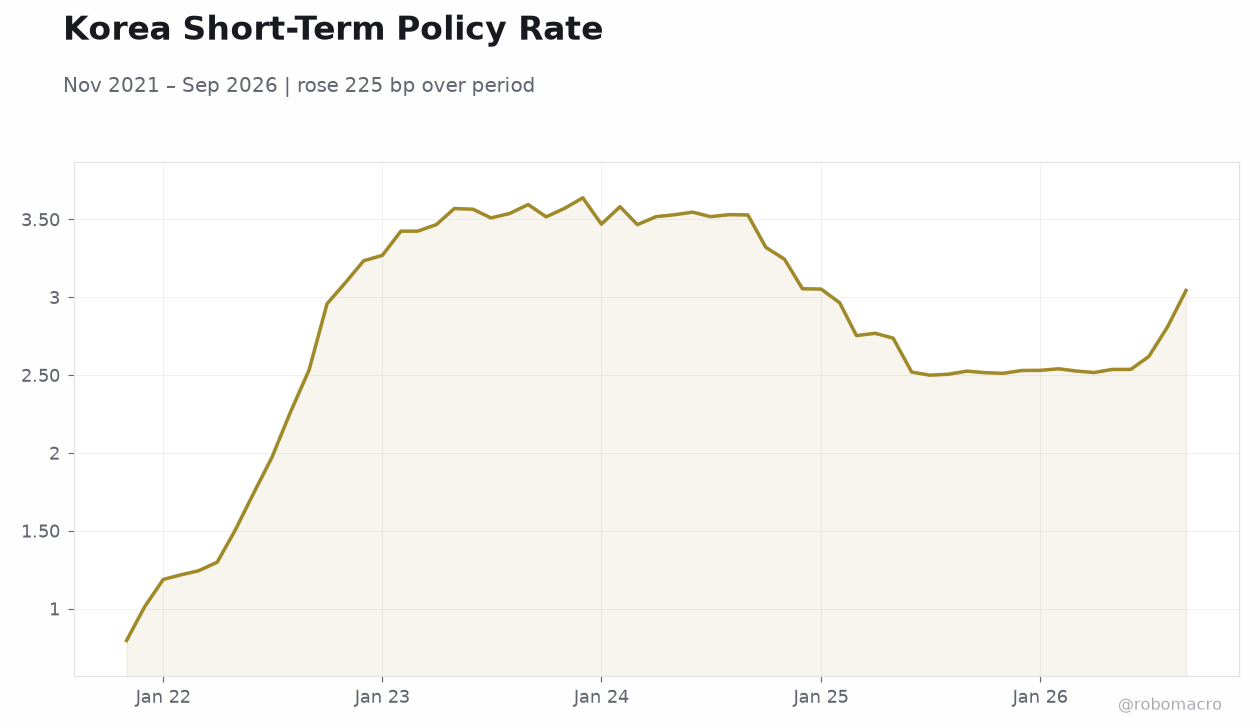 Korea Short-Term Policy Rate | Type: macro_line | Short-Term Rate (%): 3.044 (2026-09-01) | Range: 0.796–3.639 | Trend(6pt): 0.796,3.269,3.467,2.738,2.62,3.044
Today's Economic Events
| Data | Prior | Cons | Time |
|---|---|---|---|
| No events available | |||
- KOSPI rebounds 2.05% to 5,668.05 and KOSDAQ jumps 4.46% after a brutal seven-session selloff that had knocked the benchmark below 6,000
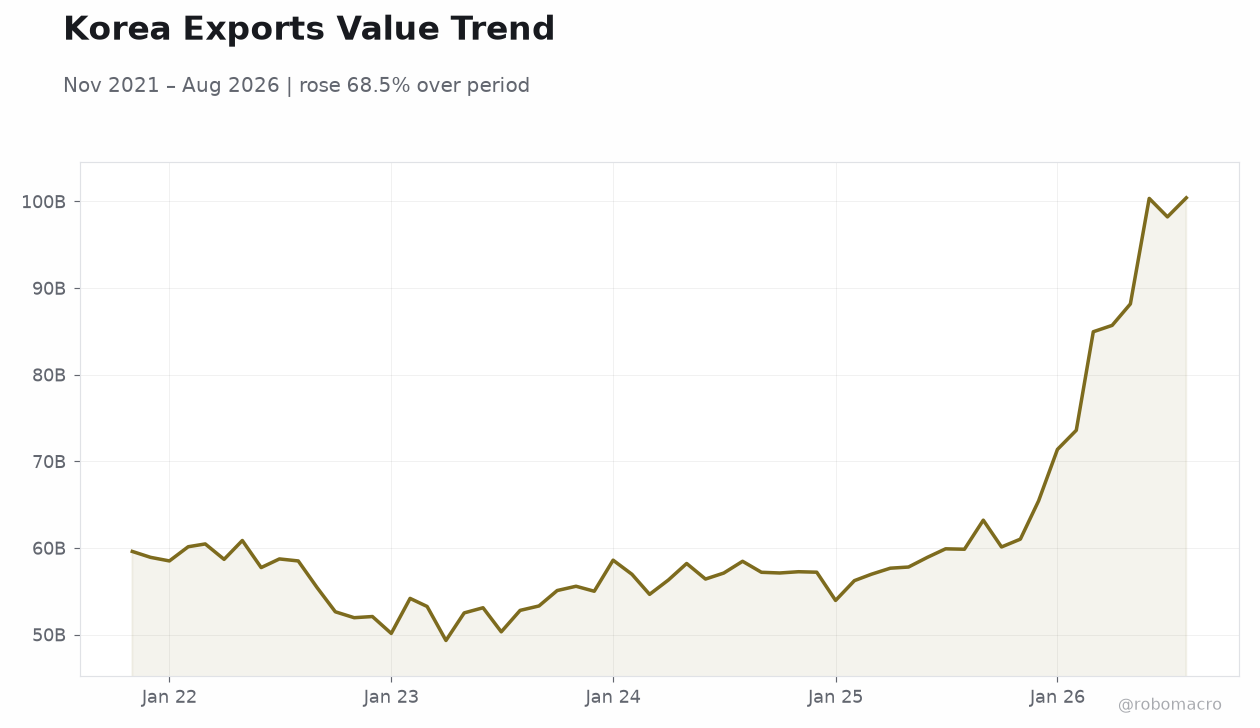
- Won strengthens to 1,332.36 per dollar, a two-year high, as robust exports and heavy dollar supply drive the currency's appreciation
- Seoul vows a crackdown on unfair trading amid the volatility, while IMF and US-Korea 2+2 talks frame the policy backdrop
Yesterday's Recap
Korean equities staged a sharp relief rally, with the KOSPI climbing 2.05% to 5,668.05 and the KOSDAQ surging 4.46% to 794.78, clawing back ground after a punishing stretch in which the benchmark had fallen more than 20% over seven sessions on AI semiconductor demand fears. Samsung Electronics rose 2.62% to 215,500 won and SK Hynix added 0.79% to 1,272,000 won, leading the tech-led bounce. The won appreciated 0.64% to 1,332.36 per dollar, touching its strongest level in over two years as exporters converted dollar earnings and dollar supply remained ample.
Sovereign yields edged lower, with the 3-year easing 2 bp to 3.85% and the 10-year down 1 bp to 4.18%, reflecting softer rate expectations and safe-haven demand even as risk appetite recovered. Authorities pledged a crackdown on unfair trading practices following the recent volatility, a signal that regulators are watching market integrity closely. The session's tone was one of stabilization after acute stress, though the magnitude of the prior drawdown keeps sentiment fragile.
The Day Ahead
No major Korean statistical releases are scheduled for the session, leaving markets to digest the prior day's rebound and the policy commentary flow. Traders will watch whether the KOSPI can hold above the 5,600 handle and whether the won sustains its strength near the 1,330 level, given exporter earnings sensitivity to currency appreciation. The finance ministry's vow to police unfair trading may keep a bid under sentiment, while attention turns to any follow-through from the US-Korea finance-central bank 2+2 dialogue.
With the calendar light, positioning and flows around Samsung and SK Hynix will dominate the domestic narrative. Bond markets will take their cue from global rate moves and the currency's trajectory.
Other Economic Notes
The stronger won is a double-edged sword — while it signals capital inflows and export strength, it raises earnings-miss fears among Korean exporters whose margins compress when the currency appreciates. Seoul apartment prices have now risen for 88 consecutive weeks, underscoring persistent property-market pressure that complicates the policy mix. A roughly $180 billion wave of low-rate bond maturities over the coming four years is set to add refinancing costs, a structural fiscal consideration for the sovereign.
↓ p.2