Korea Macro Daily(Beta Mode)
KOSPI Halts as AI Selloff Deepens, Inflation Stays Hot
Market Snapshot
| Asset | Level | Change |
|---|---|---|
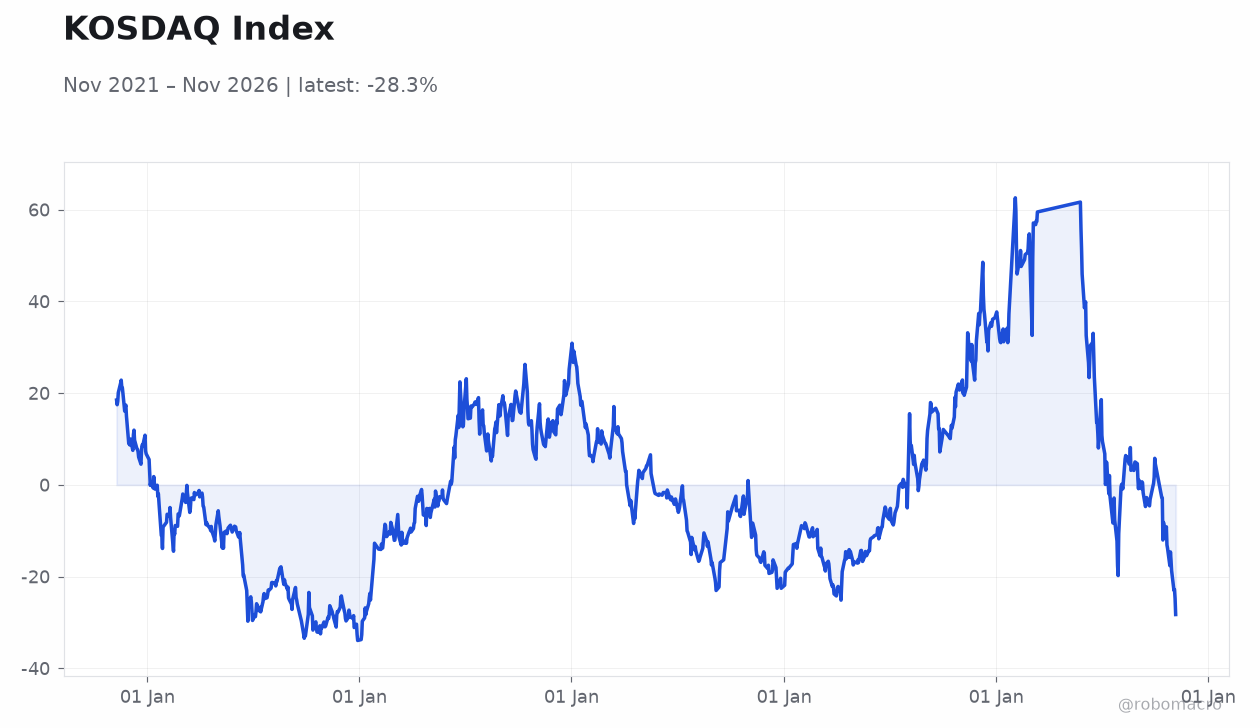
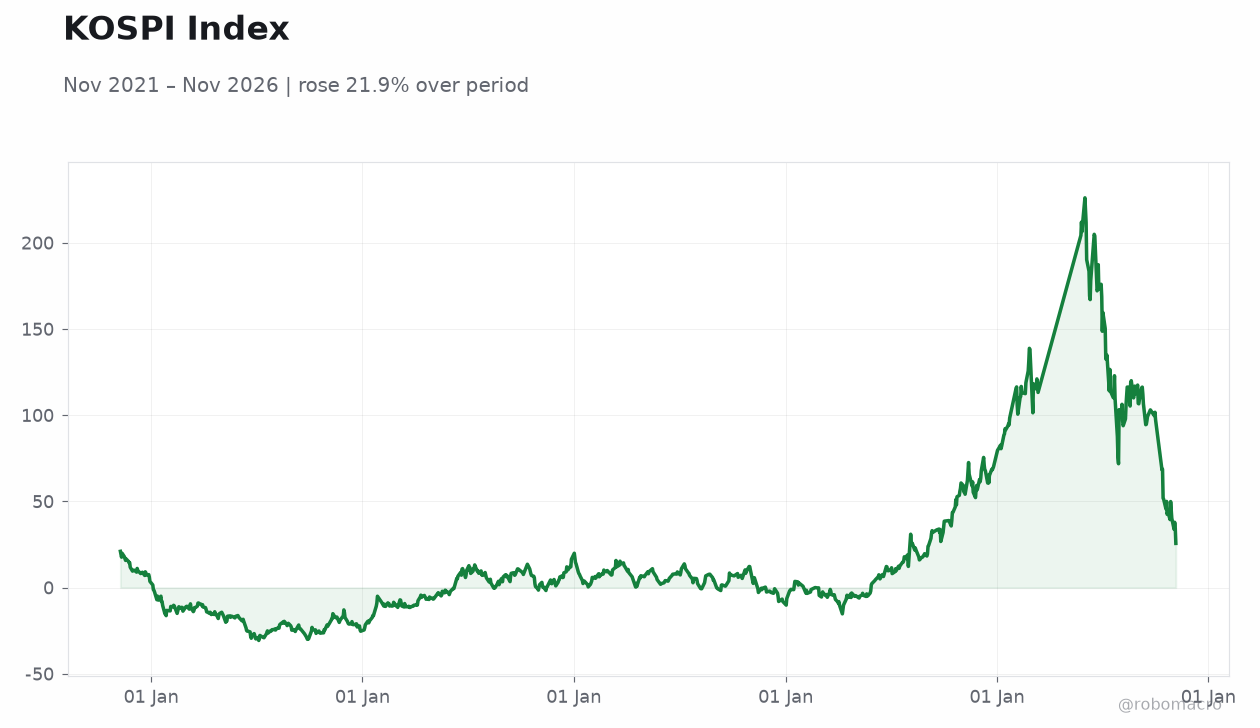
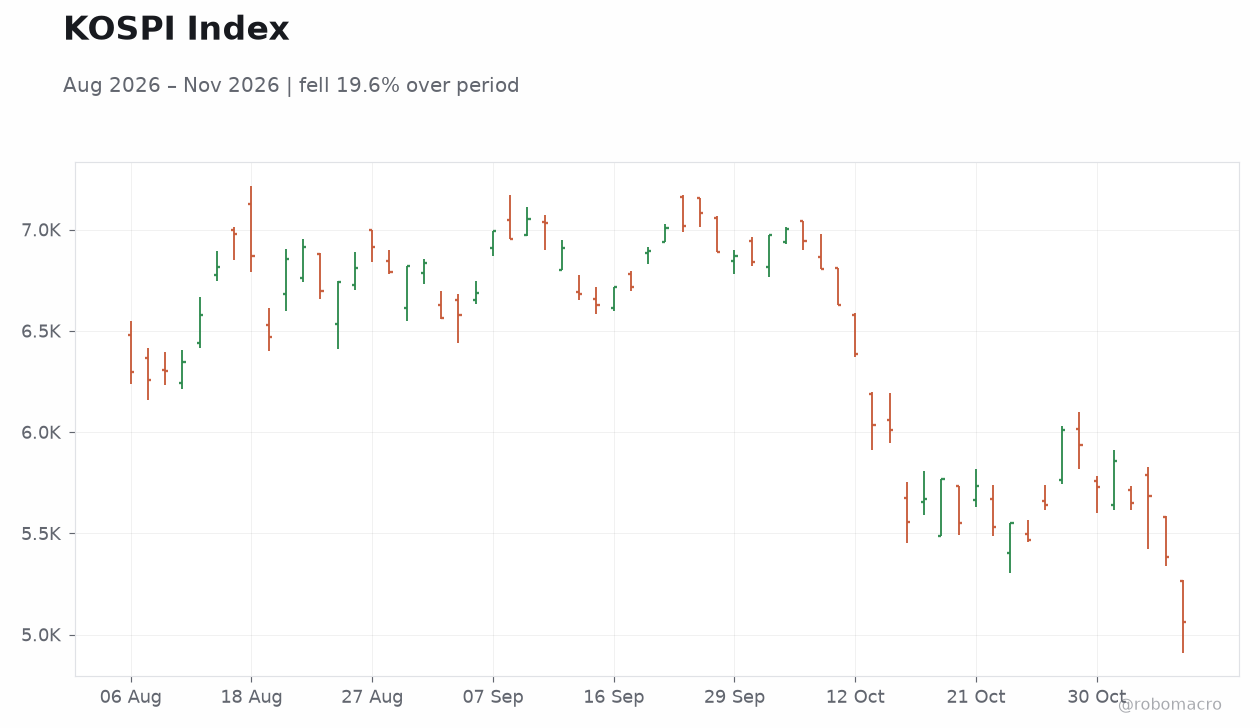
| KOSPI | 5,059.69 | -6.02% |
| KOSDAQ | 644.27 | -5.03% |
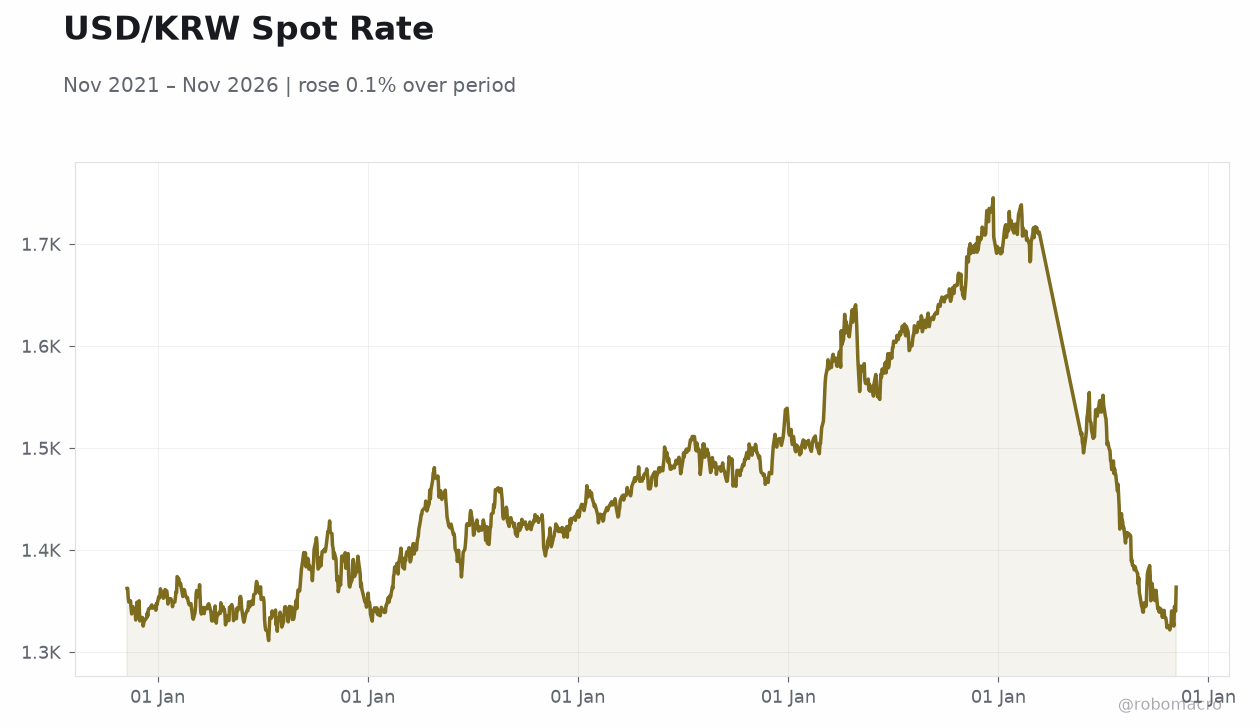
| USD/KRW | 1,363.37 | +0.52% |
| Samsung | 188,700.00 | -6.35% |
| SK Hynix | 1,132,000.00 | -10.44% |
| Brent Crude | 98.32 | +0.03% |
| Gold | 4,074.90 | -0.94% |
| Bitcoin | 75,635.69 | -0.15% |
| Korea 3Y Govt Yield | 3.61% | -6 bp |
| Korea 10Y Govt Yield | 3.85% | -4 bp |
Prior Economic Events
| Data | Prior | Cons | Actual |
|---|---|---|---|
| Inflation Rate Year-over-Year | 2.90 | 2.90 | 2.80 |
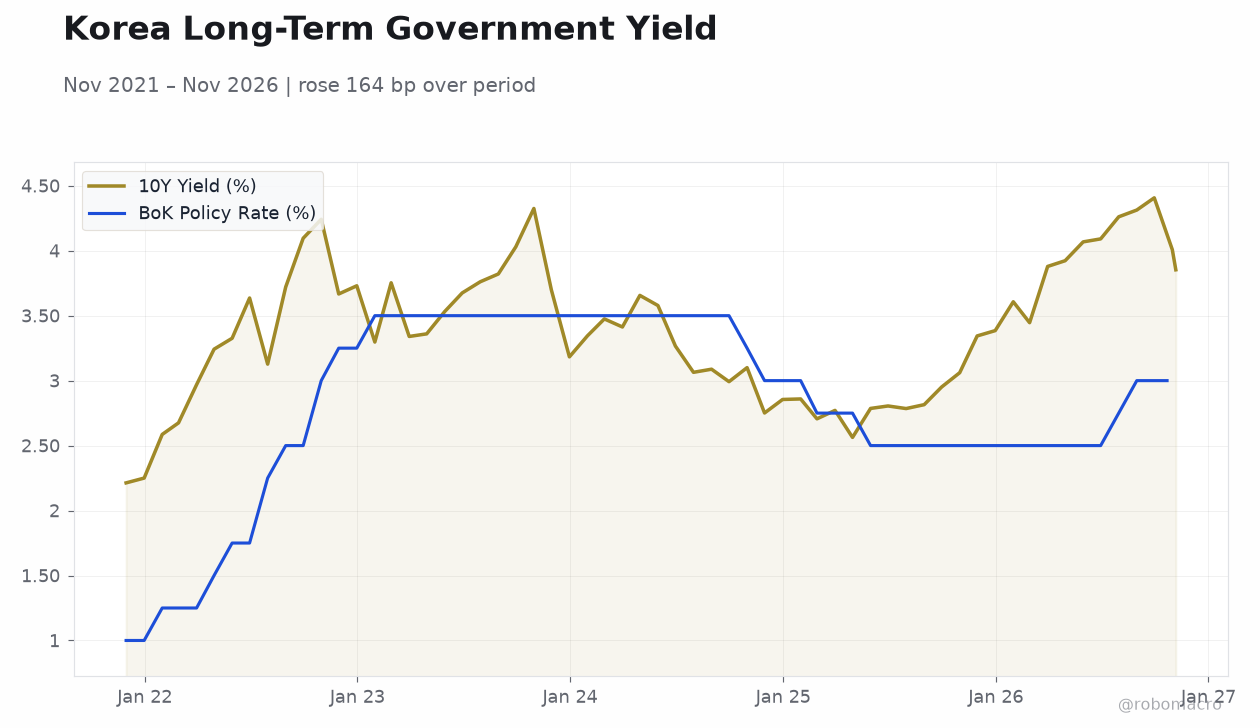 Korea Long-Term Government Yield | Type: macro_line | 10Y Yield (%): 3.853 (2026-11-06) | Range: 2.213–4.407 | Trend(5pt): 2.213,3.753,3.578,2.815,3.853 | BoK Policy Rate (%): 3 (2026-10-22) | Range: 1–3.5 | Trend(5pt): 1,3.5,3.5,2.5,3
Today's Economic Events
| Data | Prior | Cons | Time |
|---|---|---|---|
| No events available | |||
- KOSPI plunges 6.02% to 5,059.69, triggering trading halts as AI-linked tech selloff accelerates; SK Hynix collapses 10.44%, Samsung drops 6.35%
- October CPI eases marginally to 2.80% YoY from 2.9% prior, but remains above the BoK's 2% target, complicating the rate outlook
- Authorities ease margin-call rules and exempt credit-loan collateral ratios for three months as the index clings to the 5,000 level
Yesterday's Recap
South Korea's October inflation print came in at 2.80% year-over-year, a modest deceleration from the prior 2.9% and in line with consensus, though the reading remains comfortably above the Bank of Korea's 2% target. Equity markets, however, dominated the session: the KOSPI collapsed 6.02% to 5,059.69 and the KOSDAQ fell 5.03% to 644.27, with the exchange suspending trading as an AI-driven global stock selloff intensified. Samsung Electronics dropped 6.35% to 188,700 won while SK Hynix cratered 10.44% to 1,132,000 won, bearing the brunt of semiconductor-linked risk aversion.
The won weakened 0.52% to 1,363.37 per dollar amid the risk-off tone. Rates moved the other way, with the 3-year government yield easing 6 bp to 3.61% and the 10-year down 4 bp to 3.85% as investors rotated toward duration. Brent crude was essentially flat at $98.32, while gold slipped 0.94% to $4,074.90.
The Day Ahead
No scheduled Korean data releases are on the calendar for today, leaving markets to digest the prior session's violent equity move and the implications of the softer-but-still-elevated inflation print. Attention turns to October labor-market and household-loan figures expected later this week, which will be scrutinized for signs of stress in a household sector already carrying debt above 2 quadrillion won. The Bank of Korea's next policy decision is set for November 26, and officials have signaled the KOSPI plunge has become a live variable in the rate calculus.
With U.S. inflation data looming, dollar-won direction will remain sensitive to external rate differentials. Traders will also watch whether stabilization measures on margin calls and credit-loan collateral ratios calm leveraged retail positioning.
Other Economic Notes
Household debt has pushed past 2 quadrillion won, with both younger and older cohorts struggling to service obligations, keeping financial stability firmly on the policy radar. The government's three-month exemption of the credit-loan collateral ratio rule and eased margin-call requirements are targeted at preventing forced deleveraging from amplifying the equity selloff. National debt per child is approaching 250 million won, underscoring long-run fiscal pressures as demographic headwinds persist.
↓ p.2